It is well known that in recent years, China’s chip industry has developed rapidly, whether in chip design, manufacturing, or packaging and testing. Moreover, breakthroughs are continuously being made in upstream areas such as EDA, semiconductor materials, and semiconductor packaging and testing, improving self-sufficiency rates.
From an industry perspective, China is basically synchronized with the world’s top levels in chip design, although it lags slightly in manufacturing.
According to data, by 2025, the sales of China’s chip design industry are expected to reach 835.73 billion yuan, an increase of 29.4%.
At the same time, there are as many as 3,901 domestic chip design companies, with 831 companies having sales exceeding 100 million yuan, all showing comprehensive growth compared to 2024.
It can be seen that China’s chip industry has indeed been developing rapidly in recent years, especially in chip design, which has not been hindered despite significant external pressures.
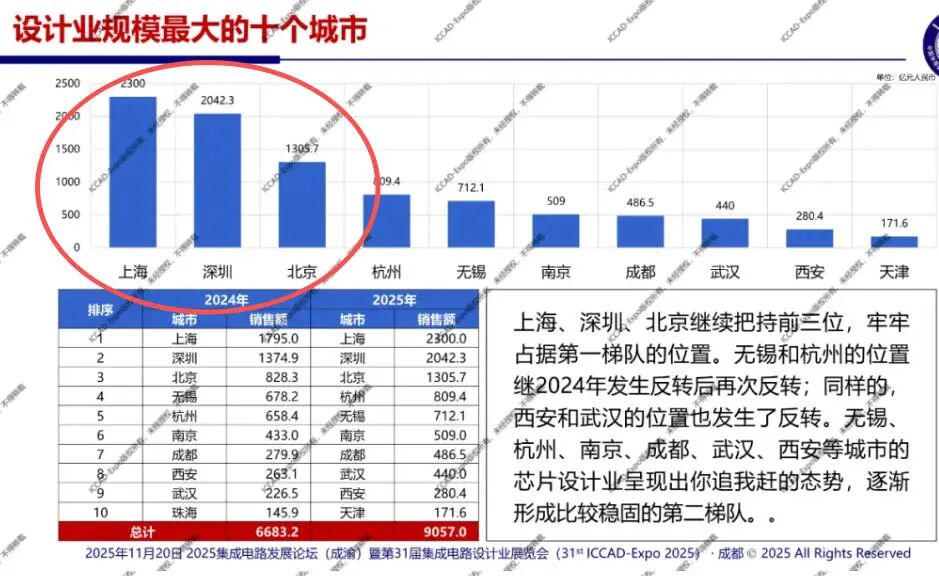
However, although the overall scale reaches 835.73 billion, 68% of this share comes from three cities: Shanghai, Shenzhen, and Beijing.
Of course, Shanghai and Beijing, as municipalities directly under the central government, have special status and functions, distinguishing them from ordinary prefecture-level cities, but they are still cities.
The total revenue of these three cities reaches 564.8 billion yuan, accounting for about 68% of the national total revenue. It can be said that these three cities are indeed the cradle and base of China’s chip design.

However, according to experts, although the domestic chip design industry is developing rapidly, it still has not escaped the situation of being small, scattered, and weak.
The top 10 chip design companies account for 30% of the industry’s sales, while the 831 companies with sales exceeding 100 million yuan account for about 85% of the sales.
So, despite having nearly 4,000 chip design companies, most of them are small enterprises, which are the most numerous. Their revenues are generally not high, and they are mostly concentrated in the low-end market, with poor product levels, relying more on price competition.
Therefore, from this data, it can be seen that the current development of the domestic chip design industry is mainly supported by a few advanced regions, and the development is not very balanced. At the same time, since more companies are still concentrated in the low-end and low-level sectors, the phenomenon of internal competition is certainly present and unavoidable.
Next, we need to advance into higher-end fields and cannot continue to repeat internal competition in low-end areas. We should create a good competitive and growth environment, and let those that need to be eliminated be eliminated, without the need for redundant construction.