 ▎Edited by WuXi AppTec Content Team Processing auditory information is crucial for the survival, social interaction, and reproduction of animals, including humans. For many years, scientists have discovered that almost all auditory information conveyed to the forebrain must pass through a complex auditory midbrain (inferior colliculus) → auditory thalamus pathway. This pathway is considered a key node in the auditory ascending pathway, responsible for effectively transmitting auditory information to higher brain regions.The auditory midbrain, also known as the inferior colliculus, is divided into three subregions: the central nucleus of the inferior colliculus (ICC), the dorsal cortex of the inferior colliculus (ICD), and the external cortex of the inferior colliculus (ICE). The inferior colliculus primarily transmits information in parallel to the auditory thalamus, which is further divided into the primary auditory thalamic area, namely the ventral part of the medial geniculate body (MGBv), and the higher auditory thalamic areas, including the ventral part (PIN/PP), dorsal part (MGBd), and medial part (MGBm/POL).Traditionally, it has been defined that the inferior colliculus subregions connect to the auditory thalamus, with ICC connecting to MGBv, ICD connecting to MGBd, and ICE connecting to MGBm. However, multiple tracing studies have indicated that the connections from the inferior colliculus to the auditory thalamus are more complex than traditionally defined, and other higher auditory thalamic nuclei such as PIN/PP and POL also receive substantial projections from the inferior colliculus, yet many unknowns remain regarding these projection patterns.“The auditory ascending pathway is textbook content. In books, the projection from the auditory midbrain to the thalamus is point-to-point from subregion to subregion, which is concise and clear. However, researchers in the field of auditory centers are well aware that the reality is ‘lean’,” said researcher Yuan Kexin from Tsinghua University, who has dedicated years to studying the auditory central nervous circuits and their analytical techniques. He pointed out that “all subregions of the auditory midbrain project diffusely to the thalamus, just with different emphases.”

▲Researcher Yuan Kexin from Tsinghua University is the recipient of the 2018 WuXi AppTec Life Science Research Scholar Award (Image Source: Provided by the Research Author)
To address this phenomenon that has puzzled the central auditory field for decades, Yuan Kexin’s research group attempted modern neural circuit analysis techniques to redefine the midbrain-thalamic projection pathways by expressing specific molecular markers in cell types. On March 6, 2024, the research team published a paper in the professional journal of neuroscience, Journal of Neuroscience, revealing that parvalbumin (PV) and somatostatin (SOM) serve as two important molecular markers that constitute parallel pathways from the auditory midbrain to the auditory thalamus. This article was selected as a Featured Article in that issue of the journal.
The researchers first employed transgenic mice and patch-clamp electrophysiological recordings, combined with self-developed methods such as tissue transparency without deformation, to study the distribution and properties of inferior colliculus neurons expressing somatostatin (SOM+) and parvalbumin (PV+).Research results showed that SOM+ and PV+ are two major types of inferior colliculus neurons (approximately 40% of total inferior colliculus neurons), distributed with different characteristics across various subregions of the inferior colliculus. Among them, SOM+ is a type of excitatory neuron, exhibiting a uniform action potential firing pattern and axonal terminal morphology; while in PV+ neurons, one-quarter are inhibitory neurons, displaying three action potential firing patterns and diverse axonal morphologies. Therefore, SOM-labeled inferior colliculus neurons possess more homogeneous characteristics.
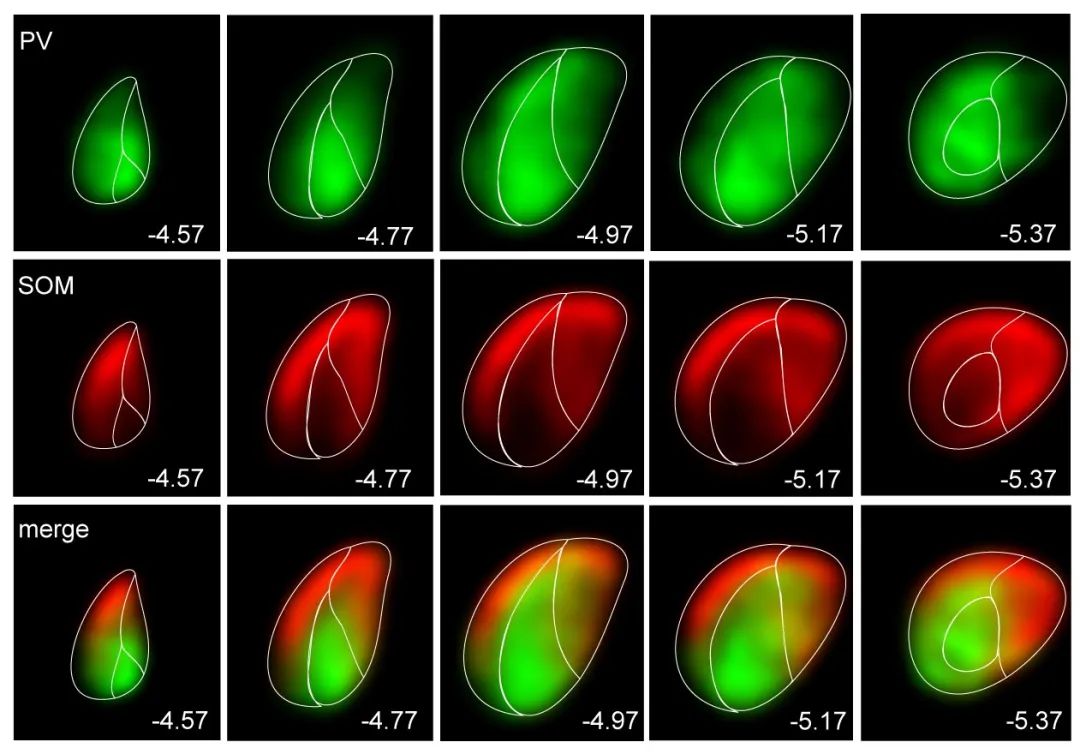
▲Density distribution map of PV+ and SOM+ in the inferior colliculus (Image Source: Provided by the Research Team)Subsequently, the researchers used AAV-synaptophysin-mRuby to label the downstream projections of these two types of neurons. Interestingly, they found that regardless of which subregion of the inferior colliculus they are located in, PV+ and SOM+ project to almost completely different auditory thalamic subregions, namely MGBv and POL. This result indicates that the parallel projections from the inferior colliculus to the auditory thalamus are more significantly correlated with the molecular expression in the inferior colliculus (at least PV and SOM).
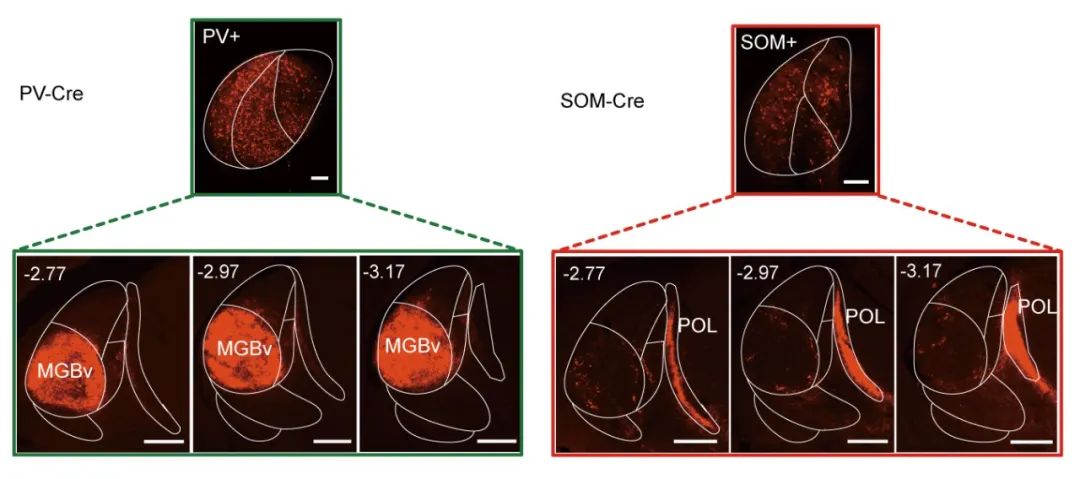
▲PV+ and SOM+ neurons in the inferior colliculus project to primary auditory thalamus and higher auditory thalamus subregions respectively (Image Source: Provided by the Research Team)POL belongs to the medial nucleus group of the higher auditory thalamus; due to its unique morphology, it is difficult to label, and previous research on this brain region has been limited, with its function still unclear. To further analyze the possible function of POL, researchers conducted upstream and downstream tracing of the ICSOM+→POL and compared it with the results of ICPV+→MGBv. The study showed that ICSOM+ significantly receives more inputs from sensory-motor nuclei, namely the periaqueductal gray (PAG) and the superior colliculus (SC), and this information is mainly projected to the tail striatum (TS) through POL. In contrast, ICPV+ mainly receives auditory information input and transmits it to the auditory cortex layer four through MGBv. These results suggest that ICSOM+→POL may play an important role in sensory-related decision-making, while ICPV+→MGBv may primarily participate in the transmission and encoding of auditory information.In conclusion, this study discovered two types of molecularly marked inferior colliculus neurons, which, rather than the traditionally defined inferior colliculus subregions, constitute the parallel pathways from the auditory midbrain to the auditory thalamus.
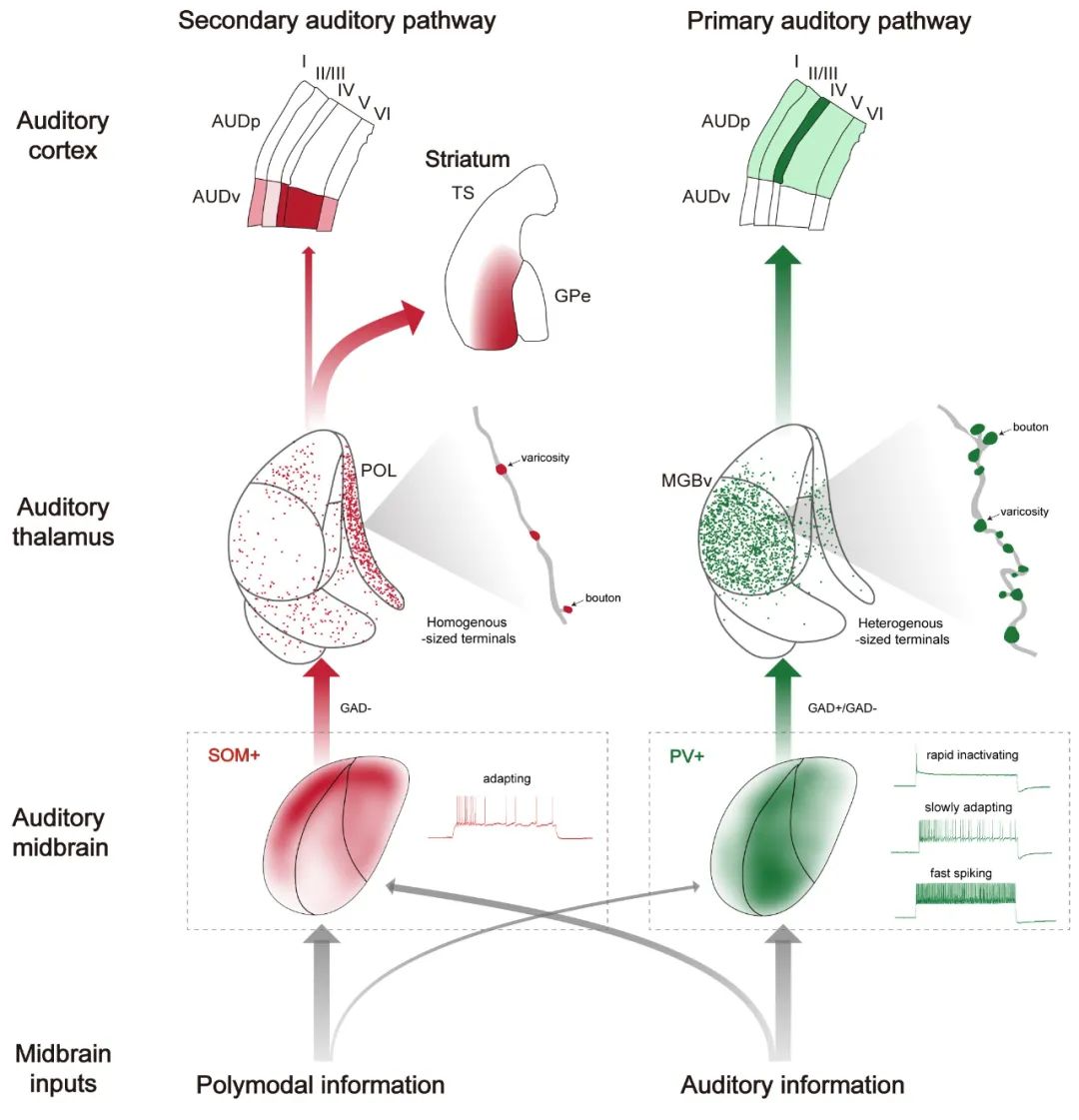
▲Midbrain PV+ and SOM+ neurons mediate two parallel auditory midbrain-thalamic pathways (Image Source: Provided by the Research Team)Professor Yuan Kexin pointed out that this work is just the beginning, as there are multiple types of neurons expressing different molecular markers in the auditory midbrain, and their projection patterns still need to be revealed. Other subregions of the auditory thalamus may receive projections from inferior colliculus neurons with different molecular expressions. In the future, further re-examining many conclusions related to the auditory midbrain-thalamic pathways in a cell-type-specific manner will be of great significance for understanding the complex functions of the auditory thalamus.
PhD student Liu Mengting from the School of Biomedical Engineering at Tsinghua University and Beijing Chaoyang Hospital affiliated with Capital Medical University is the first author, while PhD student Gao Yixiao from Yuan Kexin’s laboratory is a co-first author of this article. Yuan Kexin and Wang Ningyu from Beijing Chaoyang Hospital are co-corresponding authors. This research was strongly supported by the Ministry of Science and Technology, the National Natural Science Foundation, the Beijing Science and Technology Commission, and the National Research Institute of Tsinghua University.
References:
[1] Mengting Liu et al., Parvalbumin and Somatostatin: Biomarkers for Two Parallel Tectothalamic Pathways in the Auditory Midbrain. Journal of Neuroscience DOI: https://doi.org/10.1523/JNEUROSCI.1655-23.2024
This article is from the WuXi AppTec content WeChat team, welcome to share it with your friends, but please do not repost it on other platforms. If you need to set up a whitelist, please reply “repost” on the homepage of the “Academic Latitude” public account to obtain repost guidelines. For other cooperation needs, please contact [email protected].
Disclaimer: The WuXi AppTec content team focuses on introducing global biopharmaceutical health research progress. This article is for informational exchange purposes only; the views expressed do not represent the position of WuXi AppTec, nor do they represent WuXi AppTec’s support or opposition to the views expressed herein. This article is also not a treatment recommendation. For treatment guidance, please visit a formal hospital.
More Recommendations





Tap “Looking” before you leave~