
In today’s digital wave, wireless connectivity is as essential as air, with Bluetooth and WiFi technologies serving as the key links to achieve this connection. Bluetooth was launched ahead of WiFi, initially exploding in popularity with the wave of wireless Bluetooth headsets, and after introducing BLE low-power features, it has further thrived in the Internet of Things (IoT) and other smart wearable fields.
Currently, half of the global Bluetooth chip shipments come from China, with eight out of the top ten TWS Bluetooth main control chip suppliers being Chinese manufacturers. The mid-to-low-end market is primarily dominated by Jieli and Zhongke Lanxun, while the mid-to-high-end market is also seeing significant shares taken by Hengxuan and Woqi. Undoubtedly, domestic manufacturers have gained a strong voice in the TWS Bluetooth main control chip sector.
With the development of AI technology, Bluetooth, which only supports lightweight data transmission, can no longer meet the connection needs of high-end application scenarios. Domestic Bluetooth chip manufacturers are facing a new challenge. I Love Audio Network has observed that many mid-to-high-end Bluetooth chip manufacturers are beginning to layout in popular new markets such as AI glasses and AR/VR, planning to turn WiFi chips into a “second growth pole” for their performance.
Can Bluetooth chip manufacturers still benefit from entering the WiFi market?
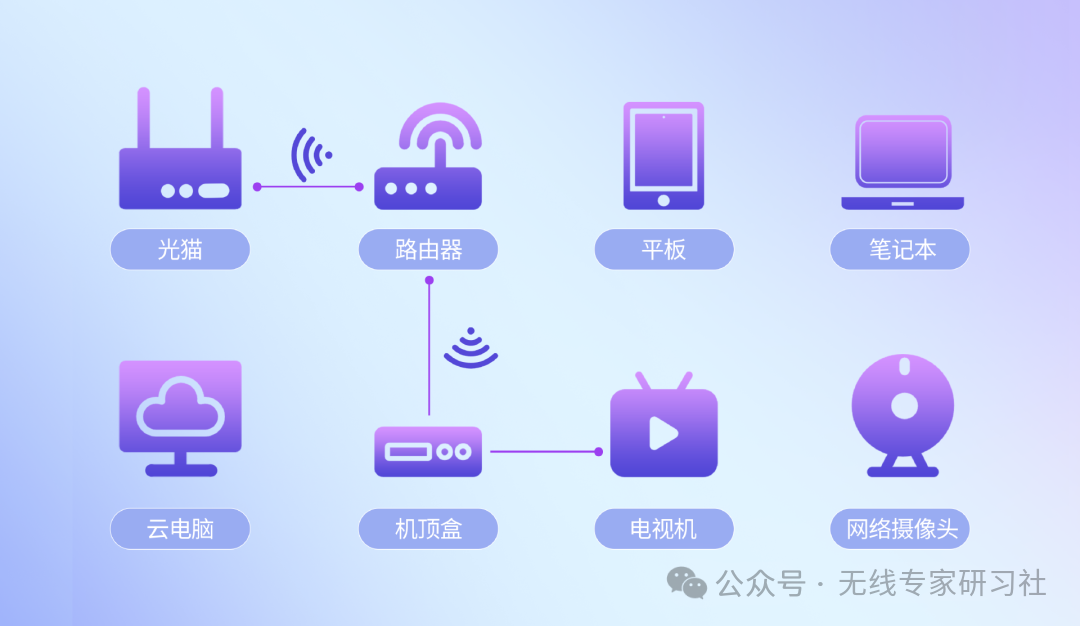
WiFi chips are mainly divided into IoT WiFi MCUs, WiFi Stations, and WiFi APs, each applied in different scenarios. IoT WiFi MCUs are primarily suitable for IoT scenarios, while WiFi Stations are used for terminal devices requiring high data throughput, such as smartphones, tablets, and TVs. WiFi APs are applied in high-end scenarios like routers and gateways.
From a technical difficulty perspective, IoT WiFi MCUs, WiFi Stations, and WiFi APs increase in complexity. The main challenge for IoT WiFi MCUs lies in low-power design, which is aimed at achieving low-power data collection, processing, and wireless transmission, with a relatively low technical threshold and development difficulty.
WiFi Stations require higher technical standards than IoT WiFi MCUs, with longer R&D cycles, necessitating a deep understanding of WiFi protocol stack implementation, RF debugging, and optimization for high throughput and low latency. WiFi APs represent the highest technical difficulty among the three types of WiFi chips, needing to meet extremely high throughput, transmission rates, and stability.
Quickly Entering the IoT WiFi MCU Market
The IoT WiFi MCU market, with its lower technical difficulty, has seen a surge of domestic manufacturers entering, making the competition very crowded and leading to fierce price competition among manufacturers. With the rise of domestic manufacturers, foreign giants have gradually abandoned this market. Espressif Technology launched a lower-priced chip in 2014, and with advantages such as high cost-performance ratio, its market share has been continuously increasing.
Currently, Espressif Technology and Broadcom Integrated have become the two dominant players in the IoT WiFi MCU field, capturing 80% of the global market share. The remaining 20% is contested by manufacturers such as Boliu Intelligent, Southern Silicon Valley, and Aojie Technology. Many Bluetooth chip manufacturers are now exploring new businesses and looking for new growth points, and they are also eyeing the WiFi chip track.
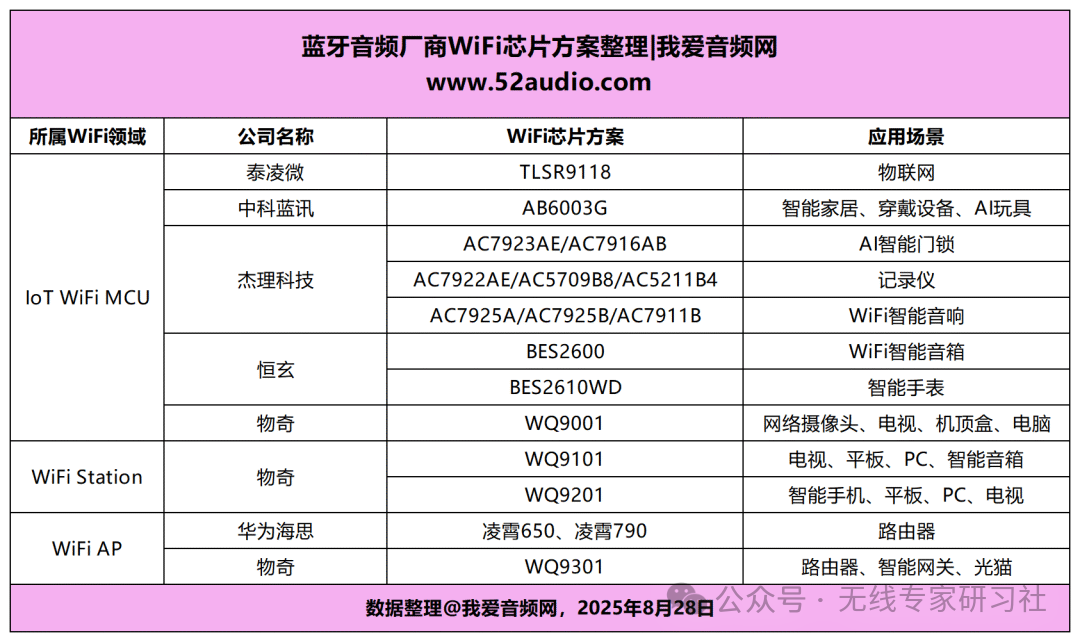
When entering the WiFi chip field, manufacturers like Jieli, Zhongke Lanxun, and Tailin Micro seem to have unanimously chosen to first establish themselves in the IoT WiFi MCU sector. The reasons behind this are not only due to the lower technical threshold of IoT WiFi MCUs but also likely related to their technical accumulation and market experience.
IoT WiFi MCUs are a field heavily focused on low-power design. Speaking of low power, Tailin Micro has focused on low-power wireless connectivity technology since its inception, and the company has been working in this area for 16 years. Based on its deep technical accumulation from previous low-power wireless IoT chips, it has achieved a rapid entry into the IoT WiFi MCU field, successfully launching its first WiFi SoC chip, the TLSR9118, last year. This product supports the WiFi 6 protocol, but its bandwidth is only 20MHz, making it primarily suitable for low-rate IoT scenarios.
Zhongke Lanxun has certain accumulation in the low-power wireless audio SoC chip field, and last year it made breakthroughs in the next-generation WiFi + Bluetooth combo RF and ePTA coexistence technology, as well as new-generation WiFi modem and baseband processing technology. This year, targeting the AI toy application market, it launched its first WiFi chip, the AB6003G, which also supports a maximum bandwidth of only 20MHz.
Additionally, Jieli Technology has launched IoT WiFi chip products that have entered application markets such as WiFi smart speakers, reading pens, and story machines. It can be seen that Jieli, Zhongke Lanxun, and Tailin Micro have all chosen to first enter the IoT WiFi MCU field based on their technical accumulation, focusing on developing technologies with lower difficulty.
However, in this low-rate application scenario, competition is already very fierce, with leading companies occupying a very high market share, and Bluetooth chip manufacturers as new entrants may find it challenging to achieve significant growth in the IoT WiFi MCU field.
Focusing on WiFi Station/AP
In the high-end WiFi Station/AP market, domestic manufacturers have been “choked” by foreign giants, who take over 90% of the market share. The main players are Broadcom, Qualcomm, and MediaTek, which together are expected to occupy 66.42% of the Chinese WiFi Station market and 68.78% of the Chinese WiFi AP market in 2024.
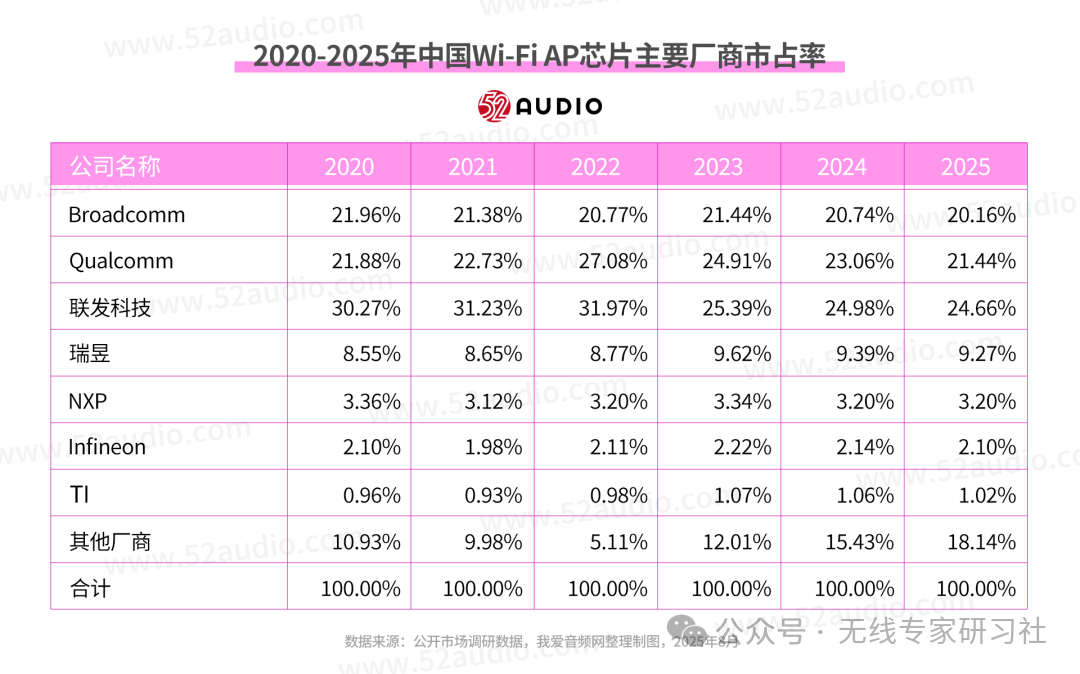
These foreign giants have a very deep technical accumulation in the high-end WiFi field and have consistently maintained a lead in advanced WiFi standards. The fastest-growing segment over the past five years has been WiFi 6 chips, and in the next five years, WiFi 6 chips are expected to replace WiFi 5 as the market leader. It is incredible that by 2025, Broadcom’s revenue from WiFi 6/6E is predicted to rise to 80%, while MediaTek’s revenue from WiFi 6/7 chips is expected to reach 88%.
Faced with the overwhelming advantages of foreign giants, most domestic manufacturers find it difficult to enter the high-end WiFi market, with only a few technically strong companies able to do so. R&D of WiFi AP router chips requires overcoming challenges such as real-time channel estimation and dynamic balancing algorithms, and applying higher-order 1024QAM/4096QAM modulation technologies, as well as the implementation of MU-MIMO and MRU technologies, which are also fraught with difficulties.
In the WiFi AP field, HiSilicon is the most advanced among domestic companies and is currently the only domestic WiFi AP chip manufacturer that can compete on the same stage as Qualcomm, Broadcom, and MediaTek, but its market share still needs to be improved.
The prospects for domestic high-end AP router chip localization are broad, not only reflected in the vast market capacity but also in its core strategic considerations. As a foundational element of network infrastructure connectivity, it is crucial to national core fields, making its industrial value particularly significant.
For Bluetooth chip manufacturers, entering the fiercely competitive low-rate IoT WiFi MCU market may not be as valuable as seeking breakthroughs in high-end WiFi chips. Expanding into high-margin WiFi Station/AP new businesses could also bring better growth to the company’s performance.
Currently, Woqi and Hengxuan, two major Bluetooth chip manufacturers, have begun to enter the high-end WiFi chip market. Woqi is a newcomer in the WiFi market in recent years, but it has developed very rapidly in the WiFi field, now not only possessing WiFi Stations but also higher-end WiFi AP router products.
WiFi chips require significant investment and have a much longer tape-out time than Bluetooth.Unlike other audio manufacturers, Woqi has invested heavily in WiFi chip R&D in recent years, seemingly determined to compete in the high-end WiFi market.
From a layout perspective, Woqi is continuously moving towards higher technical difficulty, hoping to secure a place in the higher-end WiFi chip market and break the foreign market monopoly. So far, Woqi has launched four WiFi chips, covering the entire range of STA and AP products.
These products reveal Woqi’s ambitious plans in the WiFi chip market, with product bandwidth upgrading from 40MHz, 80MHz to 160MHz, fully covering application scenarios from low-rate to high-rate, from IoT and smart terminals to routers and gateways, providing secure and high-speed connections for full-scenario home networks.
Hengxuan Technology’s WiFi Station is also accelerating its start. Industry insiders have confirmed that Hengxuan Technology has chosen to collaborate with other manufacturers to develop WiFi Station chips, which also highlights the difficulty of developing high-end WiFi chips, as Hengxuan is not yet able to independently develop them.
Overall, compared to foreign giants like Broadcom, Qualcomm, and MediaTek, domestic manufacturers are still in the early stages in the WiFi Station/AP field, with many technical challenges yet to be overcome. It can be seen that some relatively strong domestic manufacturers have already achieved initial success in the high-end WiFi chip field, and the market is gradually expanding.
However, tackling the “hard bone” of high-end WiFi chips still requires more domestic manufacturers to participate. The future potential for domestic high-end WiFi chip replacement is also significant, making it a good choice for exploring new businesses and seeking new growth.
Reasons Behind the Rush to Layout WiFi Chips
The collective rush of Bluetooth chip manufacturers to layout in the WiFi chip track is not merely a blind trend; various underlying reasons have brought about strong R&D driving forces.
First, the WiFi chip market has a sufficiently large capacity.Industry data shows that the global WiFi chip market sales are expected to reach $20.126 billion in 2024, and are projected to reach $57.534 billion by 2031, with a compound annual growth rate of 15.77%. This market size far exceeds that of Bluetooth chips, which is only $3.455 billion in 2024.
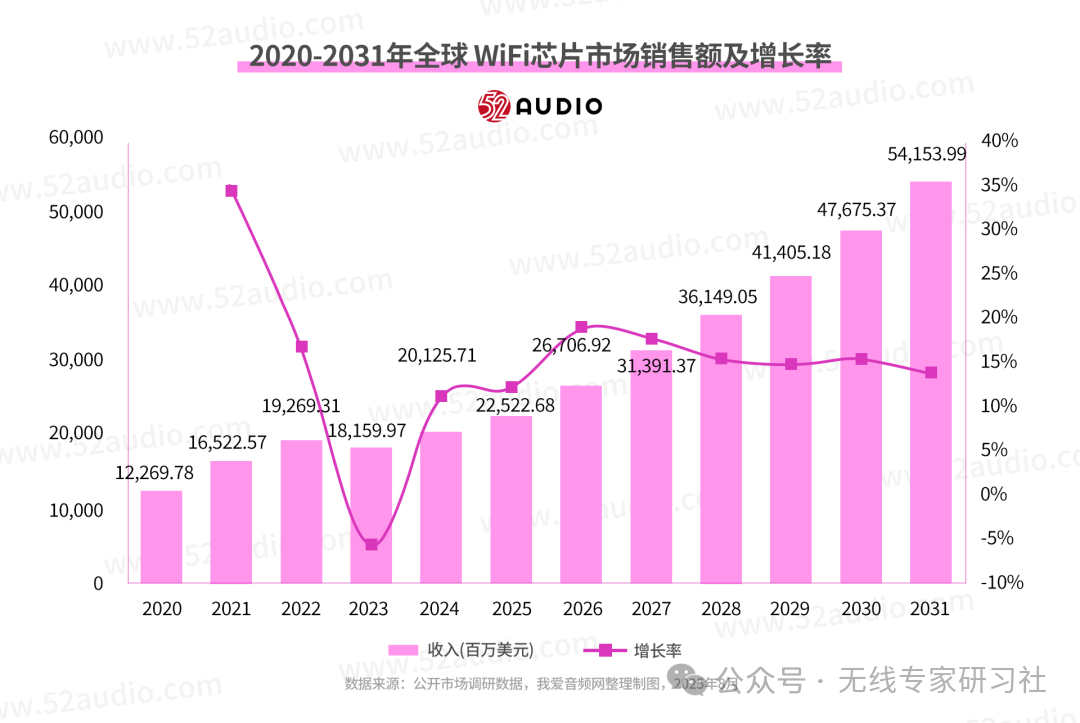
From the application scenario perspective, the market size for WiFi chips is also accelerating expansion. Currently, the demand for WiFi chips in the smart home market remains strong, and the emergence of AI will also open up new application scenarios, such as AI glasses, AI toys, AI speakers, AR/VR, driving continuous expansion of the WiFi chip market.
Moreover, China has the advantage of being “close to the water”. China is the largest application market for WiFi chips globally, and currently, the largest production area for WiFi chips is Taiwan, China. It is expected that in the next five years, mainland China will become the fastest-growing region for WiFi chip production. A significant portion of future WiFi chip production may be contributed by Bluetooth chip manufacturers.
Secondly, there is technological continuity.Bluetooth and WiFi both belong to short-range wireless communication technologies, with a high degree of overlap in their underlying technical architecture. RF design capabilities can be reused, protocol stack development experience can be transferred, and low-power technologies can also be applied. Therefore, leveraging this technological continuity, Bluetooth chip manufacturers can more quickly enter the WiFi chip field and develop WiFi chip products.
Furthermore, it facilitates future layouts for edge-side AI intelligent connections.AI large models are transitioning from the cloud to edge deployment, and in the near future, edge-side multimodal AI intelligent devices are expected to experience explosive growth, which poses demands for wireless connections that far exceed single Bluetooth technology. WiFi can better meet the needs for high-bandwidth data transmission, low latency and high reliability, as well as wide coverage and long-distance connections. The combination of WiFi connectivity and terminal AI becomes the best combination for building high-speed wireless edge intelligent products.
I Love Audio Network Summary
WiFi chips are an important foundation for building network communication infrastructure. They not only have a vast application market but also possess high-value attributes that ensure national information security and network security.
Espressif Technology and Broadcom Integrated have dominated the IoT WiFi field, and now many Bluetooth chip manufacturers such as Jieli, Zhongke Lanxun, and Tailin Micro are accelerating their entry into IoT WiFi MCU R&D based on their technical accumulation in low power. However, in this field, there are many participants, and market competition is fierce, making it uncertain whether Bluetooth chip manufacturers as new players can successfully benefit.
More ambitious Woqi and Hengxuan are now targeting the high-end WiFi Station/AP market, seeking new opportunities for performance growth. It is understood that Woqi has taken the lead in launching a WiFi 6 AP high-end router chip, which has obtained WiFi Alliance certification and product certification, and has received relevant domestic evaluation for localization, making it the fastest progressing company among domestic Bluetooth chip manufacturers in high-end WiFi development, and currently the fastest progressing startup in the Wi-Fi AP track.
These companies will join HiSilicon to become the backbone force in overcoming the “choke point” challenges of high-end WiFi chips.
September 19 | 2025Asia AI Audio ConferenceExhibition Contact: 13168060319 (WeChat same number)AudioIndustry Annual Report is continuously updated. If you want to know the latest trends in the consumer audio industry, please follow us.I Love Audio NetworkYay: D The following popular topics can be clicked on in blue to learn more, or you can reply with the following keywords in the I Love Audio Network WeChat backend to get the topic.「2024 Market Trend Full Interpretation」TWS Earbuds、OWS Open Ear Headphones、Wireless Microphones、Bluetooth Speakers、VR/AR、Smart Voice Glasses、Smart Watches/Bands、Smart Rings、New Energy Vehicle Audio、Hearing Aids/Assistive ListeningQuality • “Chip Manufacturers”Qualcomm、JH Microelectronics、Zhongke Lanxun、Woqi、SY Siyuan、LPS Weiyuan、Chuangxin Micro、Tailin Microelectronics、Shengsheng Micro、Laiyuan ElectronicsQuality • “Battery Manufacturers”Varta、Penghui、HaopengQuality • “Supply Chain Manufacturers”
Lou’s Electronics、xMEMS、Yaqi Technology、
Shunluo Electronics、Shengjiali、Ruiqin Electronics
SanTi Micro、Yixin Micro
More quality manufacturers are being updatedBusiness cooperation contact: [email protected] Be brave,and share your views on the message board!