Abstract: This article combines the operation and maintenance environment example of the Southwest Shandong Big Data Center, introducing the impact of infrastructure such as air conditioning and fresh air, power supply and distribution, lightning protection and grounding, fire protection and safety assurance, information networks and wiring, system monitoring, and water supply and drainage on IT equipment environments. It also analyzes the importance of key infrastructures like the power supply and distribution system, cooling system, and centralized control system to the operation and maintenance environment of big data centers, ensuring that the IT equipment in the data center can operate safely, reliably, and continuously.
Keywords: Data Center Infrastructure Operation and Maintenance Environment
Human society is rapidly entering the digital age, and data centers, as new infrastructure, are taking on increasingly important missions. The rapid development of data center technology and scale makes the operation and maintenance of data center infrastructure more challenging. Data center infrastructure is related to many subsystems such as power supply and distribution, air conditioning, fire protection, security, and low-voltage monitoring, which build a compact correlation and mutual influence among different subsystems. This article studies the infrastructure construction and operation and maintenance of the Southwest Shandong Big Data Center, analyzing the connections between various infrastructures to ensure that the comprehensive operational status of each subsystem reaches an optimized level, further ensuring the reliability of data center operations.
1 Project Overview
The Southwest Shandong Big Data Center project is located on the east side of Guangzhou Road and the north side of Minjiang Road in the Mudan District of Heze City. The project includes the A1# Data Room Building and the B1# Diesel Generator Building. The A1# Data Room Building has 4 floors above ground, with a building height of 26.8m, where the first floor mainly serves as the hub for the power distribution and cooling systems; the 2nd to 4th floors are the machine room modules and low-voltage power distribution room, serving as the IT data processing center. The B1# Diesel Generator Building has 3 floors above ground, with a building height of 22.50m, serving as the storage center for the diesel generator system, primarily providing power assurance for the A1# Data Room. The Southwest Shandong Big Data Center has obtained the highest national A-level data center certification from CQC and has been selected as a pilot for the construction of new-type data centers at the provincial level in Shandong, becoming a strong support for smart cities in Heze and its surrounding areas.
2 Data Center Infrastructure The composition of the data center infrastructure system is shown in Table 1, where the power supply and distribution system, HVAC system, and centralized control system play crucial roles in the data center and are key to maintaining the PUE index below 1.3. The role of the fire protection system is to protect critical equipment and important data from fire damage. Unlike general public buildings, the main machine room, power distribution room, and battery room of the data center are designed with a gas fire extinguishing network system and equipped with cart-type carbon dioxide extinguishers. Additionally, the main machine room, power distribution room, and battery room are equipped with normal ventilation and disaster ventilation systems, with accident exhaust openings set at the lower part of the protection area, normally closing the fire damper, which automatically opens the fire damper and exhaust fan after an accident for post-accident ventilation. The internal decoration is designed to meet the operational conditions of various electromechanical systems according to the characteristics of the data center.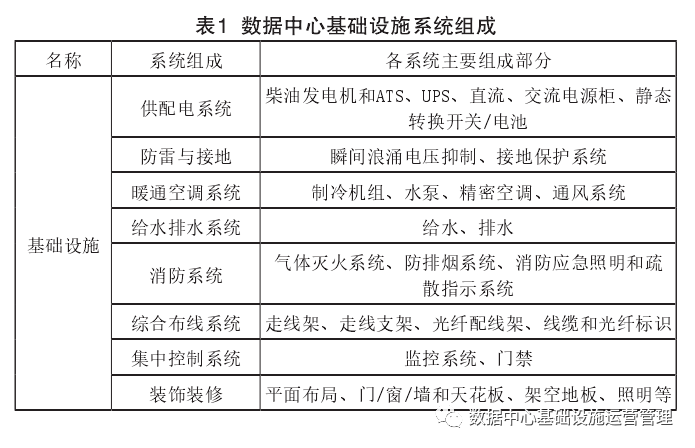 2.1 Requirements and Composition for Data Center Site Selection A successful data center must meet the core needs of IT equipment. The IT room must be located away from places that generate dust, oil fumes, and harmful gases, with complete anti-theft facilities, avoiding strong magnetic field interference, and should be located in the middle layers of the building for easy management and wiring. It should avoid being on the top floor, basement, or below water equipment. The data center is divided into four functional areas: the main machine room, auxiliary area, support area, and administrative area. The main machine room is a dedicated room for important equipment such as IT servers, network devices, and cabinets; the auxiliary area includes maintenance rooms, spare parts storage rooms, testing rooms, etc.; the support area contains functional rooms for power supply and distribution, air conditioning, fire protection, security, and low-voltage monitoring systems to support IT equipment operational status; the administrative area is for daily office work of operation and maintenance personnel. 2.2 Data Center Power Supply and Distribution System 2.2.1 Power Supply and Distribution System For data centers, the most important aspect of the power supply and distribution system is to ensure the power needs of IT equipment (power interruptions must not exceed 10ms). The data center power supply and distribution system primarily faces four common fault scenarios: power interruption, equipment failure, human error, and natural disasters. If a fault occurs in the data center power supply and distribution system, it will undoubtedly affect the stable operation of the entire data center and bring significant social impact. Therefore, the design of the data center power supply and distribution system already includes a large amount of redundancy and uninterruptible power supply equipment, such as dual power supply introduction, diesel generators, UPS, and HVDC (High Voltage Direct Current Power Supply System). To ensure stable power supply, a dual-loop system with diesel generator backup is typically used, where the diesel generator connects to the high-voltage distribution cabinet through a parallel feed cabinet as a power backup. Bus ties are set up in both high and low voltage sections, controlled uniformly by the power control system. The precision cabinet adopts dual UPS, and dual PDU (Power Distribution Unit) are set inside the cabinet, with the two PDUs distinguished by color (as shown in Figure 1).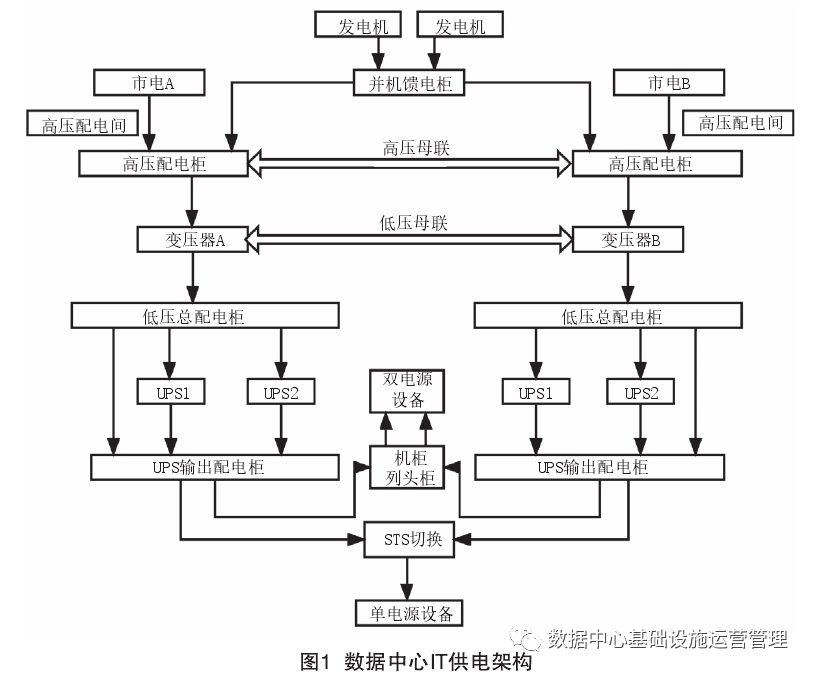
2.2.2 Characteristics of the Power Supply and Distribution System
The power demand of data center equipment is high, requiring continuous operation of equipment 24 hours a day. The stable and continuous operation of the power supply and distribution system in the data room is key to the normal operation of the data center, ensuring it performs its functions. Regarding the architecture of the data center power supply and distribution system, according to GB 50174—2017 “Data Center Design Specifications”: A-level data centers should meet fault tolerance requirements and can adopt 2N systems or other configurations that avoid single points of failure. The IT equipment in the data center, air conditioning serving the IT equipment, cooling units, pumps, fire protection, security, and low-voltage equipment are all considered special important loads within the first-level load. The first-level load must meet dual power supply requirements. When one power source fails, the other should immediately take over. The Southwest Shandong Big Data Center draws in four routes of 10kV municipal power supply, with two routes forming a group, where the two 10kV power sources in a group serve as backups for each other, sourced from two different 10kV bus sections in the park’s 110kV substation. Under normal circumstances, both 10kV power sources operate simultaneously as backups for each other, with the bus tie switch being able to engage automatically or manually. In automatic mode, when one power source loses power, the switch on the failed side is automatically disconnected, and the bus tie switch automatically engages, supplying power to both bus segments from the second power source, with each power source capable of carrying the full load. When municipal power is restored, it returns to normal status. If both 10kV municipal power sources fail, the diesel generator set is started after a delay of several seconds (0-30s adjustable) to complete the parallel operation, supplying power to the two bus segments from the generator bus and distributing the load through an automatic load distributor. When municipal power is restored, it returns to normal status.
2.3 Data Center HVAC System 2.3.1 Role of the HVAC System The HVAC system is essential for ensuring that data center IT equipment and power supply equipment operate under suitable environmental conditions. The design and operation of the data center air conditioning system directly affect the temperature and humidity in the machine room, which in turn affects the energy consumption and stability of IT data equipment. Therefore, the determination of the cooling air conditioning system scheme, the selection of main equipment such as cooling units, pumps, and terminal devices, as well as the choice of airflow organization forms are closely related to the failure rate, operational status, and energy consumption of the equipment in the data center, making it a necessary condition for the normal operation of the data center. Additionally, statistics show that the energy consumption of the HVAC system accounts for 30% to 45% of the total energy consumption in data centers[1], thus, implementing energy-saving measures in the planning of the HVAC system of the data center directly impacts the PUE value (the ratio of total energy consumption of the data center to the energy consumption of IT equipment) and the maintenance costs during the operational phase, which is of great significance for the energy saving of the entire data center.
2.3.2 Function Analysis and Energy Saving of the HVAC System
Based on the local wet bulb temperature in Heze and the design temperature and relative humidity values of the Southwest Shandong Big Data Center, a continuous cooling system is designed, using four 1300RT fast-start variable frequency centrifugal chillers with a 3+1 redundancy setup. According to seasonal and outdoor wet bulb temperature changes, three modes of cooling conversion are used to continuously obtain 15℃/21℃ chilled water, which is delivered to precision air conditioning through the chilled water system. The cold air produced by the precision air conditioning is sent into the cold aisle through the raised floor, cooling the IT servers, and the hot air generated by heat exchange is sent to the upper end of the precision air conditioning unit through the hot aisle, creating a cycle to maintain the temperature of the IT room at 23℃. Two dedicated wet film humidifiers are set in the IT room and the operator’s access air conditioning room, mixing with the return air of the precision air conditioning, with the humidification amount controlled by the room’s dew point temperature-sensitive components to maintain humidity at 60%. At the same time, the fresh air system generates fresh air delivered to the IT room to maintain a positive pressure state, preventing outdoor dust and humid air from seeping in, regulating indoor humidity, preventing static electricity and condensation, and ensuring that the air conditioning in the machine room operates at 100% sensible cooling. All refrigeration equipment adopts variable frequency control, and the IT room uses a cold aisle containment airflow form, as well as three modes of cooling conversion to effectively save energy and reduce costs, achieving a PUE index of 1.3, significantly improving energy-saving effects.
2.4 Centralized Control System
The centralized control system of the data center mainly monitors and manages the environment and equipment of the machine room, including the operational status and temperature, humidity, pressure difference, and leak detection of UPS, power supply and distribution equipment, batteries, diesel generators, fresh air systems, and precision air conditioning systems. By judging the parameters of each subsystem, it identifies any anomalies, allowing operation and maintenance personnel to make proactive and accurate judgments. Therefore, the monitoring system is especially important for data center machine rooms. The Southwest Shandong Big Data Center project uses embedded servers (or related functional products) to collect data from various end intelligent devices, and then aggregates all data through a dynamic environment dedicated network to the dynamic environment monitoring server. The dynamic environment monitoring server is located in the weak current equipment room and can centrally monitor the dynamic environment monitoring data of the relevant areas of the entire machine room building, displaying the dynamic parameters and operational status of the monitored systems in real-time through the comprehensive management platform of the data center.
A comprehensive monitoring system can prevent many faults. If the monitoring system does not provide an alarm when a fault occurs, valuable information can still be extracted from the various technical parameters and records of the monitoring system during post-fault alarm analysis to identify the cause of the alarm.
3 Conclusion The operation and maintenance work of the data center mainly involves monitoring and managing various systems of the data center. Continuous and uninterrupted operation of the data center means that unexpected situations may arise, leading to power outages, which can result in irreversible information and economic losses. In addition to operation and maintenance engineers recording various operational information of equipment in their daily work, familiarizing themselves with the use of the DCIM comprehensive management platform, being able to timely and effectively judge and record valuable information from the platform, and quickly addressing safety hazards in the data room, the construction of data center infrastructure also plays a crucial role. As long as the materials and equipment required by each key system are constructed to high standards and put into operation, the lifespan of the equipment can be greatly extended during subsequent daily operation and maintenance management, thus achieving a highly efficient, safe, reliable, and green new-type data center.(Writers: Cheng Zhanlong, Shi Zhiling, Xie Zhongxin, Zhao Zhenpeng, Zhang Zhijun, Shao Na, Lv Yanlei, Hou Limin)References:[1] Su Rongxin. Technical Points of Data Center Cooling Air Conditioning Scheme Selection [J]. Building Material Development Guide (Upper),2019, 17(3): 1-2.
Reprinting of this article prohibits deletion or modification of the content and links.Public Account: Data Center Infrastructure Operation Management
-END-
Extended Reading Links:
☞ Free Access to Data Center Infrastructure Operation and Maintenance Materials☞ Data Center Infrastructure Operation and Maintenance Materials Collection☞ Compilation of Data Center Related Standards and Specifications (with Download Method)☞ Data Center Construction Process and Construction Standards (with Download Method)☞ Data Center Infrastructure Engineering Pre-acceptance Inspection Checklist – Excel Form☞“Data Center Infrastructure Operation and Maintenance Engineer Training Textbook”☞ Electrical Calculation EXCEL Collection☞ “Data Center Infrastructure Planning and Design Video Tutorial“☞ Summary of Data Center Standards and Specifications☞ Summary of Essential Knowledge for Data Center Infrastructure Operation and Maintenance Engineers
☞ Summary of Training for Data Center Infrastructure Operation and Maintenance Engineers
Disclaimer
Content sourced from the internet, public accounts, and other open media, intended to convey more information. The content is for reference only, and readers should not simply accept the information from public accounts to replace their independent judgment. They should make decisions independently and assume risks themselves. This public account does not bear any responsibility for any losses caused by the use of the content herein. The copyright of reprinted articles belongs to the original author or institution. If there is any infringement of copyright, please inform us, and we will delete it within 24 hours!