“From heart rate monitoring in smartwatches to office work on laptops, embedded systems and general-purpose computers are ubiquitous. The former is a “specialized expert” with limited resources but real-time precision; the latter is a “versatile player” with abundant computing power and flexibility. Understanding the differences between the two reveals the unique value of these two pillars in the digital age.”
In our daily lives, embedded systems and general-purpose computers are everywhere. When you raise your hand to check the heart rate data on your smartwatch, you are interacting with an embedded system; when you work on a laptop or watch videos on your phone, you are using a general-purpose computer. These two seemingly similar technologies have fundamentally different design philosophies and application scenarios. This article will unveil their mysteries, providing a comprehensive understanding of the core differences and future prospects of these two pillars in the computing field.
—
Design Philosophy Differences
The differences between embedded systems and general-purpose computers stem from their distinct design goals from inception: embedded systems pursue “specialization and precision,” while general-purpose computers pursue “breadth and versatility.” We can clearly see this difference from six key dimensions.
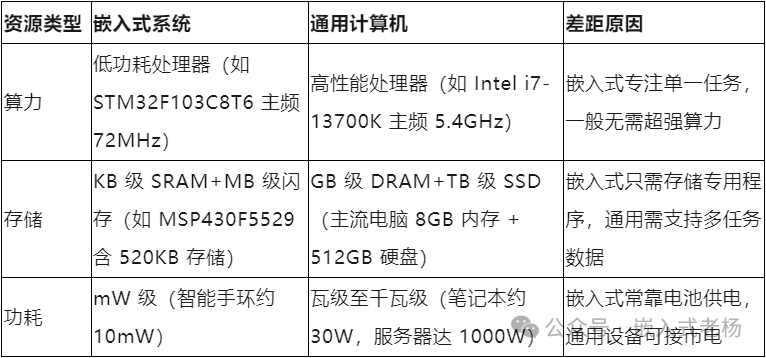
1. Resource Characteristics
The core characteristic of embedded systems is “resource constraints,” while general-purpose computers have “abundant resources.” This gap is reflected in three aspects: computing power, storage, and power consumption:
2. Application Scenarios
Embedded systems are “task-specific experts,” while general-purpose computers are “versatile players.”
Embedded systems:
Only responsible for specific tasks. For example, the engine control unit (ECU) in a car repeatedly performs one task daily—receiving sensor data and adjusting engine parameters; a smart bracelet focuses on heart rate monitoring and step counting, and cannot be used for office work or gaming.
General-purpose computers:
Can adapt to various scenarios. A laptop can simultaneously handle document processing, video playback, run programming software, and even connect peripherals to become a design workstation. Data center servers can support multiple tasks such as website operation, data analysis, and video rendering simultaneously.
3. Development Model: Hardware Binding vs. Flexible Debugging
Developing embedded systems is like “custom tailoring,” requiring precise hardware matching; developing general-purpose computers is like “buying ready-made clothes,” offering greater flexibility.
Embedded development:
Requires specialized toolchains (such as GCC cross-compilers) and must connect to hardware like development boards and debuggers for debugging. Developers need to have a deep understanding of hardware details, such as memory addresses and pin functions, and the code must be repeatedly optimized to save resources.
General-purpose computer development:
Can be directly written and debugged in a local computer IDE (such as VS Code) without additional hardware. Developers focus more on software functionality implementation without excessive consideration of hardware limitations—after all, computer memory and computing power are abundant.
4. Real-Time Performance: “Must Be On Time” vs. “Flexible Scheduling”
Embedded systems pursue “hard real-time,” while general-purpose computers emphasize “multi-task flexible scheduling.”
Real-time performance is crucial for embedded systems:
For example, the control unit of a medical ventilator must respond to breathing signals within 1 microsecond; even a slight delay could endanger lives; the control chip of an industrial robot needs to achieve motion control precise to 0.02 millimeters, or it could lead to production errors.
General-purpose computers are more flexible:
When we use computers, we can listen to music, chat, and work simultaneously, and the system will “take turns caring for” these tasks, with occasional lags of a second or two not affecting usability. The task switching delay in Windows systems is about 10-100 microseconds, which is slower than embedded systems but can support more tasks.
5. Operating Systems: Lightweight Specialized vs. Fully Functional
The operating system is the “nerve center” of both, with completely different choices:
Embedded systems commonly use RTOS (Real-Time Operating Systems):
Such as FreeRTOS and VxWorks, these systems are small (occupying only tens of KB of memory), respond quickly, and are like a “lean and efficient” small team, highly efficient.
General-purpose computers use time-sharing systems:
Such as Windows and Linux, these systems are powerful (supporting graphical interfaces, network protocols, multi-user, etc.), like a “large comprehensive hospital,” capable of handling complex demands, but also resource-intensive (the system itself requires several GB of storage).
6. Programming Languages: Performance First vs. Efficiency First
The choice of development languages also reflects the differences between the two:
Embedded systems prefer C/C++ (over 60%):
These languages can directly manipulate hardware, with high code execution efficiency and low resource consumption, suitable for the “careful budgeting” of embedded systems.
General-purpose computers commonly use Java/JavaScript (over 70%):
These languages allow for rapid development and strong cross-platform capabilities, enabling programs to run on different computers, focusing more on development efficiency rather than extreme performance.
—
Typical Product Comparisons
Through specific products, we can more intuitively understand the differences between the two:
1. Typical Products of Embedded Systems
Consumer Electronics:
Apple Watch Ultra 3 (locally performs ECG detection, with a power consumption of only 20mW), Xiaomi Smart Home Hub (connects lights, air conditioning, etc., with standby power consumption < 5W).
Automotive Electronics:
Tesla Autopilot HW4.0 (processes camera and radar data for autonomous driving, with a computing power of 12TOPS), Bosch ESP body stability system (responds to brake signals within 10ms).
Industrial Medical:
Siemens PLC controller (the “commander” of factory production lines, running without failure all year round), Medtronic heart pacemaker (implanted in the body, with a battery life of over 10 years).
2. Typical Products of General-Purpose Computers
Personal Devices:
Apple MacBook Air (fanless design, 18-hour battery life, supports office work and entertainment), Dell high-performance workstation (dual processors, supports 8K video editing).
Data Centers:
Huawei rack servers (simultaneously running hundreds of applications, supporting 256 container instances), American Frontier supercomputer (computing power of 1.1EFLOPS, used for climate simulation).
Cloud Computing:
Alibaba Cloud servers (elastic adjustment of computing power, supporting peak transactions during Double 11), Wangsu Technology edge nodes (over 2800 global nodes, accelerating video loading).
—
Future Prospects
Despite the significant differences between embedded systems and general-purpose computers, both are rapidly evolving, and there will be a trend of integrated innovation in the future.
1. Embedded Systems: Upgrading to “Smart + Low Power”
AI Embedded:
Future embedded devices will be “smarter.” For example, industrial quality inspection cameras will integrate AI algorithms directly on chips (such as Horizon Sunrise 3 chip, with a computing power of 16TOPS), capable of identifying product defects without connecting to the cloud, with a response speed increased by 10 times.
Rise of RISC-V Open Source Architecture:
Domestic chips will have opportunities. RISC-V is an open-source chip architecture, like a “public blueprint,” which companies can use for free and optimize independently. The Pingtouge Xuantie C930 processor has achieved 15/GHz performance and will be widely used in automotive and IoT devices in the future.
Low Power Revolution:
Device battery life is becoming stronger. STMicroelectronics STM32L5 chip has a standby power consumption of <1μA, and in the future, solar-powered watches and self-powered sensors will become popular, even achieving “lifetime without charging.”
2. General-Purpose Computers: Breaking Through to “Green + Intelligent”
Widespread Green Computing:
Data centers will be more energy-efficient. Baidu’s liquid-cooled cabinets will reduce energy consumption by 40% (compared to traditional air-cooled cabinets), and in the future, data centers will extensively use solar and wind energy, with PUE values (Power Usage Effectiveness) dropping below 1.1 (the closer to 1, the more energy-efficient).
Supercomputing and Quantum Computing:
The ceiling of computing power is constantly being broken. IBM plans to launch a million-qubit quantum processor by 2030 to solve problems that traditional computers cannot handle, such as chemical simulations and password cracking; supercomputers will be used for precise earthquake prediction and new drug development.
Cloud-Edge Collaboration:
Cloud and edge devices will “collaborate.” For example, edge nodes in factories will process real-time data (such as equipment temperature), while the cloud will perform big data analysis to optimize production, improving factory efficiency by 30%.
3. Integration Trend: Blurred Boundaries but Complementary Values
In the future, the boundaries between the two will gradually blur, but their core positioning will remain unchanged: embedded systems excel at “precise control in resource-limited scenarios,” while general-purpose computers excel at “handling complex tasks with powerful computing power.” They are like gears and power engines of precision instruments, jointly driving the development of digitalization—for example, in autonomous vehicles, embedded chips control steering and braking, while general-purpose computing units handle map rendering and AI decision-making, both are indispensable.
Embedded systems and general-purpose computers, one is a “specialist,” and the other is a “generalist.” There is no absolute superiority or inferiority; they simply play to their strengths in different scenarios. For enthusiasts and entry-level engineers, understanding their differences can help choose learning directions (embedded focuses on hardware + real-time control, general-purpose computing focuses on software + system design) and gain insight into future technology trends. Whether it is embedded innovations that make watches smarter or breakthroughs in general-purpose computing that make supercomputers greener, opportunities abound.