Recently, at the vehicle-road-city integration forum organized by the China Electric Vehicle Hundred Persons Association, Chen Shanzhi, Deputy General Manager and Chief Engineer of China Information and Communication Technology Group Co., Ltd.,Director of the National Engineering Research Center for Mobile Communication and Vehicle Networking Dr. Chen Shanzhi delivered a keynote speech on the topic “C-V2X Vehicle Networking and Cloud Collaboration Progress and Recommendations” around the topic of “Consolidating and Expanding the Development Advantages of New Energy Vehicles”.
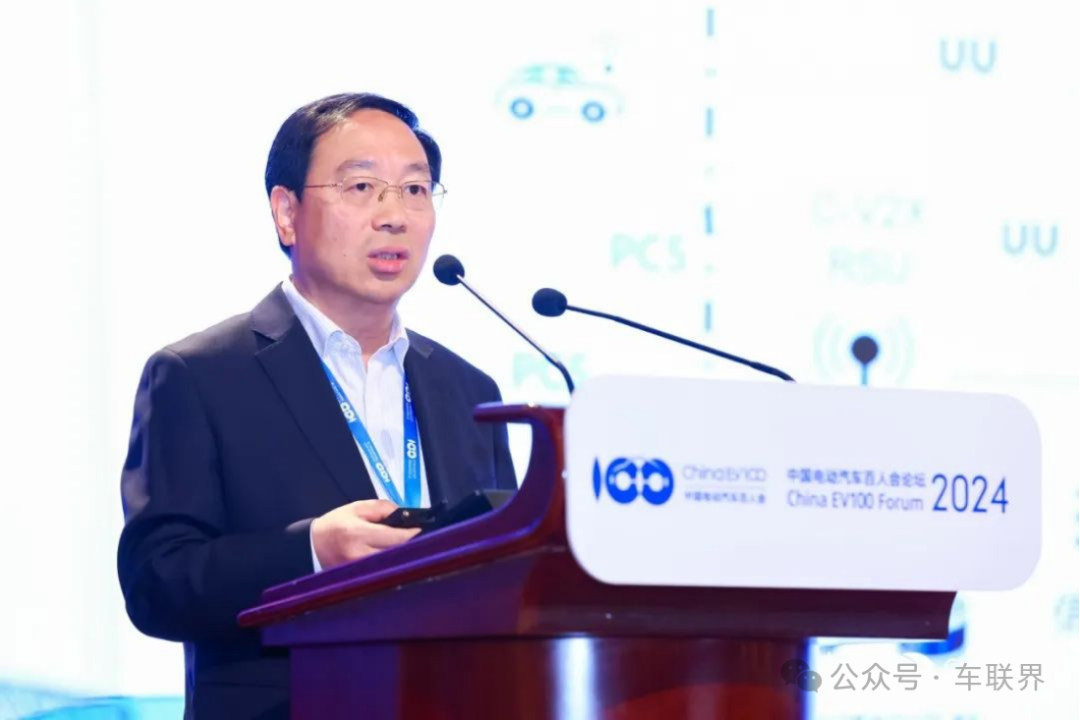
Dr. Chen Shanzhi stated that as new energy vehicles advance towards intelligent connected new energy vehicles, vehicle networking has become an essential path to support intelligent connected vehicles. He mentioned that the development of vehicle networking is currently entering the fast lane, in the 2.0 phase, with the main goal of empowering and improving intelligent driving levels, enhancing driving safety, ensuring people’s health, and improving traffic efficiency.
Regarding the two main confusions in the industry, Dr. Chen clarified them at the conference, mainly including:1. The relationship between intelligent connected vehicles, vehicle networking, and vehicle-road-cloud collaboration; 2. The relationship between various communication technologies such as 4G/5G, C-V2X vehicle networking, and satellite communication. He also expressed important views on promoting the innovative development of intelligent connected vehicles, pointing out:1. Single vehicle intelligence is the foundation and fundamental, C-V2X vehicle networking is an enhancement technology, and the two are complementary; 2. Currently, the collaborative perception between vehicles and roads is based on each’s autonomous decision-making; 3. The new infrastructure of vehicle networking will promote the integration of vehicle, road, and city development.
The following is a transcript of the speech (slightly abridged):
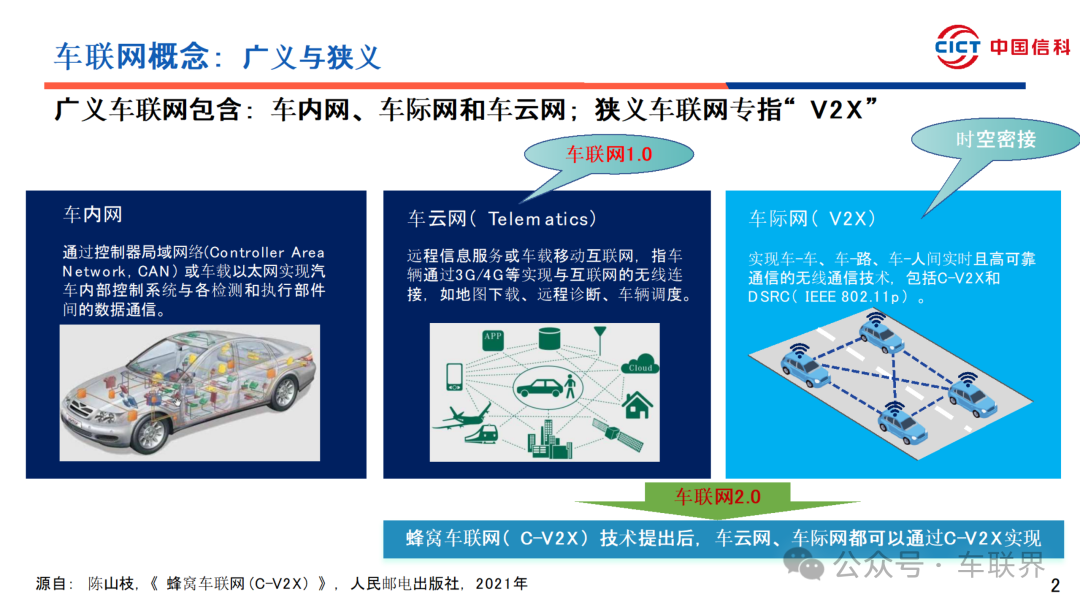
First, let me report to everyone, what is vehicle networking? First, vehicle networking includes: firstly, the in-vehicle network, which is the internal communication network of the vehicle, such as CAN or in-vehicle Ethernet, etc. Secondly, the vehicle-cloud network that has been commercially used in recent years, namely Telematics. Thirdly, the ongoing vehicle-to-everything (V2X).
Vehicle networking 1.0, namely Telematics, mainly refers to the simple basic in-vehicle information services from the past. Currently, it is at the vehicle networking 2.0 stage, which supports L2+ intelligent driving assistance, with the main goal of improving driving safety, reducing traffic efficiency, and ensuring public health. Specifically, it includes: safety warnings, collaborative perception, smart traffic, etc. The future supports L5 all-weather, all-scenario unmanned driving, which we believe is the vehicle networking 3.0 stage.
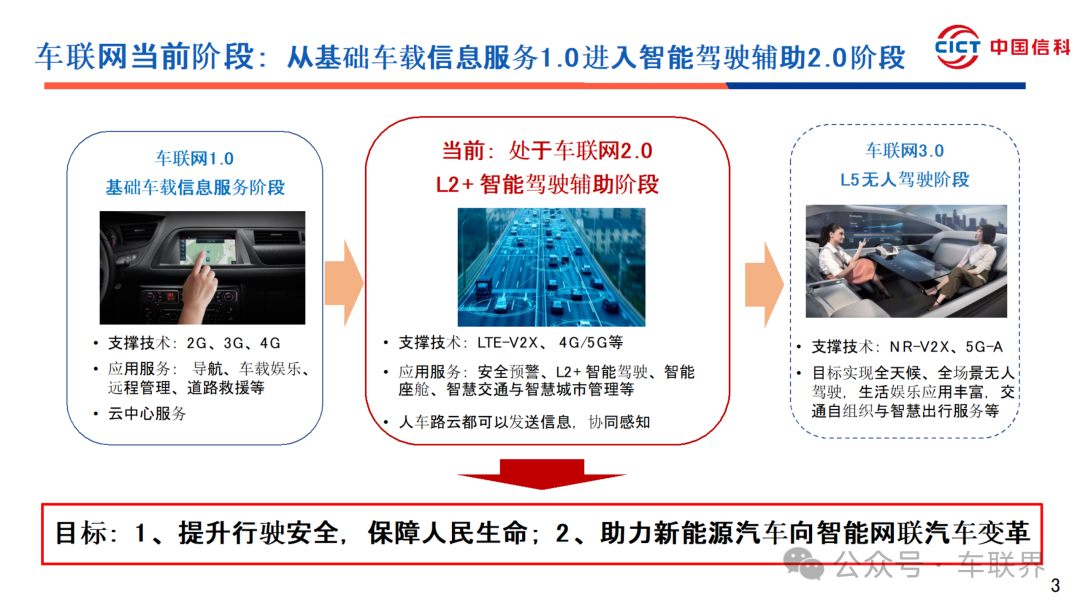
Currently, our country is vigorously promoting the transition of new energy vehicles to intelligent connected new energy vehicles, which is a significant transformation for the industry, combining social benefits and economic value. We hope to accelerate the development of vehicle networking to support the development of the intelligent connected new energy vehicle industry, achieving our leadership in the global arena.
On May 17, 2013, I was the first globally to propose the concept and key technologies of LTE-V2X, establishing the system architecture and technical route of C-V2X.
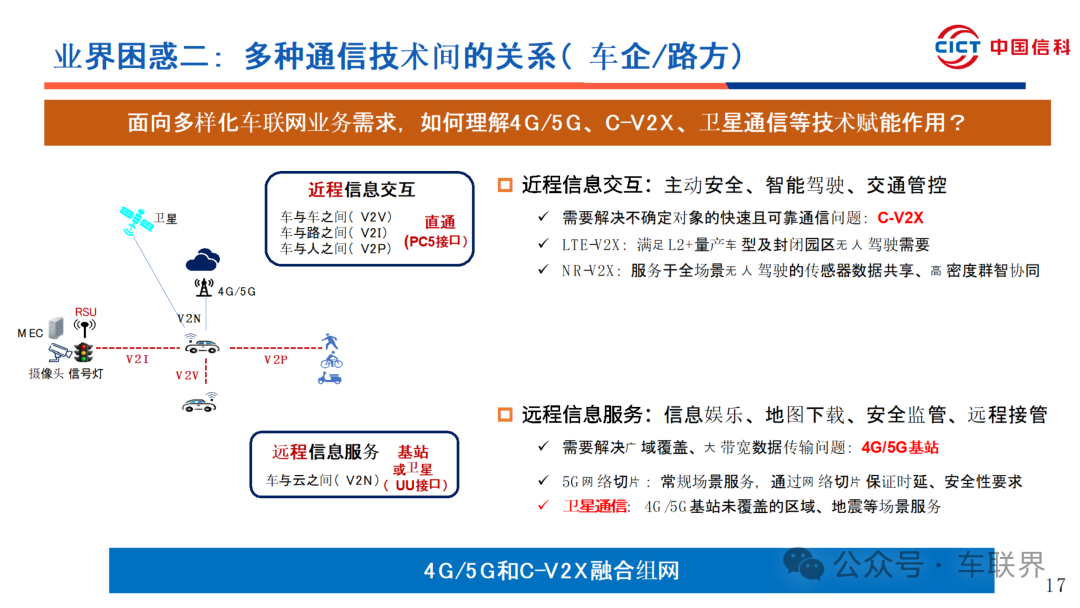
We often say “smart cars, smart roads, collaborative cloud,” which is based on the vehicle networking and vehicle-road-cloud collaboration. Smart cars need to become intelligent. Smart roads require roadside deployment of sensing devices and digitalization of signal control to become smart roads. Collaborative cloud involves traffic management, mapping, and navigation services. C-V2X vehicle networking includes near-field information exchange and remote information services. Near-field information exchange allows for communication between vehicles, between vehicles and roads, and between vehicles and vulnerable road users, with strict requirements for low latency and high reliability, closely related to intelligent driving. Remote information services refer to V2N, achieving global traffic optimization and entertainment information services, with less stringent real-time requirements but good communication coverage, mainly related to intelligent cockpits.
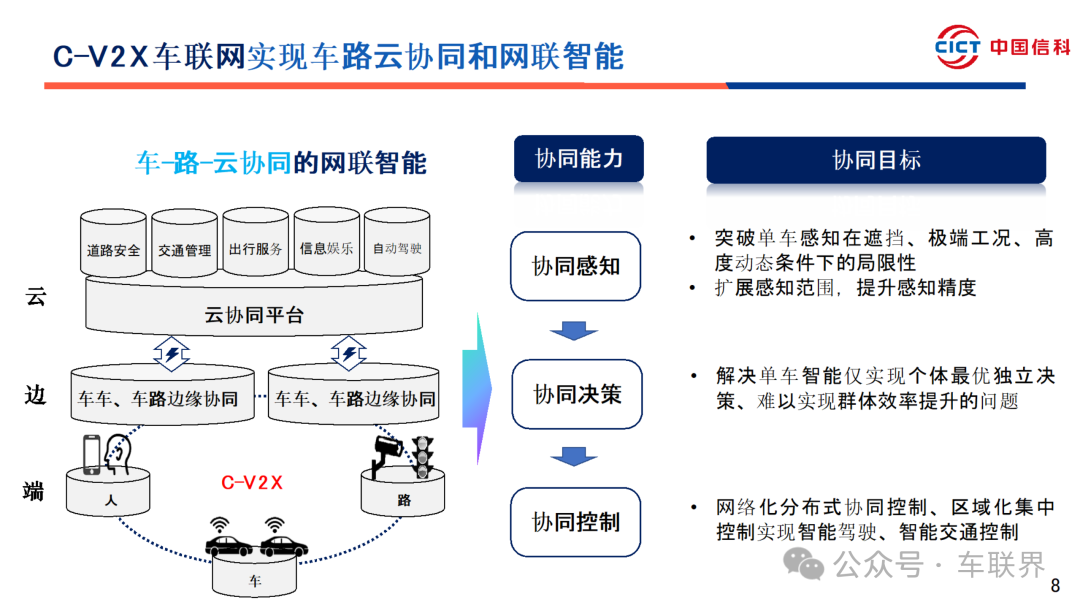
C-V2X vehicle networking has received support from national policies, especially as China’s “14th Five-Year Plan” clearly proposes: actively and steadily develop vehicle networking. In response to the development of LTE-V2X/C-V2X, the country has also introduced a series of policies.
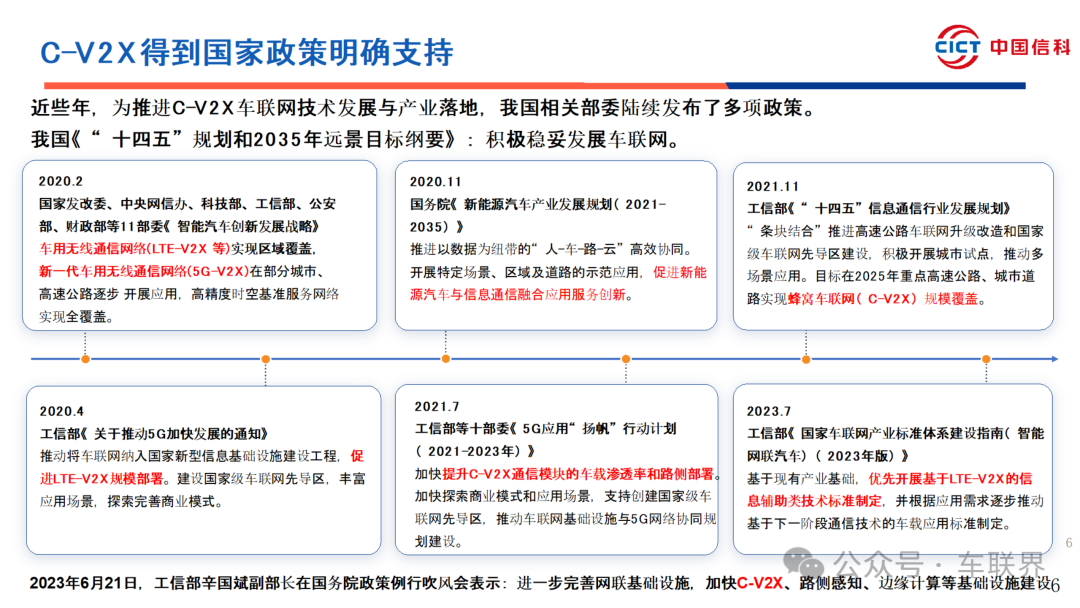
China’s C-V2X vehicle networking industrial ecosystem has matured, gradually forming a multi-manufacturer supply environment that includes communication chips, communication modules, on-board units (OBU), roadside units (RSU), testing instruments, vehicle manufacturing, testing and certification, high-precision positioning and mapping, safety, etc. In terms of technology verification and interoperability, we are also leading globally.
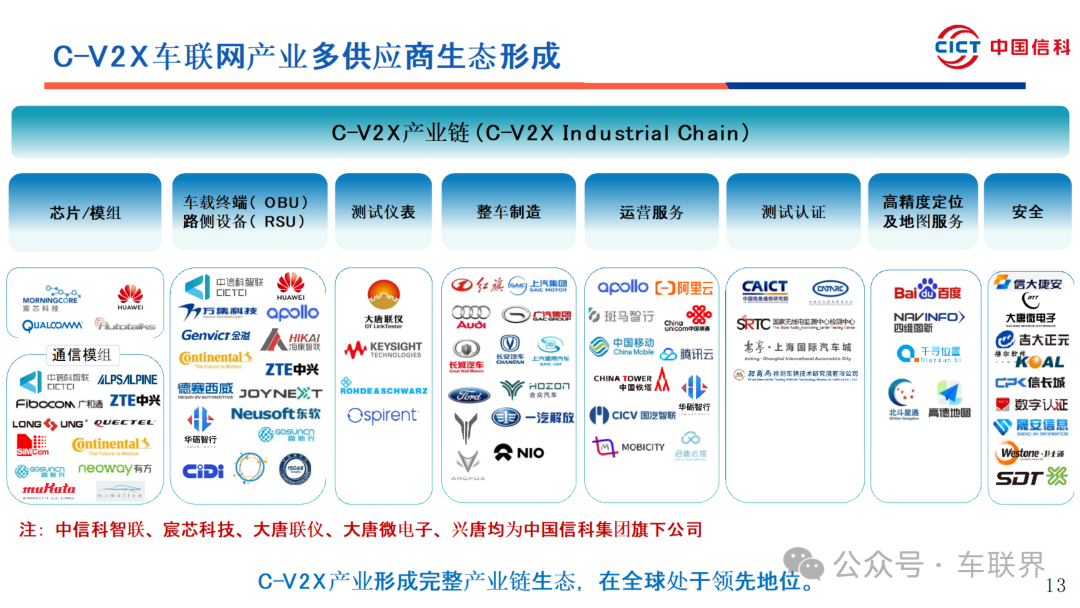
C-V2X vehicle networking is currently supporting the intelligent connected vehicles and intelligent traffic solutions of vehicle-road-cloud collaboration, achieving collaborative perception, collaborative decision-making, and collaborative control, currently still in the collaborative perception stage, and will move towards the collaborative control stage in the future.
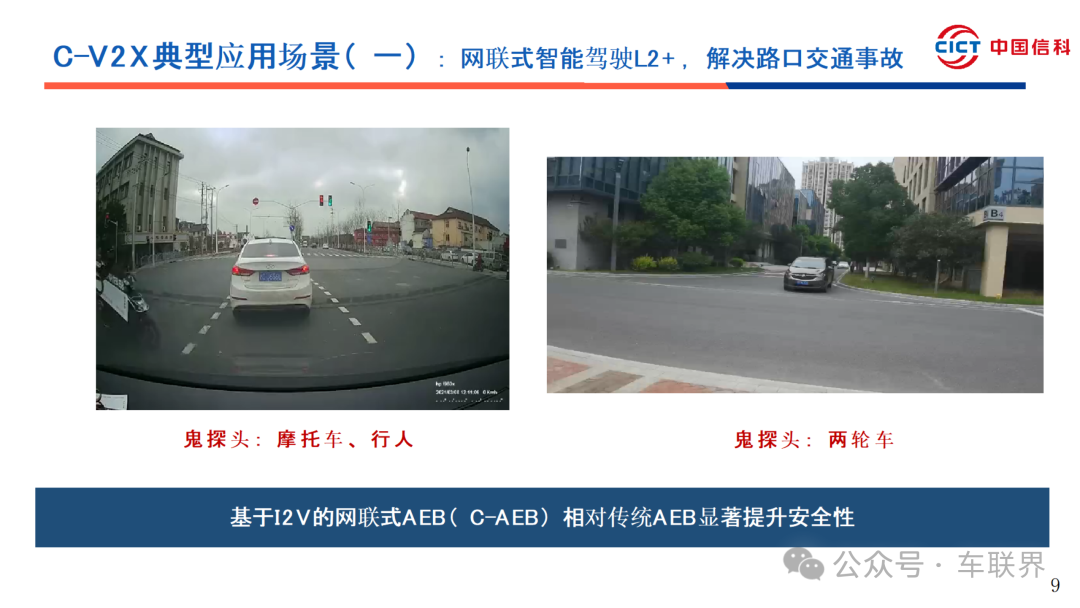
C-V2X typical application scenarios, such as the ghost intersection problem, can be solved through intelligent networking, where roadside cameras send relevant information to vehicles to avoid traffic accidents through I2V.
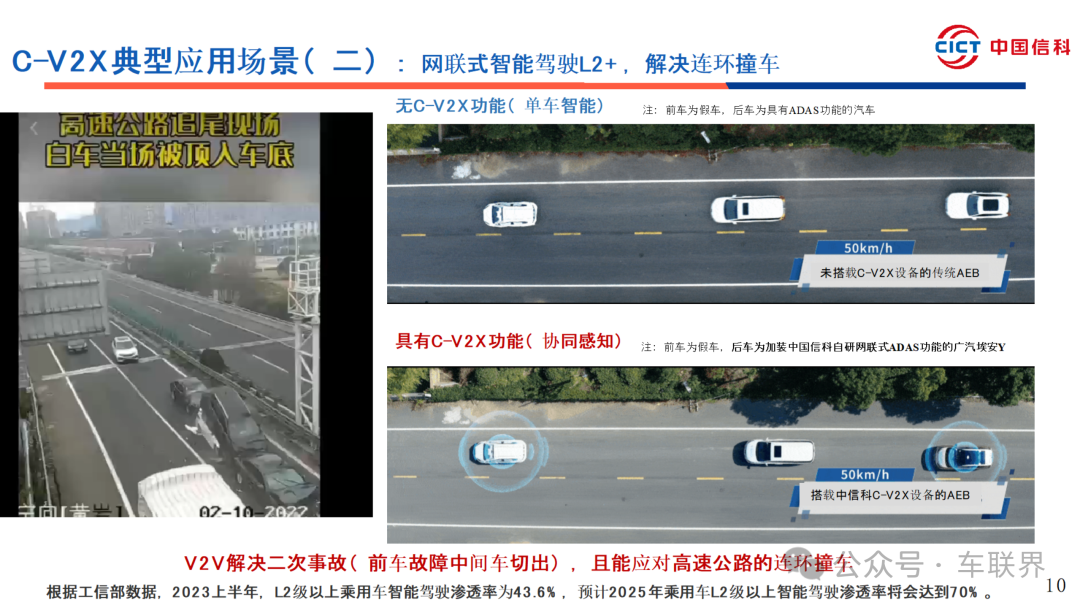
Another scenario is the high-speed chain collision scenario, the video is from a serious chain collision incident that occurred in Taizhou in 2022. This cannot be solved by single vehicle intelligence, as radar and video perception distance is about 200 meters. In high-speed scenarios, once the front vehicle encounters a problem at a speed of over 100 kilometers per hour, chain collisions are unavoidable. Through C-V2X vehicle networking, we conducted real vehicle tests for comparison, with both the front and rear vehicles equipped with connected ADAS, namely a domain controller that integrates C-V2X and ADAS. We modified it based on GAC Aion, and when the middle vehicle changed lanes, the front vehicle sent information to the rear vehicle, allowing the rear vehicle to brake in time. I also want to emphasize that our current roadside coverage and penetration rates are indeed a problem. I want to tell everyone that it is not necessary to achieve a 100% penetration rate because, in the above case, only two out of three vehicles need to be equipped with C-V2X functions to achieve this. Research shows that approximately 1% of connected vehicles can reduce traffic congestion by 14%, thus improving traffic efficiency.
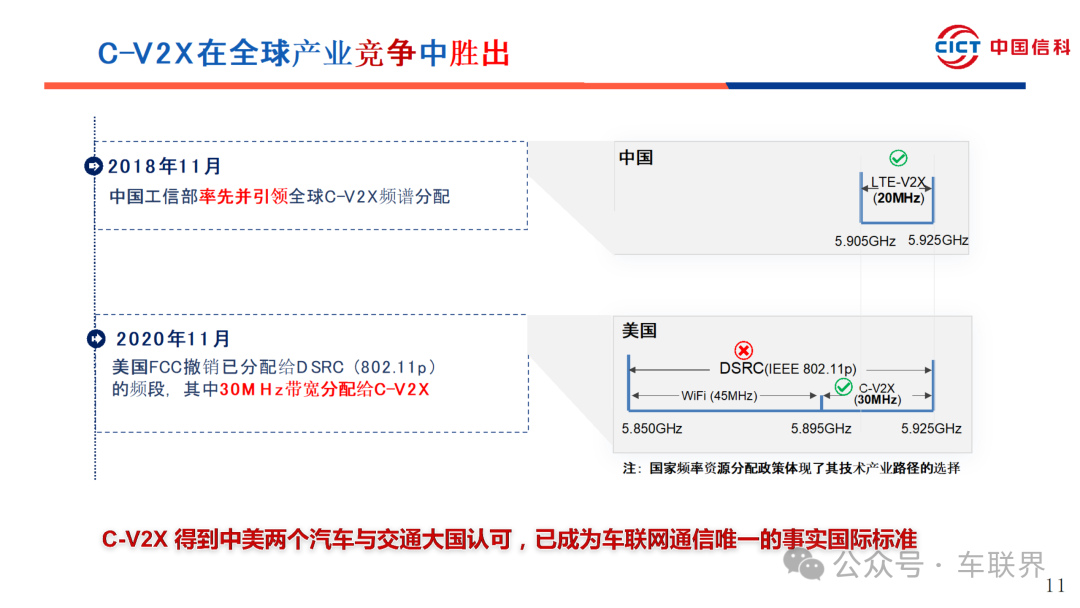
C-V2X has won in global industrial competition. In 2018, China’s Ministry of Industry and Information Technology was the first to allocate frequencies for C-V2X, while the United States canceled the frequency allocated to DSRC in 2020, with 30M given to C-V2X. Currently, C-V2X has been recognized by both China and the United States, becoming the only standard for global vehicle networking.
Last year, the United States clearly stated that it would deploy C-V2X nationwide, spending 10 years to achieve 100% coverage of C-V2X on national highways by 2034, with 75% coverage at urban intersections, and has formulated a plan for C-V2X deployment in vehicles. In fact, the United States did not say that it is developing C-V2X for unmanned driving; they are more concerned about solving traffic accident problems and achieving connected life-saving. There is a statistic in the United States that about 50% of traffic accidents occur at intersections, so it is not that future L5 autonomous driving requires C-V2X; the current L2+ intelligent driving development urgently needs C-V2X.
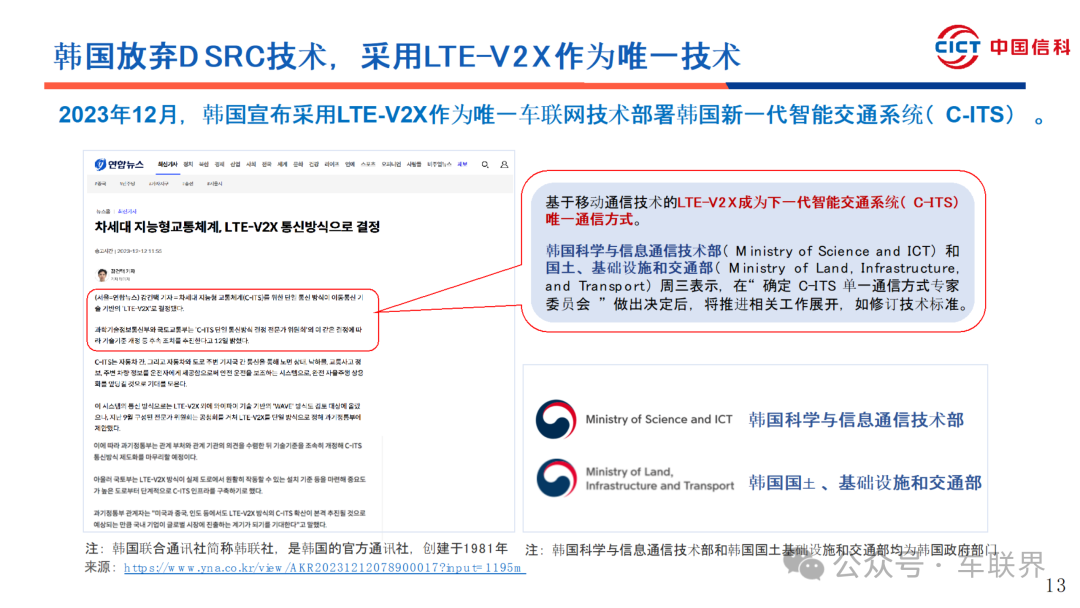
Additionally, the South Korean government announced last December to abandon DSRC technology and adopt LTE-V2X as the only vehicle networking communication technology.
In terms of C-V2X deployment in vehicles, China’s C-NCAP (China New Car Assessment Program) clearly includes C-V2X in active safety tests, which is a global first, and will be implemented in July this year, impacting the global NCAP system, known as US-NCAP in the United States, K-NCAP in South Korea, J-NCAP in Japan, and E-NCAP in Europe. China is the first to release C-V2X active safety in C-NCAP, just as the Chinese government was the first to allocate spectrum to C-V2X in 2018, which will have an important impact on the global automotive industry.
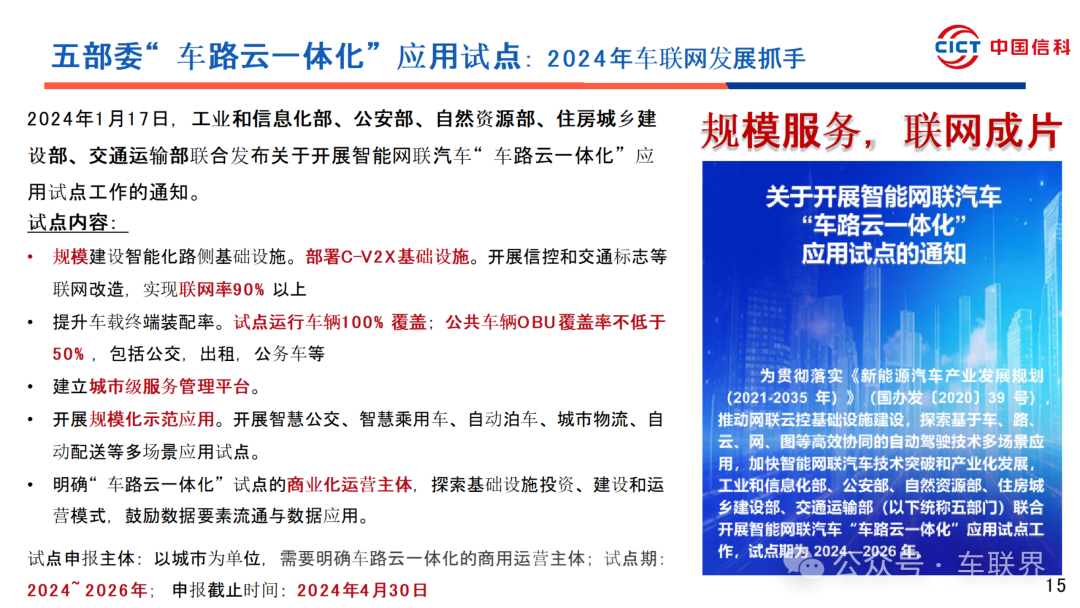
Recently, five ministries have been promoting the pilot work of intelligent networking vehicles “vehicle-road-cloud integration” applications, which actually addresses the problems existing in past developments, indicating that the industry development has reached a critical node. The experts mentioned earlier raised the issue of the “two rates,” which I was the first to propose, referring to the roadside coverage rate of C-V2X and the vehicle penetration rate. If a certain scale is not reached, the public will not have a sense of gain. Why does this pilot require the C-V2X signal control networking rate at intersections to reach over 90%? Most car companies are asking why the current pilot areas and demonstration areas have the traffic signal information reported by C-V2X RSU to the next traffic light, but not to the following one, which is very troublesome. In L2+, once the traffic light information is involved in controlling the vehicle, if the signal is not timely, it will cause point braking, leading to a very poor user experience. Therefore, the C-V2X traffic signal control signal must achieve continuous coverage; interacting with intelligent connected vehicles will have value. Why mention the penetration rate issue of C-V2X? When upgrading from 2G to 3G and from 3G to 4G, when operators developed users, they used to give new phones for recharging. Why not do that later? Because once the user penetration rate reaches 20%, the market can naturally start. Therefore, our vehicle networking and vehicle-road-cloud integration face initial market failure, requiring government guidance.
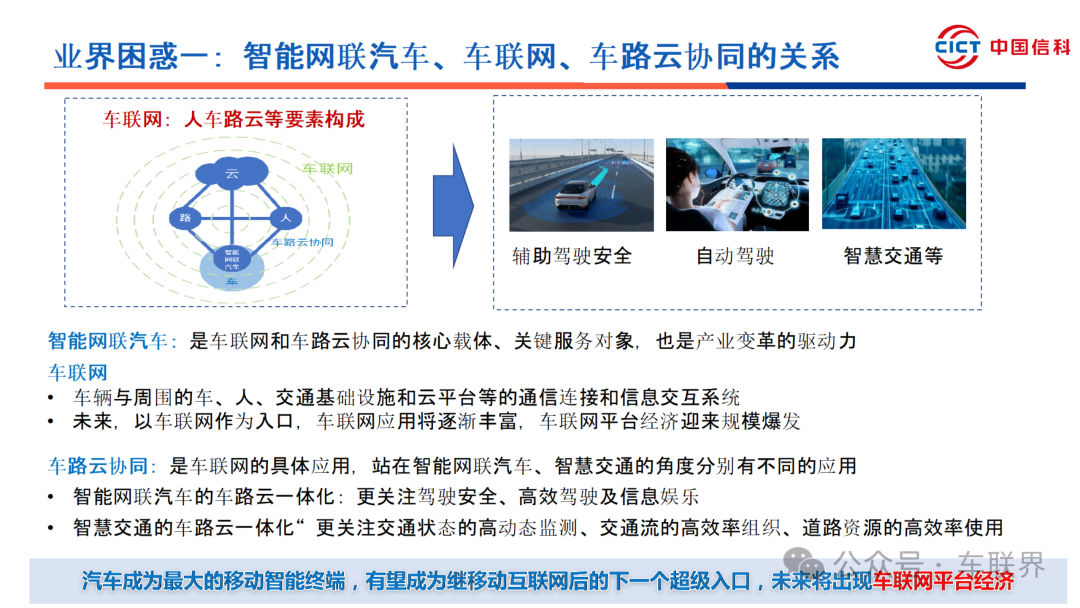
Let me also clarify that during cross-border communication, there will be confusion in the industry, and I would like to clarify:
Firstly, the relationship between intelligent connected vehicles and vehicle networking. Intelligent connected vehicles are the core carrier of vehicle networking and vehicle-road-cloud collaboration, the most important service object, and the core driving force of industrial transformation. Vehicle networking is actually the communication connection between vehicles and roads, vehicles and vehicles, vehicles and people, and vehicles and clouds. Vehicle-road-cloud is the specific application of vehicle networking, with slightly different emphases when combined with intelligent connected vehicles and smart traffic.
Secondly, the relationship between various communication technologies. The communication technologies commonly mentioned include 4G/5G, C-V2X vehicle networking, satellite communication, etc. From the perspective of serving intelligent connected vehicles and smart traffic, there are actually only two categories: near-field information exchange and remote information services. Near-field information exchange refers to C-V2X, the communication between vehicles, between vehicles and roads, and between vehicles and people, with strict requirements for low latency and high reliability, mainly related to intelligent driving, ensuring driving safety and traffic efficiency. Remote information services, such as map downloads and infotainment in intelligent cockpits, are realized through 4G/5G base stations and satellite communication, with less stringent real-time requirements but good communication coverage.
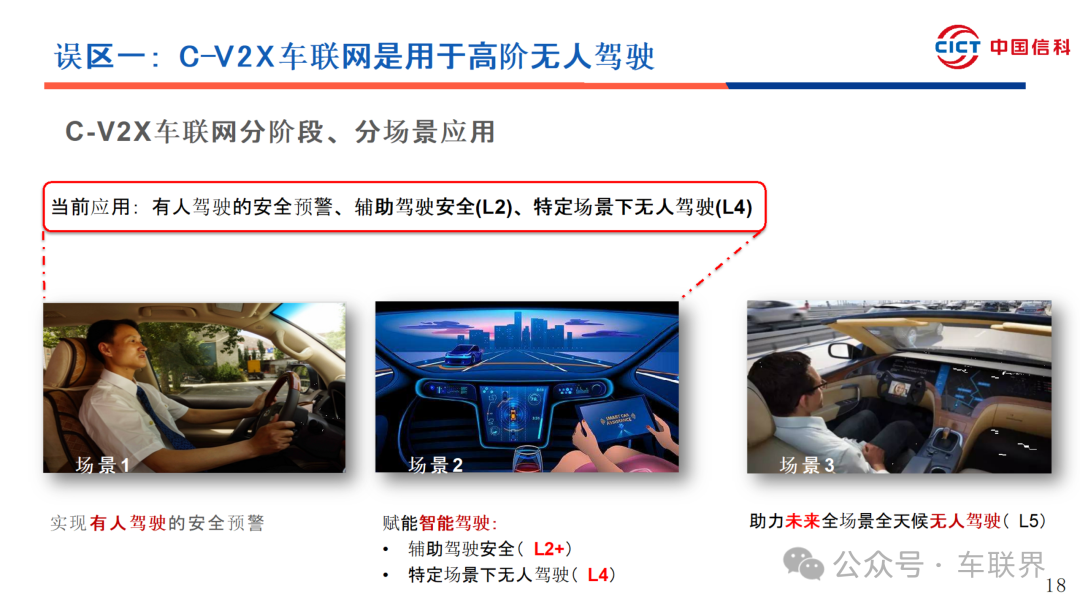
People often say that C-V2X vehicle networking is only for autonomous driving, but that is not entirely true. Today, we hope that C-V2X can serve scenarios where people drive, achieving safety warnings to assist L2+ intelligent driving; it also serves specific scenarios of L4 unmanned driving, including mines, ports, airports, and specific urban areas for RoboTaxi. Both types of scenarios currently have large-scale commercial demands. In the future, vehicle networking will empower L5 all-weather, all-scenario unmanned driving.
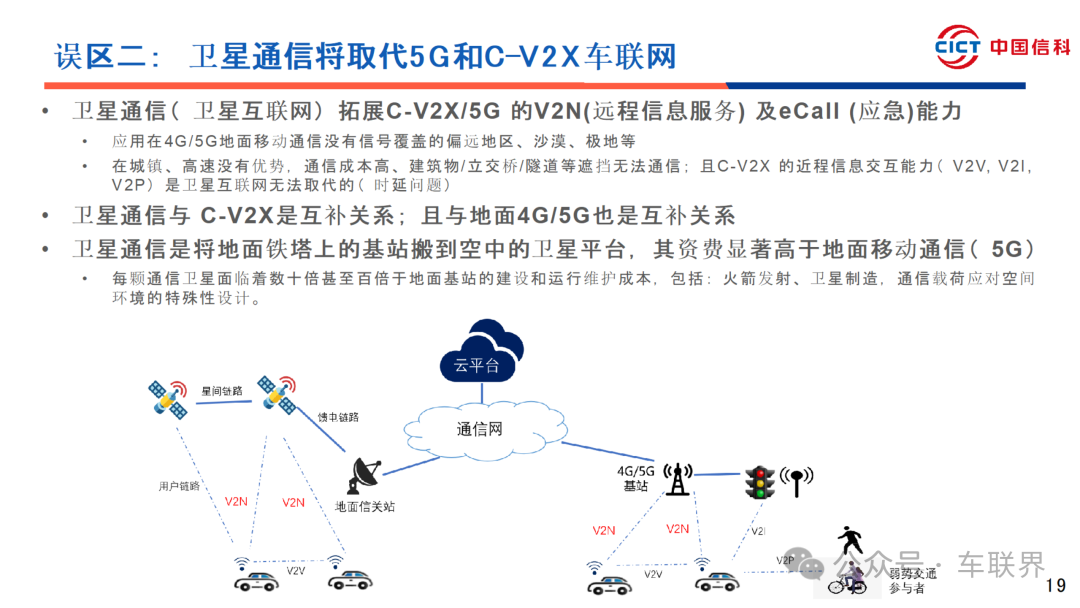
Recently, satellite communication has been a hot topic, with some believing that satellite communication will replace 5G and C-V2X, which is incorrect. C-V2X vehicle networking, 5G, and satellite communication are complementary. The most important role of satellite communication is to expand the V2N function, solving communication problems in areas where 5G base stations cannot cover, thus expanding remote information services. However, satellite communication does not have advantages in urban areas and areas obstructed by buildings or overpasses.
Let me express a few viewpoints. Viewpoint one: single vehicle intelligence is the foundation, networking is the enhancement, and empowerment. I particularly emphasize that the stronger single vehicle intelligence is, the better. I express this to car companies: first, what single vehicle intelligence can do well, networking does not do. Second, can C-V2X networking reduce costs for single vehicle intelligence that is costly? Third, what single vehicle intelligence cannot solve, networking can assist in solving.
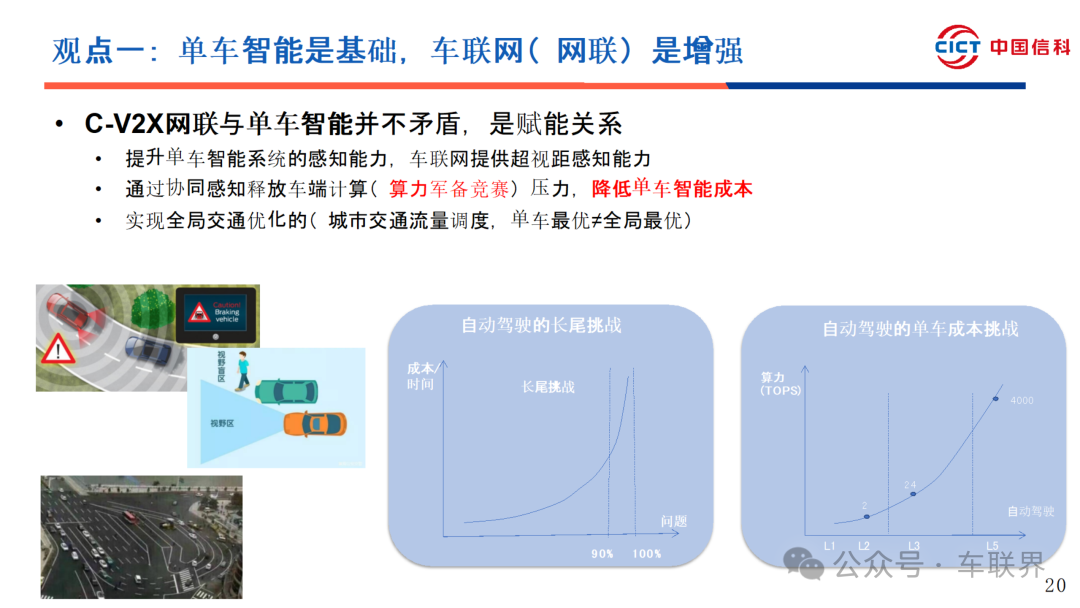
For example, single vehicle intelligence struggles to recognize traffic light signals in all-weather and all-scenario conditions, facing challenges in harsh backlighting, heavy snow, and rain. To address special scenarios (corner cases), car companies often need to enhance algorithms and computing power, increasing costs. However, if C-V2X RSU directly broadcasts traffic signals, vehicles can directly obtain traffic light information, making it simpler and more timely. Another example is global traffic optimization; single vehicle intelligence is essentially a game between individuals and does not consider global optimization. For example, when an emergency vehicle, such as a fire truck or ambulance, approaches, single vehicles cannot respond in time, delaying the passage of emergency vehicles. If vehicle-to-vehicle communication is present, a lane can quickly be cleared.
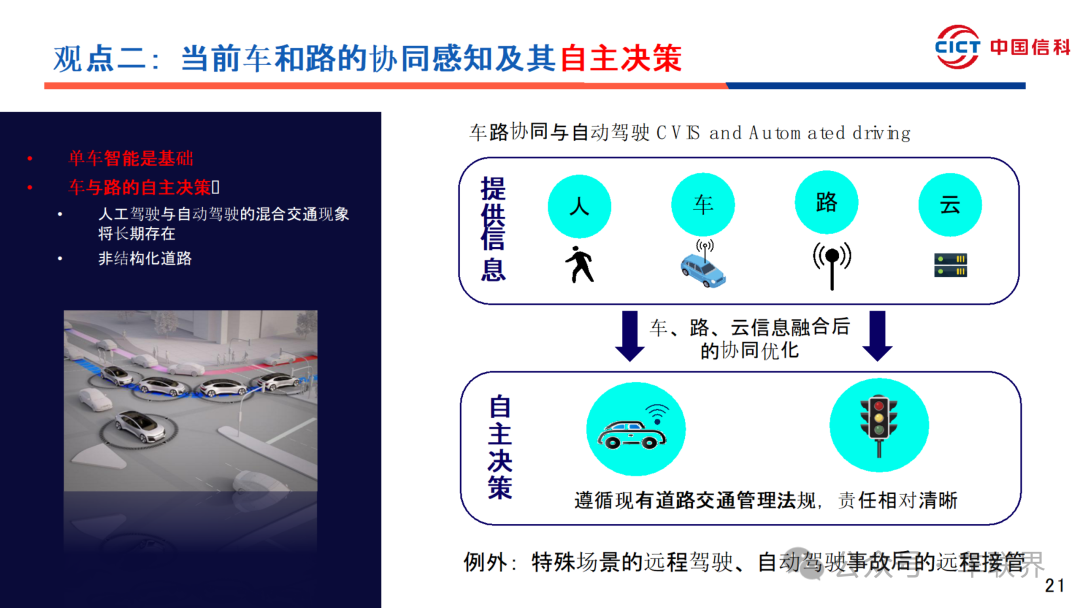
Viewpoint two: currently, the collaborative perception between vehicles and roads is based on each’s autonomous decision-making. Sometimes people say that roads control vehicles, and others say vehicles directly control traffic lights; neither is true. Because, the coexistence of manually driven and autonomous vehicles will exist for a long time. Currently, both vehicles and roads need to be intelligent, but both are autonomous decision-makers. Roads provide perception information to vehicles, and vehicles still make autonomous decisions based on single vehicle intelligence; traffic departments also receive driving information from vehicles to autonomously decide the dynamic scheduling of traffic signals and tidal lanes. This follows existing road traffic management regulations, with relatively clear responsibilities.
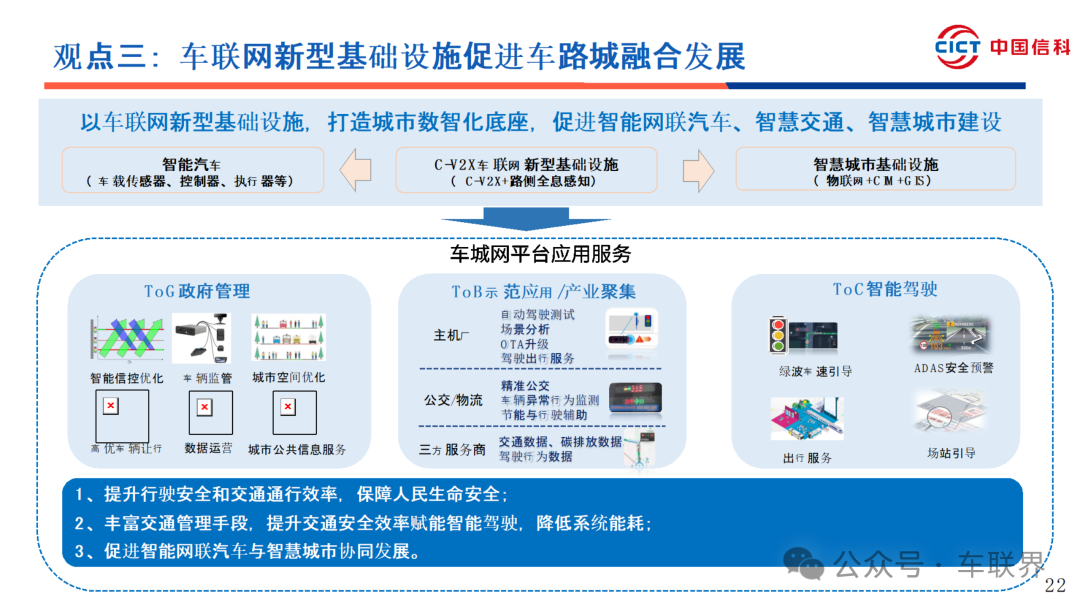
Viewpoint three: vehicle networking new infrastructure promotes the integration of vehicle and road development. In the collaborative promotion of intelligent connected vehicles and smart city development, vehicle networking, as a new type of infrastructure, reaches a certain coverage area, can serve smart cities. In the future, if edge computing achieves full coverage at intersections, it will become a network of urban computing infrastructure, providing intelligent driving services for ordinary users; providing networking empowerment services for vehicle manufacturers and public logistics; and empowering traffic management and urban governance services for the government.
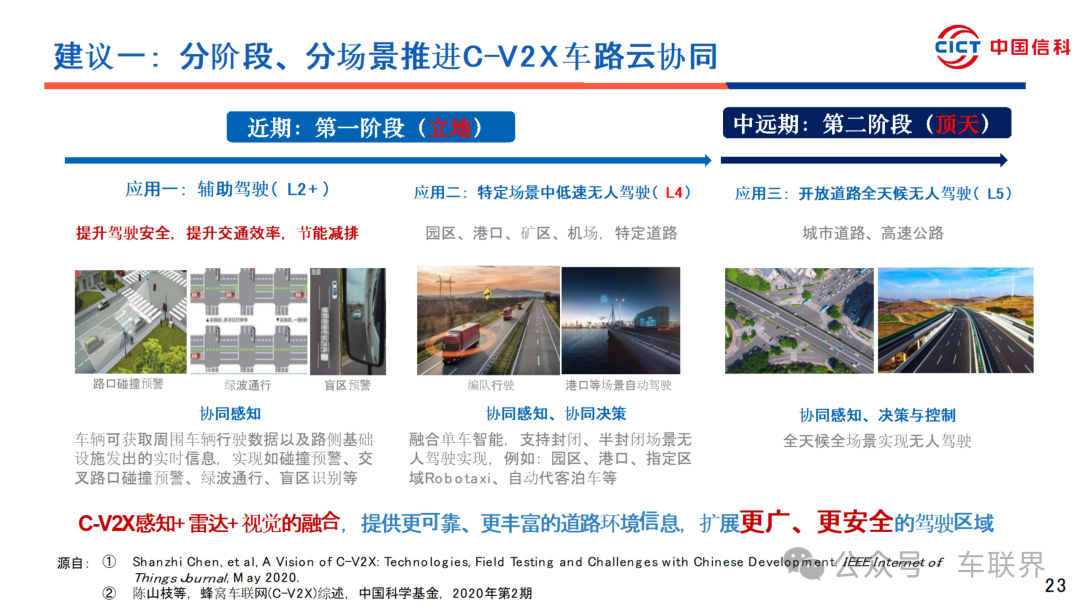
Below are two suggestions. Suggestion one: Promote C-V2X vehicle-road collaboration in phases and scenarios. Currently promoting intelligent driving assistance (L2+) for driving safety and traffic efficiency; and empowering specific scenarios for unmanned driving, including ports, airports, terminals, and specific roads for Robotaxi. In the future, empower all-weather, all-scenario unmanned driving on open roads.
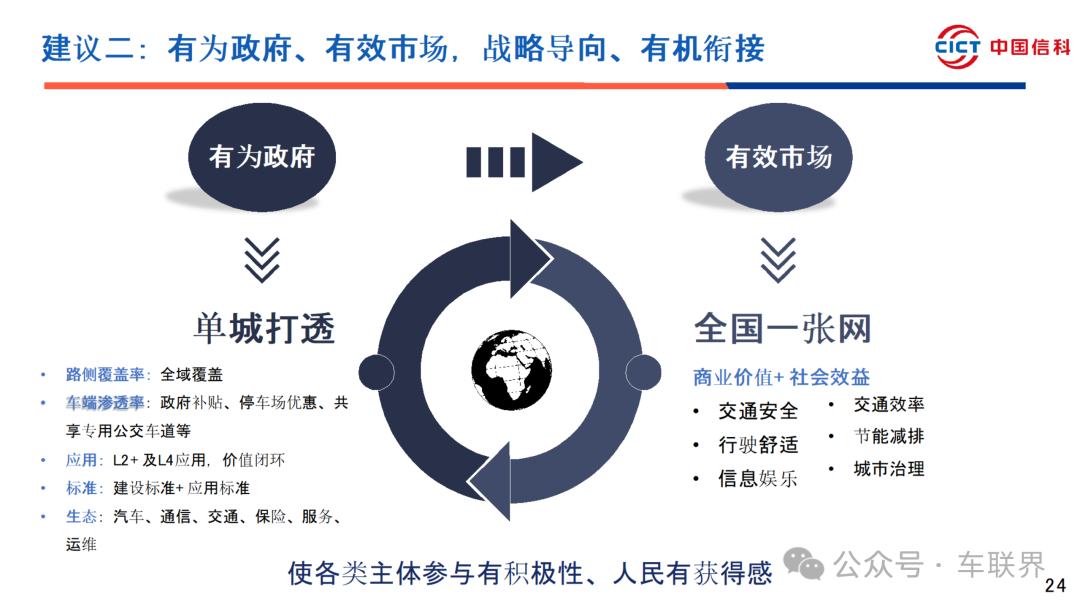
Suggestion two: Connect the proactive government with an effective market, to promote C-V2X vehicle networking and vehicle-road-cloud collaboration. In the early stages, when the market fails, the proactive government accelerates the integration of a single city, providing continuous C-V2X signal lights and complex intersection perception services for car companies. Once the coverage reaches a certain level, the effective market can naturally start; creating a nationwide network to eliminate the lack of uniform construction and application standards across regions, ensuring the development of vehicle networking progresses along a unified national network and application system.
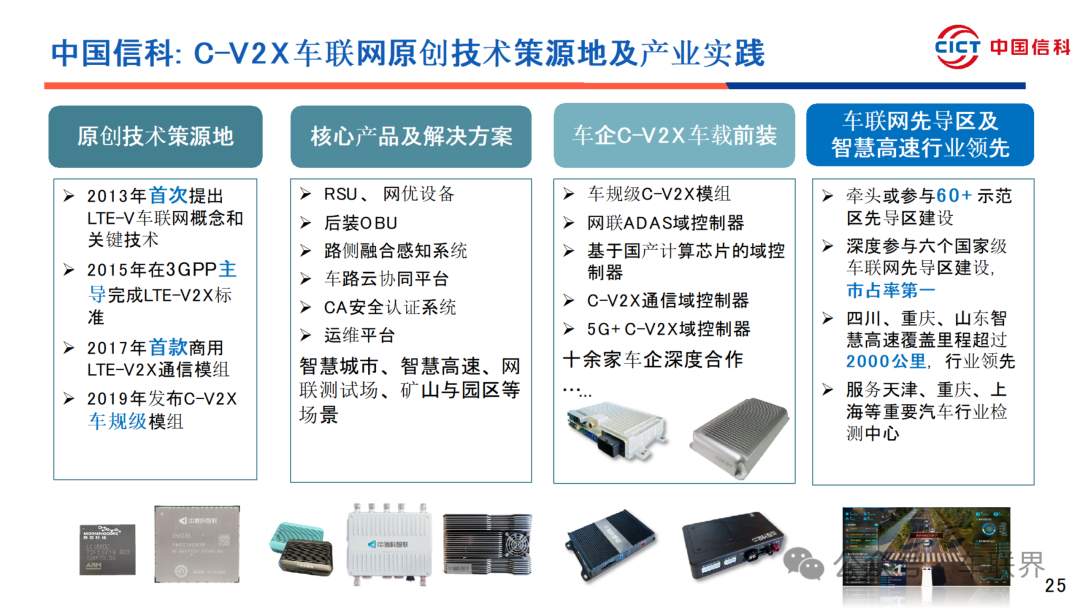
Let me briefly make two small advertisements: First, China Information and Communication Technology is the original technology source for C-V2X vehicle networking, possessing a series of core products and solutions for C-V2X, including C-V2X chips and front-mounted modules, OBU and RSU, etc. The vehicle networking pilot area and smart highways are leading in the industry, with RSU deployment ranking first in national pilot areas and demonstration areas.
I have published two bilingual books, the world’s first monograph on C-V2X, and have received support from experts such as Academician Wu from the communication field, Academician Zheng from the autonomous driving field, and Academician Li from the automotive field, who have all written prefaces.
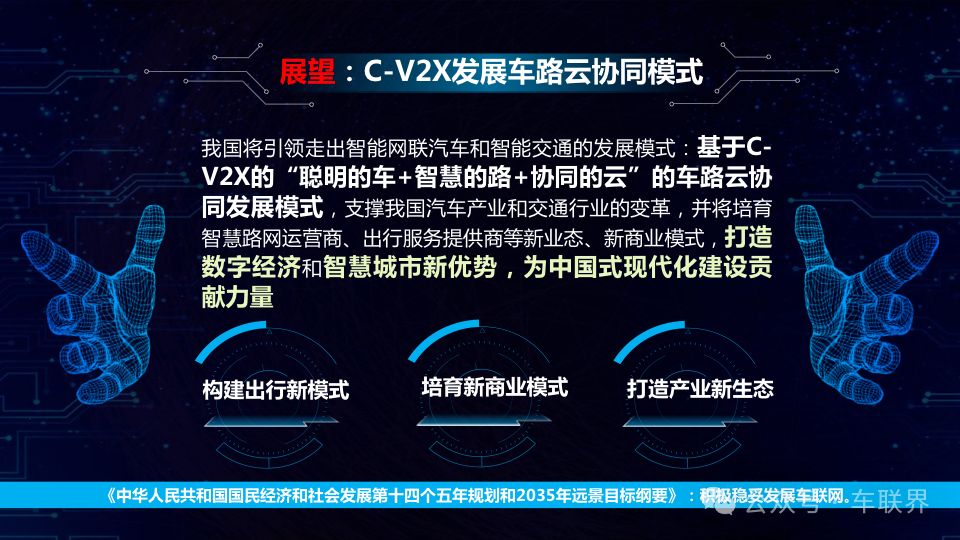
Finally, looking ahead, the development of C-V2X vehicle-road-cloud collaboration model will lead China to establish a development model for intelligent connected vehicles and intelligent traffic. Based on C-V2X’s “smart cars + smart roads + collaborative cloud” model, it will support the transformation of China’s automotive industry and traffic sector, nurturing new business formats and models such as intelligent road network operators and mobility service providers, creating new advantages for the digital economy and smart cities, and contributing to the modernization of China.
Source: Vehicle Networking