In the current rapid development of electronic devices and artificial intelligence, the six core chips: MCU, SOC, DSP, FPGA, NPU, and GPU have become the key carriers for technology implementation. Although they all belong to the category of processors, their architectural designs, functional positioning, and application scenarios differ significantly. Understanding these differences is crucial for selecting the appropriate technical solutions.
1. Core Definitions and Architectural Differences
1. MCU (Microcontroller)
The MCU, or microcontroller, is essentially a “miniature computer” that integrates the CPU, memory (RAM/ROM), and peripherals (such as serial ports, GPIO, etc.) onto a single chip. Its architecture primarily uses a Reduced Instruction Set Computing (RISC) design, focusing on low power consumption and high integration. Its core feature is being “small yet comprehensive,” capable of performing basic control functions without external expansion, with typical representatives like the STM32 series.
2. SOC (System on Chip)
The SOC, or system on chip, represents the “ceiling of integration,” incorporating the CPU, GPU, memory, peripherals, and dedicated modules (such as Bluetooth and 5G baseband) into a single chip. Its architecture is flexible, allowing for the combination of different functional modules based on requirements. It is not a single processor but a “micro system” capable of handling computing, communication, multimedia, and other multitasking simultaneously. Classic examples include Apple’s A series and Qualcomm’s Snapdragon series.
3. DSP (Digital Signal Processor)
The DSP is designed specifically for digital signal processing, utilizing a Harvard architecture (separating data and program buses) and equipped with dedicated multipliers and accumulators, excelling in high-speed calculations and data processing. Its core advantage is “real-time performance,” enabling rapid completion of complex mathematical operations such as filtering and Fourier transforms, with TI’s TMS320 series being a mainstream product.
4. FPGA (Field Programmable Gate Array)
Unlike the previous three, the FPGA is a “programmable hardware platform” composed of numerous configurable logic blocks (CLBs) and interconnect resources, without a fixed instruction set. Users can define circuit functions using hardware description languages (such as Verilog). Its characteristic is “hardware reconfigurability,” allowing for customized hardware logic based on needs, with Xilinx and Altera (under Intel) being major manufacturers.
5. NPU (Neural Processing Unit)
The NPU is a “dedicated accelerator” for the era of artificial intelligence, optimized for neural network computations (such as convolutions and matrix multiplications), integrating numerous computing units (such as MACs) and supporting parallel computing. Its core value lies in “efficiently running AI models,” significantly enhancing the processing speed of deep learning tasks, with Huawei’s Ascend and Horizon Journey series containing dedicated NPUs.
6. GPU (Graphics Processing Unit)
Originally designed for graphics rendering, the GPU architecture consists of thousands of stream processors (SPs) and excels in parallel processing of massive data. Although both NPU and GPU support parallel computing, the GPU is more versatile, capable of handling graphics, video, and AI inference tasks; the NPU focuses on neural networks, offering higher efficiency, with NVIDIA’s RTX series and AMD’s Radeon series being mainstream GPUs.
2. Performance and Function Comparison
In terms of power consumption, the MCU has the lowest (typically in the mA range), suitable for battery-powered devices; SOC and DSP are in the middle; while FPGA, GPU, and NPU have higher power consumption (GPUs often require independent power supply).
Regarding computation speed, GPUs and NPUs have the strongest parallel capabilities, suitable for large data calculations; DSP offers the best real-time performance, ideal for dynamic signal processing; MCUs and SOCs have weaker computation speeds, focusing on control functions; FPGAs can optimize speed through customized logic, offering the highest flexibility.
In terms of flexibility, FPGAs can be hardware reconfigured, making them the most flexible; SOCs can integrate multiple modules, providing functional flexibility; MCUs, DSPs, NPUs, and GPUs have relatively fixed functions, with GPUs being extensible through software adaptation (such as AI inference).
3. Application Scenario Differences
1. MCU: The “Main Force” in Embedded Control
Due to low power consumption and low cost, MCUs are widely used in smart homes (such as lighting control and sensor nodes), industrial control (such as motor drives and instrument displays), and consumer electronics (such as remote controls and electronic watches), primarily executing simple “instruction execution and peripheral control” tasks.
2. SOC: The “Core Brain” of Complex Devices
With high integration, SOCs serve as the core of smartphones, tablets, and smart car cockpits, capable of simultaneously handling communication (5G/Bluetooth), display (graphics rendering), and user interaction (touch) tasks. For example, the SOC in a smartphone needs to coordinate the collaborative work of the CPU, GPU, and baseband chip.
3. DSP: The “Specialist” in Signal Processing
DSPs are indispensable in audio processing (such as noise-canceling headphones and sound equalizers), image processing (such as image enhancement in surveillance cameras), and industrial inspection (such as radar signal analysis), capable of real-time processing of dynamic signals. For instance, automotive radars require DSPs to quickly analyze echo signals for obstacle detection.
4. FPGA: The “Solution” for Customized Needs
FPGAs are suitable for scenarios requiring customized hardware logic, such as communication base stations (custom signal processing logic), industrial testing equipment (flexibly adapting to different interfaces), and AI prototype verification (rapid iteration of neural network hardware architecture), especially suitable for R&D stages or small-batch, highly customized projects.
5. NPU: The “Acceleration Engine” for AI Tasks
NPUs are primarily used in AI inference scenarios, such as smart cameras (real-time face recognition), autonomous driving (environment perception model computation), and voice assistants (voice semantic understanding). They are core components in devices requiring efficient operation of deep learning models, with some high-end SOCs already integrating NPUs (such as smartphone SOCs).
6. GPU: The “Versatile” for Graphics and Parallel Computing
The traditional scenarios for GPUs include PC gaming and professional graphic design (such as 3D modeling); today, they are also used in AI inference (such as large-scale model deployment in data centers) and scientific computing (such as weather simulation). However, due to higher power consumption in terminal devices, they are often used in conjunction with SOCs (for example, in computers, the GPU handles graphics while the CPU manages logical control).
Conclusion
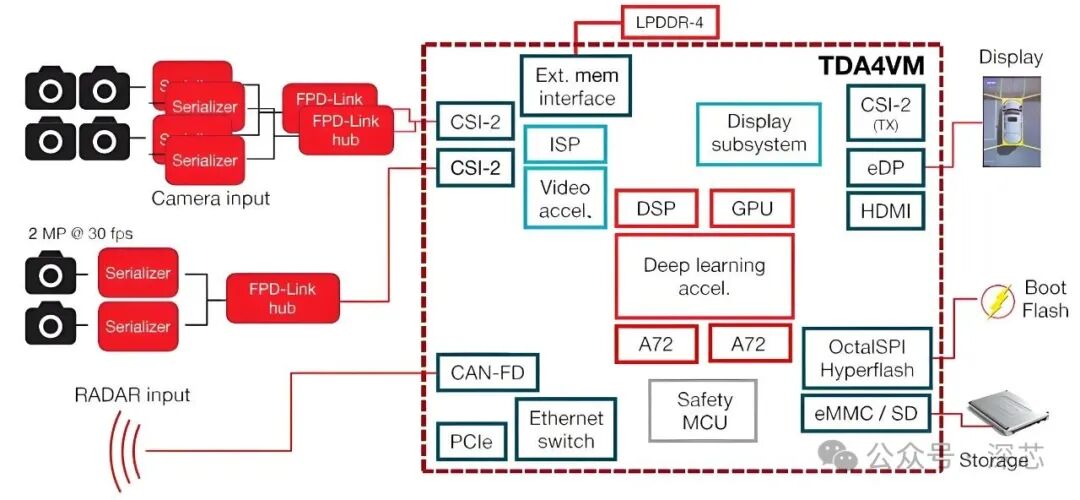
The six core chips do not have a “substitutive relationship” but rather “each has its role”: MCUs handle “simple control,” SOCs manage “complex systems,” DSPs specialize in “signal processing,” FPGAs address “custom hardware,” NPUs accelerate “AI tasks,” and GPUs support “graphics and general parallel computing.” In practical applications, they often work collaboratively — for instance, in smart cars, the MCU controls the windows, the SOC manages the cockpit, the DSP processes radar signals, the FPGA optimizes specific interfaces, the NPU runs autonomous driving models, and the GPU is responsible for dashboard displays, collectively forming a complete technical solution.