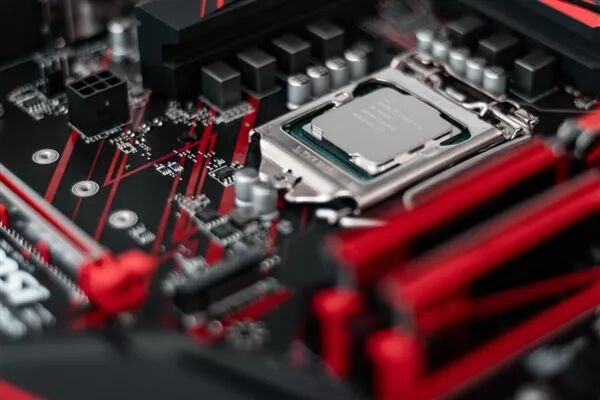
The recently released AMD third-generation Threadripper processor, the Threadripper 3970X, has a thermal design power (TDP) of 280W. However, AMD actually offers TDP settings of 180W, 140W, and even 95W for users to adjust and select, aiming for better energy efficiency.
Recently, German publication CB conducted a detailed examination of how much performance the 3970X would lose if the power consumption was reduced.
Tests showed that at 180W TDP, the 3970X’s clock speed dropped to 3.37GHz, which means a 35% reduction in power consumption and a 10% reduction in clock speed. Interestingly, even so, its multi-threaded performance still outperforms the fully powered 3960X (24 cores).
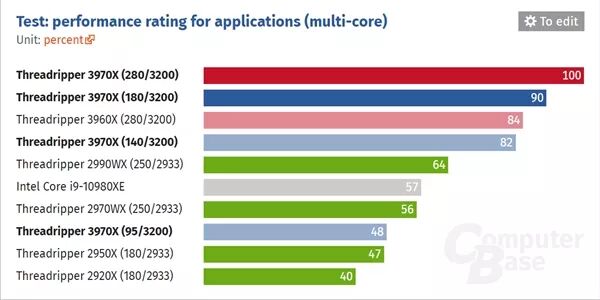
Moreover, at 140W, the 3970X’s multi-core application performance can still maintain a lead over the Intel i9-10980XE, which has a TDP of 165W and features 18 cores and 32 threads.
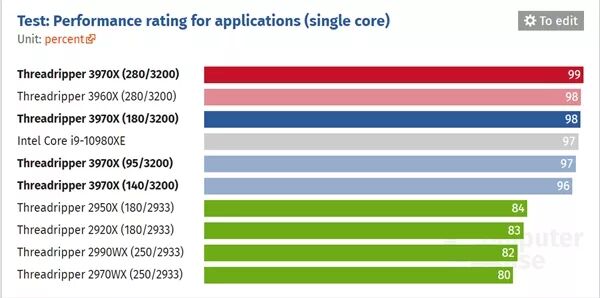
As for single-core performance, even in the ultra-economy mode at 95W, the 3970X matches the i9-10980XE.
If you are still stuck in the stereotype from three years ago that AMD processors run hot, consume a lot of power, and have low performance, then it is truly unfortunate.
Next, let’s talk about PCIe 4.0.
Despite the push from AMD and SSD manufacturers, the product lineup for PCIe 4.0 still seems insufficient, let alone widespread adoption.
Industry insiders are pinning their hopes for the revival of PCIe 4.0 on Intel, with rumors suggesting that Intel’s Tiger Lake architecture’s second-generation 10nm processors will natively support the PCIe 4.0 standard for the first time, although they may not be available until the second half of next year.
Previously, Wallace Kou, the general manager of SSD controller giant SMI, predicted that the demand for PCIe 4.0 SSDs would surge between 2020 and 2021. He also revealed that SMI will launch an enterprise-level PCIe 4.0 SSD controller solution based on the ARM Cortex-R8 architecture in the first quarter of next year.
Currently, the X570 motherboard is one of the few platforms supporting PCIe 4.0 products. In August of this year, SMI released two PCIe 4.0 SSD controllers based on TSMC’s 12nm process, one supporting 96-layer TLC flash memory, positioned as high-end, and the other supporting 96-layer QLC flash memory, aimed at the mainstream market.
Additionally, Samsung and Kioxia (formerly Toshiba Memory) have released PCIe 4.0 solid-state drives with 96-layer flash memory.