I really like some quirky little gadgets.
I have bought quite a few action figures and LEGO at home.
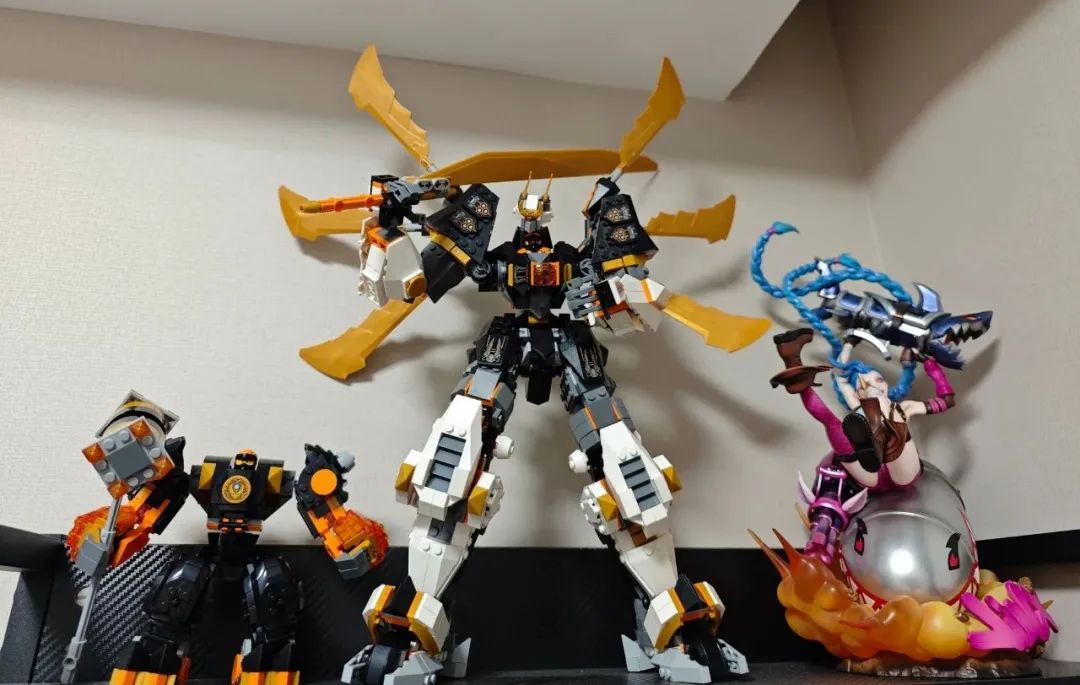
But I have always wanted to create something of my own.
After all, who doesn’t want to make something with their own hands?
Then one weekend, I saw a cute image of a “Ms. Cockroach” in a group chat that made me super excited. I really liked it. It was this one.
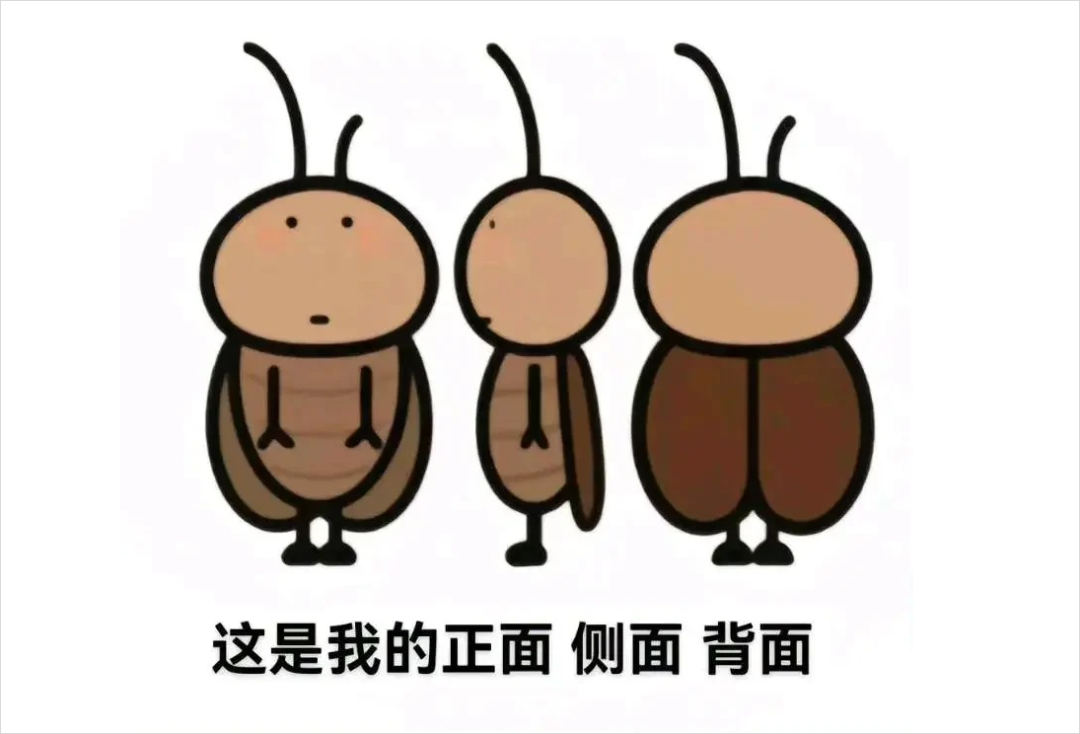
My first thought was to search on Taobao to see if there were any small action figures of this thing.
But the results were all cockroach poisons and those muscle dolls.
After searching for a long time, I finally found something similar, but they were all furry and not fun at all, plus they wouldn’t look good on my desk.
After flipping through for a long time and getting frustrated, I decided not to buy anything.
But thinking about it, I still wanted it, so I held onto the good tradition of “since I’m here, let’s just do it” during the New Year and thought, why not just make it myself?
After all, I have a 3D printer.
I could print a few and even give them to friends to play with.
So I just did it.
The process of 3D printing is actually quite simple, just two steps: first, model it, and after modeling, throw it into the 3D printing software, and it will print the model out for you.
First of all, I needed to model it.
For the first batch, I directly chose my two favorite “Ms. Cockroaches”.
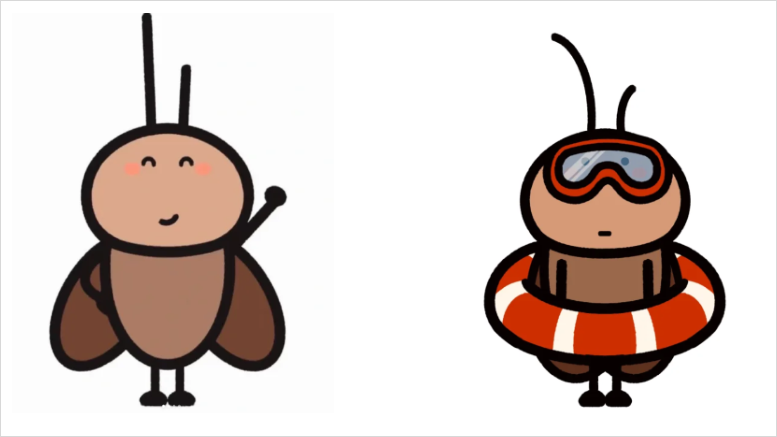
To be honest, if it were two years ago, I would have had to model it by hand.
But now, I definitely don’t want to model it myself again. I don’t even want to open C4D or Blender; as an AI blogger, going back to manual modeling would be like going back to the Stone Age.
AI 3D must be arranged.
This step can be done directly using Tripo AI, which is currently my favorite AI 3D platform. They recently released their 2.0 model, which has significantly improved in precision.
The most important thing is that their image-to-3D feature is just too good.
The website is here: https://www.tripo3d.ai/
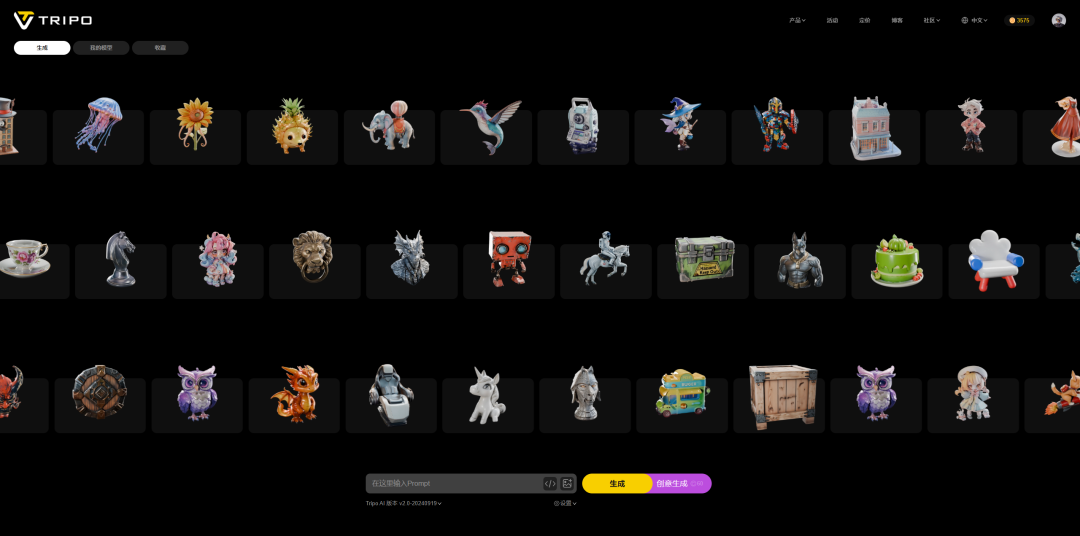
Once inside, you can directly upload an image to generate a 3D model. Of course, if you just want to play around, using text-to-3D is also fine.

After uploading the image, just click the “Generate” button, and it will start generating the 3D model. It takes less than a minute to generate.
Then you can preview the model on the webpage.

You can see that it looks almost exactly like the image I uploaded.
I must say, TripoAI’s capabilities are just amazing.
However, when I entered the details page and rotated it, I found that the arms were slightly misaligned, but this is normal. The essence of AI is that it needs a little roll.
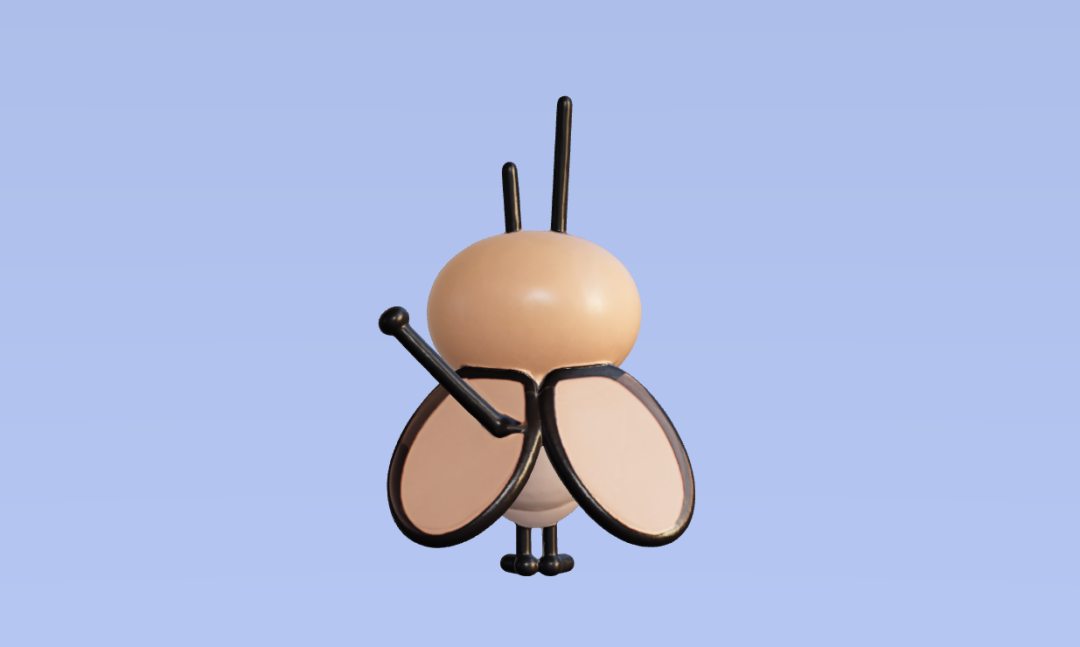
The brilliance of Tripo is that if you are not satisfied, this roll is free. Unlike many AI video products where you might run out of money but still don’t get a good clip.
Comparing this, Tripo is much more conscientious. If you are not satisfied, they will let you roll until you are satisfied.
But actually, I only rolled once, and the second time, it came out with a very perfect effect.
I canceled the material display to show everyone the white model directly.
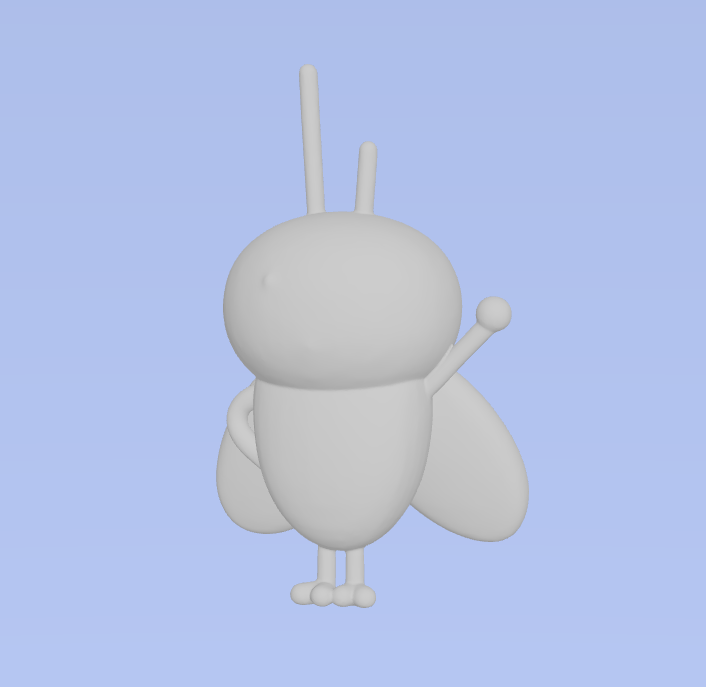
This structure, this smoothness, is unbeatable.
If you are not into 3D printing and just need models, Tripo provides you with textures and even offers a skeletal binding option…
This model is not very good for binding the skeleton since it’s a cockroach, so I’ll show you the effect with a human-shaped one.
For example, I generated a chibi version of Zoro from One Piece.

Just click the skeletal binding on the right.
Loading takes about 30 seconds to 1 minute, and the skeleton will be automatically bound… it’s really outrageous.
You can make it move.

It can even run.

This is very useful for those doing character animation and modeling.
Back to 3D printing, we now have a model. Now, it’s time to 3D print it. The 3D printing process is actually very simple. Of course, if you don’t have a 3D printer, you can also find someone on Taobao to print it for you, which is much cheaper than buying one yourself.
Here’s a brief introduction to the mainstream home 3D printing methods on the market, which are resin printing and FDM (Fused Deposition Modeling).
Resin printing works by exposing a special “photosensitive resin” to ultraviolet light, which starts as a liquid and hardens layer by layer, eventually forming a complete model.
The models produced by this method have a very smooth surface and fine details, making it particularly suitable for creating small, complex items, especially prototypes for action figures that require extremely high detail.
The downside is that it’s very expensive; both the machine and materials are costly, and I can’t afford it…
FDM is a more common and affordable 3D printing method. Its principle is somewhat like “piping cream”: it heats plastic filament (such as PLA or PETG) into a liquid state and stacks it layer by layer to form a model.
This method is faster in printing speed, and the materials are environmentally friendly and cheap.The downside is that FDM-printed models have more visible layer lines, and the surface is not as smooth as resin-printed models, so it feels less refined.
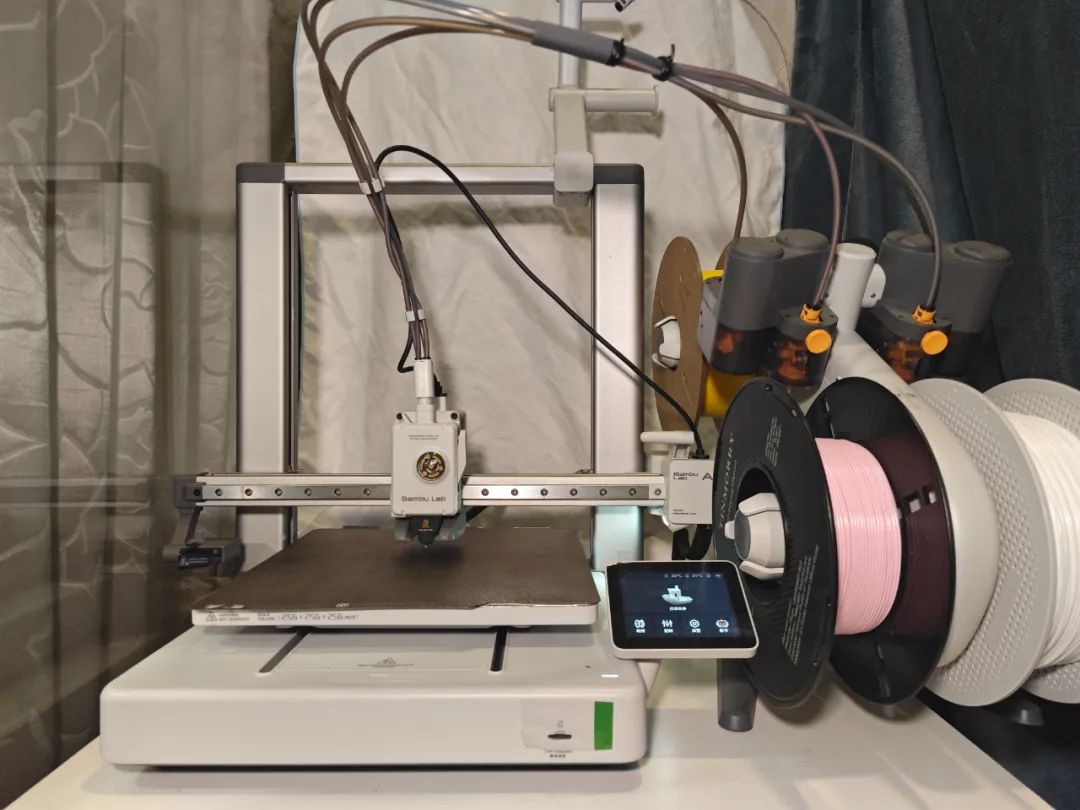
I am using the Tofu A1, which is an FDM machine.
The models generated by Tripo 3D can be directly selected in the format of the 3D printer software.
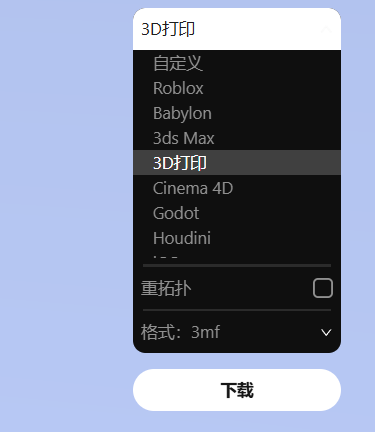
Once downloaded, you can drag it directly into the 3D printing software. If it feels unstable, just add a foot pad, and automatically add a support, otherwise the suspended parts won’t print.
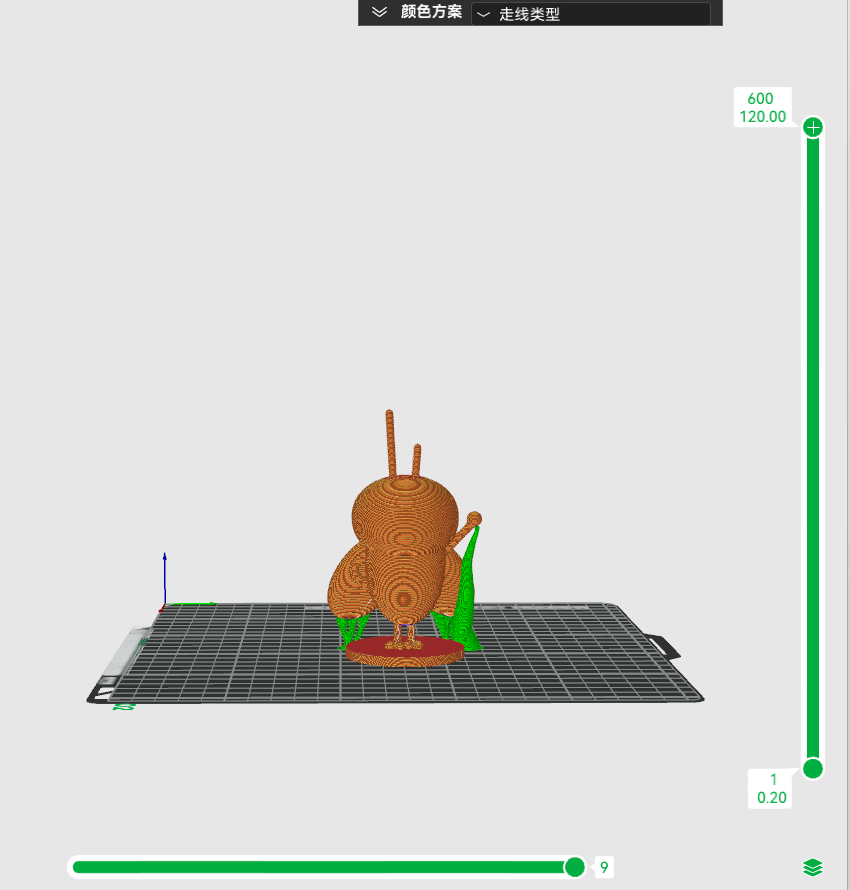
You can print in multiple colors or just print a white model to color it yourself.
I printed a white model because the AI-generated 3D model is still a single piece, and manually separating colors in the 3D printing software is too cumbersome, and it would also increase the printing time several times. What might originally take two hours to print could take more than ten hours with multiple colors, which I can’t afford.
So it’s better to print a white model and then use an acrylic marker to color it.
Isn’t that very primitive?.But it actually works very well and is hassle-free.
Before going out to eat, I clicked to start printing, and by the time I got home, it was almost done printing. After spending some time finishing the coloring, everything was great.
Finally, please take a look at my finished “Ms. Cockroach”.
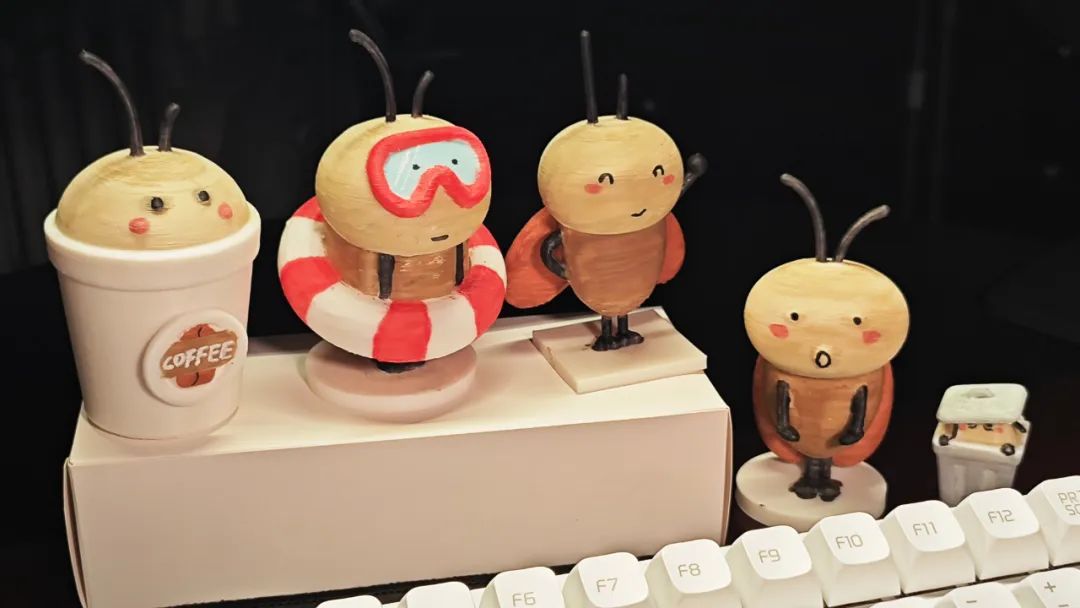
So silly and super cute.
Placing it on my desk, just looking at it every day makes me feel better.
Although the surface texture is indeed a bit rough, but this is already the limit of my 3D printer, haha. If I want to do better, I might have to change the equipment.
But I am already very happy to have reached this level.
3D printing is really not a new thing anymore, but it has never allowed me to achieve “action figure freedom”.
Because of the cost.Not the cost of consumables, but the labor cost.In the past, I wanted to print something like this, building a model was quite troublesome. “Ms. Cockroach” is relatively simple, and I might be able to finish it in a few dozen minutes, but what about the example of Zoro mentioned earlier?Or, what about this kind of model? What about this kind?
 For these kinds of things, if you want to model them, the time required is not trivial.All along, it hasn’t been that 3D printing doesn’t work, but the cost of modeling is just too high.Thanks to the development of AI and TripoAI, our dreams can be materialized into reality.I remember when I was a child, I used to work with friends to create some German-style board games. I couldn’t shake off the addiction to board games. During class, we would design our own board games in little notebooks, but everything was still very basic. I used to think, if I could create my own pieces and rules at will, and have everyone play my game, how great would that be?Until I saw someone create the things from my childhood notebook.
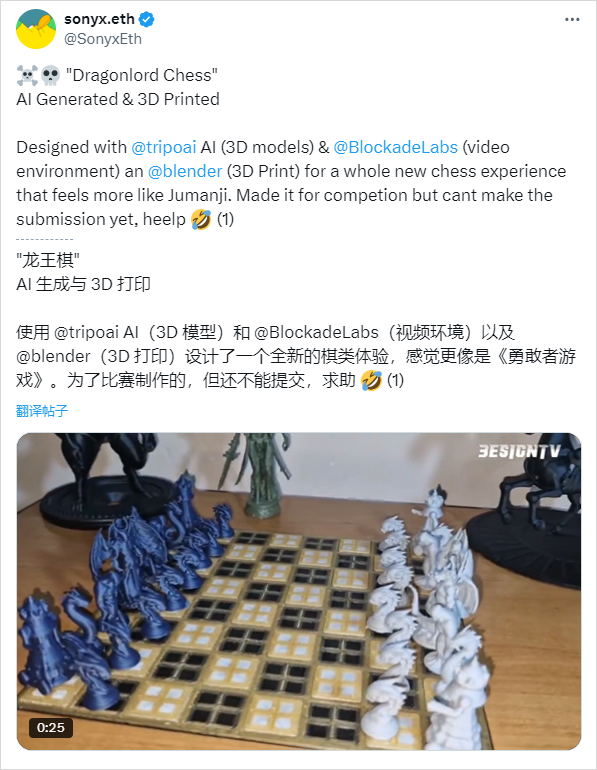 This guy, sonyx.eth, used Tripo and 3D printing to make a complete set of board games to participate in the previous Tripo piece competition.
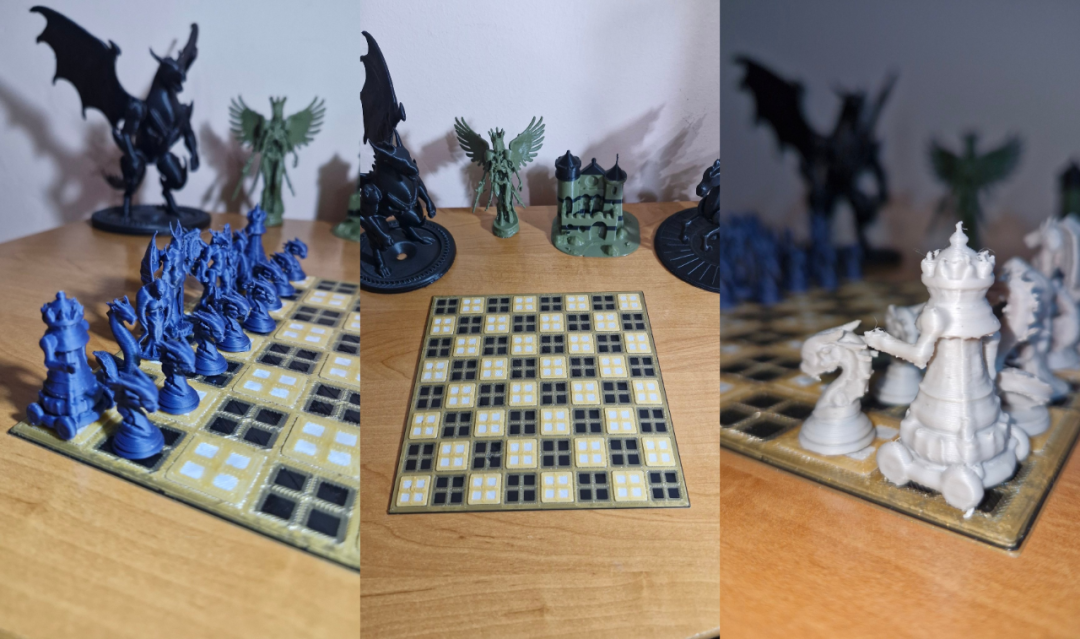 It has rules and gameplay. Although, like my little action figures, it is limited by the precision of 3D printing and is not so exquisite.But that doesn’t prevent it from resembling the game I sketched out in that broken notebook when I was a child.There’s also a 16-year-old kid from Croatia who also made a complete set of board games for the Tripo AI 3D competition. The shock I felt is beyond words; just watch the video.Everything was rendered directly after generating 3D with Tripo.The world I imagined has dragon-slaying warriors, immortal demon kings, the most competitive kingdoms, and souls sighing on the other side.It’s the wrath of the Lich King, the elegy of hell’s roar, the darkness buried deep in Hyrule, and the vanguard climbing the tower at the gate of Baldur’s Gate.When the intangible becomes tangible, those pieces can appear before you like magic.This might be the charm of AI 3D and Tripo.Now, when AI 3D is placed before you, those childhood ideas finally burst forth with unparalleled imagination.We can also personally turn our fantasies into reality.Even if there are still some ways to go to reach those real action figures and dream worlds.But this is also a small step for AI.Yet it is a giant leap for our imagination.Isn’t it?Having seen this far, if you think it’s good, please give it a like, a view, and share. If you want to receive notifications as soon as possible, you can also give me a star mark ⭐~ Thank you for reading my article, and see you next time.
The Klein bottle is a non-orientable two-dimensional compact manifold, while a sphere or a torus is a orientable two-dimensional compact manifold. When observing the Klein bottle, one point seems confusing – the neck and the body of the Klein bottle intersect, in other words, certain points on the neck occupy the same position in three-dimensional space as certain points on the bottle wall. We can understand the Klein bottle in four-dimensional space: the Klein bottle is a surface that can only be truly represented in four-dimensional space. If we must represent it in our three-dimensional space, we can only make do and represent it as if it intersects itself. The neck of the Klein bottle passes through the fourth-dimensional space and connects back to the bottom of the bottle, without passing through the bottle wall. To use a knot as an analogy, if we consider it as a curve on a plane, it seems to intersect itself, but upon closer inspection, it seems to break into three sections. However, it is easy to understand that this shape is actually a curve in three-dimensional space. It does not intersect itself but is a continuous curve. A curve on a plane cannot do this, but if there is a third dimension, it can pass through the third dimension to avoid intersecting itself. Just as we have to draw it on a two-dimensional plane, we have to make do and draw it as if it intersects or breaks. The same goes for the Klein bottle; we can understand it as a surface in four-dimensional space. In our three-dimensional space, even the most skilled craftsmen have to make it look like it intersects itself; just like the most skilled painter, when drawing knots on paper, must also draw them as if they intersect themselves. Interestingly, if we cut the Klein bottle along its line of symmetry, we end up with two Möbius strips. In two dimensions, the rope that seems to cross itself. If the Möbius strip can perfectly demonstrate a “one-dimensional space model that can infinitely extend in two-dimensional space,” then the Klein bottle can only serve as a reference for demonstrating a “two-dimensional space model that can infinitely extend in three-dimensional space.” Because in the process of making the Möbius strip, we have to twist the paper strip 180° and then connect the ends, which is an operation in three-dimensional space. The ideal “two-dimensional space model that can infinitely extend in three-dimensional space” should be a model in which moving in any direction on the two-dimensional surface can return to the origin, and although the Klein bottle can infinitely move in two-dimensional space, it can only return to the origin in two specific directions, and only in one of those directions will it pass through a “reverse origin” before returning to the origin. The making of this model would require distorting a three-dimensional model in four-dimensional space. One important branch of mathematics is called topology, which mainly studies the characteristics and laws of geometric shapes when continuously changing their shape. The Klein bottle and the Möbius strip have become one of the most interesting problems in topology. The concept of the Möbius strip has been widely applied in architecture, art, and industrial production. The three-dimensional Klein bottle is defined as a square region [0,1]×[0,1] modulo the equivalence relation (0,y)~(1,y), 0≤y≤1 and (x,0)~(1-x,1), 0≤x≤1. Similar to the Möbius strip, the Klein bottle is non-orientable. However, the Möbius strip can be embedded in three-dimensional space, while the Klein bottle can only be embedded in four-dimensional (or higher-dimensional) space. The Möbius strip is formed by taking a strip of paper, twisting one end 180°, and then gluing the two ends together. This is also a surface with only one side, but unlike the sphere, torus, and Klein bottle, it has an edge (note that it only has one edge). If we glue two Möbius strips along their only edge, we get a Klein bottle (of course, we must not forget that we can only complete this gluing in four-dimensional space; otherwise, we would have to tear the paper a little). Similarly, if we cut a Klein bottle appropriately, we can obtain two Möbius strips. Besides the shape of the Klein bottle we see above, there is a lesser-known “8-shaped” Klein bottle. It looks completely different from the above surface, but in four-dimensional space, they are actually the same surface – the Klein bottle. In fact, we can say that the Klein bottle is a 3° Möbius strip. We know that in the plane, if we draw a circle and place something inside it, if we want to take it out in two-dimensional space, we must cross the circumference. But in three-dimensional space, it is easy to take it out without crossing the circumference. Projecting the trajectory of the object along with the original circle into two-dimensional space gives us a “two-dimensional Klein bottle,” which is the Möbius strip (the Möbius strip here refers to the topological sense of the Möbius strip). Now imagine that in our three-dimensional space, it is impossible to take the yolk out of an egg without breaking the shell, but in four-dimensional space, it can be done. Projecting the trajectory of the yolk along with the eggshell into three-dimensional space will inevitably show a Klein bottle. In the past, German mathematician Klein proposed the “impossible” hypothesis, that is, the topological monster – the Klein bottle. This bottle has no inside or outside; no matter where you penetrate the surface, you still end up outside the bottle. Therefore, it is essentially a strange thing that is “outside but not inside.” Although modern glass manufacturing has developed very advanced techniques, the so-called “Klein bottle” has always been a “fiction” in the mind of the great mathematician Klein and cannot be manufactured at all. Mathematicians from many countries have tried to create one as a gift for the International Congress of Mathematicians. However, they faced one failure after another. Some even thought that if they could not produce a glass product, making a paper model would also be good. If they could solve this problem, it would be a significant achievement! The diameter and age Recent studies suggest that the diameter of the universe may be 92 billion light-years or even larger. Currently, the observable age of the universe is about 13.82 billion years. Shape The temperature at one end of the cosmic microwave background is high, suggesting a curved shape. Current cosmological theories suggest that the universe may have a saddle-like negative curvature shape, which originates from the Big Bang theory, with the entire universe resembling an inflated balloon, and we live on the “surface” of the universe. At the same time, scientists also believe that the universe is flat. According to a survey by NASA, the universe may be flat, and a 2013 survey found that if the universe is flat, the margin of error is only 0.4%. Stephen Hawking stated that the shape of our universe may be an incredible geometric figure, closer to surrealistic art, like the patterns created by Dutch artist M.C. Escher. Hawking’s ideas are based on string theory, which is still hypothetical and unproven. If we were to describe the shape of the universe in words, it should present a multi-layered mosaic pattern, with infinitely repeating twisted surfaces interlocking, similar to Escher’s “Circle Limit IV” pattern and the “Smith Circle” created by American engineer P.H. Smith, reflecting the concept of hyperbolic space, which is a non-Euclidean spatial form. Hierarchical structure Contemporary astronomical research indicates that the universe has a hierarchical structure, a system of celestial bodies that is continuously expanding, diverse in material forms, and constantly evolving. Planets, asteroids, comets, and meteoroids all revolve around the central body, the sun, forming the solar system. Other planetary systems also exist outside the solar system. Approximately 250 billion stars similar to the sun and interstellar matter constitute a larger celestial system – the Milky Way. The Milky Way has a diameter of about 100,000 light-years, with the sun located in one of its spiral arms, about 26,000 light-years from the galactic center. There are many similar celestial systems outside the Milky Way, known as extragalactic galaxies, commonly referred to as galaxies. Currently, about 100 billion galaxies have been observed, and scientists estimate that there are at least 2 trillion galaxies in the universe. Galaxies cluster together in groups of various sizes, called galaxy clusters. On average, each galaxy cluster contains about a hundred galaxies, with a diameter of up to tens of millions of light-years. Thousands of galaxy clusters have been discovered. Including the Milky Way, a small cluster of about 40 galaxies is called the Local Group. An even higher-level celestial system formed by several galaxy clusters is called a supercluster. Superclusters often have an elongated shape, with their long axes reaching hundreds of millions of light-years. Typically, a supercluster contains only a few galaxy clusters, with only a few superclusters having dozens of galaxy clusters. The Local Group and its nearby superclusters of about 50 galaxy clusters form the Local Supercluster. Galaxy classification Based on sequence numbers reflecting the developmental state of galaxies, they can be roughly classified into five types: elliptical galaxies, lenticular galaxies, spiral galaxies, barred spiral galaxies, and irregular galaxies. Solar system celestial bodies The sun accounts for 99.86% of the total mass of the solar system, and its strong gravity keeps all celestial bodies in the solar system firmly bound around it, ensuring they do not drift away and orbit it in an orderly manner. At the same time, the sun, as an ordinary star, leads its members in an eternal orbit around the center of the Milky Way. The sun’s radius is 696,000 kilometers, its mass is 1.989×10^30 kg, and its core temperature is about 15 million degrees Celsius. If a person stood on the surface of the sun, their weight would be 20 times that on Earth. Modern nebular theory proposes, based on observational data and theoretical calculations, that the original solar nebula of the solar system was a small cloud that collapsed from a massive interstellar cloud, initially rotating and contracting under its own gravity, forming the sun at its center, while the outer parts evolved into a nebular disk, which later formed planets. Currently, various schools of thought exist within modern nebular theory, with many differences among them that require further research and verification. Venus is the second planet from the sun and is the second brightest object in the night sky after the moon. Venus has no water, its atmosphere is severely lacking in oxygen, with carbon dioxide accounting for over 97%. The air has a thick layer of sulfuric acid clouds, with surface temperatures never dropping below 400 degrees Celsius, making it a veritable “hell”. The atmospheric pressure on Venus is 90 times that of Earth, equivalent to the pressure at a depth of 900 meters in Earth’s oceans. The atmosphere of Venus is mainly composed of carbon dioxide and other greenhouse gases, and the uncontrolled greenhouse effect is the main cause of Venus’s extreme climate. Due to the lack of an intrinsic magnetic field for protection, the immense energy released from magnetic reconnection in the magnetic field accelerates the escape of Venus’s atmosphere after it is heated. The scientific community believes that the escape of Venus’s atmosphere is the reason for the lack of water on Venus, which is shrouded in a dense atmosphere rich in carbon dioxide, leading to severe greenhouse effects. Jupiter is the fifth planet from the sun and the largest, with a mass 2.5 times that of all other planets combined (318 times that of Earth) and a diameter of 142,987 km. It is a gaseous planet without a solid surface, composed of 90% hydrogen and 10% helium (in atomic ratio, 75/25% in mass ratio) along with trace amounts of methane, water, ammonia, and “rock”. This composition is very similar to that of the original solar nebula that formed the entire solar system. Jupiter may have a rocky inner core equivalent to 10-15 Earth masses. Most of the planet’s material is concentrated in the form of liquid hydrogen. Liquid metallic hydrogen consists of ionized protons and electrons (similar to the interior of the sun, but at a much lower temperature). Jupiter has a total of 67 moons. In order of proximity to Jupiter’s center, they are: Callisto, Ganymede, Europa, Io, Amalthea, Himalia, Elara, Pasiphae, Sinope, Lysithea, Carme, Ananke, Leda, Thebe, Adrastea, Metis, and more. Mercury is the planet closest to the sun. Mercury has a radius of about 2,440 kilometers, making it the smallest of the eight planets. Mercury experiences extreme temperature fluctuations, with daytime temperatures reaching 430 degrees Celsius and nighttime temperatures dropping to about -170 degrees Celsius, making it the planet with the largest temperature difference among the eight planets in the solar system. Mercury’s outer atmosphere is very thin, composed of atoms and ions from Mercury’s surface and the solar wind. Scientists have confirmed that Mercury’s surface contains a rich amount of carbon, which is believed to be the reason for its dark appearance, with its surface rocks composed of low-weight percentage graphite carbon. The Curiosity rover collects samples on the surface of Mars. Mars is Earth’s neighbor and the fourth planet in the solar system. With a diameter of 6,794 km, its volume is 15% that of Earth, and its mass is 11% that of Earth. The surface of Mars is a desolate world, with carbon dioxide accounting for 95% of its atmosphere. Mars has a very thin atmosphere, with a density less than 1% of Earth’s atmosphere, making it incapable of retaining heat. This results in extremely low surface temperatures, rarely exceeding 0 degrees Celsius, with nighttime temperatures dropping to -123 degrees Celsius. Mars is known as the red planet due to its surface being covered in oxides, giving it a rusty red color. Most of its surface consists of a large desert rich in red oxides, along with ochre gravel and solidified lava flows. Mars often experiences violent winds that can create massive dust storms that can cover the entire planet. Each dust storm can last for weeks. The polar ice caps of Mars and the atmosphere contain moisture. Data obtained from Mars’s surface indicate that it once had liquid water in ancient times, and a significant amount of it. Saturn is the sixth planet from the sun, with a diameter of 120,536 km, making it the second largest after Jupiter. It is primarily composed of hydrogen, with small amounts of helium and trace elements, and its inner core includes rock and ice, surrounded by several layers of metallic hydrogen and gas. Earth is 1.3 billion kilometers away from Saturn. Saturn’s gravity is 2.5 times stronger than Earth’s, which can pull other planets in the solar system, causing Earth to orbit in an elliptical path while maintaining an appropriate distance from the sun, suitable for life to thrive. When Saturn’s orbit is tilted by 20 degrees, it will cause Earth’s orbit to be closer to the sun than Venus’s orbit, which will completely push Mars out of the solar system. Saturn is the only known planet with a density less than that of water; if it could be placed in a giant bathtub, it would float. Saturn has a massive magnetic field and an atmosphere that is ravaged by storms, with wind speeds near the equator reaching 1,800 kilometers per hour. Among the 31 moons orbiting Saturn, Titan is the largest, larger than Mercury and the Moon, and is the only moon in the solar system with a dense atmosphere. Uranus is the seventh planet from the sun, with a diameter of 51,118 km. Its volume is about 65 times that of Earth, making it the third largest after Jupiter and Saturn. The atmosphere of Uranus consists of 83% hydrogen, 15% helium, 2% methane, and trace amounts of acetylene and hydrocarbons. The methane in the upper atmosphere absorbs red light, giving Uranus a bluish-green appearance. The atmosphere collects into cloud layers at fixed latitudes, similar to the bright striped color bands of Jupiter and Saturn. The average temperature of Uranus’s cloud layers is -193 degrees Celsius. Its mass is 8.6810±13×10²⁵ kg, equivalent to 14.63 times that of Earth. Its density is relatively low, only 1.24 grams per cubic centimeter, which is 74.7% of Neptune’s density. Neptune is the eighth planet from the sun, with a diameter of 49,532 km. Neptune’s orbit around the sun has a radius of 4.5 billion kilometers, taking 165 years to complete one revolution. Neptune’s diameter is similar to that of Uranus, but its mass is slightly larger. The main atmospheric components of Neptune and Uranus are hydrogen and helium, and their internal structures are also very similar, so Neptune and Uranus are considered twin brothers. Neptune has the strongest winds in the solar system, with recorded speeds reaching 2,100 kilometers per hour. The temperature at the top of Neptune’s clouds is -218 degrees Celsius, making it one of the coldest regions in the solar system. The core temperature of Neptune is about 7,000 degrees Celsius, comparable to the surface of the sun. Neptune was discovered on September 23, 1846, and is the only planet discovered using mathematical predictions rather than planned observations. Pluto, located in the inner Kuiper Belt beyond Neptune, is the largest known body in the Kuiper Belt. Its diameter is approximately 2,370±20 km, which is 18.5% that of Earth. On August 24, 2006, the International Astronomical Union voted to no longer classify Pluto, traditionally considered one of the nine planets, as a planet, but rather as a “dwarf planet.” The resolution passed defined a “planet” as a body that orbits the sun, has sufficient gravitational force to overcome its rigid body forces to assume a spherical shape, and can clear other objects near its orbit. Among the traditional “nine planets” of the solar system, only Mercury, Venus, Earth, Mars, Jupiter, Saturn, Uranus, and Neptune meet these criteria. Pluto’s orbit intersects with that of Neptune, so it does not meet the new definition of a planet and is automatically downgraded to a “dwarf planet.” The surface temperature of Pluto is between -238 and -228 degrees Celsius. Pluto’s composition is composed of 70% rock and 30% ice water mixture. The bright areas on its surface may be covered with solid nitrogen, along with small amounts of solid methane and carbon monoxide, while the dark areas may be composed of some basic organic materials or light-chemical reactions caused by cosmic rays. Pluto’s atmosphere mainly consists of nitrogen with small amounts of carbon monoxide and methane. The atmosphere is extremely thin, with surface pressure only a few micro-pascals. Earth is the third planet from the sun, our human home. Although Earth is an ordinary planet in the solar system, it is unique in many ways. For example, it is the only planet in the solar system that is mostly covered by water and is currently the only known planet with life. Its mass is M=5.9742 ×10^24 kg, and its surface temperature ranges from -30 to +45 degrees Celsius. British researchers reported in the journal Astrobiology that, barring events that could drastically change the environment, Earth is suitable for human habitation for about 1.75 billion more years, although human-induced climate change may shorten this time. Comets are a type of small celestial body in the solar system composed of dust and ice, orbiting the sun. Scientists have analyzed the chemical residues of comets using probes and found that their main components are ammonia, methane, hydrogen sulfide, hydrogen cyanide, and formaldehyde. Scientists concluded that the smell of comets is a combination of rotten eggs, horse urine, alcohol, and bitter almonds. The “67P/Churyumov-Gerasimenko” comet. Surrounding the solar system is a vast “Oort Cloud”. The cloud contains countless ice chunks, snowballs, and debris. Some of these are influenced by the sun’s gravity and fly into the inner solar system, which are comets. As these ice chunks, snowballs, and debris enter the inner solar system, their surfaces begin to vaporize due to solar wind. Thus, comets have long tails, which become longer and more pronounced as they approach the sun. The interstellar space within the solar system is not a vacuum; it is filled with various particles, rays, gases, and dust. The Kuiper Belt is a theoretical ring believed to be the source of short-period comets, located 50-500 astronomical units from the sun, at the outer edge of the solar system. The Kuiper Belt is a massive ring composed of icy remnants, located beyond Neptune’s orbit, encircling the outer edge of the solar system. Material diversity Red giants are stars that, after spending a long time in their youth – the main sequence stage, enter their old age by first becoming a red giant. They are called “giants” to highlight their massive size. During the giant stage, the star’s volume expands to a billion times its original size. They are called “red” giants because, as the star expands rapidly, its outer surface moves farther from the center, causing the temperature to decrease and the light emitted to become increasingly red. However, even though the temperature decreases somewhat, the size of the red giant is so large that its brightness also becomes very high, extremely bright. Once a red giant forms, it heads toward the next stage of the star’s evolution, the white dwarf. A white dwarf is a type of low-luminosity, high-density, high-temperature star. Due to its white color and small size, it is called a white dwarf. The Hubble Space Telescope has observed the death process of white dwarfs. A white dwarf is a very special celestial body; it is small in size, low in brightness, but has a large mass and extremely high density. A white dwarf is the end point of the evolutionary path of low to medium mass stars. At the end of the red giant stage, the core of the star stops producing energy due to insufficient temperature, pressure, or nuclear fusion reaching the iron stage. The gravitational force of the star’s outer shell compresses it into a high-density celestial body. A typical stable white dwarf has about half the mass of the sun and is slightly larger than Earth. This density is second only to neutron stars and quark stars. If a white dwarf exceeds 1.4 times the mass of the sun, the repulsive force between atomic nuclei is insufficient to counteract gravity, and electrons are forced into the atomic nucleus to form a neutron star. Atoms are composed of atomic nuclei and electrons, and under immense pressure, electrons will be expelled from the atomic nucleus, becoming free electrons. This free electron gas will occupy the spaces between atomic nuclei, significantly increasing the amount of material contained in a unit space and greatly increasing the density. Figuratively speaking, at this point, atomic nuclei are “immersed in” electrons, commonly referred to as being in a “degenerate state.” Most stellar cores burn through hydrogen nuclear fusion, converting mass into energy, producing light and heat. When the hydrogen fuel in the stellar interior is completely consumed, it begins helium fusion, forming heavier elements like carbon and oxygen. This process is relatively short for stars like the sun and results in the formation of a carbon-oxygen white dwarf. If its mass exceeds 1.4 times that of the sun, it will undergo a type Ia supernova explosion. Quasars, since the 1960s, astronomers have found celestial bodies that appear as points of light like stars outside the Milky Way, but in fact, they have luminosity and mass similar to galaxies, and we call them quasars, of which thousands have been discovered. Supernovae are a stage in the evolution of stars. A supernova explosion is a violent explosion that certain stars undergo at the end of their evolution. It is generally believed that stars with a mass less than about nine times that of the sun cannot form supernovae after undergoing gravitational collapse. In the late stages of massive stars, when they can no longer produce new energy, their immense gravity causes the entire star to collapse rapidly towards the center, compressing the center material into a neutron state, while the outer material collapsing bounces off this hard “neutron core,” causing an explosion. This becomes a supernova explosion, and for more massive stars, a black hole can form at the center. The energy released during a supernova explosion is equivalent to what our sun would produce over 900 billion years of burning. The study of supernovae has profound significance for humanity’s own fate. If a supernova explosion occurs very close to Earth, the current consensus among the international astronomical community is that this distance is within 100 light-years, it can have a significant impact on Earth’s biosphere, and such a supernova is called a near-Earth supernova. Some studies suggest that the Ordovician extinction event in Earth’s history was caused by a near-Earth supernova, leading to the extinction of nearly 60% of marine life on Earth at that time. It is generally believed that the complete heliocentric model of the universe was proposed by Polish astronomer Copernicus in 1543 in his book “On the Revolutions of the Celestial Spheres.” In fact, the ancient Greek astronomers Aristarchus and Heraclitus mentioned more than 300 years before Christ that the sun is the center of the universe, and the Earth revolves around the sun. The solid earth being in motion was very difficult for ancient people to accept, as they lacked sufficient observational data of the universe and held anthropocentric views, leading them to mistakenly believe that Earth was the center of the universe. Furthermore, Ptolemy’s geocentric system could be well aligned with the observational data of the time, so the geocentric theory was widely accepted by the public and regarded by the contemporary clergy as an inviolable truth. Therefore, for more than half a century after the publication of “On the Revolutions of the Celestial Spheres,” the heliocentric theory received little attention, with very few supporters. The most famous supporter of the heliocentric theory was Giordano Bruno. Bruno was always associated with “heresy” and was exiled for it, ultimately being burned at the stake by the Inquisition in the Flower Square. He supported Copernicus’s heliocentric theory, developing the “infinite universe theory,” which made him a controversial figure in his time and is often seen as a pioneer of modern science and a martyr who defended scientific truth. Another view suggests that the struggle between geocentrism and Copernican heliocentrism has been greatly exaggerated. Bruno’s execution in 1600 was not solely due to his support for heliocentrism but also because of his pantheistic and polytheistic beliefs that angered the church. However, regardless, Bruno did play a crucial role in promoting the heliocentric theory. In fact, it wasn’t until 1609, when Galileo used a telescope to discover new astronomical phenomena that contradicted the old Aristotelian cosmology and Ptolemaic system, that the heliocentric theory began to gain attention. These astronomical phenomena mainly included: the moon’s surface being pockmarked and not as perfect as imagined by the ancient Greeks, the existence of sunspots (indicating that the heavens or “lunar realm” are not unchanging), and the discovery of the Jovian moons directly illustrating that Earth is not the only center. The discovery of the full phase changes of Venus also exposed the errors of the Ptolemaic system. However, since neither Copernicus’s heliocentric theory nor Ptolemy’s system could match Tycho Brahe’s observations, the heliocentric theory still did not hold an advantage at this time. It wasn’t until Kepler replaced circular orbits with elliptical ones that the heliocentric theory truly triumphed over geocentrism. Copernicus wrote a paper titled “Commentariolus” to explain his basic ideas on celestial mechanics. He defined three motions of the Earth: one is the daily rotation around its axis; one is the annual revolution around the sun; and one is to maintain the direction of the axial tilt during the Earth’s revolution around the sun. In his book “On the Revolutions of the Celestial Spheres,” Copernicus stated that celestial motion must satisfy the following seven points: there is no common center for all celestial orbits or bodies; Earth is merely the center of the moon’s orbit, not the center of the universe; all celestial bodies revolve around the sun, with the center of the universe near the sun; the distance from Earth to the sun is negligible compared to the height of the celestial sphere; any motion observed in the sky is caused by Earth’s motion; the apparent motion of the sun in the sky is not due to its own movement but is caused by Earth’s motion; the forward and backward movement of planets observed by people is due to Earth’s motion. Copernicus’s arguments to support his theory were mainly of a mathematical nature. He believed that a scientific theory is a set of ideas derived from certain hypotheses. He believed that a true hypothesis or theorem must accomplish two things: they must explain the observed motions of celestial bodies. They must not contradict Pythagoras’s assertion that celestial motion is circular and uniform. At that time, there were many opposing views, but Copernicus countered them using the knowledge available at the time. Opposing argument: If the Earth is rotating, the air would lag behind, creating a persistent easterly wind. Copernicus replied: The air contains soil particles, which are of the same nature as the land, so it is compelled to follow the Earth’s rotation. The absence of resistance when the air rotates is because the air is connected to the constantly rotating Earth. Opposing argument: If a stone is thrown upwards, it would be thrown behind by the Earth’s rotation and land to the west of the throwing point. Copernicus replied: Since the object under its own weight belongs mainly to the nature of the soil, all parts undoubtedly maintain the same nature as their entirety. Opposing argument: If the Earth rotates, it would collapse due to centrifugal force. If the Earth does not rotate, then larger celestial bodies like stars must rotate at very high speeds, which would easily cause them to be torn apart by centrifugal force. Copernicus replied: Centrifugal force can only be found in unnatural, artificial movements, while in natural movements, such as the motion of the Earth and celestial bodies, it is not present. The geocentric theory was long dominant in ancient Europe. It was initially proposed by the ancient Greek scholar Eudoxus (who proposed the “concentric spheres” model) and later developed and gradually established by Aristotle and Ptolemy. Ptolemy believed that the Earth was the center of the universe and remained stationary. The moon, Mercury, Venus, the sun, Mars, Jupiter, and Saturn revolve around the Earth in their respective circular orbits. Among them, the movements of planets are more complex than those of the sun and the moon: planets move in their own orbits, while their orbits revolve around the Earth. Beyond the sun and moon are the celestial spheres embedded with all the stars – the celestial sphere. Outside of that is the primary celestial body that drives the motion of celestial bodies. The geocentric theory was the first planetary system model in the world. Although it mistakenly placed Earth as the center of the universe, its historical achievements should not be overlooked. The geocentric theory acknowledged that Earth is “spherical” and distinguished planets from stars, focusing on exploring and revealing the motion laws of planets, marking a significant advancement in human understanding of the universe. The most important achievement of the geocentric theory was the mathematical calculation of planetary movements. Ptolemy also first proposed the concept of “orbital trajectories,” designing a model of epicycles and deferents. According to this model, people could quantitatively calculate the movements of planets and predict their positions, which was an incredible creation. For a certain period, based on this model, it could predict celestial phenomena to a certain extent, thus having some practical significance in production. However, by the late Middle Ages, as observational instruments improved, the measurements of planetary positions and movements became increasingly accurate, and the discrepancies between the observed positions of planets and the calculations from this model gradually became apparent. However, the proponents of the geocentric theory did not recognize that this was due to the errors of the geocentric theory itself, but instead tried to remedy it by adding more epicycles. Initially, this approach could barely cope, but later the number of epicycles increased to over 80, yet it still could not satisfactorily calculate the accurate positions of planets. This inevitably raised suspicions about the correctness of the geocentric theory. By the 16th century, Copernicus, building upon the works of the ancient Greeks and contemporary scholars, finally established the heliocentric theory. From then on, the geocentric theory gradually fell out of favor.