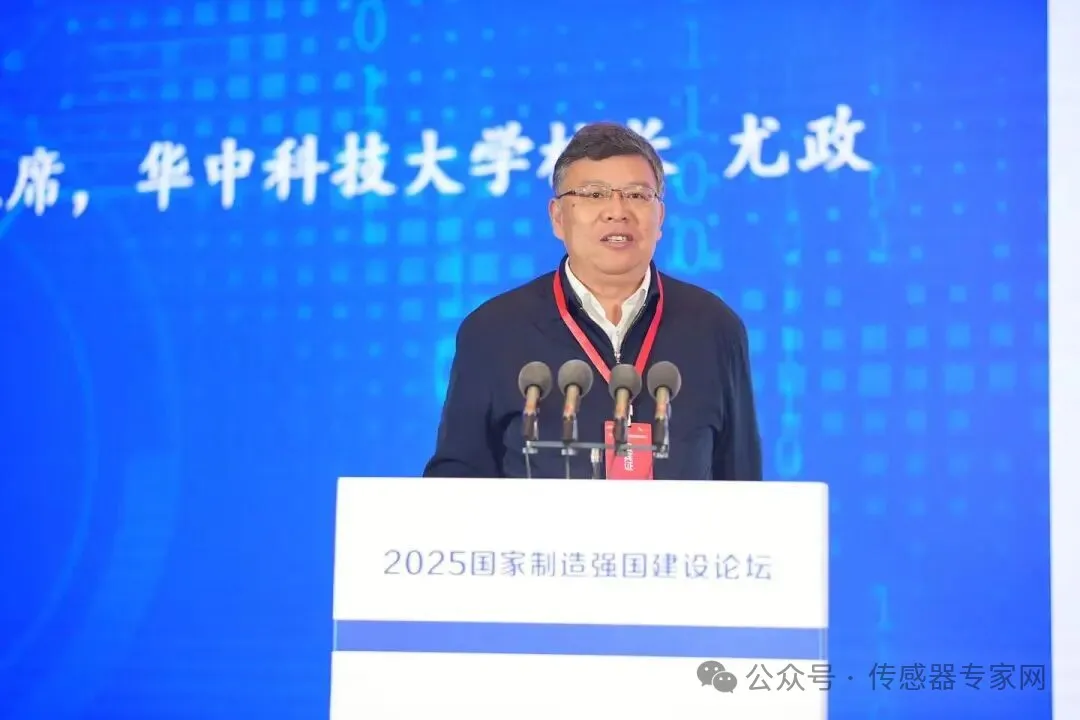
 For a wealth of sensor knowledge and industry reports, please reply with the keyword 【Data Download】 in the public account dialog box to obtain access to some materials.《Over 100 Professional Knowledge Materials on Sensors, There’s Always One Suitable for You~》Here👇Follow me, and remember to click the menu bar in the upper right corner•••👉Set as a Star Mark⭐Editor’s Note: Recently, the 2025 National Manufacturing Power Construction Forum was held in Hefei, Academician of the Chinese Academy of Engineering and Vice President of the China Association for Science and Technology, President of the China Instrument and Control Society, and President of Huazhong University of Science and Technology, You Zheng attended and delivered a speech on “High-end Sensor Technology and Applications”, presenting several latest insights on the Chinese sensor industry:
In developed countries, the sensor industry accounts for about 1% of GDP, while sensors and instruments together account for about 5%, yet they can drive 50%-60% of national economic development; over 80% of the high-end sensor and instrument market in China is monopolized by foreign countries; in the future, the value proportion of sensors in automobiles may reach 1/5 or even 1/2; 30%-40% of mobile phone profits come from sensor systems; a humanoid robot capable of interacting with the external environment requires over 200 miniaturized sensors; sensor technology is becoming the “source of technology” for intelligent technology…
The following is a summary of the content from Academician You Zheng’s speech, organized by the “China Information Technology Weekly”.
At the 2025 Manufacturing Power Construction Forum, Vice President of the China Association for Science and Technology, and President of Huazhong University of Science and Technology, You Zheng pointed out during his speech on “High-end Sensor Technology and Applications” that the sensor industry chain and supply chain are characterized by long chains and many links, with upstream covering sensitive materials, components, and chips, midstream focusing on product design and manufacturing, and downstream covering terminal devices and application scenarios in various fields.The market size of the sensor industry itself accounts for about 10% of the market size of the industries that sensors can drive and generate, making it a “lightweight industry with heavy impact”.
Sensor technology is a crucial cornerstone of modern society.
You Zheng pointed out that sensors are the “interfaces” between the physical world and the digital world, serving as the source of information acquisition and a strategic cornerstone of modern society. The evolution of information technology from digitization to intelligence relies fundamentally on sensors’ precise perception of the physical world; otherwise, the digital world would lose its foundation. Academician Wang Daheng once stated that sensors and their instruments are the “cornerstone” and “leaders” of innovation-driven development, serving as both a “multiplier” for economic and social growth and a “warning device” and “guardian” for national security and public welfare.
From space to everyday life, sensors are needed to acquire information and digitize it, allowing it to connect to the digital world for processing, followed by decision-making systems generated through large model learning. For instance, a humanoid robot with human-like functions requires over 200 sensors, with miniaturization, high precision, and low cost being core requirements. Additionally, sensors are key supports for basic research, with several Nobel Prize achievements directly related to their technological breakthroughs. In fields such as national defense, automotive, and others, sensors are irreplaceable, with typical examples being radar and vehicle-mounted sensor arrays.
Sensor technology is a “lightweight industry with heavy impact”.
You Zheng stated that although sensor technology is important, it is often limited by insufficient investment. From the perspective of the manufacturing power strategy, sensors are a microcosm of China’s manufacturing industry. The country has included them in the key focus of the “Five Basics” for industrial strength, issuing a series of policies to support development. Currently, China’s sensor industry layout is basically formed, with a complete range of products, mid- to low-end products basically meeting domestic demand, and some already possessing global competitiveness.However, there are issues such as low industry concentration, oversupply of mid- to low-end products, and weak R&D capabilities, with a gap of 5-10 years compared to foreign countries.
Globally, the sensor industry in developed countries accounts for about 1% of GDP, while sensors and instruments together account for about 5%, yet they can drive 50%-60% of national economic development, which can be described as “lightweight industry with heavy impact”. In China, over 80% of the high-end sensor and instrument market is monopolized by foreign countries, with high-end sensor imports being highly dependent in fields such as industrial mother machines, medical, and process industries.
Sensor technology is accelerating towards intelligence, networking, miniaturization, and system-level integration. The deep integration of semiconductor and sensing technology is creating new opportunities, presenting two major technological paths in the stage of semiconductor development beyond Moore’s Law: one is to enhance computing speed and storage capacity through process optimization, and the other is to promote the high-level integration of sensing, measurement, and control functions on a single chip or system level.Currently, three-dimensional heterogeneous integration technology has become a key breakthrough, achieving the heterogeneous fusion of silicon-based materials and optoelectronic materials through semiconductor processes, deeply embedding optoelectronic sensing capabilities into traditional silicon-based information systems.
The development of intelligent sensors/micro-systems is driven by five major forces: IoT technology, automotive and transportation electronics development, health, consumer electronics, and humanoid robots. IoT technology is driving the development of better and cheaper sensors; the development of automotive electronics has significantly increased the demand for sensors in smart vehicles, with the future value proportion of sensors in automobiles possibly reaching 1/5 or even 1/2; in the health sector, medical systems, especially home health care systems, have an absolute demand for sensors, such as blood glucose sensors and chip organs; in consumer electronics, the core of smart terminals is sensors, with 30%-40% of mobile phone profits coming from sensor systems; the development of humanoid robots also relies on a large number of sensors, with a truly interactive humanoid robot requiring over 200 miniaturized sensors.
Intelligent micro-systems also have many typical examples, such as “smart dust” and “killer bees”, which are small but powerful and can serve as important components of environmental sensing systems.
Focusing on Key Drivers for Development
You Zheng pointed out that China has achieved international parity in the field of intelligent micro-system technology, having independently developed intelligent micro-system design toolchains and completed key process standardization breakthroughs. Regarding sensor development, he proposed three strategic paths:
First, deep integration of industry and education is needed; the innovation field urgently requires compound talents and breakthroughs in original technology, necessitating the establishment of a collaborative mechanism that connects the education chain, talent chain, and industry chain; second, reasonable layout is essential, as sensors are widely distributed, and the construction of public platforms is very important; just as the development of integrated circuits benefited from public technology platforms, sensors also need public platforms to form China’s advantages; third, market-driven focus on regional characteristic application scenarios to drive technological iteration and cultivate industrial ecology.
As a strategic cornerstone of information perception, sensor technology is becoming the “source of technology” for intelligent technology. You Zheng emphasized the need to grasp the evolution laws of intelligent technology and promote innovation at the source of information through breakthroughs in sensor technology, injecting new momentum into the high-quality development of the manufacturing industry.
Author:Wang JieEditor: Gao ShanshanSupervisor: Liu JingWhat are your thoughts on this article? Feel free to leave a comment below this content on the Sensor Expert Network public account. or engage in discussions in China’s largest sensor community: the Sensor Exchange Circle.
What are your thoughts on this article? Feel free to share your comments!
Share and click to view, and let more people understand the dynamics of China’s sensor industry!
Star-marked content = content you care about. According to the recommendation principles of public accounts, if you do not set the Sensor Expert Network public account homepage as a star mark, you will not be able to receive the latest information in the sensor industry in a timely manner!
Disclaimer: The content of this article reflects the author’s personal views and does not represent the views or positions of the Sensor Expert Network. If there are any infringements or other matters, please contact via WeChat: MM380702. For more insights, feel free to leave comments.If you have any submission or interview requests, please send an email to:[email protected].