What is the Embedded Engineering Roadmap? It is essentially an open-source “learning map” that lists all the necessary software, hardware, soft skills, and toolchains in the embedded field in one comprehensive diagram. Whether you want to learn about microcontrollers, RTOS, DSP, IoT, or even edge AI, you can find the corresponding learning paths and resources (books, videos, blogs are all marked) here. In short: it pieces together fragmented knowledge into a clear growth path.
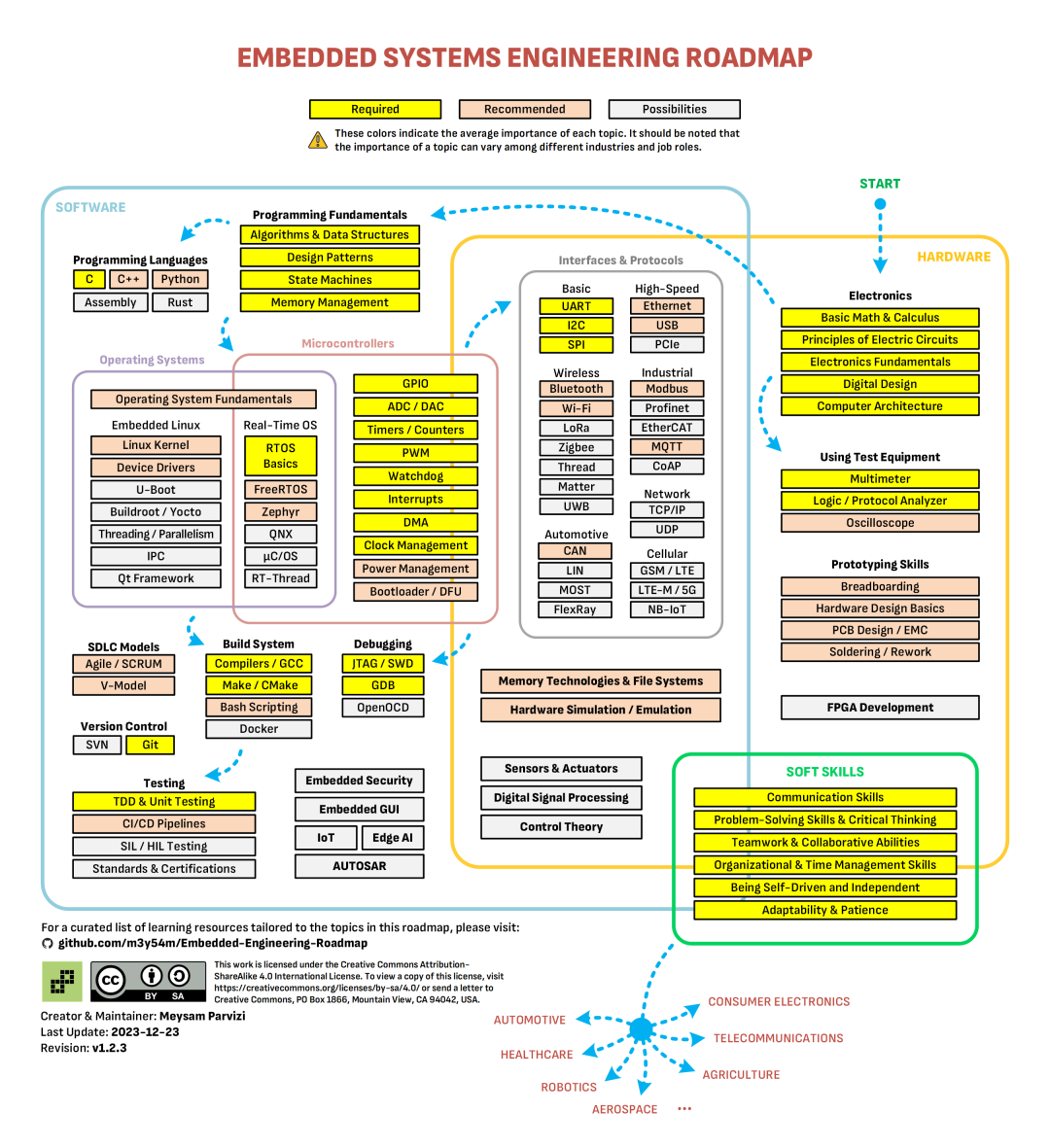
What pain points does it address?
| Pain Point | Corresponding Solution from the Roadmap |
| Information is too scattered | Classifies and stars hundreds of resources (👶 Beginner, 💎 Advanced) |
| Not sure what to learn first | Divides into three major sections: hardware → software → soft skills in progression |
| Career positioning is unclear | Each position (Firmware, Embedded Linux, Hardware Design) has its own dedicated branch, directly corresponding to your goals |
Installation & Usage Instructions
- 1. Clone the repository (as long as you have Git)
git clone https://github.com/m3y54m/Embedded-Engineering-Roadmap.git cd Embedded-Engineering-Roadmap - 2. Open
<span>roadmap.md</span>: This contains the markdown version of the roadmap, which can be previewed directly using editors like VSCode or Typora. - 3. Select a direction: For example, if you want to work with STM32 + FreeRTOS, find FreeRTOS under “Software → RTOS”; the link will take you to the official documentation, introductory videos, and practical projects.
- 4. Practice hands-on: Each resource has a “Project Recommendations” section, where you can follow along to create a blinking LED → UART debugging → simple sensor readings, learning while practicing.
Pros and Cons Overview
| Pros | Cons |
| Comprehensive: Presents software, hardware, soft skills, and toolchains all at once | Large amount of information: It may be overwhelming the first time you open it |
| Open-source community: Updated regularly, and you can submit your own PRs | Requires self-selection: Not all resources are suitable for everyone |
| Resource tagging: Quality labels (👶, 💎) save time | Relatively few Chinese resources: Most links are in English |
| Career-oriented: Clear paths corresponding to job positions | No “one-click install” script (manual cloning required) |
| Free: No paywall | No interactive practice platform (you can only practice on your own) |
Conclusion If you find yourself at the crossroads of “wanting to learn embedded systems” and “not knowing where to start,” the Embedded Roadmap serves as a GPS map, helping you avoid detours and quickly locate your path. It dismantles the traditional notion that “hardware is hard, and software is soft” by promoting a “learn both hardware and software together” approach, allowing you to naturally fill in the gaps through practical projects. All you need to do is take action: follow the roadmap step by step, coding and connecting circuits; don’t be afraid to get stuck, as the community’s Issue section is always available for help.
Project address: https://github.com/m3y54m/Embedded-Engineering-Roadmap