Special Thanks: A special thanks to Arm Technology and Chipone for their support of this report! Overview of AI Chip ReportAs part of the AspenCore Fabless100 series industry analysis reports, the 2023 AI chip report summarizes 60 domestic AI chip manufacturers based on the 2022 report on “45 Domestic AI Chip Manufacturers Research and Analysis Report” and categorizes them roughly as follows:Cloud acceleration, intelligent driving, smart security, smart home, smart wearables, and other AIoT.For each selected company, we provide a comprehensive profile analysis from aspects such as main products, core technologies, application scenarios, market competitiveness, and development milestones.We first briefly elaborate on the “Compute-Storage Integration” technology and its impact on the future development of AI chips, and then summarize market trends for three major AI application scenarios (cloud acceleration, intelligent driving, edge computing). The content outline of this report is arranged as follows:
- Compute-Storage Integration AI Chips and Technology Trends
- AI Applications: Cloud Acceleration
- AI Applications: Intelligent Driving
- AI Applications: Edge Computing
- Top 10 AI Chip Companies in Fabless100 Ranking
- Summary of Information on 60 Domestic AI Chip Manufacturers
- Conclusion and Outlook
Fabless100 series technology and application live broadcast – AI design challenges and solutions for high-performance computing
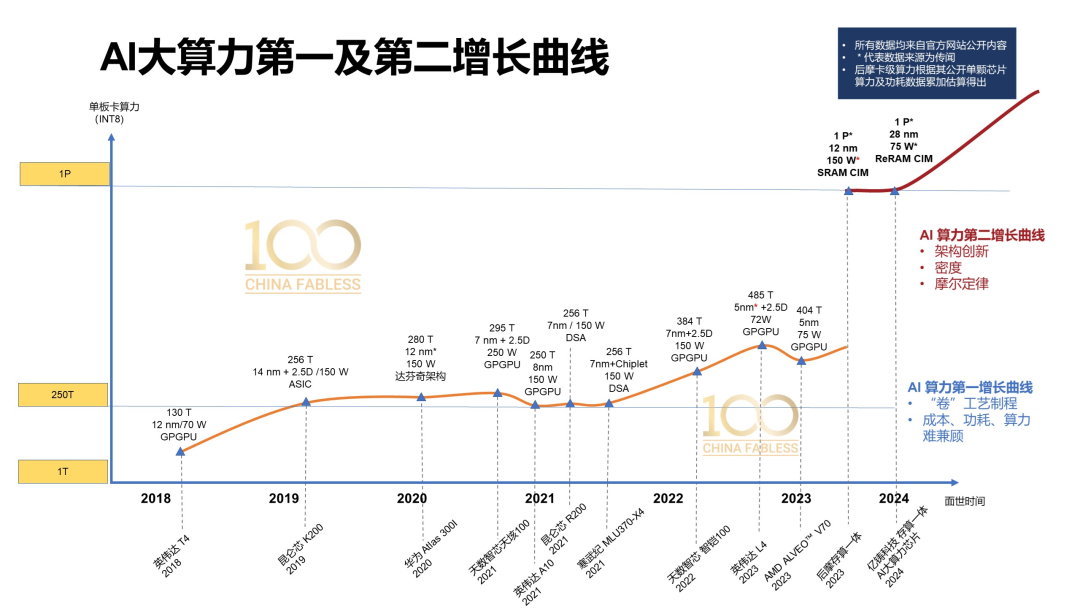
Compute-Storage Integration AI Chips and Technology TrendsThis section discusses the “Compute-Storage Integration” technology breaking through the energy consumption wall, Chiplet and 2.5D/3D stacked advanced packaging, ReRAM materials/processes and AI application potential, and how Compute-Storage Integration + Chiplet aids in the second growth curve of AI computing power, etc. For detailed reading, please click the link above.
AI Applications: Cloud AccelerationAI model training for large language models (LLM) such as ChatGPT requires massive parallel processing power, and the most suitable chips currently are GPUs, like NVIDIA’s H100 and A100. Despite the high price and significant power consumption of GPUs (the H100 GPU SXM accelerator card using TSMC’s 4nm process has a power consumption of up to 700W), internet giants like Microsoft and Google continue to purchase large quantities to win the AI race, and the strong demand for NVIDIA GPUs is expected to persist.In addition to NVIDIA GPUs, independent manufacturers and products that can provide cloud training and inference acceleration chips include Biren Technology’s BR100 series, Qualcomm’s Cloud AI 100, Moore Threads’ Antoum processors, Suiyuan Technology’s Suyuan 2.0/2.5, Hanbo Semiconductor’s SV100, Cambricon’s Siyuan 370, and Kunlun Technology’s CAISA data flow inference AI chips.Taking the domestic AI chip startup Moore Threads as an example, in the recent MLPerf evaluation, Moore Threads won the championship on the ResNet50 model with its software-hardware collaborative sparse computing technology. Its S40 computing card achieved a global first with 127,375 FPS for single-card computing power; the S30 computing card achieved a global first with 383,520 FPS for four-card computing power.The Moore Threads AI computing card series is based on its sparse computing AI chip, the 12nm Antoum, which outperforms 4nm process GPUs, showcasing the powerful advantages of sparse computing.Based on dual sparsification algorithm technology and a unique AI chip architecture, the Antoum chip is designed for cloud AI inference scenarios and can support up to 32 times sparsity. Antoum is a high-performance, general-purpose programmable chip that supports CNN, RNN, LSTM, Transformer, BERT, and other network models and various data types, including floating point and fixed point. The Moore Threads AI acceleration card based on the Antoum chip can support comprehensive sparsified neural network development through optimized computing modes, making it a high-performance, low-power general-purpose AI inference acceleration card.Sparse computing can bring dozens of times acceleration performance to large AI models and may be a new “hardware” approach for cloud acceleration beyond GPUs. The previously mentioned “Compute-Storage Integration” may be another “hardware” approach to meet the challenges of large models. The domestic AI chip startup Yizhu Technology is developing a fully digital Compute-Storage Integration AI high-performance chip and acceleration card based on ReRAM, which can achieve 500T of computing power with only 75W of power consumption.AI Applications: Intelligent DrivingWith the intelligence of automobiles, the E/E architecture is shifting from traditional ECU-based to domain controllers, and the computing architecture design is gradually transitioning from distributed to centralized processors. We are currently in the process of transitioning from the past distributed EE architecture to a domain centralized EE architecture, which is expected to be completed around 2025. This will open up cross-domain integration, transitioning to an era of “Central + Zonal” (Central & Zonal) computing EE architecture.Cars are gradually transforming into connected communication and computing devices like smartphones and computers, but the requirements for real-time and reliability in computing processing are higher because the operating environment of cars is more complex, and safety requirements are more stringent. AI chips for L2 and above intelligent driving mainly target three sub-fields: Advanced Driver Assistance Systems (ADAS), smart cockpits, and autonomous driving.ADASADAS (Advanced Driver Assistance Systems) typically includes navigation and real-time traffic systems (TMC), electronic police systems (ISA), adaptive cruise control (ACC), lane departure warning systems (LDWS), lane keeping systems, collision avoidance or pre-collision systems, night vision systems, adaptive light control, pedestrian protection systems, automatic parking systems, traffic sign recognition, blind spot detection, driver fatigue detection, downhill control systems, and electric vehicle alarm systems, etc.As the functions of automobiles become increasingly complex, the chips supporting these systems are also becoming more complex. ADAS is no longer a standalone domain controller but has been integrated and defined as a complex SoC, with multi-core real-time response becoming standard. Functions such as AEB and LKA require strong visual algorithms, and complex algorithms using lidar, traditional radar, and visual fusion require powerful chip support. Many SoCs have adopted 14nm or even 7nm process nodes.From the perspective of chip design, the main challenges faced by ADAS processor chips now include: automotive-grade standards, such as ISO26262, requiring compliance with ASIL-B or even ASIL-D levels; the processing of multi-sensor fusion requires higher chip performance and bandwidth to meet fast data processing and transmission throughput requirements; increasing hardware deep learning design, how to achieve good software-hardware collaboration, and adapt to the rapidly evolving AI computing models.Traditional automotive chip manufacturers like NXP, Infineon, Renesas, ST, and TI have their own ADAS chips and system application solutions. Mobileye, which started with ADAS and autonomous driving chips, has also occupied an important position in this market. Domestic automotive intelligent driving chip developers such as Horizon Robotics, Black Sesame Intelligence, Chipone Technology, and Geely Technology’s Jiefa Technology also provide competitive chip products and ADAS application solutions in the ADAS field.Smart CockpitSingle-chip solutions for smart cockpits, similar to cockpit domain controller solutions, can streamline cockpit processor layouts and reduce costs. Smart cockpit single-chip solutions must be able to handle multiple high-definition screens, HUD, camera inputs, voice and gesture interaction, etc., so chip manufacturers need to have certain technical accumulation to develop similar integrated chip solutions.With the diversification of customer needs and technological advancements, smart cockpits centered on multi-modal interaction are becoming a major trend in the automotive industry’s technological development. Among them, under the high integration requirements of interaction technologies such as visual recognition and voice processing, independent perception layers based on AI chips will become the key driving force for achieving multi-modal interaction and promoting the rapid development of smart cockpits.The future cockpit systems will become very complex, requiring not only chip solutions but also corresponding algorithm support.Chips support the operation of operating systems, ADAS, and other software by providing computational power. The integrated experience represented by smart cockpits, including “in-vehicle infotainment systems + streaming rearview mirrors + head-up displays + full LCD instrument panels + vehicle networking systems + in-car occupant monitoring systems,” all rely on the enhancement of chip computing power. Companies that possess both chip R&D and corresponding software and algorithm development capabilities will be more competitive in the fierce market competition.International chip manufacturers represented by Qualcomm have provided smart cockpit chip and system solutions that have been adopted in many domestic car models. The domestic smart car AI chip startup Chipone Technology has released the multimedia smart cockpit chip “Dragon Eagle No. 1,” which has been installed in Geely’s new energy medium-sized SUV – Lynk & Co 08. This smart cockpit chip, model SE1000, is manufactured using a 7nm process, has an 8-core CPU, a 14-core GPU, and an independent NPU with 8 TOPS of AI computing power. Its powerful audio and video processing capabilities can support up to 7 high-definition screen outputs and 12 video signal inputs, and it is equipped with dual HiFi 5 DSP processors. Additionally, this chip features a high-security level “Safety Island” design, meeting ISO26262 automotive safety certification, with a professional hardware encryption/decryption engine providing security guarantees for automotive applications.Autonomous DrivingAutonomous driving from L0 to L5 levels, with the improvement of functions and performance, raises higher demands on AI chip computing power and performance while providing a better intelligent experience. L2 (ADAS) requires AI computing power of less than 10 TOPS; L3 requires AI computing power of 30~60 TOPS; L4 requires AI computing power of >100 TOPS; L5 requires AI computing power of 500-1000 TOPS. AI processing chips that need to handle environmental perception, multi-sensor fusion, and deep learning algorithms’ ultra-large computing power demands typically use GPUs or DSA dedicated chips, such as NVIDIA’s Orin GPU and Horizon’s Journey J5.NVIDIA DRIVE Orin SoC can provide 254 TOPS of performance, powering autonomous driving, confidence view, digital clusters, and AI cockpits. With the scalable DRIVE Orin platform, developers can upgrade from L2+ level systems all the way to L5 full autonomous driving systems. The Orin SoC is manufactured using a 7nm process and consists of an Ampere architecture GPU, ARM Hercules CPU, second-generation deep learning accelerator DLA, second-generation vision accelerator PVA, video codec, and wide dynamic range ISP, while introducing automotive-grade safety island design. Orin supports 204GB/s memory bandwidth and up to 64GB DRAM, with high-speed I/O interfaces compatible with the previous generation Xavier SoC interfaces, capable of achieving 275 TOPS of INT8 computing power (7 times that of Xavier) with a power consumption of 55W.Horizon Robotics has released the high-performance, high-computing vehicle intelligent chip Journey 5, its third-generation automotive-grade product, developed following the ISO 26262 functional safety certification process and has passed ASIL-B certification. This chip is designed based on the Horizon BPU Bayesian architecture and can provide up to 128 TOPS of computing power; it has rich external interfaces that can connect more than 16 channels of high-definition video input; it is suitable for advanced image perception algorithm acceleration and supports multi-sensor fusion such as lidar and millimeter-wave radar; it supports prediction planning and H.265/JPEG real-time encoding and decoding.Based on self-developed computing platforms and product matrices, Horizon has now supported solutions for different levels of autonomous driving, including L2, L3, and L4. In the intelligent driving field, Horizon’s business ties with the four major automotive markets globally (the US, Germany, Japan, and China) are deepening, and they have established partnerships with car manufacturers and Tier 1 suppliers including Audi, Bosch, Changan, BYD, SAIC, GAC, Great Wall, and Li Auto.Another domestic intelligent driving AI chip company, Humo Intelligent, recently released the Hongtu H30 chip based on SRAM storage media, adopting a digital compute-storage integration architecture, which has extremely low memory access power consumption and ultra-high computing density. This chip, based on a 12nm process, can achieve up to 256 TOPS of physical computing power at Int8 data precision, with a power consumption not exceeding 35W, achieving a SoC energy efficiency ratio of 7.3 Tops/W. To better achieve automotive-grade functions, Humo Intelligent has developed hardware enhancement and detection mechanisms based on the Hongtu H30, improving chip reliability while further ensuring functional safety. The Hongtu H30 chip is suitable for intelligent driving solutions for commercial vehicles at L4 level and passenger vehicles at L2++ level. Coupled with its powerful domain controller hardware and software algorithm reference design, it can provide a comprehensive L4 autonomous driving solution for commercial vehicle operators in vertical traffic application scenarios.AI Applications: Edge ComputingCompared to cloud acceleration and intelligent driving applications, AI chips aimed at edge computing and end-side application scenarios generally emphasize low power consumption and high efficiency since the number of computing devices deployed in these applications is vast and widely distributed (from edge gateways to terminals), and many end-side devices are battery-powered, making power consumption requirements particularly strict. These applications include smartphones/tablets, smart security, smart homes, smart wearables, as well as smart cities, industrial IoT, smart agriculture, and smart healthcare.According to Deloitte and Statista’s forecasts, the shipment volume of edge and end-side AI chips compared by different application devices is as follows. The shipment volume of AI chips integrated into smartphones is the largest, expected to increase from 500 million units in 2020 to 1 billion units in 2024; tablets, smart speakers, and wearable devices are also expected to grow to varying degrees; the growth rate of enterprise edge devices is the highest, increasing from 50 million units in 2020 to 250 million units in 2024.Edge/End-Side AI Chip CharacteristicsAI chips aimed at edge and end-side AI computing have the following characteristics:
- Data security and privacy protection: Data can be processed locally without being transmitted to the cloud, thus reducing the risk of sensitive data theft or leakage;
- Network independence: Some applications may have no network connection, or the network connection quality is poor or transmission speed is slow; in such cases, edge AI chips can “process” data locally, achieving many functions and tasks that were previously impossible;
- Lower power consumption: Edge AI chips consume significantly less power than cloud AI chips and can perform AI computations with extremely low power consumption on many battery-powered devices;
- Low latency: Performing AI processing directly on devices using edge AI chips can reduce data latency to the nanosecond level, which is crucial for the immediate collection, processing, and execution of data;
- Low-cost deployment: Edge and end-side devices generally have a large installation volume, and AI chips embedded in these devices must have lower power consumption and cost than cloud AI chips to enable widespread deployment of AI applications. The technological development trends of edge computing AI chips mainly reflect in three aspects:
- Low-power design: As edge computing needs to utilize computing resources and hardware power supply capacity more efficiently, many AI chip architectures are beginning to adopt low-power designs to reduce the energy consumption overhead of chips, allowing them to run longer;
- Security encryption: With the increasing number of cloud attack incidents, AI chip architectures are paying more attention to security, typically adopting encryption technologies, authentication measures, etc., to protect data and system security;
- Flexible design: Since edge computing is closer to practical application scenarios and edge and terminal applications are more fragmented, many AI chip architectures are beginning to adopt flexible designs to adapt to different application needs, thereby improving application stability and scalability.
In addition to changes in hardware design, deep learning frameworks are also evolving. Many frameworks are beginning to include support for edge computing, such as PyTorch, TensorFlow, Caffe, etc. These frameworks not only support deep learning inference on edge devices but also provide native support for various edge computing platforms, such as FPGA, ASIC, etc.Edge AI Application ScenariosIn addition to smartphones and tablets, enterprise computing and communication networks, intelligent driving/ADAS, edge AI application scenarios also include:
- Smart Security: From the perspective of visual analysis, for scenarios that require real-time or near-real-time processing, or involve data privacy, inference and recognition are often performed on intelligent edge platforms. Compared to traditional image and video processors, visual chips integrate computing units designed specifically for acceleration. Due to their design for acceleration, there will be significant improvements in computation speed and accuracy. It is predicted that by the year, the security chip market size will exceed 100 million USD, of which two-thirds are functional chips.
- Smart Home: The Matter standard accelerates the integration of the global smart home ecosystem, leading to more cross-scenario and multifunctional smart home innovative product forms. Data shows that global consumer spending on smart home reached 103 billion USD in 2019, and the market size is expected to grow to 157 billion USD by 2023, showing rapid development.
- Smart Wearables: Currently, smartwatches, bands, and headphones account for over 90% of the market, while AR/VR glasses and wearable medical devices are emerging as new forces in the smart wearable market, likely driving the next round of growth. Additionally, healthcare is a key focus for differentiation in smart wearable products, with major manufacturers striving to create differentiated competitive advantages.
- Industrial IoT: With the rapid rise of industrial intelligence and IoT trends, the industrial sector is entering a new era of IoT, with billions of embedded devices achieving seamless interconnection, and the scope of industrial IoT continues to expand, with market size continuously rising.
Edge AI application scenarios also include smart cities (smart transportation, smart poles, and municipal smart electric/water/gas meter networks, etc.), smart agriculture (breeding/cultivation, food safety traceability and anti-counterfeiting, ecological tourism), and smart healthcare (smart medical devices, telemedicine, medical big data analysis), etc.2023 International AIoT Ecological Development ConferenceScan to register!

 Edge AI Market CompetitionThe research and development investment in edge and end-side AI chips and the downstream application design introduction are relatively lower than that of cloud training and inference AI chips, making competition more intense. On the one hand, international chip giants are entering this market due to the application prospects of edge computing, including Intel, AMD, NVIDIA, Qualcomm, MediaTek, Broadcom, TI, ST, Renesas, Infineon, Microchip, and NXP, among others. On the other hand, the rise of AI has also driven venture capital and startups to join the competition for edge and terminal AI chips, with well-known startups in this field including Hailo, Anari, Groq, Gyrfalcon, Kalray, Mythic, Zero ASIC (Adapteva), etc.In the field of edge AI chips, domestic startups are basically on the same starting line as foreign manufacturers, and the competition in terms of financing and market is even more intense. Among the 60 AI chip manufacturers we summarized, most are aimed at edge and end-side AI application scenarios, such as Huawei HiSilicon, Unisoc, Horizon Robotics, Yizhi Electronics, Aixin Yuan Zhi, Beijing Junzheng, Rockchip, Allwinner Technology, and Yuntian Lifa.Top 10 AI Chip Companies in Fabless100 RankingThe AspenCore analyst team carefully selected the companies with the strongest comprehensive strength and growth potential in the Chinese IC design industry based on quantitative mathematical models, publicly available company information, manufacturer survey questionnaires, and first-hand interview data. These companies are categorized (each company is only classified into one category), and the Top 10 are selected from each category. Among the more than 60 domestic AI chip companies, we selected 10 companies with the most strength and growth potential based on corporate financing, technological innovation, product shipment volume, and market competitiveness.
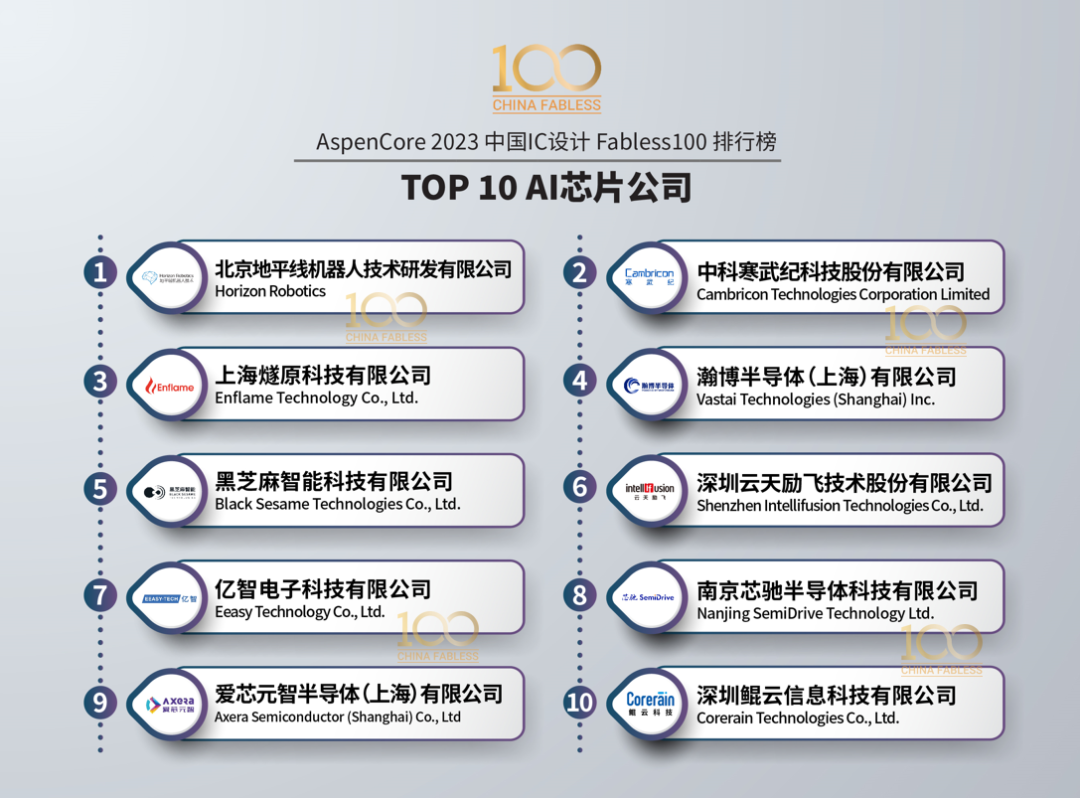
Basic information of selected companies (only Cambricon is a publicly listed company, and the other selected companies do not have a comprehensive index):

Summary of Information on 60 Domestic AI Chip ManufacturersAmong the 60 domestic AI chip companies we selected, there are 22 in the cloud acceleration application category; 14 in smart security; 11 in intelligent driving; 6 in smart wearables; 5 in smart homes; and 2 in other AIoT categories.From the perspective of the cities where the companies are headquartered, there are 18 in Shanghai; 16 in Beijing; 6 in Shenzhen; 5 in Hangzhou; 2 in Nanjing; 2 in Zhuhai; 2 in Chengdu; 2 in Jiangsu Province; 2 in Fujian Province; and one each in Hubei, Anhui, Chongqing, Guangzhou, and Suzhou.From the perspective of the year of establishment, there are 20 companies established in 2016 and earlier; 7 established in 2017; 14 established in 2018; 6 established in 2019; 8 established in 2020; 4 established in 2021; and 1 established in 2022.
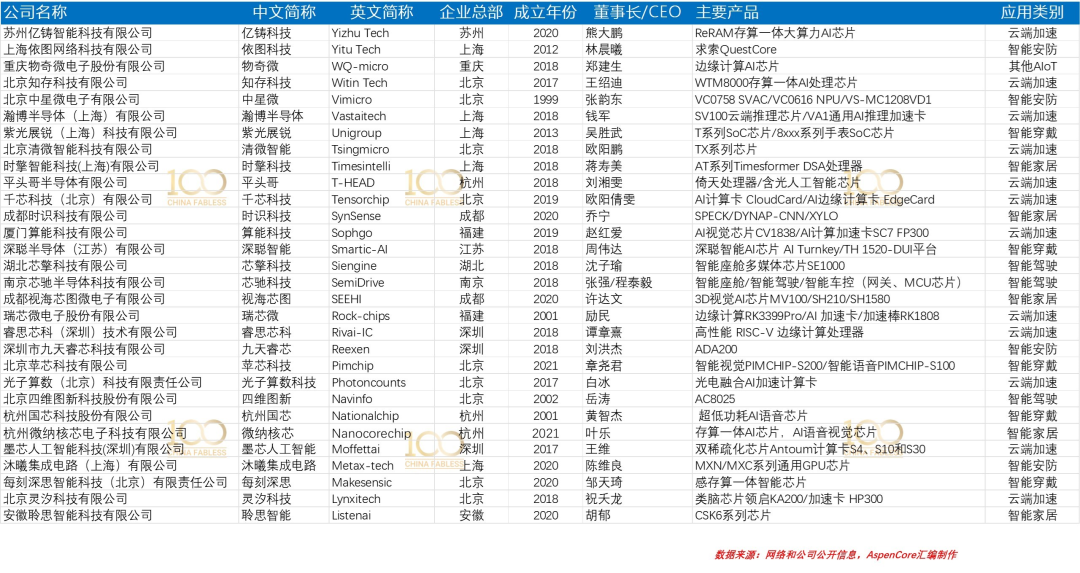
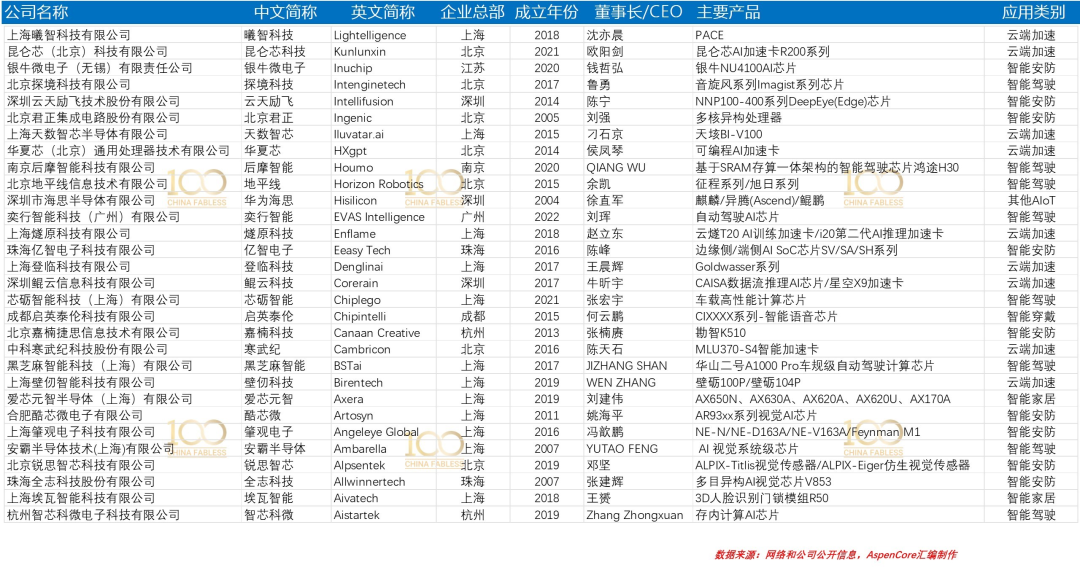
Detailed Introduction of 60 Domestic AI Chip ManufacturersYizhu Technology
Main Products: Fully digital Compute-Storage Integration AI high-performance chip and acceleration card based on ReRAM.
Core Technology: In-depth understanding and application of new memristor RRAM cell-level technology; hardware and software architecture design of Compute-Storage Integration AI high-performance chips; supporting software compilers and toolchains.
Application Scenarios: Central-side servers, cloud computing, data centers, smart security, smart education, smart finance, autonomous driving, computer vision, intelligent video processing applications, natural language processing, AIGC, cloud and edge computing applications, etc.
Market Competitiveness: Ultra-high energy efficiency ratio, ultra-large computing power development space, supporting high-precision computing, the first company to launch Compute-Storage Integration AI high-performance chips aimed at cloud computing and central-side; the team has extensive experience in high-end integrated circuit design and mass production as well as rich application and productization practical experience.
Development Milestones: Completed over 100 million yuan in angel round financing, led by Zhongke Chuangxing, Lenovo Star, and Huixin Investment (National 5G Innovation Center); obtained over 100 million yuan in Pre-A round financing, led by Longqiao Capital.
Aixin Yuanzhi
Main Products: AX650N, AX630A, AX620A, AX620U, AX170A
Core Technology: SoC chips with high computing power, high picture quality, and high energy efficiency ratio. Miniaturized packaging and low power consumption bring quality AI experience.
Application Scenarios: AI cameras, smart boxes, smart action cameras, smart traffic cameras, smart vehicle vision systems, AI acceleration cards, smart vision hubs
Market Competitiveness: Ultra-strong computing power, AISP, 4K encoding and decoding, video structuring, multi-channel decoding
Development Milestones: As of January 2022, Aixin Yuanzhi has completed four rounds of financing, and the overall financing process has been smooth, with the company’s development direction highly recognized by investors.
Horizon Robotics
Main Products: Journey series Journey®5 chip, Xuri series Xuri®3, Matrix series Matrix®5
Core Technology: The third-generation automotive-grade product, and the first domestic automotive intelligent chip developed in accordance with ISO 26262 functional safety certification process and has passed ASIL-B certification.
Application Scenarios: Mass production of high-level autonomous driving and smart cockpit
Market Competitiveness: Dual-core BPU Bayesian architecture, high-performance computing power of 128 TOPS, eight-core Arm® Cortex® -A55 CPU cluster, CV engine, dual-core DSP, dual-core ISP, powerful Codec, supporting multi-channel 4K and full HD video input and processing, dual-core lock-step MCU, functional safety level reaches ASIL-B(D), fully compliant with AEC-Q100 Grade 2 automotive-grade standards.
Development Milestones: In 2020, Horizon mass-produced China’s first automotive-grade AI chip “Journey II”; in December 2020, the total amount of C round financing exceeded 700 million USD, and C1 round financing has been completed.
Hanbo Semiconductor
Main Products: Carrier Sky VA1: General AI inference acceleration card, SV100 series: performance-excellent cloud inference chips
Core Technology: High-efficiency deep learning AI inference acceleration: INT8 peak computing power exceeds 200 TOPS, with AI throughput 2-10 times that of GPUs under the same energy consumption, ultra-low latency, suitable for real-time applications. Deep learning inference performance indicators are several times that of existing mainstream data center GPUs, with ultra-high throughput and ultra-low latency;
Application Scenarios: Machine vision, video processing, image processing, deep learning AI inference acceleration, detection, classification, recognition, segmentation, video processing, LSTM/RNN, NLP/BERT, recommendation, etc. A general architecture optimized for various deep learning inference loads, supporting computer vision, video processing, natural language processing, and search recommendation inference application scenarios.
Market Competitiveness: Strong video processing performance: supports high-density H.264, H.265, or AVS2 1080p decoding, with resolution support up to 8K.
Good generality and scalability: supports many mainstream neural networks for fast deployment, including FP16, BF16, and INT8 data types. Integrating high-density video decoding, widely applicable to cloud and edge solutions, with a single-chip INT8 peak computing power exceeding 200 TOPS, saving equipment investment and reducing operating costs.
Development Milestones: Hanbo Semiconductor was selected for the first KPMG China “Chip Technology” Emerging Enterprises 50 list, and Hanbo Semiconductor was selected for the 2021 EE Times Silicon 100 list. In April 2021, it completed A+ round financing of 500 million yuan, and in December 2021, it completed 1.6 billion yuan of continuous financing in B-1 and B-2 rounds.
Cambricon
Main Products: Intelligent acceleration card – MLU370-S4 intelligent acceleration card, intelligent edge computing module – MLU220-SOM, MLU220-M.2 edge AI acceleration card
Core Technology: TSMC 7nm process, supported by Cambricon’s next-generation AI chip architecture MLUarch03, adopting the new MLUv02 architecture, capable of achieving 16 TOPS of AI computing power in a credit card-sized module with a power consumption of only 15W.
Application Scenarios: Smart finance, smart energy, intelligent manufacturing, smart power, intelligent manufacturing, smart rail transit, smart energy, and other edge computing scenarios. Supports highly diverse AI applications such as vision, voice, natural language processing, and traditional machine learning, achieving intelligent solutions for various businesses at the edge.
Market Competitiveness: Compared to similarly sized GPUs, it can provide 3 times the decoding capability and 1.5 times the encoding capability. The MLU370-S4 acceleration card has excellent energy efficiency, is compact, and can achieve high-density deployment in servers. High integration: edge intelligent SOC module, low latency: intelligent business implemented locally, wide application: supports various AI applications.
Development Milestones: In September 2018, Cambricon was ranked first in the theme visit route at the High-Tech Fair; in December 2021, it released its first 7nm training chip Siyuan 290 and Xuansi 1000 accelerator.
Black Sesame Intelligence
Main Products: Black Sesame Intelligence Huashan° II A1000 Pro ultra-high-performance automotive-grade autonomous driving computing chip
Core Technology: A1000 Pro supports INT8 sparse acceleration, with INT8 computing power of 106 TOPS and INT4 computing power reaching a leading 196 TOPS in China. The chip adopts a heterogeneous multi-core architecture, with a 16-core Arm v8 CPU, 16nm process technology, and a typical power consumption of 25W; it supports up to 20 channels of high-definition camera input and meets ASIL-B level.
Application Scenarios: Providing multi-scenario solutions for L3/L4 level autonomous driving, the high-computing architecture supports L3/L4 high-level autonomous driving functions, achieving seamless connections from parking lots to urban areas and highways.
Market Competitiveness: Supports high-level autonomous driving functions, 20 channels of high-definition camera input, typical power consumption of 25W, supports high-level autonomous driving functions, parking, urban, highway, etc., seamless connection across multiple scenarios.
Development Milestones: In August 2022, Black Sesame Intelligence completed all financing in rounds C and C+, raising over 500 million USD, with a post-investment valuation of 2 billion USD. Currently, the Black Sesame Intelligence Huashan II A1000 chip has obtained fixed-point projects for 15 different vehicle models.
Humo Intelligent
Main Products: Second-generation chip – high-performance, high energy efficiency intelligent computing chip based on advanced storage processes such as RRAM, Hongtu H30
Core Technology: Based on advanced storage processes such as RRAM, continue to expand model capacity, further reduce power consumption, increase computing power, ultimately achieving single-chip computing power of 1000 TOPS. The Hongtu H30 is the first compute-storage integration intelligent driving chip, with a maximum physical computing power of 256 TOPS and a typical power consumption of 35W, becoming the first company in China to land compute-storage integration high-performance AI chips.
Application Scenarios: Solutions for edge scenarios such as general robotics/unmanned vehicles
Market Competitiveness: Open chip, toolchain, forming a complete reference sample, open and easy to use, enabling one-stop deployment and rapid application. The Hongtu H30, based on SRAM storage media, adopts a digital compute-storage integration architecture, with extremely low memory access power consumption and ultra-high computing density. Under Int8 data precision conditions, its AI core IPU energy efficiency ratio reaches 15 Tops/W, more than 7 times that of traditional architecture chips. It has successfully run commonly used classic CV networks and various advanced networks for autonomous driving.
Development Milestones: Completed tens of millions of USD in angel round financing, led by Sequoia Capital China Fund, completed 300 million yuan in Pre-A round financing, led by Qiming Venture Partners, and announced completion of hundreds of millions of yuan in Pre-A+ round financing, led by Jingwei China Venture Capital and other institutions.
In the interest of brevity, only a portion of representative manufacturer information is displayed. For detailed information on these 60 domestic AI chip manufacturers, readers are encouraged to:
Click the link “Read the original text” to submit an application online, or scan the QR code below to obtain the complete PDF version of the report for free.