 According to Interesting Engineering, a website focused on industrial science, the team from the Korea Institute of Science and Technology (KITECH) has successfully manufactured a titanium alloy space fuel tank using Directed Energy Deposition (DED) technology, which has passed extreme environmental testing. The Ti64 titanium alloy container successfully withstood the combined impact of -196°C ultra-low temperature and 330 bar (approximately 330 times atmospheric pressure) at the concrete barrier testing ground of the Korea Aerospace Research Institute (KARI), marking the first verification of the reliability of large 3D printed structures in simulated space environments.Traditional forging processes require fixed molds and have a material waste rate of up to 80%. In contrast, the KITECH team utilized Electron Beam Melting Wire Deposition (EBF) technology (a variant of DED) — which melts titanium wire layer by layer using an electron beam — reducing the manufacturing cycle by over 80% and increasing material utilization by three times. Project leader Dr. Lee Hyun-pae stated, “This lays the foundation for the large-scale application of 3D printing in the aerospace field.”Core of the Technical Breakthrough
 (1) DED TechnologyThe core of DED technology lies in moldless forming and efficient material utilization. The Korean team melts titanium wire into a liquid state under inert gas protection using a laser, and then layers it through a precision nozzle to form two hemispheres, which are then welded together to create a complete fuel tank. Compared to the satellite fuel tanks manufactured by Lockheed Martin in 2018, the manufacturing cycle has been compressed to three days, and costs have been reduced by 50%. Its core advantages include:1. Design Flexibility: Rapid adjustments to size and structure to meet customization needs.2. Material Performance:Ti64 exhibits significantly better corrosion resistance than stainless steel in aerospace cryogenic propellant environments, with a strength-to-weight ratio 1.8 times that of aerospace aluminum alloys.3. Supply Chain Resilience:Eliminating dependence on large forging equipment and molds.(2) Low-Temperature High-Pressure TestingDuring testing, the fuel tank was placed in a -196°C liquid nitrogen environment and subjected to 330 bar pressure, simulating the extreme conditions of space propellant storage. Although the team achieved success in a single test, they still need to conduct cyclic pressure tests to verify its durability under repeated stress. Researcher Kim Hyun-jun emphasized, “This is a prerequisite for obtaining space certification, and we plan to complete full-cycle verification by 2026.”(3) Multiple Path BreakthroughsIn addition to DED, other metal printing technologies are accelerating military applications:1. Electron Beam Melting (EBM):The Royal Air Force of the UK uses Wayland Additive’s Calibur3 system to manufacture mounting components for the Typhoon fighter jet, completing production in a high-temperature vacuum environment, eliminating the need for post-processing heat treatment, and reducing the waiting time for spare parts from months to days.2. Cold Metal Fusion (CMF):Germany’s Headmade company utilizes SLS equipment to print titanium alloys, achieving support-free complex structure manufacturing on EOS and Huazhuo High-tech equipment, suitable for mass production of military parts.3. Binder Jetting (MBJ):HP technology enables low-cost mass production but faces challenges with sintering deformation.
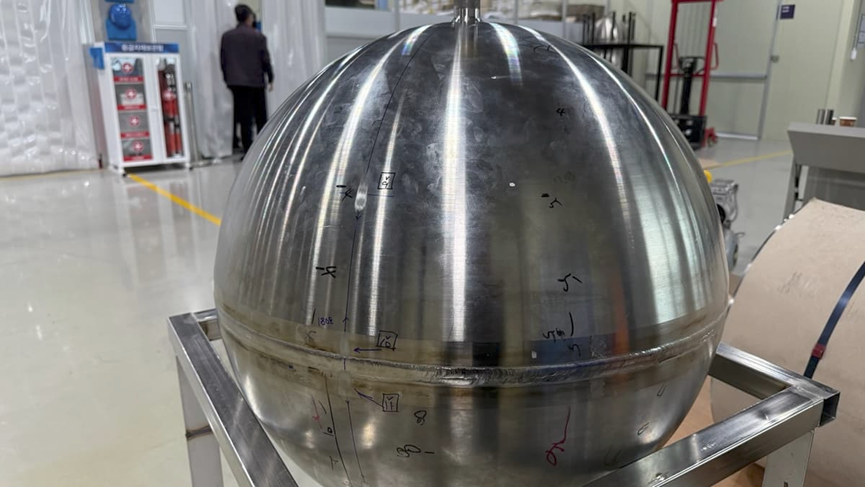 Products created by welding two hemispheres together after DED 3D printing / Image from the Korea Institute of Science and TechnologyMilitary Application Overview(1) Reshaping Logistics Rules1. Soldier-less Drone Factories:The British Army’s Rifle Regiment used a Top Bamboo FDM printer during exercises in Kenya to manufacture and assemble FPV attack drones on-site within four hours, reducing costs to one-fifth of traditional procurement (approximately 3600 RMB). Commander Stephen Watts noted, “We can customize drones based on daily missions, supplying the front lines regularly like ammunition.”2. Revolution in Ship Maintenance:The U.S. Marine Corps’ containerized mobile printing laboratory reduced the delivery cycle of a $30,000 ship component from 6-9 months to 3 days during the Trident Warrior exercise, and with cold spray technology, repairs can even be made during helicopter flight.3. Low-Cost Air Defense:The Ukrainian Wild Hornets organization uses a Bambu Lab 3D printer cluster to produce 100 “Sting” intercept drones daily, costing only $1,000-4,000 (1/35 of the Russian Shahed-136 drone, 0.25‰-1‰ of traditional air defense missile costs), achieving a cost-effectiveness advantage of $1.69 billion by downing 448 targets.(2) Cost and Function Breakthroughs
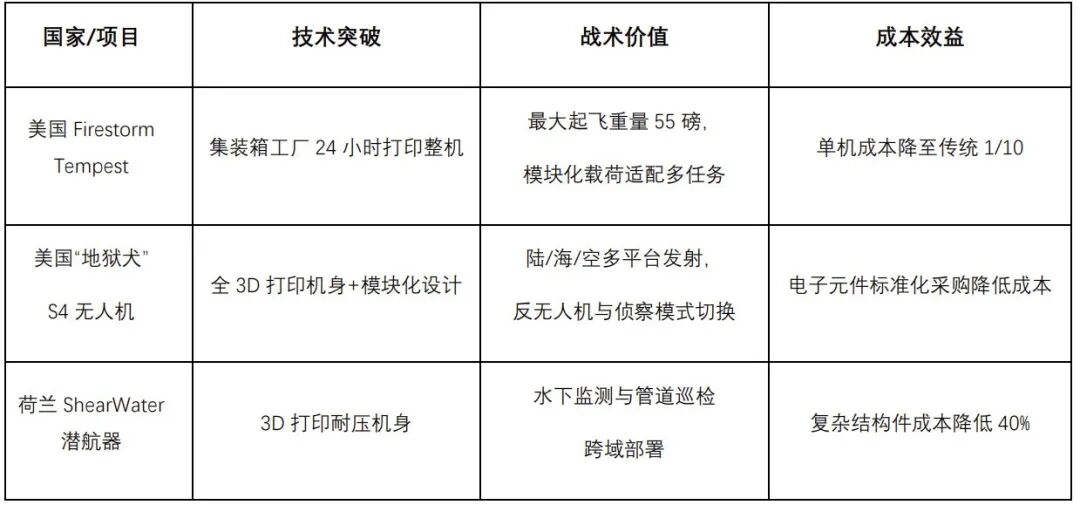 (3) A New Era of On-Orbit ManufacturingThe breakthrough of the Korean fuel tank directly promotes the development of on-orbit manufacturing technology. Traditional satellite fuel tanks require over a year of forging cycles, while 3D printing can significantly compress the process:Lockheed Martin’s 3D printed titanium alloy fuel tank dome, with a diameter of 1.2 meters, reduced delivery time from 2 years to 3 months, and NASA’s on-orbit manufacturing project (OSAM-2) plans to achieve satellite fuel tank printing at the space station by 2027.China’s Aerospace Sixth Academy applied 3D printing to the “Qiao Qiao No. 2” satellite storage tank, while the Eighth Academy achieved one-time forming of 3.6-meter high-strength steel components for the space station’s Meng Tian module.The U.S. Air Force Research Laboratory (AFRL) has explicitly planned in its “Directed Energy Future 2060” report that 3D printing will support the manufacturing of complex structural components for a 30,000-foot high laser “shield”.Five Disruptive Changes in Future Warfare(1) From Physical Supply Chains to Digital ChainsThe traditional “forecast-reserve-transport” model will be replaced by a “digital transmission-on-site manufacturing” network. The case of the U.S. Creech Air Force Base shows that the cost of MQ-9 drone parts dropped from $10,000 to $15, a 99.85% reduction. Marine Corps innovation unit commander Michael Ladiqan described it as “the Uber service of manufacturing — delivering nuclear-grade components globally at Amazon speed.”(2) A Thousandfold Cost-Effectiveness ReconstructionUkrainian practices have proven that a cost of one-thousandth can achieve similar tactical effectiveness. When the price of intercept drones drops from the million-dollar range to the thousand-dollar range, the economic rationality of traditional air defense systems is completely overturned. The Wild Hornets’ Sting drones, with a speed of 250 km/h and a combat radius of 15 km, create a sustainable consumption air defense swarm.(3) AI-Driven Battlefield OODA LoopThe team led by Zhao Kai from China’s Aerospace Eighth Academy pointed out, “The integration of machine learning and additive manufacturing is an inevitable trend.” Future systems will achieve a four-step closed loop:1. Self-collection: Scanning battlefield-damaged components.2. Self-modeling: AI generates optimized designs.3. Self-decision: Selecting materials and process paths.4. Self-manufacturing: On-site printing of repair parts.The xCell system from U.S. Firestorm Labs has already realized a semi-automated “design-print-deploy” container factory prototype.(4) Formation of a Three-Tier Manufacturing SystemGeneral Atomics’ 2024 tests show that the MQ-20 drone mothership releases fully 3D printed sub-drones in the air, rehearsing the “aerial factory” concept. Based on the U.S. Department of Defense’s “AM Strategic Roadmap” (2024), the three-tier system employs differentiated technologies:1. Strategic Level: DED/SLM production of high-value components (such as satellite fuel tanks) at rear bases, relying on precision equipment and environmental control.2. Campaign Level:Mobile container factories using Binder Jetting (MBJ) for mass production of drones, balancing speed and precision.3. Tactical Level:Frontline FDM printing of expendable parts, quickly integrating batteries and sensors through modular interfaces (such as U.S. Army PEO Aviation standards).
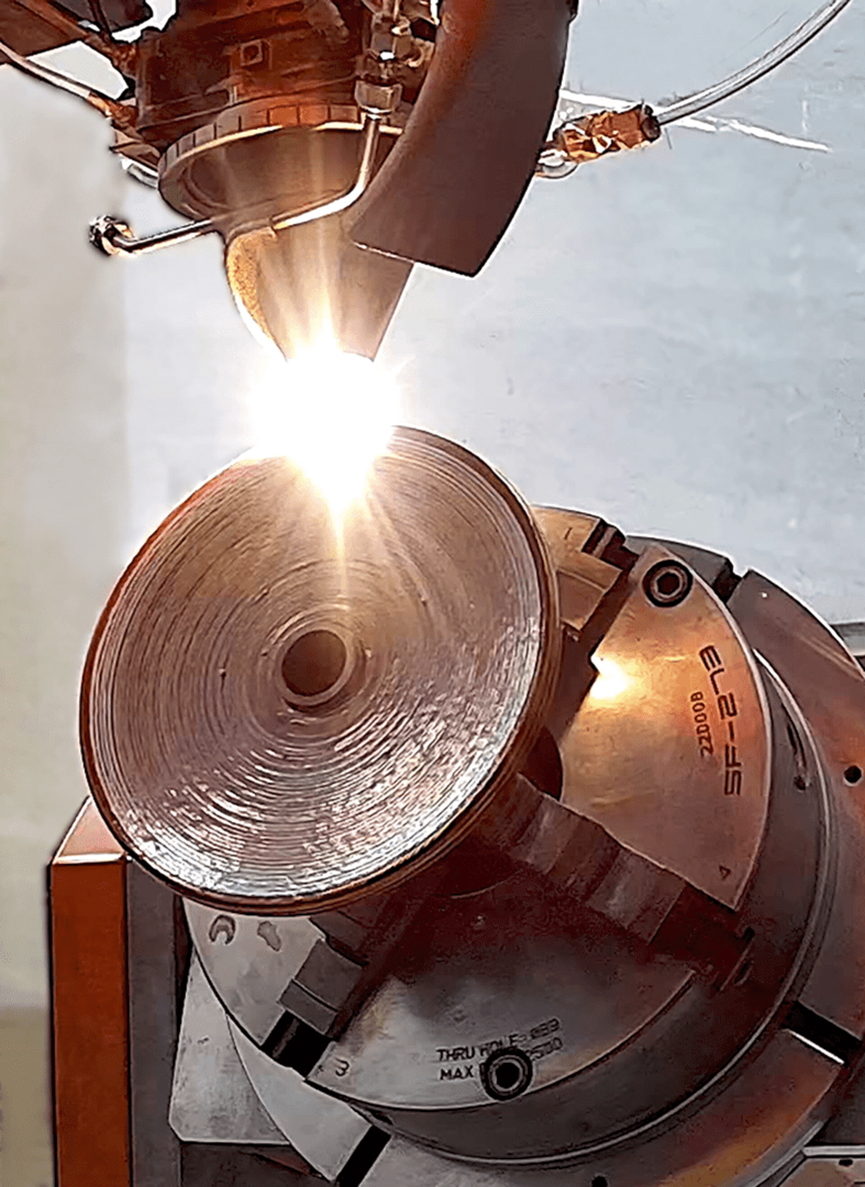 Electron Beam Melting Wire Deposition process / Image from the Korea Institute of Science and TechnologyChallenges and Critical Points(1) Certification GapThe Royal Air Force of the UK has explicitly labeled 3D printed components for the Typhoon fighter as “temporary replacement parts,” reflecting the stringent requirements of current military standards regarding fatigue life and material consistency. Although the Korean fuel tank has passed a single test, it must undergo 10,000 cyclic pressure tests to obtain space certification.(2) Process Bottlenecks1. Environmental Sensitivity:Titanium alloy printing requires 99.99% pure argon gas protection (oxygen content ≤ 200 ppm), which is difficult to guarantee in battlefield environments.2. Thermal Stress Deformation:SLM technology requires complex mesh supports when manufacturing thin-walled structures, limiting design freedom.3. Scale Bottlenecks:The Firestorm Tempest drone requires 24 hours to print its body, still having an order of magnitude difference compared to traditional production lines.(3) Material LimitationsCurrent technology primarily addresses structural component manufacturing, while electronic systems (flight control, sensors) still rely on traditional supply chains. In the UK FPV drone practice, core components such as batteries and cameras still need to be manually installed, accounting for 70% of the total cost.From Laboratory to Battlefield: A Disruptive PathThe testing of the titanium alloy fuel tank by the Korea Institute of Science and Technology marks a key step in the application of 3D printing technology from the laboratory to practical combat use. In the next decade, this technology will drive military transformation in the following areas:1. Equipment Performance Leap:The application of high-temperature superalloys and lightweight composite materials will increase the range and payload of fighter jets and missiles by over 30%.2. Logistics System Reconstruction:The establishment of distributed manufacturing networks will enhance the autonomous support capabilities of frontline troops by 50%, significantly improving battlefield sustainability.3. Strategic Deterrence Transformation: The rapid response capability of 3D printing makes “instant deterrence” possible, allowing for the real-time manufacturing of new weapon systems to create dynamic strategic balance.However, while achieving technological breakthroughs, countries must seek a balance between innovation and risk. As emphasized by the U.S. Department of Defense in its “Additive Manufacturing Strategy”: “3D printing is not just a manufacturing tool, but a core component of national defense strategy.” In the future, whoever can first solve the challenges at the material, process, and strategic levels will gain the upper hand in this military revolution.



Recommended Reading

Long-Term Vision: Mushroom Cloud 2024 Work Summary and New Year Greetings

A chip earns $3,750, Nvidia compromises for market share
From live-fire exercises to neural deception, the U.S. military’s VBS4 tactile system tears apart traditional battlefield boundaries