2024 Comprehensive Python Beginner Tutorial

2024 Comprehensive Python Beginner Tutorial

Follow 👆 the official account and reply with "python" to receive the beginner tutorial! Source from the internet, will remove if infringed. Python is an open-source, free, general-purpose scripting programming language that is easy to learn and powerful, adhering to the principle of “minimalism”. Python has an extremely rich library (module), making it almost omnipotent; … Read more

Setting MySQL Case Sensitivity on Linux

Setting MySQL Case Sensitivity on Linux

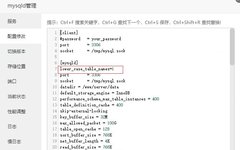
1. Check If MySQL Is Case-Sensitive show variables like '%case_table%'; lower_case_table_names=1 (indicates it is case-insensitive) lower_case_table_names=0 (as shown in the image, 0 indicates case-sensitive) 2. Change lower_case_table_names Value to 1 (1) Since I am using the Baota panel, I can directly modify the configuration information Add lower_case_table_names=1 under [mysqld] (as shown below) (2) Modify /etc/my.cnf … Read more

One-Click Installation of MySQL on Linux

One-Click Installation of MySQL on Linux

Preparing Installation Package mysql-8.0.28-linux-glibc2.12-x86_64.tar.xz Download and install the package to /usr/local/soft, this path should match the one in the script file Write the script fileinstall_mysql.sh (CentOS version) The content of the file is as follows: #! /usr/bin/bash## Fully automated source code compilation and installation for any versionif [ ! -d "/usr/local/soft" ]then echo "Directory does … Read more

Linux MySQL Installation Tutorial

Linux MySQL Installation Tutorial

Ubuntu, OpenWRT, Debian,OpenKyline has a package manager that allows for direct online software installation. However, embedded operating systems, such as Buildroot, typically use cross-compilation to install software like the MySQL database.Most commonly used software actually has pre-compiled installation packages available, so customers do not need to recompile. Here, we take the MySQL database as an … Read more

Completely Uninstall MySQL 5.7 on CentOS 7 [Test Successful]

Completely Uninstall MySQL 5.7 on CentOS 7 [Test Successful]

Method 1: 1. Check MySQL installation rpm -qa|grep -i mysql 2. Stop MySQL service before uninstalling rpm -ev –nodeps mysql-community-release-el7-5.noarch rpm -ev –nodeps mysql-community-common-5.6.38-2.el7.x86_64 rpm -ev –nodeps mysql-community-client-5.6.38-2.el7.x86_64 rpm -ev –nodeps mysql-community-libs-5.6.38-2.el7.x86_64 rpm -ev –nodeps community-server-5.6.38-2.el7.x86_64 After executing the command, execute again rpm -qa|grep -i mysql to find that it has been uninstalled. Or directly … Read more

Compilation Process Record of MySQL Version 8.4.2 on the Feiteng Platform with ARM Architecture

Compilation Process Record of MySQL Version 8.4.2 on the Feiteng Platform with ARM Architecture

As a globally popularMySQL database, it has witnessed the growth ofMySQL from version3.x to the current8.x. The issue known as the2038 problem withMySQL has been resolved since version8.0.28. Recently, I downloaded the latest8.4.2 version and compiled it from source on the minimal Feiteng platform with ARM architecture, documenting some issues encountered during the process. 1.WARN_MISSING_SYSTEM_TIRPC … Read more

How to Deploy a Nacos Cluster with One Click Using Ansible?

How to Deploy a Nacos Cluster with One Click Using Ansible?

Use Ansible to achieve one-click deployment of a 3-node Nacos cluster. Definition of the hosts file [root@localhost ansible]# cat inventory/hosts [all:vars] # ansible_ssh_pass: Host password # ansible_user: Host account ansible_become=true ansible_ssh_pass=123456 ansible_ssh_user=weihu ansible_become_pass=123456 ansible_become_user=root ansible_become_method=sudo [nacos] 192.168.10.150 nacos_db_init=true 192.168.10.151 192.168.10.152 Definition of global variable file [root@localhost ansible]# cat inventory/all.yml all: vars: mysql_nacos_host: "192.168.10.128" mysql_nacos_port: "3306" … Read more

Practical Implementation of MySQL Deployment with Ansible

Practical Implementation of MySQL Deployment with Ansible

1. Overview of Ansible Ansible is an open-source automation tool for IT operations, created by Michael DeHaan in 2012 and acquired by Red Hat in 2015 for over $100 million. It is developed in Python and manages remote nodes via SSH protocol without the need to install any client agents on the controlled end (Agentless). … Read more

Linux Tutorial: Getting Started with Clickhouse and Maxwell (Part 2)

Linux Tutorial: Getting Started with Clickhouse and Maxwell (Part 2)

Introduction: In the previous chapter, we discussed the basics of Clickhouse and its deployment in a Linux environment. In this chapter, we will learn how to synchronize and update data using Maxwell. This will be explained in a straightforward manner. Please ensure that your server has MySQL database and RabbitMQ middleware installed, along with a … Read more

Stop Tying Down MySQL! The Ultimate Guide to Nacos Embedded Derby Solutions and Database Selection

Stop Tying Down MySQL! The Ultimate Guide to Nacos Embedded Derby Solutions and Database Selection

When you are struggling locally with Nacos and exclaim, “Installing MySQL, configuring master-slave, changing ports… I just want to run a demo locally!” In fact, 90% of developers do not know: you can start Nacos with zero dependencies without installing MySQL—the secret lies in the embedded database Derby. 1. Derby: The Overlooked King of Embedded … Read more