Usage of the Linux Text Processing Command awk

Usage of the Linux Text Processing Command awk

<span>awk</span> is a powerful text processing tool and a data stream processing programming language in Linux/Unix systems. It is particularly suitable for handling structured data (such as logs, CSV, etc.) and supports programming features like pattern matching, variables, and functions. 1. Basic Syntax awk [option] 'pattern { action }' input_file • pattern: Matching pattern (optional), … Read more
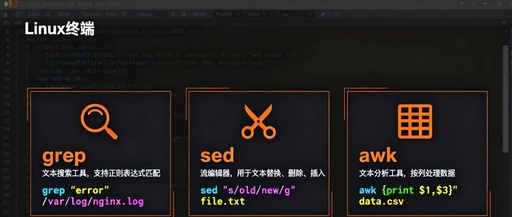

Daily Linux: Efficient Text Processing with awk Command

1. Command Introduction and Principles 1.1 Introduction awk is a powerful text processing programming language, named after the initials of its three founders: Alfred Aho, Peter Weinberger, and Brian Kernighan. It is not only a text processing tool but also a complete programming language, particularly suitable for handling structured data and generating reports. 1.2 Working … Read more

Chip Debugging: Using AWK and GREP to Retrieve Data

When debugging chips in a Linux system, we often need to read the values of registers. Sometimes, manual reading is sufficient, but in scenarios where the reading frequency is high and the data volume is large, scripts are necessary to solve the problem. Scripting languages such as Python and shell can be used, with complex … Read more

Overview of the awk Command in Linux for Bioinformatics Applications

Today, I am sharing an overview of the awk command in Linux for bioinformatics applications, covering core principles, frequently used scenarios, and examples, which can efficiently process commonly used structured text data such as genomic and transcriptomic data. 1. Core Principles of awk awk = Text Scanning Engine + Programming Language Line-by-line Processing: Treats the … Read more

A Comprehensive Guide to AWK and Its Applications in Genomics

AWK is an acronym for the names of developers Aho, Weinberger, and Kernighan, and we would like to express our gratitude to these pioneers.The history of AWK can be traced back to the early Unix era. It is part of the POSIX standard and should be available on any Unix-like system, and possibly on other … Read more

Mastering the ‘Three Musketeers’ of Linux: A Detailed Guide to grep, sed, and awk

Mastering the 'Three Musketeers' of Linux: A Detailed Guide to grep, sed, and awk

Mastering the ‘Three Musketeers’ of Linux: A Detailed Guide to grep, sed, and awk The Three Musketeers of Linux Introduction: “Why can others complete log analysis in 5 minutes while I have to manually search for a long time?” “Why do my operations colleagues always seem to perform ‘magic’ in the command line?” The answer … Read more

The Three Musketeers of Text Processing in Linux

The Three Musketeers of Text Processing in Linux

Core Concepts • grep: Global Regular Expression Print. Used for searching and filtering text. Its core function is to match patterns (regular expressions) and output the matching lines. • sed: Stream EDitor. A stream editor used for basic text transformations such as replacing, deleting, and inserting text. It processes text line by line and is … Read more

The Three Musketeers of Linux: awk

The Three Musketeers of Linux: awk

In Unix and Unix-like operating systems, text processing is a fundamental and critical task. Since the 1970s, with the development of computer technology and the growing demand for data processing, a series of powerful text processing tools have emerged. Among them, <span>awk</span> is highly regarded for its unique text analysis and report generation capabilities. The … Read more

Practical Linux Text Processing Tools: Essential Skills for Log Analysis

Practical Linux Text Processing Tools: Essential Skills for Log Analysis

tail, grep, and awk are three commonly used command-line tools in Linux/Unix environments. Each has its own focus, but they are often used together to process text data. 1. <span><span>tail</span></span>: View the end of a file Function: Displays the end portion of a file (default last 10 lines), commonly used for viewing logs or real-time … Read more

Modal Synthesis Method Example: Including ANSYS Command Stream and MATLAB Source Code

Modal Synthesis Method Example: Including ANSYS Command Stream and MATLAB Source Code

Explanation of Analytical Solution A cantilever plate with three free edges and one fixed edge can solve the variational equation by reducing it to a regular ordinary differential equation in another direction using one-way analytical methods. Analytical Solution Process: For specifics, please refer to Cao Zhiyuan’s “Theory of Plate and Shell Vibrations” pages 47-49. Finite … Read more