Linux Find Command: Detailed Explanation of find, grep, and ripgrep (rg)

Linux Find Command: Detailed Explanation of find, grep, and ripgrep (rg)

1. Detailed Explanation of the find Command 1.1 Purpose <span>find</span> is the most powerful file search tool in Linux, capable of recursively searching for files in a directory tree. It supports filtering by various criteria such as name, type, size, and time, and can perform various operations on the search results. 1.2 Syntax find [path] … Read more
Linux Command Series: The Powerful Text Search Tool grep

This article provides a detailed introduction to the usage of the grep command, including common options, regular expression applications, and more. Let’s learn together and improve together! Continue reading!First, what is grep?grep is a command in the Linux system used to search for text within files, useful for various text processing and log analysis. I … Read more

Chip Debugging: Using AWK and GREP to Retrieve Data

When debugging chips in a Linux system, we often need to read the values of registers. Sometimes, manual reading is sufficient, but in scenarios where the reading frequency is high and the data volume is large, scripts are necessary to solve the problem. Scripting languages such as Python and shell can be used, with complex … Read more

Commonly Used grep Commands in Linux/Shell Scripts

1. Introduction to the grep Command grep is a powerful command used for text searching in Linux/Unix systems. It searches for matching content in files or input streams based on specified patterns (regular expressions or strings) and outputs the lines containing the matches. 2. Basic Syntax of the grep Command grep [options] pattern [file..] pattern: … Read more

Finding Files in Linux: More Reliable Than Finding a Partner!

1. The “Courier Sorter” of File Searching: whereis 1.1 Basic Usage: The Precision Trio whereis is known as the “courier sorter” in the Linux world, specifically responsible for locating binary files (.bin), help documents (.man), and source code files. For example, if you want to know where the “ls” command is hidden, just typewhereis ls, … Read more

Usage of the Linux Text Search Command grep

<span>grep</span> (Global Regular Expression Print) is a powerful and commonly used text search tool in Linux/Unix systems, used to search for lines that match a specified pattern (usually a regular expression) in files or standard input, and outputs the matching lines to standard output. 1. Basic Syntax grep [options] pattern [file…] • Pattern: The string … Read more

Detailed Usage of Linux grep

Today, I will share the Detailed Usage of Linux grep, covering core principles, practical applications, and advanced optimization techniques, in conjunction with biological data file formats (FASTA/VCF/SAM, etc.). 1. Core Operating Mechanism of grep 1. Search Pattern Hierarchy graph TD A[Standard Input/File] –> B[Line-by-Line Scanning] B –> C{Pattern Matching Judgment} C –>|Basic Regex| D[BRE Mode] … Read more

How grep Became an Efficient Tool for Text Search in Linux

When faced with hundreds of lines of log files, how can you quickly locate key error messages? When you need to filter valid content from a large number of configuration files, how can you avoid the tediousness of line-by-line searching? The Linux command we are introducing today—grep—is an efficient tool that solves these problems. Known … Read more

Overview of the Linux grep Command for Bioinformatics

Today, I will share an overview of the Linux grep command tailored for bioinformatics scenarios, covering core principles, high-frequency usage, and examples to quickly filter text data such as genes and transcriptomes. 1. Core Principles of grep grep = Pattern Matching Engine Line-by-line Scanning: Matches file content based on regular expressions (RegEx) Pattern Types: Basic … Read more

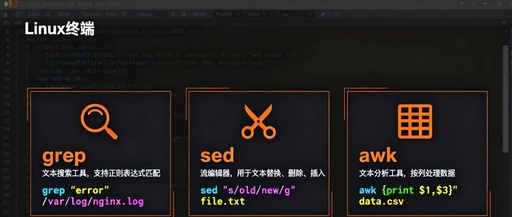
Mastering the ‘Three Musketeers’ of Linux: A Detailed Guide to grep, sed, and awk

Mastering the 'Three Musketeers' of Linux: A Detailed Guide to grep, sed, and awk

Mastering the ‘Three Musketeers’ of Linux: A Detailed Guide to grep, sed, and awk The Three Musketeers of Linux Introduction: “Why can others complete log analysis in 5 minutes while I have to manually search for a long time?” “Why do my operations colleagues always seem to perform ‘magic’ in the command line?” The answer … Read more