This article contains 2234 words, and reading it will take approximately 7 minutes.

The legislative waves surrounding chips are grand, and market growth is evident. After specialized legislation, did Prince Chip and Princess Mask live happily ever after? You certainly know that is not the case.
But you may not know that it is not only not the case, but it is also quite uncomfortable.
Taking the United States as an example, since the establishment of the “Semiconductor Chip Protection Act”, there have only been two court rulings, and even the number of registrations in recent years can be ignored.
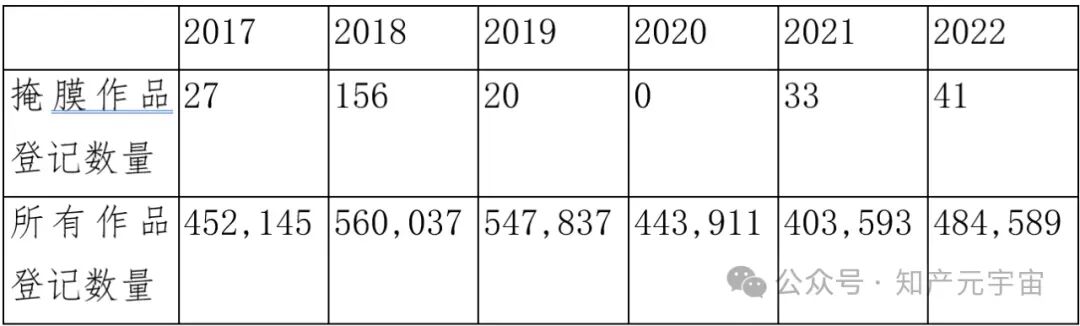
Since 2019, the number of registrations in China has shown a significant increase. Although there are factors related to industry development, the main reason is that the Supreme Court made a ruling (No. 490) recognizing that chip samples submitted during registration can serve as the basis for protecting layouts.
However, after a shot of adrenaline, the number of registrations has also begun to decline.
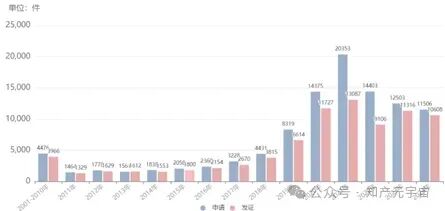
Statistics on the registration status of integrated circuit layout designs by the National Intellectual Property Administration
From the number of cases, this specialized protection for chips, which was highly anticipated before its birth, has been neglected after its birth, which is somewhat humiliating.
From the number of cases, layout design does not seem to be successful, but from the perspective of industry development, American companies can confidently outsource the least profitable chip manufacturing, allowing the sub-semiconductor industry to rise.
Is it possible that the existence of layout design protection itself has its value? Similar to hiring a bodyguard, who only acts twice in decades, it may not be that the bodyguard is useless; perhaps the deterrent effect of having a bodyguard means that there is no need to act, especially since before hiring a bodyguard, one often got beaten up. Family members, who understands?
Speaking of layout design, a right specifically created for chips, one must mention the overall pattern of the chip industry.
Since the 1960s and 70s, American companies have started the era of outsourcing manufacturing to reduce costs and tax benefits. The original intention of layout design protection includes responding to the copying and competition from foreign companies[1], and objectively, outsourcing chip manufacturing has indeed made American companies a lot of money.
But it has also created today’s semiconductor manufacturing industry in East Asia.
At that time, outsourcing chip manufacturing was no different from outsourcing television manufacturing. But no one expected that under the support of Moore’s Law, chip manufacturing would soar like a dragon in the sky.
Speaking of the dragon soaring in the sky, from a materialist perspective, the prosperity of the East Asian semiconductor industry resembles the Qian hexagram in the I Ching:

1960s: The first line of the Qian hexagram, “The hidden dragon does not use its power”, begins to accumulate strength. In 1966, General Instruments began to set up factories in Kaohsiung, Taiwan, and Fairchild began to build factories in South Korea, marking the beginning of the semiconductor industry in both regions.
1970s and 80s: The second line of the Qian hexagram, “The dragon appears in the field, and it is beneficial to see great people”; diligent development finally meets the outsourcing of large enterprises. For example, after TSMC was established in 1987, it received a large number of orders from Texas Instruments.
1990s: The third line of the Qian hexagram, “The dragon is active all day, vigilant in the evening”. After day-long caution and night vigilance, in 1992, Samsung was the first to develop 64M DRAM, and TSMC went public in Taiwan in 1994 and on the New York Stock Exchange in 1997.
At the turn of the century: The fourth line of the Qian hexagram, “The dragon leaps in the abyss”. In 2001, TSMC experienced a 24% decline in maximum performance, but for the first time formed a global lead in 0.13 microns; Samsung faced a halving of the DRAM market size from $28.8 billion to $11 billion, but while laying off 30% of its workforce, it invested $4 billion in expansion, ultimately leaping over the abyss.
New century: The fifth line of the Qian hexagram, “The dragon soars in the sky”. Just look at TSMC’s profit curve, it is indeed soaring in the sky.
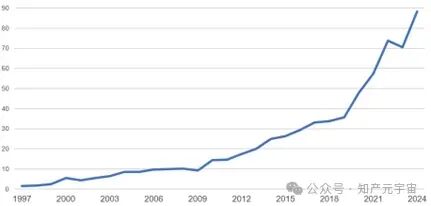
TSMC’s profits from 1997 to 2024[2] (Unit: billion USD)
In recent years: The sixth line of the Qian hexagram, “The dragon in the sky has regrets”. The so-called extreme must turn back; from a technical perspective, Moore’s Law is facing its final chapter, and more advanced processes require higher costs, but do not necessarily yield more economical results, and this impact is long-term. From a situational perspective, the so-called return of manufacturing and the turmoil caused by the U.S. government cannot be ignored.
Regardless, although the demand for mobile chips is slowing, AI chips are thriving. Currently, chip foundries in Taiwan and South Korea are still booming, and strong manufacturing means strong design, but the protection of designs through layout design is indeed not robust enough and needs rescue.
Since the Supreme Court agreed to use chip samples submitted during the application for layout design protection as the basis for rights[3], integrated circuit layout design has received a shot of adrenaline, at least the application volume has visibly increased.
However, this rescue seems insufficient. So how can we rescue it?
For example, the NE555 chip, which is over fifty years old, has been around since 1971 and is still performing well, often becoming a best-seller. In contrast, Apple is expected to release the A19 chip in September 2025, having released chips every year for 16 consecutive years since the A4 in 2010. The huge difference between these two is also a challenge to layout design.
For certain analog chips, a 10-year protection period for integrated circuit layout design may not be enough. But for certain digital chips, they often do not have a lifespan of 10 years. Is it possible for the protection system to respond?
For instance, if layout design applications are not publicly exchanged for protection, could applicants be allowed to keep their submissions completely confidential? For example, allowing applicants to submit invisible encrypted drawings, or administrative agencies generating blockchain to ensure that the drawings are immutable, so that during rights protection, verification through blockchain is sufficient for rights protection.
For example, layout design only protects the layout, theoretically not extending to the circuit itself, but reverse engineering can obtain the circuit, and “rewriting” is feasible. Could we consider extending protection to the circuit itself under certain conditions?
These are all issues that the industry needs to discuss. In fact, the industry has been trying to save itself, such as trying to add watermarks to layouts to make “rewriting” traceable, or attempting to charge licensing fees for reverse engineering, etc.
Currently, layout design is merely an auxiliary protection measure for chips; trade secrets and patents are undoubtedly more important means. If layout design remains stagnant, its importance will inevitably decrease.
In fact, for the NE555, remaining motionless is somewhat painful; if it could see its successors soaring past, that might be the happiest outcome.
Notes
[1] U.S. House of Representatives Report No. 98-515, 98th Congress, (1984): The 1984 Congressional Report (House Report 98-781) pointed out that foreign companies could produce imitations by reverse engineering American designs with only 1/10 of the original R&D costs, leading to a loss of competitiveness for American companies in the global market. The committee believed that a new type of intellectual property protection system must be established through legislation to prevent such piracy from eroding America’s technological advantage;
[2] https://companiesmarketcap.com/tsmc/revenue/;
[3] (2019) Supreme Court Civil Judgment No. 490.

Jin Qiang
Yuanhe Law Firm
Partner
Main practice areas: Intellectual property and competition law dispute resolution.。
Previous Issues
|
01 Yuanhe Insights • Chip IP Expert Jin Says (Part 20) | The Integrated Circuit Layout Design in Need of Rescue (Part 1) |
|
02 Yuanhe Insights • Chip IP Expert Jin Says (Part 19) | The End of Patents: The First Sword of the Market, First Slay the Californians |
|
03 Yuanhe Insights • Chip IP Expert Jin Says (Part 18) | Nobel Prize and Job Inventions |
|
04 Yuanhe Insights • Chip IP Expert Jin Says (Part 17) | American Semiconductors, Patents are the Main Body, NPE Initiated, You Can Too |
About the Firm
The intellectual property team at Yuanhe Law Firm has long provided comprehensive intellectual property legal services to globally renowned enterprises, research institutions, and technology and cultural innovation companies, successfully representing numerous high-profile intellectual property cases both domestically and internationally, and participating in many complex intellectual property transactions, possessing outstanding professional quality and rich practical experience.
Yuanhe has established long-term and stable cooperative relationships with many intellectual property agencies and law firms worldwide, forming a one-stop service system centered on international patent applications, international trademark registrations, and international intellectual property dispute resolution, capable of providing clients with rapid response and internationalized services for their global intellectual property legal needs.
If you have any needs, please feel free to contact us:
Contact Address:
27th Floor, Fortune Financial Center, 5 Dongsanhuan Zhonglu, Chaoyang District, Beijing, China, 100020
电话:+86-10-5733-2388
Fax:+86-10-5733-2399
Website:www.yuanhepartners.com
Images in this article are sourced from: ibaotu
Disclaimer
This article does not represent any form of legal opinion or advice issued by Beijing Yuanhe Law Firm or its lawyers. For reprints or citations, please indicate the source from the public account “Yuanhe Legal Research Institute” and the author’s name at the beginning of the article.
– THE END –