Do kids lose points when writing C code after learning C++? Parents are also confused: Are C and C++ alternatives or complementary? Today, we will break down complex programming logic using two very intuitive life metaphors, making it easy for both parents to guide and children to learn independently!
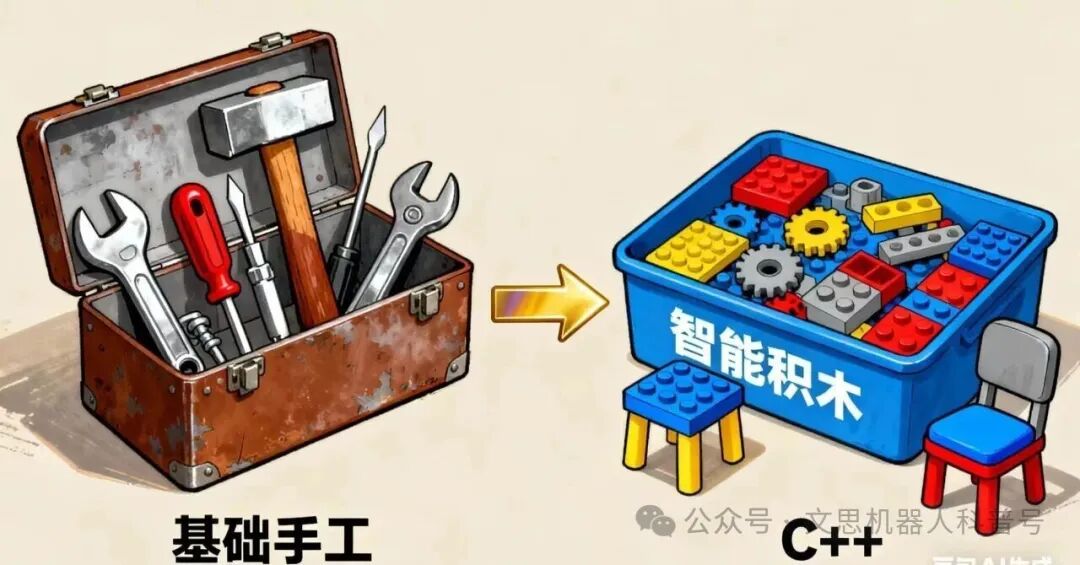
1. Core Positioning: C is the “Basic Toolbox”, C++ is the “Smart LEGO Set”
Programming Logic: From “Step-by-Step Operation” to “Modular Creation”
The C language is like a basic hand tool kit, containing only essential tools like hammers and screwdrivers. To make a small stool, you must follow the steps of “cutting wood → nailing the frame → sanding” one step at a time, with manual control at each step, focusing on “instruction-driven, fixed processes”. For example, to count array elements, you have to write loops and define counters yourself, doing everything manually.
C++, on the other hand, is like a smart LEGO set that not only includes all the basic tools from the C toolbox but also adds various “pre-made modules” (classes and objects) and “assembly rules” (inheritance, polymorphism, generic programming). When making a small stool, C++ allows you to directly use the “stool leg module” and “stool top module”, combining them as needed, and can quickly transform into a chair, table, or other forms, focusing on “module reuse and flexible expansion”.
Functionality and Tools: C “Manually Assembles”, C++ “Intelligently Empowers”
The difference in tool libraries: C++ comes with a “universal parts package” (STL library), which includes ready-made “storage boxes” (vector containers), “classification racks” (map containers), and “quick sorters” (sort algorithms), allowing you to directly call complex functions; C language lacks ready-made parts, and even to store a set of data, you have to manually build a “storage space” using arrays and pointers.
Syntax Strictness: C++ is like a “meticulous engineer”, requiring precise operations, such as void* pointers needing explicit type conversion to use, with no allowance for ambiguous operations; C language is more like a “flexible craftsman”, allowing for some “simplified operations”, such as implicit type conversion, leaving more “flexibility” in programming.
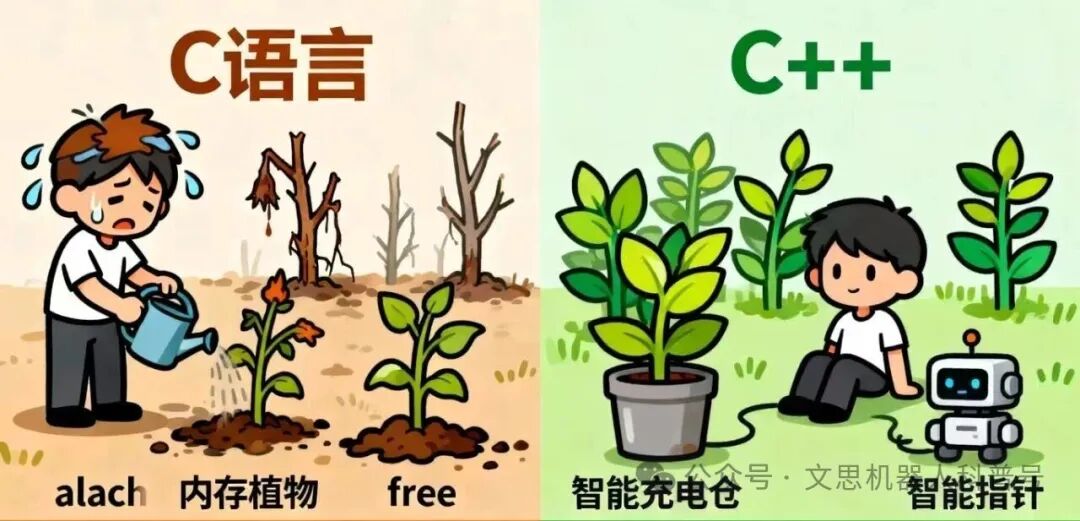
Memory Management: C language requires manual “charging of tools” (malloc for memory allocation) and “powering off and storing” (free for memory release); forgetting to store can lead to “tool accumulation” (memory leaks); C++ comes with a “smart charging station” (new/delete) and can enable “automatic storage mode” (smart pointers), reducing the probability of errors without manual supervision.
2. The Truth About Pitfalls: Why Do C++ Experts Struggle with C?
1. The “Invisible Differences” in Tool Usage Rules
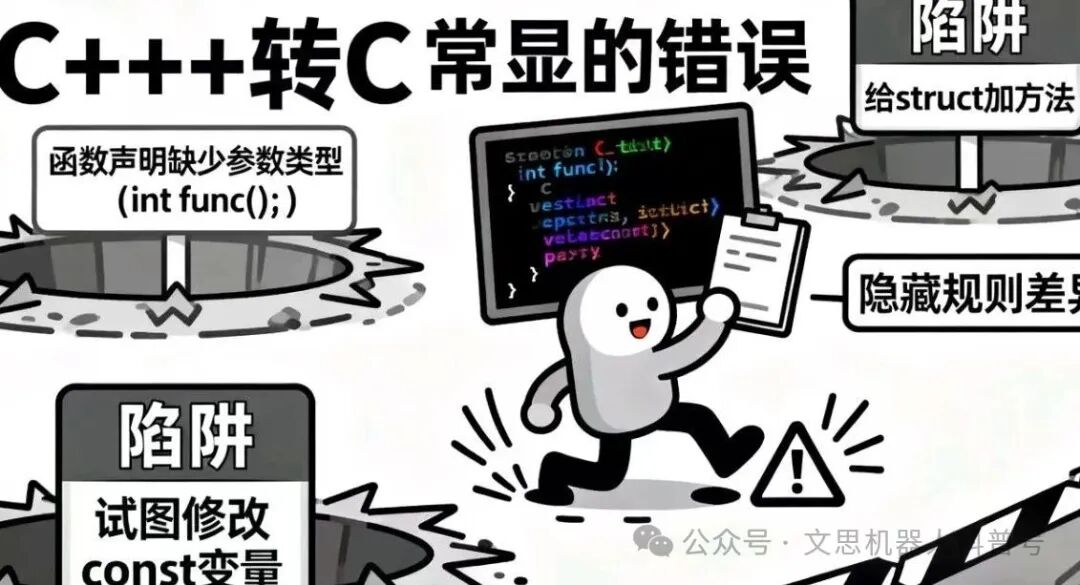
Function Declaration: C++ requires that the “tool usage instructions” clearly specify parameter types, such as int calculate(int a, int b); to be compliant; C language allows “simplified instructions”, such as int calculate(); which can also compile. Children accustomed to C++’s strict standards can easily lose points in C code due to “incomplete instructions”.
const Attribute: In C++, const variables are “fixed-size parts” that cannot be modified once formed; in C language, const is more like a “modifiable template” that can indirectly change values through pointers. Writing C code with C++ thinking can easily lead to “logical conflicts”.
2. The “Compatibility Trap” of Modules and Tools
Struct Usage: In C language, struct is just a “parts storage box” that can only hold variables (like recording student information such as name and age); in C++, struct is a “functional module” that can hold both variables and “operation methods” (like functions to calculate student grades). Adding methods to C’s struct with C++ thinking will directly fail to compile.
Function Name Handling: C++ compilers add “identification codes” (name mangling) to “tool names”, such as add(int) becoming add_int; C compilers keep the names unchanged. When used together, it can lead to linking failures due to “unrecognized tools”, requiring extern “C” declarations for “intercommunication”.
3. Learning Strategy: Should Kids Learn C First or Jump Straight to C++?
C and C++ are not “who replaces whom”, but rather a complementary relationship of “foundation and advancement”—C is the “underlying logic cornerstone” of programming, while C++ is a “multi-functional platform” built on that cornerstone.
Learning C First: Suitable for children who enjoy “disassembling, repairing, and exploring principles”, allowing them to grasp core concepts like pointers and memory allocation, understanding “how code communicates with hardware”. They can quickly pick up any programming language later, but when writing large projects, they need to manually handle many details, which can be frustrating.
Jumping Straight to C++: Suitable for children who enjoy “building and creating quickly”, allowing them to use the STL library and object-oriented thinking to quickly create small games and tools, providing a sense of achievement. However, they need to first understand abstract concepts like “classes and objects”, which can present a cognitive barrier at the beginning.
Parents can guide like this: Don’t get caught up in “either/or”; C++ is fully compatible with C’s core syntax. Let children choose based on their interests—those who love exploring principles can start with C, while those who enjoy hands-on creation can jump straight to C++; later, they can cross-complement, learning C++ and then revisiting C’s underlying details, or learning C and then upgrading to C++’s advanced features. Balancing both will help them become “programming whizzes who understand principles and can create”!
Ultimately, the core of programming is problem-solving. Whether it’s C’s “simplicity and efficiency, mastering the underlying”, or C++’s “powerful functionality and flexible expansion”, letting children first enjoy the fun of programming and then gradually delve into details is the most sustainable learning path~