In the field of C++ programming, memory management has always been a critical and challenging task. The new keyword is a familiar tool for allocating memory on the heap and constructing objects. The conventional new operation seamlessly allocates memory and calls the object’s constructor to complete initialization, providing great convenience for object creation. However, in certain specific scenarios, conventional new cannot meet our need for fine-grained control over memory usage. This is where Placement new comes into play.
Placement new allows us to construct objects at existing, pre-allocated memory addresses. This feature breaks the conventional model that tightly couples memory allocation with object construction, granting programmers more flexible and lower-level memory operation permissions. It plays an important role in scenarios such as memory pool management, custom memory allocation strategies, and performance-critical applications.
However, this flexibility comes with a higher threshold for use and risks. If used improperly, it can easily lead to serious issues such as memory leaks and undefined behavior. So, how can we correctly use Placement new while enjoying its powerful features and avoiding potential pitfalls? This requires us to delve into its basic syntax, usage steps, precautions, and more.
1. Starting with new, introducing placement new
In the world of C++, memory management is a crucial skill, and the new operator is a cornerstone of dynamic memory allocation. When we need to dynamically create objects at runtime, we often use the new keyword, with the basic syntax being: Type* ptr = new Type(args...);, where Type is the type of the object to be created, and args... is the list of parameters passed to the constructor.
For example, when we want to create a dynamic variable of type int, we can write:
int* num = new int;
*num = 10;
Here, new int allocates a block of memory on the heap that can store int type data and returns the address of this memory, assigning it to the pointer num. We can then manipulate this memory through the pointer num, for example, assigning it a value of 10.
Similarly, to create an object of a custom class MyClass:
class MyClass {
public:
    MyClass(int value) : data(value) {
        std::cout << "MyClass constructor, data = " << data << std::endl;
    }
    ~MyClass() {
        std::cout << "MyClass destructor" << std::endl;
    }
private:
    int data;
};

MyClass* obj = new MyClass(5);
new MyClass(5) not only allocates enough memory on the heap to store a MyClass object but also calls the constructor of MyClass, passing the parameter 5 to initialize the object. When we no longer need this object, we use the delete operator to free the memory:
delete obj;This way, delete first calls the destructor of MyClass and then frees the memory occupied by the object.
Conventional new operations can meet our needs in most cases, but they also have some limitations. For example, frequent new and delete operations can lead to memory fragmentation, reducing memory usage efficiency; in scenarios with strict requirements on memory layout, such as embedded system development and high-performance computing, conventional new cannot precisely control the object’s position in memory.
So, is there a way to break through these limitations?
At this point, placement new shines. Placement new allows us to create objects in already allocated memory areas; it does not handle memory allocation but only calls the constructor to initialize the object. This is a clear distinction from conventional new in terms of memory allocation and object construction, and it is this distinction that allows placement new to play a unique role in specific scenarios.
Usage Principles:
- First: In C++, when using
new, the compiler will request memory and then call the class’s constructor to initialize the object. Callingdeletewill destroy the object while releasing the memory occupied by that object, and we can overload thenewoperator. - Second: Placement new requires us to pass a pointer
*p. At this point, it will construct the object in the memory space pointed to by that pointer, which can be heap space, stack space, or static storage area.
We can pre-allocate a memory space and then use placement new to construct the object, which will construct the object in the specified memory space. The benefit of this approach is that it avoids frequent allocation and release of space, which can cause significant memory fragmentation in the system.
Placement new, as a special memory construction method provided by C++, is commonly used in scenarios with precise memory usage requirements, such as memory pools and shared memory communication. However, to deeply grasp the principles and applicable scenarios of placement new, we first need to have a basic understanding of C++’s conventional memory allocation mechanisms.
2. Detailed Explanation of C++ Memory Allocation Mechanisms
In C++’s memory management toolkit, the new operator, operator new function, and placement new are like three sharp blades, each playing a unique and critical role. The new operator is our common means of requesting dynamic memory, concise and efficient; the operator new function silently supports the underlying core logic of memory allocation; while placement new, as a special memory allocation method, provides the possibility for fine-grained memory control in specific scenarios.
2.1 The new Operator
The new operator is primarily used to dynamically allocate memory on the heap, creating objects or arrays. Compared to stack memory, heap memory’s lifecycle is manually controlled by the programmer, granting us greater flexibility while also bringing more responsibility.
When we need to create a single variable on the heap, the syntax is straightforward: type* pointerVariable = new type(initialValue);. For example, int* num = new int(5); allocates a block of memory on the heap for storing int type data, initializes it to 5, and returns the address of that memory, assigning it to the num pointer. Through num, we can access and manipulate this integer created on the heap in other parts of the program.
When we need to create an array, the syntax changes slightly: type* pointerVariable = new type[arraySize];. For example, int* arr = new int[10]; allocates a contiguous block of memory on the heap for storing 10 int type elements, returning the address of the first element to the arr pointer. We can then access and modify these elements using indices, such as arr[0] = 1;, arr[1] = 2;, and so on.
(1) Return Value and Exception Handling
When the new operator successfully allocates memory, it returns a pointer to the allocated memory, which strictly matches the type of the object or array we requested. This is like finding a suitable “island” in a vast ocean of memory, and new precisely hands us a “key” to that island— a pointer, allowing us to freely read and write data in that memory area.
However, memory allocation is not always smooth sailing. When the system runs out of memory and cannot meet the request of the new operator, it triggers an exception mechanism. In C++, the new operator will throw a std::bad_alloc exception by default. This is like encountering a storm at sea, where the ship (program) may face danger. To ensure the stability and robustness of the program, we need to use a try-catch block to catch this exception and handle it accordingly. For example:
try {
    int* bigArray = new int[10000000];
    // Use bigArray for subsequent operations
    delete[] bigArray;
} catch (const std::bad_alloc& e) {
    std::cerr << "Memory allocation failed: " << e.what() << std::endl;
    // Handle the error, such as releasing other resources, notifying the user, etc.
}
In the above code, the try block attempts to allocate a large array containing 10,000,000 integers. If the allocation fails, the catch block will catch the std::bad_alloc exception and output an error message. We can also perform some remedial measures in the catch block, such as releasing already allocated other resources or providing a friendly prompt to the user, informing them of the memory allocation failure.
(2) Pairing with delete
In the world of C++ memory management, new and delete are like inseparable partners that must be used in strict pairs. When we use new to create a block of memory on the heap, this memory is like a “rented” space; if we do not “return” (release) it in a timely manner after use, it will cause memory leaks. This is like borrowing a book and not returning it; the library’s book resources will gradually decrease, ultimately affecting the normal operation of the entire system.
For a single object, we use delete to release its memory, for example:
int* num = new int(5);
// Use num for operations
delete num;
For arrays, we need to use delete[] to release them, for example:
int* arr = new int[10];
// Use arr for operations
delete[] arr;
If we do not use them in accordance with the rules, it will lead to undefined behavior. For example, using delete to release array memory may cause the compiler to fail to correctly release the entire array’s memory, leading to partial memory leaks; while using delete[] to release a single object’s memory will also cause the program to crash or memory corruption and other serious issues. Therefore, when using new and delete, we must always remember their pairing rules to ensure correct memory allocation and release, allowing the program to run in a stable memory environment.
2.2 The operator new Function
In C++’s memory management system, operator new is a crucial global function, typically declared as void* operator new(std::size_t size) throw(std::bad_alloc);. This function is responsible for the important task of allocating memory on the heap, with its parameter size clearly specifying the amount of memory to be allocated, measured in bytes.
When we call operator new, it will strive to find a contiguous block of memory of size size in the heap. Once it successfully finds it, it will return a pointer to the starting address of this memory, which is of type void*, meaning it is a generic pointer that can point to any type of data. However, it is important to note that operator new is only responsible for memory allocation and does not call the object’s constructor. This is like renting an empty house (allocating memory), but the house has not yet been furnished with any furniture or living supplies (the constructor has not been called to initialize the object).
For example, if we want to allocate memory for an int type variable, we can call it like this:
void* intMem = operator new(sizeof(int));Here, operator new calculates the required memory size based on sizeof(int), then finds suitable space on the heap and returns its pointer to intMem. At this point, the memory space pointed to by intMem is still just a block of uninitialized raw memory, with its value being uncertain. operator new is closely related to the new operator; the new operator, when performing memory allocation, actually calls the operator new function to obtain memory. It can be said that operator new is the unsung hero behind the implementation of memory allocation for the new operator, providing the most basic memory allocation support for it.
(1) Overloading operator new for Classes
In C++, classes can overload the operator new function according to their needs, thus customizing their own memory allocation strategy. This feature provides us with great flexibility when dealing with complex memory management scenarios. For example, when our class has special requirements for memory allocation, such as needing to obtain memory from a specific memory pool or requiring additional initialization and checks for the allocated memory, we can achieve this by overloading operator new.
Below is an example code of a class overloading operator new:
class MyClass {
public:
    static void* operator new(std::size_t size) {
        std::cout << "Custom operator new called, allocated memory size: " << size << " bytes" << std::endl;
        void* mem = ::operator new(size); // Call the global operator new for actual memory allocation
        // Additional processing for allocated memory can be added here, such as initialization
        return mem;
    }
    static void operator delete(void* ptr) noexcept {
        std::cout << "Custom operator delete called, releasing memory address: " << ptr << std::endl;
        ::operator delete(ptr); // Call the global operator delete to release memory
    }
};
In the above code, the MyClass class overloads the operator new and operator delete functions. In the operator new function, we first output the relevant information about memory allocation, then call the global ::operator new function to actually allocate memory, ensuring that we are calling the global version of operator new using the :: scope resolution operator. After that, we can add custom memory handling logic in the function.
When we create an object of the MyClass class, this custom operator new function will be called. For example:
MyClass* obj = new MyClass;When this line of code is executed, the new operator will first call the overloaded operator new function in the MyClass class to allocate memory, and then call the constructor of MyClass to initialize the allocated memory. When the object is no longer needed, the delete operator will call the overloaded operator delete function to release the memory. Through this overloading mechanism, we can implement more efficient and flexible memory management strategies according to the specific needs of the class, meeting the memory allocation and release requirements in different scenarios.
(2) The Relationship with the new Operator
The new operator and the operator new function have a close cooperative relationship, and understanding their interaction is crucial for mastering C++’s memory management mechanism. When we use the new operator to create an object, the execution process behind it can be divided into two key steps.
First, the new operator calls the operator new function to complete the memory allocation work. The operator new function searches for and allocates a sufficiently large block of memory on the heap based on the size parameter passed in, returning a pointer to the starting address of that memory. This pointer is like a key that opens the door to the newly allocated memory area.
Next, after obtaining this uninitialized memory, the new operator calls the constructor of the object on this memory. The constructor is like a careful decorator, initializing the memory and giving the object its initial state and properties, making it a usable object. For example, when we execute MyClass* obj = new MyClass;, the new operator first calls the operator new function to allocate memory, assuming the allocation is successful and returns a pointer ptr, then calls the constructor of MyClass to initialize the object in the memory pointed to by ptr, and finally returns the pointer to the initialized object to obj.
This process shows that the operator new function focuses on memory allocation, while the new operator coordinates both memory allocation and object initialization. The two complement each other, jointly completing the creation of the object. In practical programming, we usually use the new operator to create objects because it provides a more concise and intuitive syntax, while the operator new function silently supports it, providing powerful memory allocation capabilities. When we need to customize memory allocation strategies, we can achieve this by overloading the operator new function, and the new operator will automatically call our overloaded version, thus achieving precise control over the memory allocation process.
2.3 Placement new
Placement new is a unique memory allocation method in C++ that allows us to construct objects directly in already allocated memory without needing to allocate memory again. This is like having a furnished house (allocated memory) and now just needing to move in the furniture (objects) and arrange them (construct objects).
The syntax of placement new is new (placement_address) type (initializers);. Here, placement_address is a pointer to the already allocated memory address, specifying where the object will be constructed; type indicates the type of the object to be constructed; and initializers are optional initialization parameters used to assign initial values to its member variables when constructing the object.
For example, we can first allocate a block of memory and then use placement new to construct a MyClass object in that memory:
#include <iostream>
#include <new>

class MyClass {
public:
    MyClass(int value) : data(value) {
        std::cout << "MyClass constructor called, data = " << data << std::endl;
    }
    ~MyClass() {
        std::cout << "MyClass destructor called" << std::endl;
    }
private:
    int data;
};

int main() {
    char buffer[sizeof(MyClass)]; // Allocate memory of size MyClass object
    MyClass* obj = new (buffer) MyClass(42); // Use placement new to construct MyClass object in buffer
    // Use obj for operations
    obj->~MyClass(); // Explicitly call destructor
    return 0;
}
In the above code, we first define a MyClass class with a parameterized constructor and a destructor. Then in the main function, we allocate a character array buffer of size equal to that of a MyClass object. Next, we use new (buffer) MyClass(42) to construct a MyClass object in the memory pointed to by buffer, initializing it with the value 42. Finally, since placement new does not automatically manage memory release and object destruction, we need to explicitly call obj->~MyClass() to call the destructor and release the resources occupied by the object.
2.4 The Relationship Among the Three
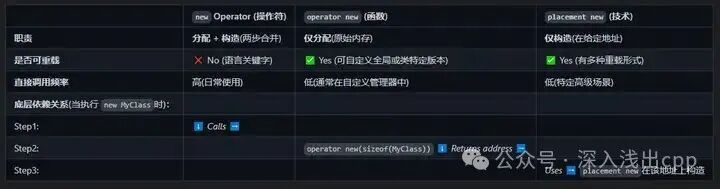
In simple terms:
new T = (operator-new) + (placement-new)delete pT; = (pT->~T();) + (operator-delete(pT))
3. Usage Scenarios of Placement new
3.1 Custom Memory Pool
In software development, memory pools are a commonly used memory management technique. They pre-allocate a large block of memory and then allocate and recycle objects within this area, avoiding frequent requests to the operating system for memory allocation and release. This is like running a hotel, where you prepare a certain number of rooms (memory blocks) in advance, and when guests (objects) arrive, you directly arrange them in the existing rooms instead of building a new hotel (requesting memory from the operating system) each time. This can greatly improve the efficiency of memory allocation and reduce memory fragmentation issues.
Placement new plays an important role in the implementation of custom memory pools. When we obtain a block of memory from the memory pool, we can use placement new to directly construct objects in that memory without needing to allocate new memory through conventional new operations. Below is a simple code example demonstrating the process of using placement new to allocate and construct objects in a memory pool:
#include <iostream>
#include <new>

class MemoryPool {
public:
    MemoryPool(size_t size) : pool(new char[size]), used(0) {}
    ~MemoryPool() { delete[] pool; }

    void* allocate(size_t size) {
        if (used + size <= capacity()) {
            void* result = pool + used;
            used += size;
            return result;
        }
        return nullptr;
    }

    void deallocate(void* /*ptr*/) {
        // Simple memory pool, no real release implemented here, just for illustration
        // Actual applications may require more complex memory recovery mechanisms
    }

private:
    char* pool;
    size_t used;

    size_t capacity() const {
        return sizeof(pool) / sizeof(char);
    }
};

class MyClass {
public:
    MyClass(int value) : data(value) {
        std::cout << "MyClass constructor, data = " << data << std::endl;
    }
    ~MyClass() {
        std::cout << "MyClass destructor" << std::endl;
    }
private:
    int data;
};

int main() {
    MemoryPool pool(1024);
    void* mem = pool.allocate(sizeof(MyClass));
    if (mem) {
        MyClass* obj = new (mem) MyClass(10);
        // Use obj
        obj->~MyClass();
        pool.deallocate(mem);
    }
    return 0;
}
In this example, the MemoryPool class represents a simple memory pool that allocates a block of memory of size size in its constructor. The allocate method is used to allocate a block of memory of a specified size from the memory pool. If there is enough space in the memory pool, it returns the allocated memory address; otherwise, it returns nullptr. The deallocate method does not implement real release in this simple example; in actual applications, a more complex memory recovery mechanism may be needed.
In the main function, we first create a memory pool pool of size 1024 bytes, then allocate a block of memory of size sizeof(MyClass) from the memory pool into mem. If the allocation is successful, we use placement new to construct a MyClass object in mem, passing the parameter 10. After using the object, we explicitly call the destructor of the object and finally return the memory to the memory pool. This approach avoids frequent requests to the operating system for memory allocation, improving memory usage efficiency.
3.2 Stack Object Creation and Explicit Memory Management
Stack memory is an area of memory automatically allocated and managed by the system during program execution, characterized by fast allocation and release speeds. When memory is allocated on the stack, the system automatically allocates memory space for variables and automatically releases memory when the variables go out of scope. However, sometimes we want to have more precise control over the object creation and destruction process after allocating memory on the stack, and this is where placement new can help.
For example, in some scenarios requiring explicit memory management, we can first allocate a sufficiently large block of memory on the stack and then use placement new to create objects in that memory. Below is an example:
#include <iostream>
#include <new>

class MyClass {
public:
    MyClass(int value) : data(value) {
        std::cout << "MyClass constructor, data = " << data << std::endl;
    }
    ~MyClass() {
        std::cout << "MyClass destructor" << std::endl;
    }
private:
    int data;
};

int main() {
    alignas(MyClass) char buffer[sizeof(MyClass)];
    MyClass* obj = new (buffer) MyClass(5);
    // Use obj
    obj->~MyClass();
    return 0;
}
In this example, we first define a MyClass class. In the main function, we create a character array buffer of size sizeof(MyClass), using alignas(MyClass) to ensure that the memory alignment of buffer meets the requirements of MyClass. We then use placement new to construct a MyClass object in buffer, passing the parameter 5. When the object is no longer needed, we explicitly call the destructor of the object to release the resources occupied by the object. Through this method, we can achieve explicit management of object memory on the stack, flexibly controlling the object’s lifecycle.
3.3 Performance Optimization Scenarios
During program execution, frequently using new and delete operations can incur certain performance overhead. This is because the new operation not only allocates memory but may also involve memory searching, memory alignment, and other operations; while the delete operation, in addition to releasing memory, may also require memory merging and other operations. All these operations consume a certain amount of time and system resources.
Placement new has unique advantages in performance optimization. When we already have a suitable memory area, using placement new to construct objects in that memory only requires calling the object’s constructor, avoiding the memory allocation overhead involved in the new operation. Similarly, when destroying the object, we only need to explicitly call the destructor without needing to execute the complex memory release process involved in the delete operation.
This feature makes placement new widely used in scenarios with high performance requirements, such as embedded system development. In embedded systems, resources are often very limited, memory space is tight, and there are high real-time requirements for the system. Using placement new can reduce the time overhead of memory allocation and improve the system’s response speed. For example, in high-performance computing, a large number of computational tasks require frequent creation and destruction of objects, and using placement new can effectively optimize performance and improve computational efficiency.
4. In-Depth Analysis of Memory Allocation Constraints
4.1 Manual Memory Management
When using placement new, programmers need to take on the responsibility of manually managing memory allocation and release. This is significantly different from conventional new operations, which automatically call the constructor when allocating memory and automatically call the destructor and release memory when using delete. Placement new only calls the constructor on existing memory, and both memory allocation and release must be manually handled by the programmer.
If, after using placement new, we directly release memory without manually calling the destructor, the resources occupied by the object cannot be correctly released, leading to memory leaks. Conversely, if we release the memory first and then call the destructor, it will lead to accessing released memory, resulting in undefined behavior.
Below is an example to deepen understanding:
#include <iostream>
#include <new>

class MyClass {
public:
    MyClass() {
        std::cout << "MyClass constructor" << std::endl;
    }
    ~MyClass() {
        std::cout << "MyClass destructor" << std::endl;
    }
};

int main() {
    char* buffer = new char[sizeof(MyClass)];
    MyClass* obj = new (buffer) MyClass();
    // Error demonstration: releasing memory without calling destructor
    // delete[] buffer;
    // Correct approach: call destructor first
    obj->~MyClass();
    // Then release memory
    delete[] buffer;
    return 0;
}
In this example, if we follow the erroneous demonstration and directly delete[] buffer, the destructor of the MyClass object will not be called, and any resources the object holds (such as open files, allocated other memory, etc.) will not be released, leading to memory leaks. Only by first calling obj->~MyClass() and then delete[] buffer can we ensure that the object’s resources are correctly released and the memory is returned to the system.
4.2 Memory Alignment Issues
Memory alignment is a very important concept in memory management, referring to storing data in memory addresses according to certain rules, so that the starting address of the data is an integer multiple of a specific value (usually the size of the data type or its multiple). When using placement new, it is crucial to ensure that the provided memory block meets the alignment requirements of the object. Refer to Thoroughly Understanding Linux Memory Alignment to Make Your Program Run Faster.
Different data types have different alignment requirements when stored in memory. For example, in a 32-bit system, the int type usually requires 4-byte alignment, meaning the starting address of an int type variable must be a multiple of 4; the double type usually requires 8-byte alignment. If the provided memory block does not meet the alignment requirements of the object, constructing the object in that memory may lead to hardware exceptions or runtime errors.
For example, suppose in a system that requires 8-byte alignment, we have the following code:
#include <iostream>
#include <new>

class MyClass {
public:
    double data;
    MyClass(double value) : data(value) {}
    ~MyClass() {}
};

int main() {
    // Allocate memory but did not consider alignment
    char buffer[sizeof(MyClass)];
    // Here buffer may not be 8-byte aligned, constructing the object may cause errors
    MyClass* obj = new (buffer) MyClass(10.0);
    return 0;
}
In this example, the MyClass class contains a double type member, which requires 8-byte alignment. However, the directly created char buffer[sizeof(MyClass)] may not guarantee 8-byte alignment. When using placement new to construct a MyClass object in buffer, it may cause errors due to alignment issues.
To solve alignment issues, we can use the alignas keyword to ensure that the memory block is aligned. Modify the above code as follows:
#include <iostream>
#include <new>

class MyClass {
public:
    double data;
    MyClass(double value) : data(value) {}
    ~MyClass() {}
};

int main() {
    // Use alignas to ensure buffer is 8-byte aligned
    alignas(8) char buffer[sizeof(MyClass)];
    MyClass* obj = new (buffer) MyClass(10.0);
    obj->~MyClass();
    return 0;
}
By using alignas(8), we ensure that the memory alignment of buffer meets the requirements of the double type member in MyClass, thus avoiding alignment errors. In actual applications, it is essential to carefully handle memory alignment issues based on the type of the object and the alignment rules of the target platform to ensure the correctness and stability of the program.
4.3 Memory Reuse Rules
When reusing memory with placement new, it is crucial to strictly follow the rule of explicitly calling the destructor of the old object first. This is because if we directly use placement new to construct a new object in memory that has already been constructed without first destroying the old object, the resources occupied by the old object will not be correctly released, leading to resource leaks and undefined behavior.
Below is an example to illustrate the consequences of violating this rule:
#include <iostream>
#include <new>

class MyClass {
public:
    MyClass() {
        std::cout << "MyClass constructor" << std::endl;
    }
    ~MyClass() {
        std::cout << "MyClass destructor" << std::endl;
    }
};

int main() {
    alignas(MyClass) char buffer[sizeof(MyClass)];
    MyClass* obj1 = new (buffer) MyClass();
    // Error demonstration: constructing new object obj2 without calling obj1's destructor
    MyClass* obj2 = new (buffer) MyClass();
    return 0;
}
In this example, we first construct obj1 in buffer, and then without calling the destructor of obj1, we directly construct obj2 in buffer. This way, the destructor of obj1 will not be executed, and any resources occupied by obj1 (if any) will not be released, leading to resource leaks. At the same time, this operation will also lead to data confusion in memory, as obj2 overwrites the memory area of obj1, which may still be in an incomplete destruction state, thus causing undefined behavior.
The correct approach is to explicitly call the destructor of the old object before constructing the new object:
#include <iostream>
#include <new>

class MyClass {
public:
    MyClass() {
        std::cout << "MyClass constructor" << std::endl;
    }
    ~MyClass() {
        std::cout << "MyClass destructor" << std::endl;
    }
};

int main() {
    alignas(MyClass) char buffer[sizeof(MyClass)];
    MyClass* obj1 = new (buffer) MyClass();
    // Call obj1's destructor first
    obj1->~MyClass();
    MyClass* obj2 = new (buffer) MyClass();
    obj2->~MyClass();
    return 0;
}
By following this approach, we ensure that the resources of the old object are correctly released before constructing the new object in that memory, avoiding resource leaks and undefined behavior.
5. Analysis of Frequently Asked Interview Questions
Question 1: What is the essential difference between placement new and ordinary new?
Answer Analysis:The core difference between placement new and ordinary new lies in the coupling of memory allocation and object construction: ordinary new automatically allocates memory from the heap and calls the constructor, while placement new is only responsible for constructing objects in pre-allocated existing memory (such as stack, memory pool, or shared memory), decoupling memory allocation from object initialization, suitable for scenarios requiring precise control over memory layout or high performance (such as custom memory management, avoiding fragmentation), but requires manual management of destruction and memory release.
Question 2:List 5 scenarios where placement new must be used.
Answer Analysis:
- Custom memory pool management (avoiding frequent heap allocation overhead, improving performance);
- Shared memory or memory-mapped files (need to construct objects at fixed addresses);
- Non-volatile memory (NVM) programming (such as initializing persistent data structures);
- Real-time systems or embedded development (need precise control over object memory layout and lifecycle);
- Object resurrection (constructing the same type of object in already released memory).
Typical Code
// Memory pool scenario
char* pool = new char[POOL_SIZE];
MyClass* obj = new (pool) MyClass();  // Construct object in pre-allocated memory
obj->~MyClass();  // Manual destruction
Question 3: What are the mandatory constraints on memory allocation when using placement new?
Answer Analysis:
- Memory must be pre-allocated: Memory cannot be allocated through placement new; the developer must ensure the validity of the memory address (such as allocating through
mallocormmap). - Memory size must be sufficient: The provided memory must be able to accommodate the target object; otherwise, it leads to undefined behavior (such as overwriting adjacent data).
- Memory alignment must be correct: It must meet the alignment requirements of the object type (such as classes modified with
alignas); otherwise, it may cause hardware exceptions or performance degradation. - Directly calling
deleteis prohibited: Memory release must be done through the original allocation method (such asfree, stack automatic recovery);deletewill lead to double release. - Explicitly call the destructor: When the object’s lifecycle ends, the destructor must be manually called to release resources (such as file handles, dynamic memory).
Error Example
void* buffer = malloc(sizeof(MyClass));
MyClass* obj = new (buffer) MyClass();
delete obj;  // Error! Memory allocated by malloc cannot be released with delete
Question 4: How to implement a high-performance memory pool using placement new?
Answer Analysis:
① Pre-allocate memory pool:
const size_t POOL_SIZE = 1024 * 1024;  // 1MB memory pool
char* memoryPool = new char[POOL_SIZE];
② Manage free blocks: Use a linked list to record the addresses of free blocks, with each block’s starting position storing a pointer to the next free block.
void* allocate() {
    if (freeList == nullptr) return nullptr;
    void* slot = freeList;
    freeList = *reinterpret_cast<void**>(slot);  // Get the next free block
    return slot;
}
③ Object construction and destruction:
MyClass* obj = new (allocate()) MyClass();  // Construct object in free block
obj->~MyClass();  // Manual destruction
deallocate(obj); // Return memory block to free list- Allocation time complexity is O(1), avoiding the overhead of system calls for
malloc/free. - Reduces memory fragmentation and improves cache utilization (contiguous memory blocks are easier for the CPU cache to hit).
Question 5: What key issues need to be addressed when using placement new in shared memory?
Answer Analysis:
- Memory synchronization: Multiple processes need to map the same shared memory through
shm_openormmap, ensuring address consistency. - Object lifecycle management: When destructing objects, coordination across processes is required to avoid data races (such as using semaphores or atomic operations).
- Memory alignment and size: Shared memory must be pre-allocated with sufficient space and meet the alignment requirements of the object (such as
alignas(64)for high-performance computing). - Exception handling: If the constructor throws an exception, the already allocated shared memory must be manually released to avoid resource leaks.
Implementation Code:
// Process A: Create shared memory and construct object
int fd = shm_open("/shared_mem", O_CREAT | O_RDWR, 0666);
ftruncate(fd, sizeof(MyClass));
void* mem = mmap(nullptr, sizeof(MyClass), PROT_READ | PROT_WRITE, MAP_SHARED, fd, 0);
MyClass* obj = new (mem) MyClass();

// Process B: Access shared memory object
void* mem = mmap(nullptr, sizeof(MyClass), PROT_READ, MAP_SHARED, fd, 0);
MyClass* obj = static_cast<MyClass*>(mem);
Question 6: What are the typical application scenarios of placement new in embedded systems?
Answer Analysis:
- Hardware register operations: Binding objects to the physical addresses of hardware devices (such as GPIO control registers at 0x40000000).
volatile GPIO* gpio = new (reinterpret_cast<void*>(0x40000000)) GPIO();
gpio->setDirection(OUTPUT);- Memory-constrained environments: Pre-allocating fixed memory blocks to avoid fragmentation caused by dynamic allocation (such as sensor data acquisition systems).
- Bootloaders: Constructing startup objects at fixed addresses to ensure system initialization stability (such as critical modules in BIOS).
- Real-time task scheduling: Placing task control blocks (TCB) in specific memory areas to improve scheduling efficiency.
Precautions:
- Use
volatileto modify hardware register pointers to prevent compiler optimization. - The memory address must be consistent with the hardware data manual; otherwise, it may lead to system crashes.
Question 7: What is the impact of memory alignment on placement new? How to solve it?
Answer Analysis:
(1) Alignment requirements: Objects must be stored at addresses that meet their alignment requirements. For example, a class with alignas(16) requires 16-byte alignment; otherwise, it may cause hardware exceptions or performance degradation.
(2) Consequences of misalignment:
- Hardware level: Some CPU architectures (such as ARM) throw exceptions for unaligned access.
- Performance level: Unaligned access may lead to multiple memory reads and writes (such as 64-bit data crossing two 32-bit words).
(3) Solutions:
- Use
aligned_allocorposix_memalignto allocate aligned memory. - Manually adjust the address to the alignment boundary before placement new.
void* buffer = aligned_alloc(16, sizeof(MyClass));
MyClass* obj = new (buffer) MyClass();  // Ensure 16-byte alignment
Technical Details:
C++17 introduced std::align_val_t, allowing explicit specification of alignment:
void* operator new(size_t size, std::align_val_t align, void* ptr) {
    return std::align(align, size, ptr, sizeof(ptr));
}
Question 8: How to correctly release objects created with placement new?
Answer Analysis:
(1) Explicitly call the destructor:
obj->~MyClass(); // Release internal resources (such as dynamic memory, file handles)(2) Release the original memory:
- If the memory comes from
malloc: callfree(buffer). - If the memory comes from shared memory: call
munmap(mem, size). - If the memory comes from the stack: no need to release (automatically reclaimed by the system).
(3) Error Example:
// Error! Double release of memory
MyClass* obj = new (buffer) MyClass();
delete obj;  // Error: `delete` only applies to memory allocated by ordinary `new`
Question 9: What precautions should be taken regarding placement new in exception handling?
Answer Analysis:
(1) Constructor exceptions: If the constructor throws an exception, the already allocated memory (such as shared memory or memory pool blocks) must be manually released to avoid resource leaks.
try {
    MyClass* obj = new (buffer) MyClass();  // Construction may throw an exception
} catch (...) {
    free(buffer);  // Release memory to avoid leaks
    throw;
}
(2) Custom placement new and placement delete: If overloading operator new(size_t, void*), operator delete(void*, void*) must also be overloaded to ensure proper memory release in case of exceptions.
void operator delete(void* ptr, void* original) noexcept {
    // Release logic (such as returning memory block to memory pool)
}
Global placement new does not require custom placement delete, but it is essential to ensure that the memory release logic is consistent with the allocation method.
Question 10: What should be noted when using placement new in conjunction with smart pointers?
Answer Analysis:
- Custom deleters: Smart pointers (such as
std::unique_ptrorstd::shared_ptr) must provide custom deleters to avoid the defaultdeleteoperation (because the object’s memory may come from non-heap allocation or require special release logic); - Explicit destructor calls: The destructor of the object must be manually called in the deleter (since the memory lifecycle is separate from the object’s lifecycle);
- Avoid double management: Ensure that the same block of memory is not managed by multiple smart pointers (to prevent double destruction);
- Memory source consistency: Ensure that the deleter of the smart pointer matches the memory allocation method (for example, pooled memory must return to the memory pool rather than
delete).
The core principle is that the smart pointer takes over the object’s lifecycle, but the destruction and release logic must be manually adapted.