In today’s digital age, programming skills have become one of the essential skills for young people. GESP (CCF Programming Ability Level Certification) serves as an authoritative certification for programming ability, providing a platform for young people to assess their programming skills. It is divided into levels 1 to 8, covering programming knowledge and skills from basic to advanced levels.
Lower Levels (1-4):These levels primarily assess basic computer knowledge, fundamental programming structures, and simple algorithms and data structures, suitable for the widespread cultivation of programming abilities among young people.
Higher Levels (5-8):These levels focus on more complex algorithms, data structures, and advanced topics such as object-oriented programming, aimed at selecting outstanding young programming talents and aligning with the CSP-J/S certification.
To help everyone better understand the GESP exam levels, this article provides a detailed analysis of the exam points, knowledge objectives, and corresponding courses for GESP levels 1-8, facilitating understanding and guidance for exam preparation!
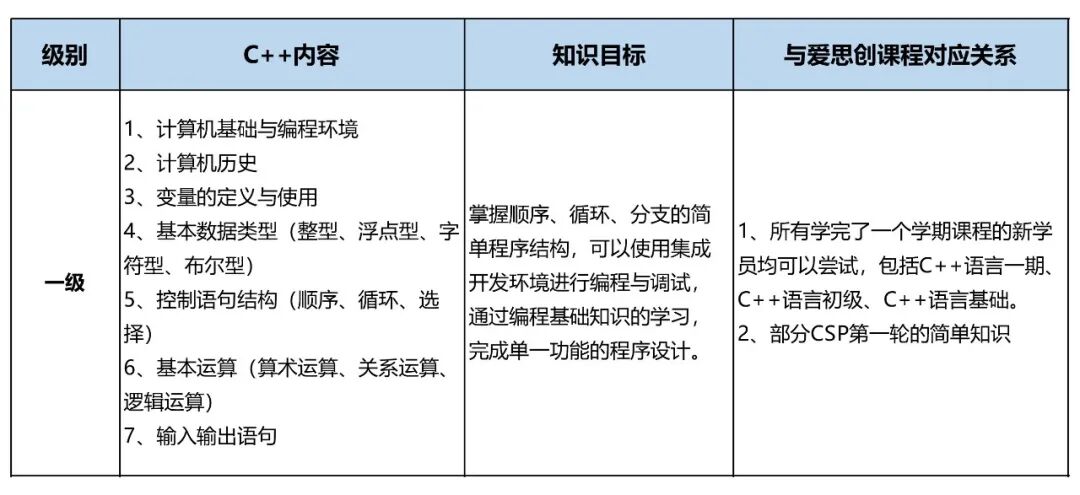
GESP Level 1
The GESP Level 1 exam mainly tests candidates’ preliminary grasp of C++ programming fundamentals, such as variables, data types, operators, expressions, and input/output statements. This is the introductory stage of programming learning, focusing on familiarizing candidates with the programming environment and basic syntax rules. For example, candidates will be tested on their definitions and usage of different data types (integer, float, character, etc.), as well as simple arithmetic and logical operations.
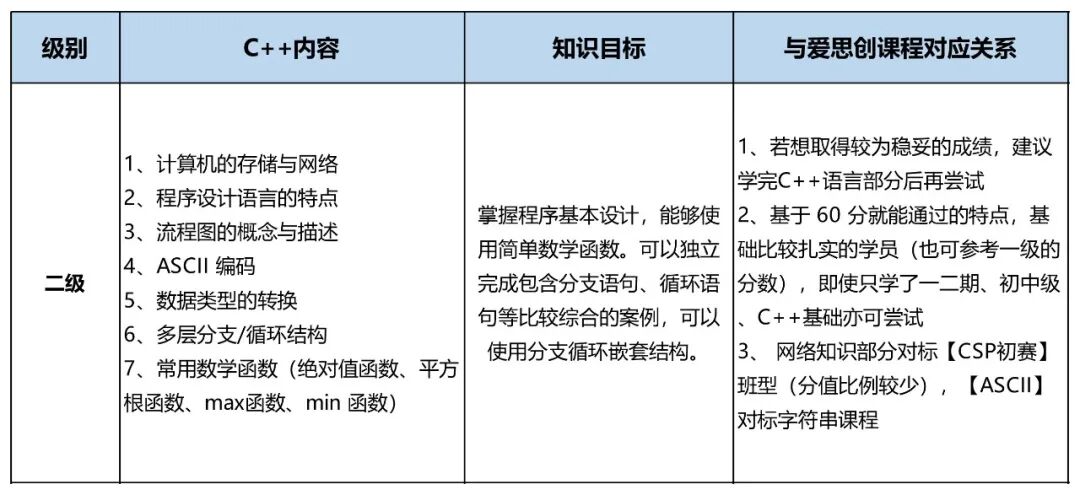
 GESP Level 2
Building on Level 1, Level 2 adds the assessment of control structures (such as if-else statements, for loops, while loops). Candidates need to master how to use these control structures to implement logical control in programs and solve simple problems. For instance, outputting a specific sequence of numbers using loop statements or using conditional statements to determine the parity of a number. Additionally, it will involve some simple mathematical function applications, such as calculating square roots and absolute values.
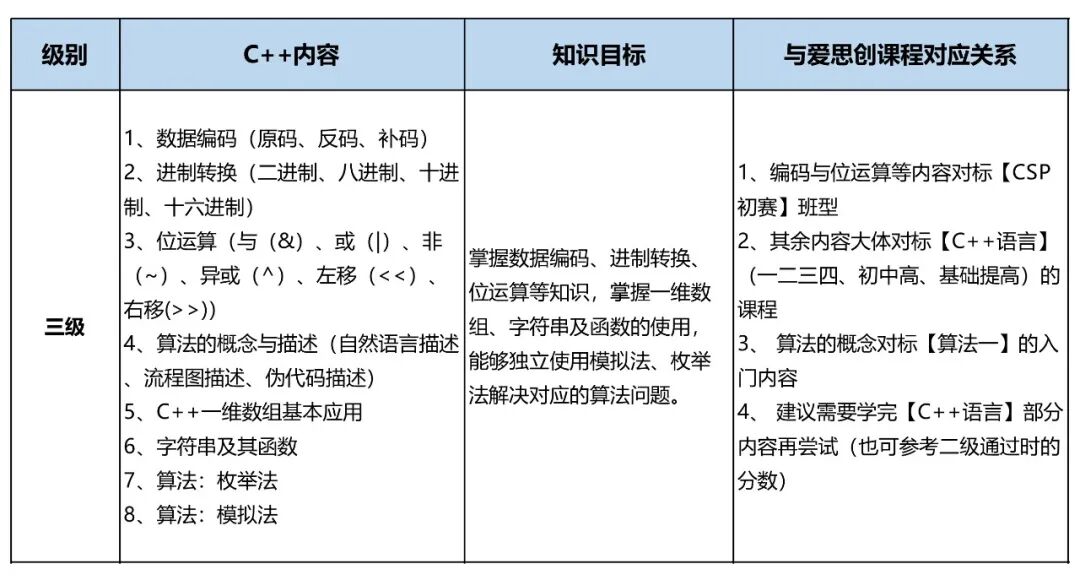
 GESP Level 3
Level 3 further delves into C++ syntax, including the use of arrays and strings. Candidates need to master the definition, initialization, and access of arrays, and be able to use arrays to solve practical problems, such as finding the maximum, minimum, and average values in a set of data. For strings, candidates should master input/output, concatenation, and searching operations. Additionally, it will assess base conversion, bit manipulation, enumeration algorithms, and the basic flow of algorithms.
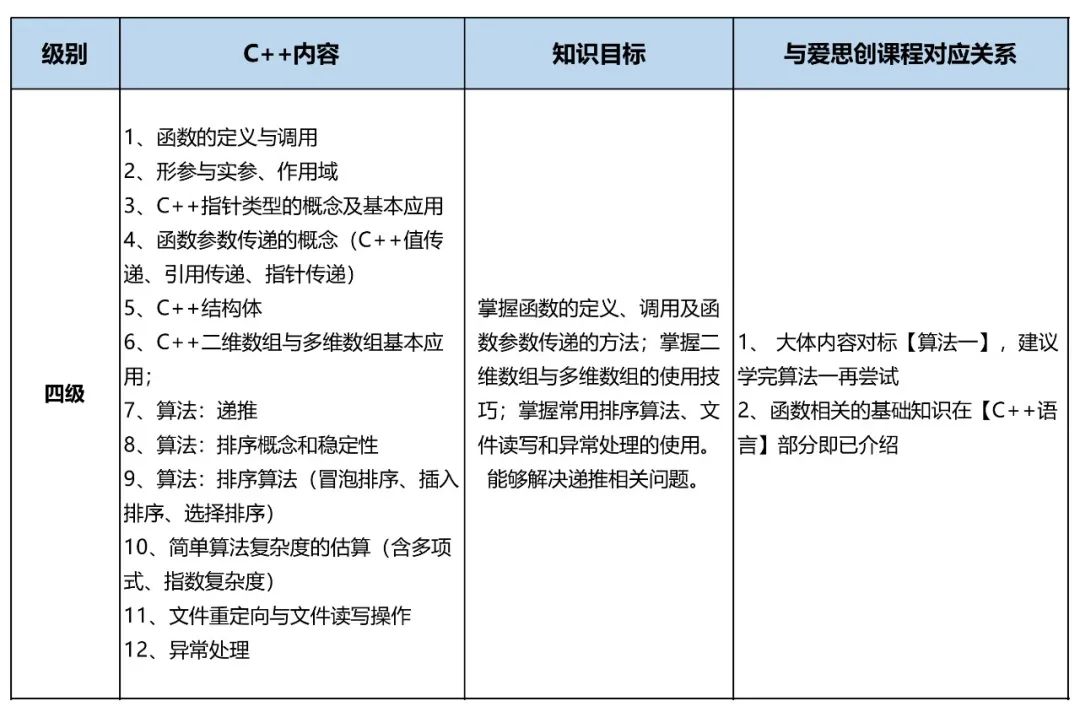
 GESP Level 4Starting from Level 4, the assessment of algorithms is officially introduced. This level mainly tests some simple algorithmic concepts, such as the basic principles of bubble sort and selection sort, the application of functions and pointers, two-dimensional arrays, sequence recursion, file read/write redirection operations, and exception handling. For example, using enumeration algorithms to find all combinations that meet specific conditions or using recursive algorithms to calculate the Fibonacci sequence.
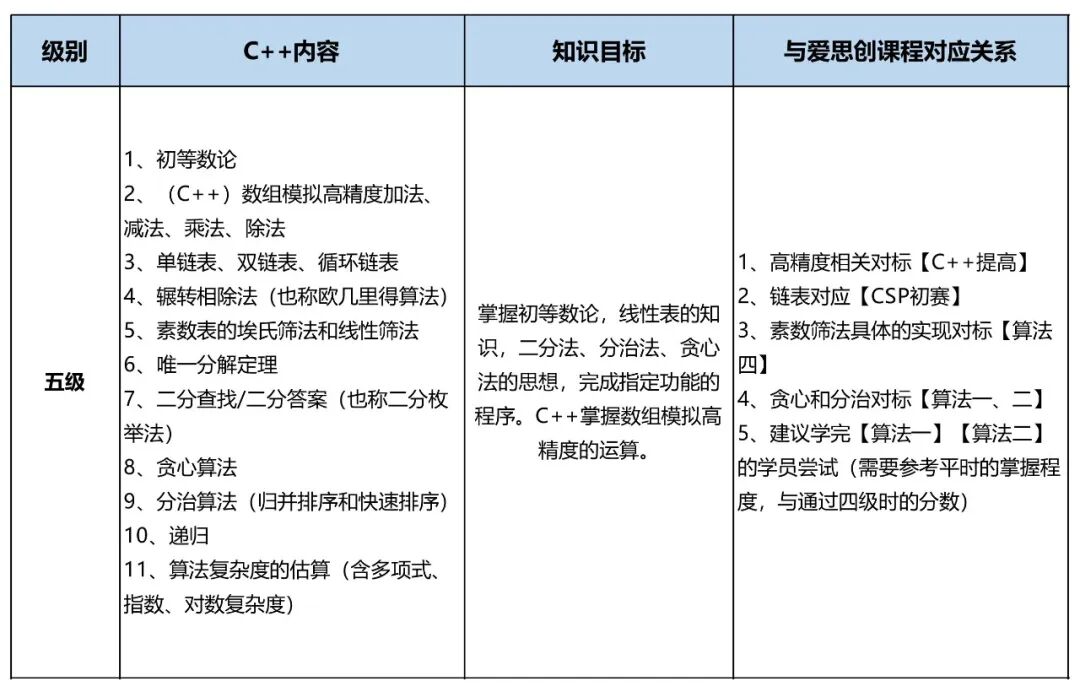
 GESP Level 5
Level 5 assesses more complex algorithms and data structures, such as greedy algorithms and divide-and-conquer algorithms. The greedy algorithm requires candidates to make the optimal choice at each step based on the current state to achieve a global optimal solution. The divide-and-conquer algorithm involves breaking down a complex problem into several smaller subproblems, solving them separately, and then combining the results to obtain the solution to the original problem. Additionally, it assesses number theory, merge sort, and quick sort based on the divide-and-conquer approach.
 GESP Level 6
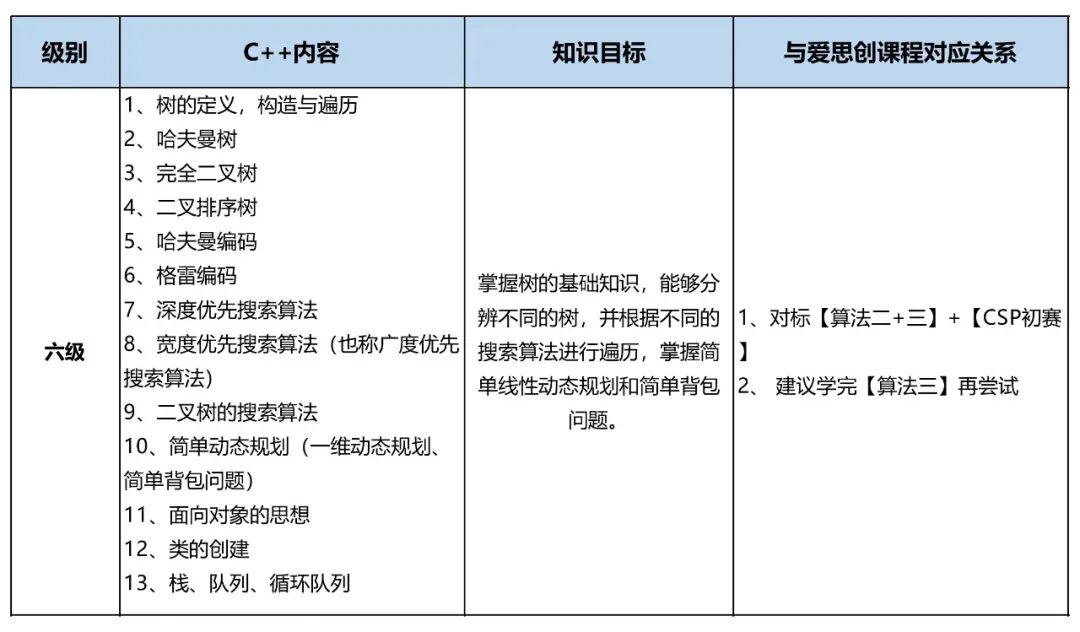
Level 6 assesses algorithmic concepts such as depth-first search (DFS), breadth-first search (BFS), and simple dynamic programming. It focuses on the application of trees, such as complete binary trees, Huffman trees, and binary search trees, as well as tree traversal (pre-order, in-order, post-order). Additionally, it will involve a deeper assessment of data structures, such as the basic operations and applications of stacks and queues.
 GESP Level 7
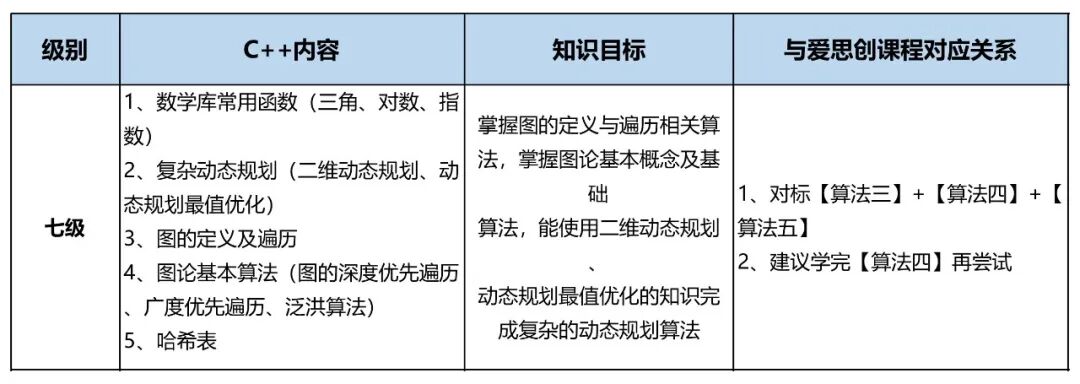
Level 7 continues to deepen the assessment of algorithms and data structures, including complex dynamic programming (two-dimensional dynamic programming, optimization of dynamic programming), and introduces basic concepts and algorithms of graph theory, such as depth-first search (DFS) and breadth-first search (BFS). Candidates need to understand the storage structures of graphs (adjacency matrix, adjacency list) and be able to use DFS and BFS algorithms to solve graph-related problems. Additionally, it will assess some advanced data structures, such as the application of hash tables.
 GESP Level 8
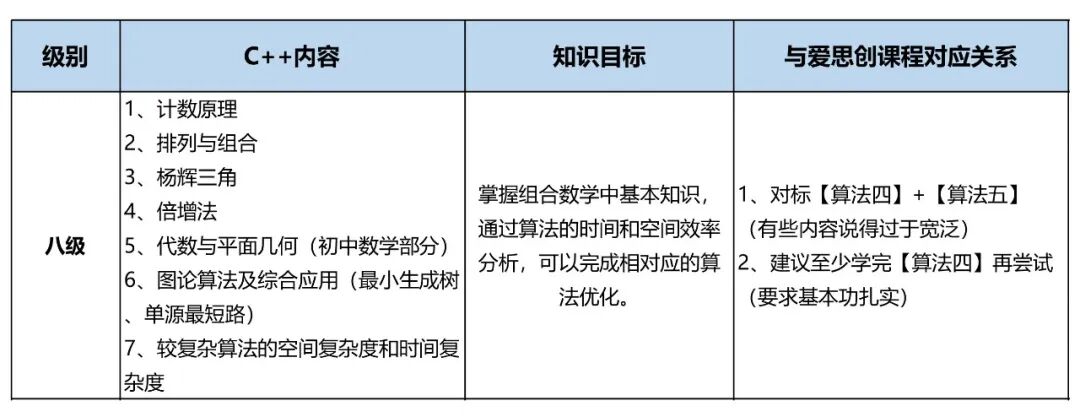
Level 8 is the highest level of GESP, with content that is more comprehensive and in-depth, requiring candidates to have a solid programming foundation, strong algorithmic skills, and excellent problem-solving abilities. GESP Level 8 focuses on a wide range of knowledge and skills, including counting principles, permutations and combinations, Pascal’s triangle, and the doubling method; mastery of algebra and plane geometry (middle school mathematics); learning graph theory algorithms (minimum spanning tree, shortest path algorithms); and understanding the time and space efficiency analysis of algorithms and algorithm optimization techniques.
Conclusion:The exam points of GESP levels 1-8 cover a comprehensive range from C++ programming fundamentals to advanced algorithms and data structures, with increasing difficulty. By gaining an in-depth understanding of the exam points at each level, candidates can prepare more effectively and gradually enhance their programming abilities.
For inquiries about GESP certification and C++ courses, please consult.