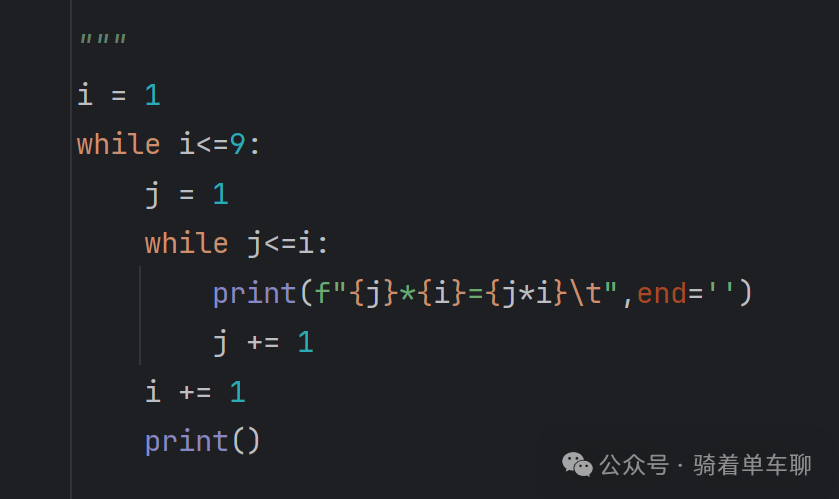
I plan to start learning Python, and here are my learning results:Below is the program code for the multiplication table:
# Multiplication Table Program
for i in range(1, 10):
    for j in range(1, 10):
        print(f'{i} x {j} = {i * j}')
 Now let’s take a look at the program’s output:
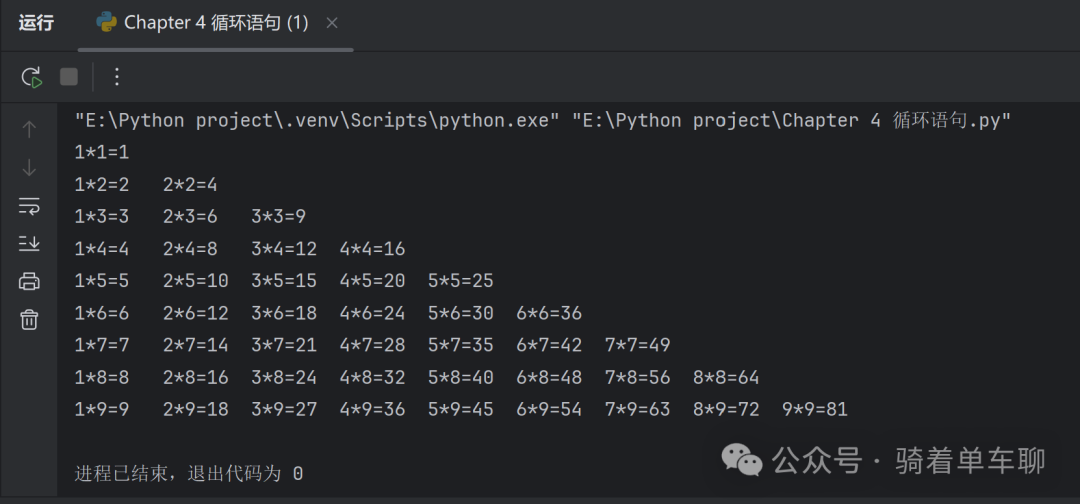 After running successfully, I was very happy. Although it is just a few extremely simple lines of code, being able to automatically generate the multiplication table truly made me feel the magic of programming.So, as a 40-year-old, why should I learn programming? What is the use of learning programming? With so many computer programming languages available, why choose Python? I would like to share my personal thoughts.There are two main purposes for learning programming:First, learning computer programming can help me build my own knowledge base. I have been thinking about how to organize and categorize what I write every day. This not only connects my thoughts on the same topic over different periods but also relates to other relevant topics, allowing all recorded content to be interconnected, thus constructing a complete knowledge system that can be iteratively optimized. Once I integrate my recorded knowledge, it becomes very convenient to retrieve it, eliminating the need to search through individual documents, thereby improving productivity.Second, it can help me keep up with the pace of AI transformation. The AI revolution is described as a new era’s “industrial revolution,” profoundly affecting everyone’s future life and work. AI will become the infrastructure of our society, just like computers are now integrated into our lives and work. AI will also become our tool, so we must learn to use this tool effectively. As non-professionals, we cannot become developers of large AI models, but we need to understand and use them well. Therefore, I am learning Python to further understand and utilize various AI tools.I once wanted to create some intelligent agents on the “Kouzi” platform. Although these platforms claim that you can create various intelligent agents or apps without knowing programming, many steps in practice require a basic understanding of code. If you know nothing, it becomes very cumbersome to operate.AI is both familiar and frightening for most ordinary people. It is familiar because we often chat and ask questions with large AI models like Doubao, and it is frightening because we fear its power might replace our jobs and lead to unemployment.The greatest opportunity for ordinary people in the AI era is to combine the powerful functions of AI with our production and life practices, using AI as a lever to amplify our capabilities and improve our efficiency. This is the correct attitude ordinary people should have towards AI.Now, to answer the second question: why choose Python?There are many excellent programming languages, such as C++ and Java. I consulted three large models: Doubao, Qianwen, and DEEPSEEK, and they all recommended Python as the top choice. Additionally, I noticed that there are many paid Python training courses online, indicating that Python has a strong market. However, the most important reason is that Python is the simplest and easiest to learn.The best way to learn a programming language is through project-based practice. I am not very clever and cannot start directly with an app or small program like smart people do. My method is to take it step by step. First, I borrowed a book on Python from the library and spent a week reading it to get a general understanding of Python. Then, I searched online for related Python teaching videos, asking AI models to help me filter out good teaching bloggers. I listed five candidate bloggers and opened their videos, choosing the one I thought explained the best to follow through. During the learning process, I typed out every piece of code demonstrated by the instructor. This not only tested whether I could actually type it out but also helped me develop a feel for coding and become familiar with the English terms used in code.That concludes my discussion on learning Python. Now, it’s time to work hard!