Recommended public account to follow ↓In today’s rapidly advancing artificial intelligence technology, the choice of computing hardware has become a key factor driving AI progress. The AI chip market in 2025 shows a clear “dual-track parallel” pattern, with Graphics Processing Units (GPUs) continuing to dominate with a 60% global market share, while Application-Specific Integrated Circuits (ASICs) have significantly increased their penetration in inference scenarios from 18% in 2020 to 40%. This market distribution reveals a core issue: in the AI era, there is no absolute optimal choice; the selection of hardware depends more on specific application scenarios and requirements.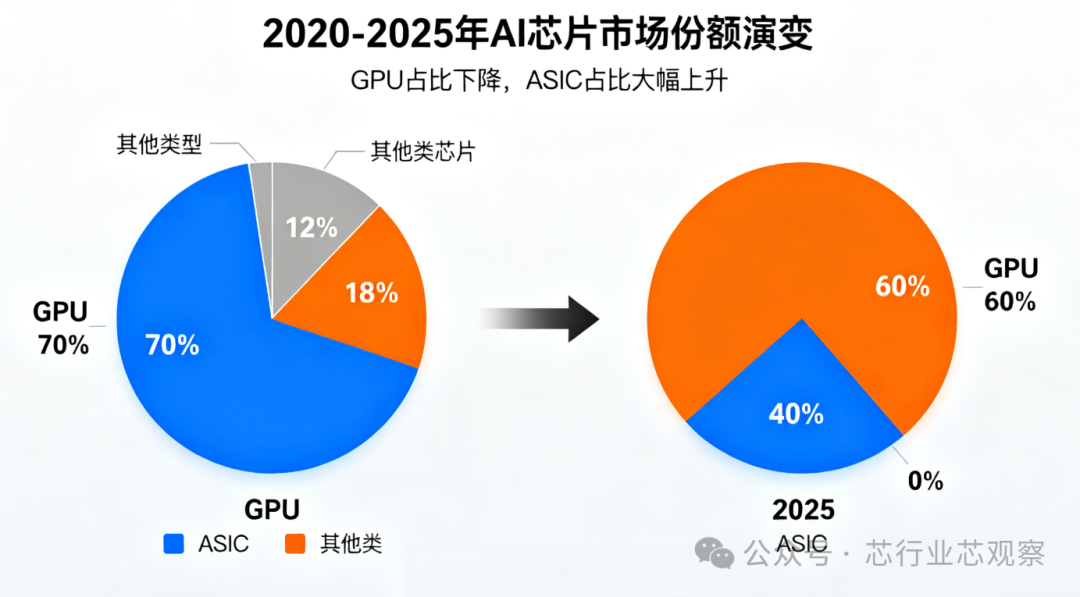 GPUs were originally designed for graphics rendering, and their unique parallel computing architecture allows them to handle a large number of similar computational tasks simultaneously.This feature perfectly aligns with the needs of training neural networks in deep learning, especially when it comes to a large number of Floating-Point Operations and Tensor Operations. Taking NVIDIA’s Blackwell architecture GPU as an example, it employs a multi-chip design and supports a flexible programming model, efficiently handling various complex AI training tasks. The NVIDIA B200, set to launch in 2025, is equipped with 192GB of HBM3e memory, while the higher-end Rubin Ultra system can provide up to 144TB of storage through multi-chip combinations, meeting the needs of ultra-large model training.
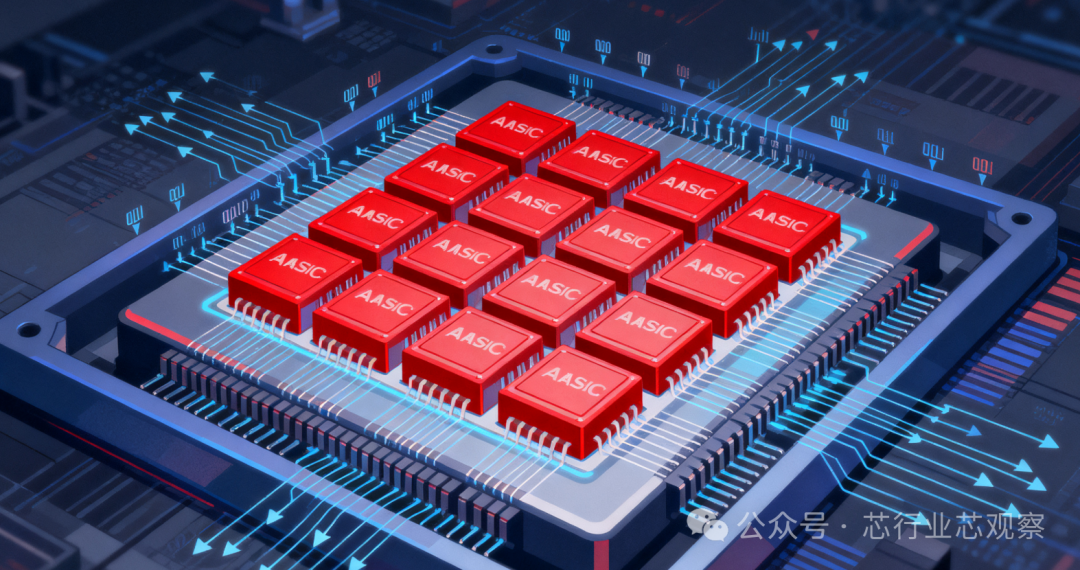 In contrast to GPUs, ASICs are integrated circuits tailored for specific tasks.This customized design allows ASICs to achieve extremely high efficiency when executing predefined tasks. Google’s latest seventh-generation TPU (Tensor Processing Unit) architecture, Ironwood, is a typical example, with a peak computing power of 4614 TFLOPS (trillions of floating-point operations per second), more than 16 times that of the 2022 TPU v4. This performance improvement mainly stems from hardware optimizations for specific AI computations, such as tensor processing, allowing ASICs to far exceed the efficiency of general-purpose GPUs when executing specific tasks.
 In the field of AI training, GPUs still hold an unshakable position.The training process requires handling massive amounts of data, performing complex Backpropagation and gradient updates, which demand hardware with high flexibility and powerful parallel computing capabilities. NVIDIA’s GPUs, with their mature CUDA ecosystem and strong computing power, occupy 80% of the data center market share. However, ASICs are also beginning to show potential in the training field. Research from Morgan Stanley indicates that when training large models like Llama-3 400B, Google’s TPU v7 demonstrates significant cost advantages due to its optimized architecture and lower power consumption.The inference scenario presents a different pattern.Inference refers to the process of using trained models for actual predictions, which typically requires higher demands for latency and Energy Efficiency Ratio. In this field, ASICs are beginning to shine due to their customized advantages.Data shows that ASICs have a cost-effectiveness ratio that is 30-40% higher than high-end GPUs in inference tasks, with Amazon’s Trainium chip being a typical example. Huawei’s Ascend 910C claims to have an energy efficiency ratio 60% higher than NVIDIA’s H100, performing excellently in edge computing and data center inference scenarios.Cost factors play an important role in hardware selection.Although high-end GPUs have a high initial investment, for research institutions and enterprises that require frequent iterations of model architectures, this investment is worthwhile. In contrast, ASICs have high design and development costs, but once they enter large-scale production, their marginal costs significantly decrease.This characteristic makes ASICs particularly suitable for application scenarios where model architectures are relatively stable and large-scale deployment is needed. For example, in intelligent driving and edge computing devices, the cost advantages of ASICs can be fully realized.
 It is worth noting that the Chinese market is forming a diversified AI chip landscape.Local companies such as Huawei’s Ascend and Cambricon have achieved a combined market share of 62% in the cloud training chip market, demonstrating a strong trend of domestic substitution.This diversified competition not only drives technological innovation but also provides more choices for companies of different sizes.Looking ahead,GPUs and ASICs are not in a mutually exclusive relationship but are evolving towards collaborative development.It is expected that by 2026-2027, the shipment of ASICs may surpass NVIDIA’s AI GPUs for the first time. This turning point does not signify the decline of GPUs but reflects the diversification of AI computing demands. In practical applications, a hybrid architecture is forming: cloud training uses GPUs to meet complex and variable model demands, while edge devices and data center inference largely adopt ASICs to improve efficiency.From the perspective of technological evolution, GPUs and ASICs are borrowing advantages from each other. The next generation of GPUs continues to integrate more dedicated acceleration units, while ASICs are also increasing a certain degree of programmability to adapt to more scenarios. This trend of technological integration indicates that future AI computing architectures will be more flexible and efficient.Ultimately,the roles of GPUs and ASICs in the AI era are not an either-or choice but an optimized configuration based on specific needs.For cutting-edge research that pursues innovation and flexibility, GPUs remain the first choice; while for large-scale deployment with strict cost and energy efficiency requirements, ASICs show clear advantages. As AI technology continues to develop, this complementary and symbiotic relationship will become more apparent, jointly promoting the advancement and application of artificial intelligence technology. In this rapidly evolving field, maintaining an open and flexible hardware strategy may be the best choice to meet future challenges.Having read this, do you have many viewpoints you want to share? Feel free to leave a comment~~