Click the blue text above to follow us
Last week, The Information reported that Google has intensified its efforts to promote its self-developed TPU, attracting considerable attention. I had not spent much time focusing on international ASIC developments, but I was surprised by how rapidly they are advancing. Almost every well-known AI company in the United States is developing its own chips, and OpenAI’s chip development progress is also faster than expected. For the roadmap of various companies’ self-developed chips, please refer to the image below: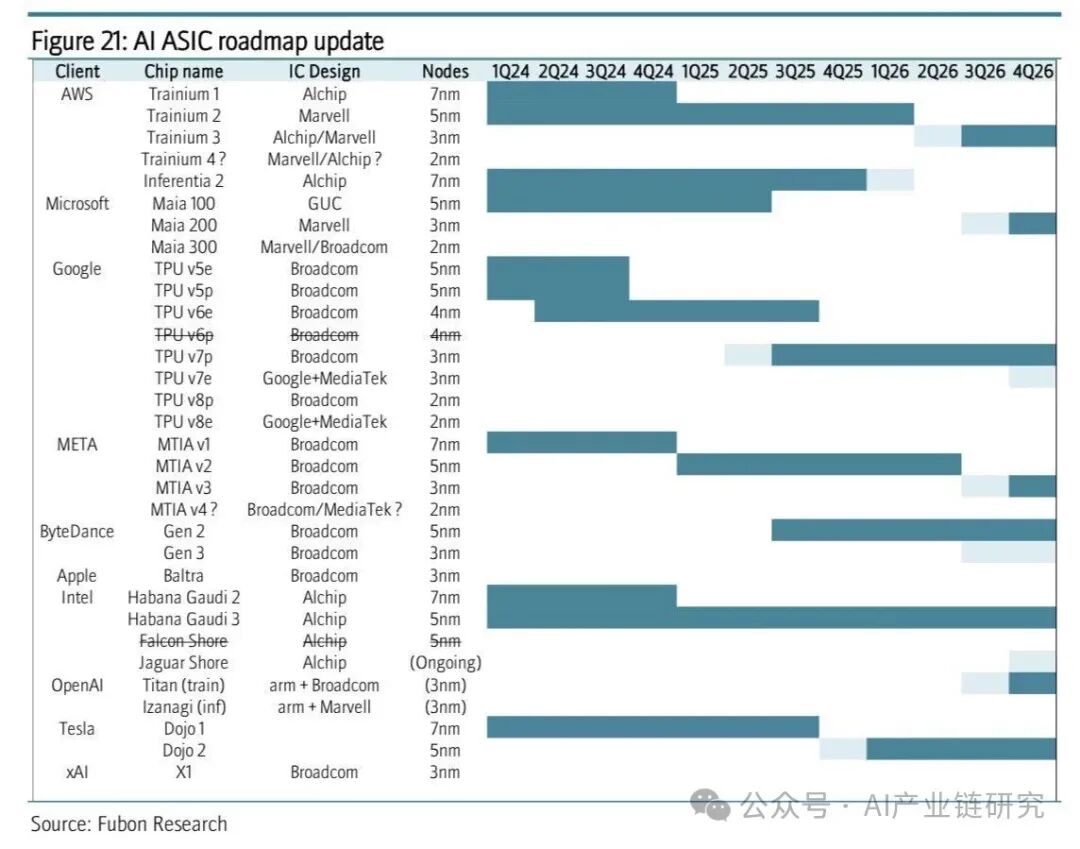 Today, we share a report released by Jefferies on September 3, which updates the status of self-developed chips by various AI companies in the United States, including development progress and shipment status.
 Main Content
 01
01
Google Expects to Ship 2.7 Million TPUs by 2026
Google has made significant achievements in the AI field, and the TPU is undoubtedly a key factor supporting this growth. Previously, we believed that Google had matured in ASIC (Application-Specific Integrated Circuit) development, so its shipment volume should not experience unexpected fluctuations. However, in this quarter’s update, we have significantly raised our expectations for Google’s TPU shipments in 2026, from 1.8 million units to 2.7 million units.In recent months, we have noticed that the expected shipment volume of TPUs has been continuously rising each month. The expected shipment volume from upstream (i.e., the capacity allocation promised by foundries) has also been steadily increasing, from 1.2 million units, 1.5 million units, 1.8 million units, to the current 2 million units, and this growth trend is not expected to stop at 2 million units, with further increases anticipated in the future.According to our investigation, Google’s demand for TPUs with Broadcom currently stands at 2.7 to 2.8 million units. We believe this demand target is likely to be achieved for the following reasons:
- Google is a leading ASIC customer in the CoWoS field, and recent business developments have been smooth. Capacity will be allocated gradually based on customer priority and end-market conditions, and Google has met all priority allocation conditions;
- Rolling expectations will be reviewed in a timely manner, which is why we see the expected TPU shipment volume being adjusted upward each month. As the demand outlook becomes clearer, foundries will commit to more capacity allocation. According to our investigation, the current supply is sufficient to meet Google’s and Broadcom’s demand for 2.7 to 2.8 million TPUs.
02
META Launches 2-Nanometer ASIC Subproject
In our previous report, we mentioned that Meta has a positive attitude towards ASIC development. From 5-nanometer ASICs to 3-nanometer ASICs, the average selling price (ASP) has increased fivefold, and shipments have nearly doubled. Now, Meta brings another surprise – it has launched a subproject for 2-nanometer process ASICs.According to our investigation, Meta will advance two ASIC projects in the 2-nanometer process stage, both expected to begin mass production in the second half of 2027. One high-end project is named “Olympus,” which will continue to be outsourced to Broadcom for development, as Meta aims to create the most powerful ASIC: each chip will be equipped with two computing cores and 12 sets of HBM3E (12Hi, i.e., 12 layers of stacked high-bandwidth memory). Currently, there are not many cloud service providers (CSPs) attempting to use 12 sets of HBM, and the metaverse is expected to be the first company to achieve this configuration.The other mid-to-low-end ASIC project is being considered for development using a customer-owned technology (COT) model, where the internal team is responsible for front-end design, while back-end design is outsourced to a third party. The outsourcing partners for this project are still being screened, with competitors including Marvell (MRVL), MediaTek (MTK), Alchip, and GUC.We refer to this as a “subproject” because the shipment volume may not match that of “Olympus,” but for the design service providers participating in the bidding, the expected average selling price (ASP) is relatively high, making this project still highly competitive.03 Other ASIC HighlightsWe have maintained our expectations for Amazon Web Services (AWS) ASIC shipments in 2026. As AWS is a second-tier customer in the ASIC field, its ability to secure more CoWoS capacity depends on two factors: whether other customers release existing capacity quotas and whether AWS adjusts its product structure. According to our investigation, AWS is considering upgrading its Trn2.5 chip product line to Trn3.We have also not adjusted our expectations for OpenAI ASIC shipments, which are expected to begin mass production in the fourth quarter of 2026, with an initial shipment volume of 136,000 units. Currently, there is very limited information regarding xAI (Elon Musk’s AI company) ASICs, and the outlook remains unclear.The most significant change in this report pertains to Apple’s ASIC expectations. According to our investigation, due to internal disagreements, the development progress of Apple’s ASIC has been delayed: some teams believe that self-developed ASICs are crucial, while others insist that the company has procured sufficient GPUs (graphics processing units) from NVIDIA and does not need to invest resources in self-developing ASICs. Based on the current progress, the likelihood of Apple achieving mass production of ASICs in 2026 is extremely low.Other emerging ASIC highlights include Oracle’s ASIC. According to our investigation, this chip is expected to begin mass production in 2027-2028, with its end customer potentially being a Chinese cloud provider.
END
 To obtain the original report or for communication, please scan the code