
At the iFLYTEK Global Developer Festival on November 6, 2025, Chairman Liu Qingfeng conducted a comparative demonstration:
Under conditions of high noise and long distance, the latest iPhone 17 Pro and the iFLYTEK Smart Office Book X5 were used for simultaneous audio recording and transcription. As the noise level increased from 30 decibels to 80 decibels, the transcription accuracy of the iPhone 17 Pro dropped from 94.23% to below 50%, ultimately ceasing transcription; meanwhile, the X5 demonstrated remarkable stability, maintaining a transcription accuracy of 95.08% even in the 80-decibel noisy environment.
At the end of the test video, a low murmur arose in the audience. While everyone expected a difference, no one anticipated that in a professional setting, the best performance achievable by a general-purpose smart device would still show such a significant gap compared to specialized AI hardware.
This seemingly random comparison reflects the structural differentiation that has already emerged in the AI hardware industry: according to IDC data, the global smartphone shipment growth rate in Q3 2025 was only 3.2%, marking a ten-year low; in contrast, AI hardware focused on vertical niche scenarios saw a market size growth of 13.4% year-on-year, reaching 1.102 trillion yuan, with consumer-grade AI hardware exceeding 400 billion yuan.
As general-purpose smart terminals encounter clear innovation bottlenecks, the rapid growth of specialized AI hardware is driving a shift in the global technology power landscape.
From DJI capturing 80% of the global consumer drone market, to the iFLYTEK Smart Office Book leading top smartphones with its extreme specialized capabilities, to Huawei’s Ascend chips supporting a significant portion of domestic large model computing power… Chinese companies are taking the lead in this wave of AI hardware explosion, becoming shapers of new rules and applying AI at an unimaginable speed compared to other regions, fundamentally altering the future productivity landscape.

The “inch by inch” market and iFLYTEK’s third-generation products
Behind the innovation in the AI hardware industry lies a truth often overlooked by most manufacturers: the market rewards companies that first perceive demand. Liu Qingfeng’s iFLYTEK Smart Office Book serves as a prime example.
In 2018, the backdrop of the era was still defined by the “e-reader” war initiated by Kindle. That year, Kindle’s annual sales in China surpassed one million for the first time, achieving great acclaim. An internal Amazon document stated that by the end of 2017, China had become Kindle’s largest market, accounting for over 40% of its global sales.
With followers flocking in, at that time, you could easily find no less than five brands making “e-paper books” in the consumer electronics section of any shopping website. Brands like iReader, Onyx, Mooc, Dami, Hanvon, and various other obscure brands that have long since disappeared were all trying to enter the e-ink terminal battlefield.
However, in 2018, iFLYTEK was testing a completely different e-ink device—the iFLYTEK Smart Office Book X1.
Before the X1 appeared, the core keyword for e-ink devices was “reading,” a market defined by Kindle, so brands were naturally divided into two camps: Kindle and “others.”
After the X1’s introduction, the keyword for e-ink devices shifted from “reading” to “office,” a track pioneered by iFLYTEK, thus in the smart office book category, brands were naturally divided into two camps: iFLYTEK and “others.”
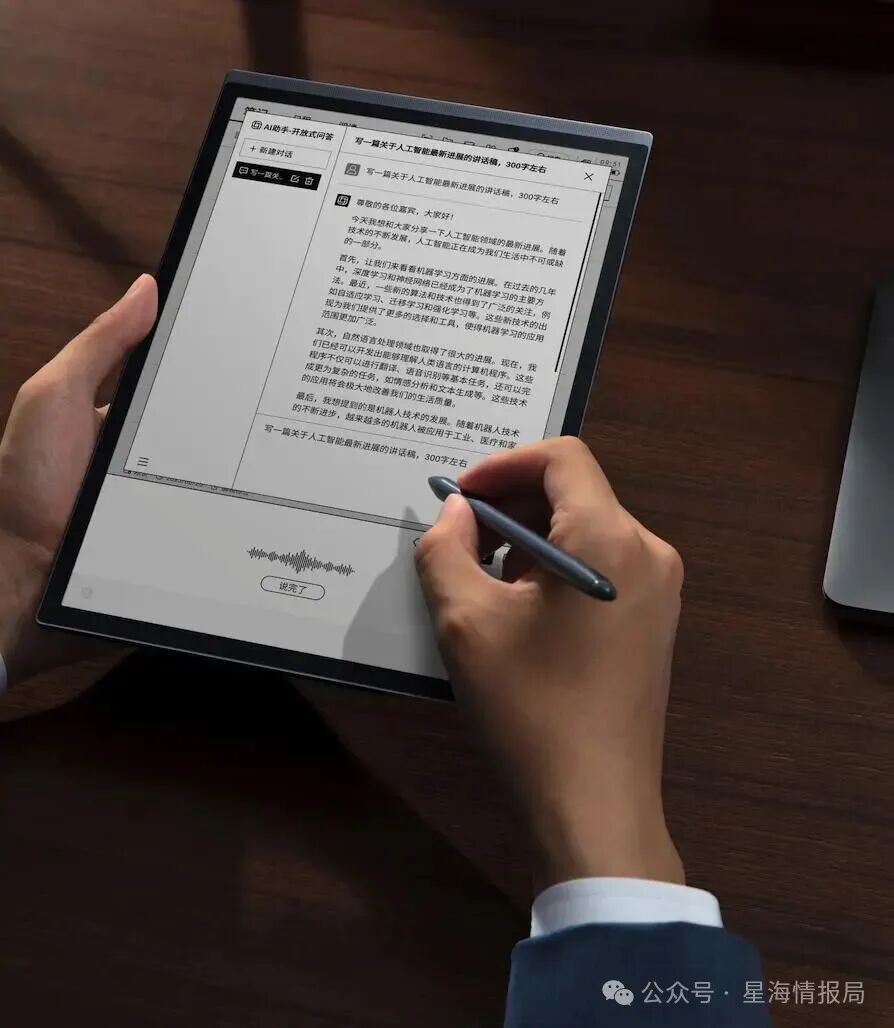
Just as DJI previously had no consumer drones, before iFLYTEK jumped out of the “reading” red sea to find the “recording” blue ocean, there was no category of e-ink office books on the market. This device, once humorously referred to as an “electronic stenographer” by early users, sold over 120,000 units in its first year, with 73% of users being professionals such as lawyers, executives, and researchers. Even the e-ink office book category attracted attempts from major terminal giants like Huawei and Xiaomi.
However, the market is always about “inch by inch.” Once the demand for recording was met, users would inevitably seek more than just “what was recorded,” but rather “what the recorded content means.”Thus, iFLYTEK’s true advantage began to emerge.
In 2023, the emergence of ChatGPT ignited global enthusiasm for generative AI, allowing all users to see the potential for their needs to be met. However, the vast majority of players in the industry responded somewhat hastily. Many manufacturers chose to “just connect an API,” but due to insufficient hardware processing capabilities, delays often exceeded five seconds, and recognition rates were criticized by users as being akin to artificial stupidity, with performance inferior to the Q&A features in mobile apps.
In contrast, iFLYTEK’s second-generation product demonstrated overwhelming AI invocation capabilities—it utilized its self-developed Spark large model but did not overreach, instead focusing on a series of deep optimizations around the core scenario of “meetings.”It is a model of being well-resourced yet pragmatically low-key.
However, structured AI meeting minutes, excellent dialect and foreign language support, and intelligent AI speech draft expansion were still not enough for the ever-demanding users. The fact is, once you achieve 1, a flood of demands 2, 3, 4, 5, and 6 will collectively erupt.
You say I can invoke the cloud to use the large model, users say, what if I am on a plane? You say you can transcribe content in advance, users say, it’s not about whether it’s pre-transcribed or not; we have high confidentiality levels in our meetings, you may dare to provide a connected model, but I cannot use it.
You say I can achieve 98% transcription accuracy in a meeting room environment, and I can even locate people by position, automatically identify speakers, and intelligently distinguish voices in a multi-person mode. Users say we don’t hold meetings in conference rooms, but in factories, on construction sites; what if the noise is a bit louder? What if there are too many interruptions from multiple speakers?
Thus, in 2025, after two years of a nationwide AI craze, the ever-demanding users awaited the arrival of iFLYTEK’s third-generation Smart Office Book X5.

Opening up blue oceans in the red sea of the industry—iFLYTEK’s differentiated positioning and core capabilities
When iFLYTEK’s Smart Office Book completed its third product iteration in 2025, the entire e-ink screen industry was caught in a “silent internal competition.” According to the RUNTO report on the “Q1 2025 China Electronic Paper Tablet Market Analysis,” the total channel sales of electronic paper tablets in China for that quarter reached 417,000 units, a year-on-year increase of 8.6%. Behind this seemingly stable growth is the intensifying homogenization competition in the industry—major brands are still fiercely competing on traditional parameters such as screen resolution and battery life.
However, amidst this red sea, iFLYTEK exhibited a distinctly different growth curve in the smart office sector. In the first half of 2025, revenue from iFLYTEK’s Smart Office Book, translation machines, recording pens, and dictionary pens in key markets such as China, Japan, South Korea, and the United States grew by 346% year-on-year. The iFLYTEK Hearing SaaS platform surpassed 98 million users, covering Hong Kong and Macau, while the international version product Deepting surpassed 1 million users in the EU and UK markets. The X5, as the latest flagship product, still topped the sales list for high-end office hardware priced over 4,000 yuan during the Double Eleven shopping festival.
Moreover, iFLYTEK’s most critical breakthrough lies in liberating the Smart Office Book from the category perception of “e-paper books” with its three generations of products, redefining it as an “AI-powered high-end productivity tool.” This transformation has led to a complete restructuring of the value system, elevating the competition.
Not only in the e-ink field, but even when considering all smart terminals, various smartphones, computers, and tablets, it is challenging to find AI hardware products that can fully match the iFLYTEK X5.
The premise of all this is iFLYTEK’s integrated hardware and software strategy, which has built a technological barrier that is difficult for others to replicate over the past decade.
Taking the X5 as an example, iFLYTEK pioneered the “4 up and 4 down ring microphone array”; this eight-microphone array hardware layout configuration can only be adopted by professional devices like office books and cannot currently be installed in general smart devices like smartphones. The sound source localization and adaptive noise reduction algorithms used by iFLYTEK are also optimized based on this hardware configuration.
In the face of such a professional solution that integrates hardware and software, even with profound voice recognition technology reserves, it is challenging for the general-purpose smart hardware like the iPhone 17 Pro to surpass the transcription accuracy of the X5 under extreme conditions. The comparison test results at the beginning of the article reflect the ultimate embodiment of the iFLYTEK Smart Office Book team’s integrated hardware and software capabilities.
It is precisely this capability that transforms AI from a “showy” toy into a truly knowledgeable “workplace advisor.” The core keyword driving all evolution is “understanding”—
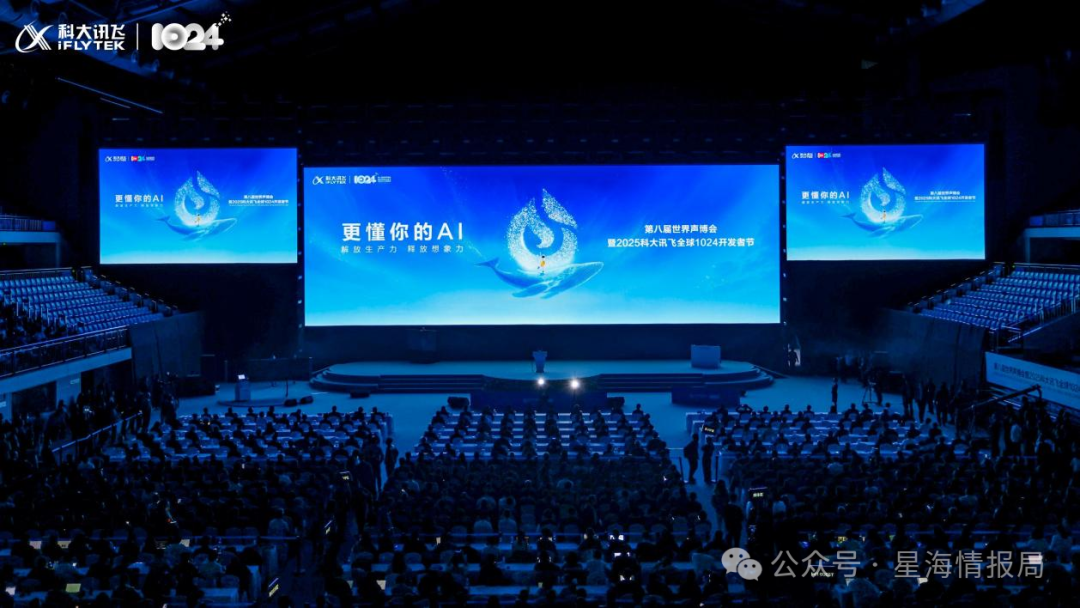
understanding the environment, understanding the scenario, supporting historical data activation, understanding your past, and hoping to understand your future needs through your historical data. This is why Liu Qingfeng set the theme of his speech at the iFLYTEK 1024 Global Developer Conference as “AI that understands you better.” Because only by understanding you better can it cooperate with you more effectively, provide you with better tools, and achieve higher efficiency.
For example, iFLYTEK even designed a physical network disconnection switch for the X5, as most executives require absolute certainty when discussing sensitive business matters—ensuring that data will not leak. The physical disconnection design of the X5 provides this certainty, which cannot be matched by pure software solutions. To prevent any misoperation, iFLYTEK even added an indicator light on the physical switch.
However, while ensuring data security, the daily high-intensity meetings and influx of information also make them urgently need AI assistance. Therefore, the X5 is equipped with an edge-side large model, ensuring that even under physical disconnection conditions, it can still invoke local models for functions such as voice transcription and AI meeting minutes. The edge-side large model will also continuously self-train based on usage, becoming increasingly attuned to your needs.
Under such a product strategy, the role of the X5 gradually extends from work scenarios to become the core hub of personal knowledge management. I know a user who has continuously used three generations of iFLYTEK Smart Office Books; she now stores all her meeting notes, reading notes, and inspiration fragments in the office book, and this data is analyzed by AI, almost becoming her second brain.
In this transformation, the development path of the iFLYTEK Smart Office Book may become an important reference for the entire industry—the future competition will no longer be a comparison of parameters, but a contest of value creation capabilities. More importantly, iFLYTEK’s success proves the possibility of Chinese companies achieving technological leadership in the AI hardware field.
By combining a self-controllable technological architecture with a deep understanding of local user needs, Chinese companies are fully capable of occupying a leading position in the global AI hardware market.

From insights in China to validation globally—good products are a universal language
When the iFLYTEK Smart Office Book X5 topped the sales list for high-end office hardware priced over 4,000 yuan during the Double Eleven shopping festival in 2025, this achievement was not only a victory for the Chinese market but also heralded a global reconstruction of AI hardware value.
In the first three quarters of 2025, iFLYTEK’s C-end business revenue grew by nearly 40%, with overseas revenue increasing by 2.7 times year-on-year. Behind these numbers are engineers from Japan, oil companies from the Middle East, financial institutions from Southeast Asia, and even executives from multinational mining groups in Africa. The common ground in the global market is the high-end business crowd’s pursuit of efficiency and security.
Currently, the iFLYTEK AINOTE 2 has achieved 25 million yuan in crowdfunding sales globally, covering over 50 countries and regions, attracting more than 6,200 supporters, winning the Guinness World Record for “the world’s thinnest electronic ink tablet,” and topping the three major international crowdfunding platforms: Kickstarter in the USA, Makuake in Japan, and Wadiz in South Korea, receiving unanimous recommendations from top global media such as USA TODAY and Tom’s Guide.

Moreover, localized innovations targeting various regions around the globe have become a tool for iFLYTEK to further globalize. In the ASEAN market, iFLYTEK launched a multilingual large model base optimized for ten languages; in the Middle East, the device enhanced its recognition capabilities for Arabic dialects. This deep adaptation reflects iFLYTEK’s precise grasp of global scenarios.
It is these seemingly minor yet crucial optimizations that have allowed the iFLYTEK Smart Office Book to be viewed overseas not just as a tool, but as an “intelligent partner that understands local business.” The success in the global market, in turn, validates the universality of the Chinese AI hardware innovation model. It proves not only the excellence of a single product but also a victory of an industrial logic: true innovation is not about stacking parameters, but about deeply responding to the real needs of global users.
When we shift our focus from the seven-year journey of the iFLYTEK Smart Office Book to the entire Chinese AI hardware field, we find a similar path being repeated across different tracks: DJI occupies over 80% of the global consumer drone market, starting from the niche demand of professional model enthusiasts; Huawei’s absolute leadership in communication equipment began with a deep dive into the “thankless” scenario of network coverage in remote areas. The success of the iFLYTEK Smart Office Book began with a seemingly niche “office demand” and has ventured into the vast sea of AI hardware.
In the field of AI hardware, Chinese companies are transforming from technology followers to co-creators of rules. The success of all these companies together forms a uniquely Chinese innovation paradigm—in the midst of extreme internal competition and external pressure, honing the deepest insights into demand and the most extreme responsiveness.
This paradigm can be summarized in a three-part “value innovation” trilogy:
First, reconstructing the track from “red ocean” to “blue ocean.” Chinese manufacturers’ most unique ability lies in their capacity to open up new blue oceans in a recognized red ocean through keen insights into users’ “unspoken pains.” iFLYTEK did not engage in a bloody battle with Kindle in the “e-paper book” bloodbath but redefined the “smart office book”; just as DJI did not continue to improve remote-controlled airplanes but created “flying cameras.” The core behind this is not about avoiding competition but about doing what others cannot.
Second, building asymmetric competitiveness through “integrated hardware and software.” When pure software or pure hardware innovations are easily replicated, leading Chinese manufacturers have chosen the most challenging yet stable path: integrated hardware and software. iFLYTEK self-developed the Spark large model and deeply coupled it with microphone arrays and chips; Huawei optimized the entire chain from communication protocols to Kirin chips to HarmonyOS. This model, which deeply integrates hardware, software, algorithms, and ecosystems, creates an experience barrier of 1+1>10, making it difficult for competitors to disrupt through a single technological advantage. This is no longer about parameter competition but about elevating system capabilities.
Third, forging “localized insights” into a “global weapon.” The complexity and diversity of the Chinese market provide the most demanding training ground for AI hardware. A product that can simultaneously meet the foreign meeting needs of financial elites in first-tier cities, transcribe in noisy environments in manufacturing factories, and understand dialects in local government meetings inherently possesses the foundational capability to conquer global markets. The success of the iFLYTEK Smart Office Book’s overseas expansion essentially replicates the success validated in the Chinese market to the global market, with targeted local adjustments.
Looking back at the comparison test with the iPhone at the beginning of the article, its significance has long transcended the victory of a single product. It seems to hint at the shift in the global technology industry power structure:
In the field of AI foundational hardware, we have Huawei; in general smart mobile terminals, we have Xiaomi, OPPO, and Vivo; in the automotive sector, we have BYD, Changan, Chery, and the emerging players; and in the consumer-grade vertical AI hardware track, we have iFLYTEK’s office books, translation machines, learning machines, as well as smart rice cookers, robotic vacuum cleaners, smart refrigerators, hotel delivery robots, and countless other smart hardware manufacturers.
From ENIAC to iPhone, nearly all major hardware innovations over the past 80 years have been dominated by Europe and the United States. However, the AI-driven paradigm revolution is rewriting the historical script.
When Liu Qingfeng raised the world’s thinnest electronic ink tablet X5, it seemed that he was holding not just a product, but a key to opening the door to a new world.
····· End ·····Star Sea Intelligence Bureau System ResearchChinese Manufacturing and Domestic SubstitutionFocusing on the Rise of Chinese Industries▲Follow industry news, crack the technology codeChasing advanced technology trends, witnessing the vast sea of Chinese manufacturing