TFT LCD is the abbreviation for Thin Film Transistor Liquid Crystal Display in Chinese, which is called “薄膜晶体管液晶显示器”, and is one of the most widely used flat panel display technologies today. It has dominated the mainstream display market for laptops, mobile phones, televisions, and monitors for many years (although it is gradually being replaced by OLED in some areas, it is still widely used in mid-range and low-end devices).
1. Core Principle:“Control of Light” instead of “Active Emission”
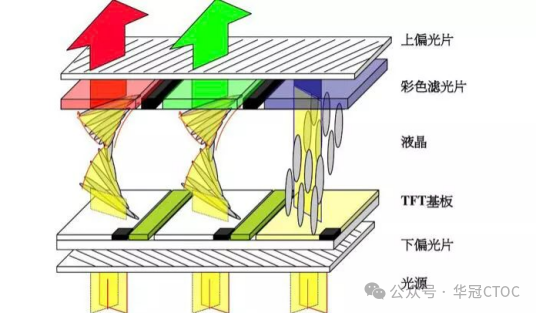
TFT LCD itself does not emit light, but displays images bycontrolling the light transmittance of the backlight layer, which consists of two parts working together: the “backlight module” and the “liquid crystal display panel (including the TFT driving layer)”. The specific principle can be broken down into 3 key steps:
1.The backlight layer provides the basic light source
The “backlight module” at the bottom/side of the display (earlier models often used CCFL cold cathode fluorescent lamps, while the mainstream now is LED light-emitting diodes) emits uniform white light, which serves as the “basic light source” for the display.
2.The polarizer filters the direction of light
The light emitted from the backlight is “unpolarized light” (light vibrates in any direction) and must first pass through the first layer of “polarizer” (polarizer), which filters out “light vibrating in a single direction” (e.g., vertical direction) before it can enter the liquid crystal layer.
3.TFT drives the liquid crystal, controlling light transmittance
This is the core step of TFT LCD:
◦The “light rotation” property of the liquid crystal layer: Liquid crystal molecules have the property of “changing their arrangement direction when electrified” — when not electrified, the liquid crystal molecules rotate the direction of polarized light by 90°, allowing it to pass through the second layer of “analyzer” (which is perpendicular to the polarizer direction), ultimately forming “bright pixels”; when electrified, the arrangement direction of the liquid crystal molecules changes, no longer rotating the light, and the light is blocked by the analyzer, forming “dark pixels.
◦The “precise control” function of TFT: Each pixel corresponds to an independent “thin film transistor (TFT)”, which acts as a “micro switch” that receives signals from the driving circuit, precisely controlling the on/off state and voltage of that pixel (the voltage can adjust the degree of liquid crystal rotation, achieving “grayscale, and combined with color filters, can display color).
1.The color filter presents colors
In front of the analyzer, each pixel is divided into “red (R), green (G), blue (B)” three sub-pixels, corresponding to three layers of color filters. By controlling the brightness (grayscale) of the three sub-pixels, any color can be mixed, ultimately forming a color image.
2. Core Structure: Five Key Components
The display panel of TFT LCD can be divided into 5 layers from bottom to top (or from light source to observer), with each layer having a clear and irreplaceable function:
|
Layer (from bottom to top) |
Core Component |
Function Description |
|
1 |
Backlight Module |
Provides uniform white light, serving as the “source of light” for the display (LED backlight is thinner and more energy-efficient than traditional CCFL). |
|
2 |
Lower Polarizer (Polarizer) |
Filters the unpolarized light from the backlight into “polarized light vibrating in a single direction”, preparing for subsequent control. |
|
3 |
TFT Array Substrate |
Composed of numerous thin film transistors (TFT) and pixel electrodes, TFT is responsible for precisely controlling the on/off state of each pixel. |
|
4 |
Liquid Crystal Layer |
Sandwiched between the TFT substrate and the color filter, it rotates or does not rotate the polarized light through molecular arrangement changes. |
|
5 |
Color Filter + Upper Polarizer (Analyzer) |
The color filter achieves RGB color separation, and the upper polarizer filters the light, ultimately forming visible color pixels. |
3. Core Advantages and Limitations of TFT LCD
As a display technology that once dominated the market, TFT LCD has very distinct characteristics, and due to its limitations, it is gradually being replaced by new technologies such as OLED.
1. Core Advantages
•Low cost and mature mass production: With years of technological iteration, production lines are mature, especially for medium-sized (e.g., monitors, laptops) and large-sized (e.g., televisions) products, the cost is far lower than OLED.
•High brightness and good visibility: LED backlight can provide high brightness (usually 300-500 nit, and can reach 1000+ nit in outdoor scenarios), still clearly displaying in strong light, superior to early OLED.
•Long lifespan and high stability: No OLED exists “burn-in” risk (uneven pixel degradation), under normal use, the lifespan can reach 5-10 years, suitable for long-term static displays (e.g., monitoring, billboards).
•Balanced color performance: Through wide color gamut technology (e.g., sRGB, DCI-P3), it can achieve near professional-level color reproduction, meeting the needs of office, design, and viewing.
2. Major Limitations
•Does not support self-emission, has “light leakage” issues: The light from the backlight layer is difficult to be completely blocked by the liquid crystal, especially at the edges of the screen, which can easily lead to “light leakage” (grayish display when showing black), with contrast lower than OLED (OLED can completely not emit light in black).
•Slower response speed, with “ghosting” risk: Liquid crystal molecules take time to rotate, traditional TFT LCD response speed is about 5-10 ms, fast-moving images (e.g., games, sports events) may experience ghosting (which needs to be improved through “overdrive technology”).
•Higher power consumption (relative to OLED): The backlight layer needs to continuously emit light, even when displaying black, the backlight cannot be turned off, resulting in higher power consumption than self-emitting OLED (especially in small devices like mobile phones).
•Cannot achieve flexible displays: The characteristics of the glass substrate and liquid crystal make it difficult for TFT LCD to bend or fold, while OLED can achieve foldable and rollable screens based on flexible substrates.
4. Main Application Scenarios of TFT LCD
Despite being squeezed by OLED , TFT LCD still occupies a dominant position in the following scenarios due to its cost and stability advantages:
•Mid-range and low-end smartphones / tablets: Budget smartphones and entry-level tablets often use TFT LCD (e.g., LCD screens of the iPhone SE series), balancing cost and experience.
•Computer monitors / laptops: Mainstream office monitors, gaming monitors (high refresh rate LCD, such as 144Hz, 240Hz), and laptop screens (especially those with 15.6 inches and above).
•Large-sized televisions: Mid-range televisions of 55 inches and above, TFT LCD (LED backlight) is still mainstream, with prices far lower than the same size OLED televisions.
•Industrial / commercial displays: Monitoring screens, ATMs, POS machines, billboards, etc., which require high lifespan and stability, are more reliable with TFT LCD.
5. Key Differences Between TFT LCD and OLED
To better understand their positioning, we can compare TFT LCD with the current mainstream OLED across core dimensions:
|
Comparison Dimension |
TFT LCD |
OLED (Organic Light Emitting Diode) |
|
Light Emission Principle |
Backlight + Liquid Crystal Control (Passive Emission) |
Self-emission of pixels (Active Emission) |
|
Contrast |
Medium to low (light leakage leads to impure black) |
Extremely high (black does not emit light at all) |
|
Response Speed |
Slower (5-10 ms, prone to ghosting) |
Extremely fast (<1 ms, no ghosting) |
|
Flexibility |
Not flexible (glass substrate) |
Flexible (flexible substrate, supports folding / rolling) |
|
Power Consumption |
Higher (backlight continuously emits light) |
Lower (only emitting pixels consume power) |
|
Lifespan / Burn-in Risk |
Long, no burn-in risk |
Shorter, static display for long periods has burn-in risk |
|
Cost |
Low (mature mass production) |
High (especially for large sizes) |
Conclusion
TFT LCD is a display technology based on “thin film transistor-driven liquid crystal control of light”, which has long dominated the global display market due to its mature mass production process, low cost, and high stability. Although it is inferior to OLED in terms of contrast, flexibility, and power consumption, it still has irreplaceable advantages in mid-range devices, large-sized televisions, and industrial displays, representing an important example of “cost-effectiveness” in the current display field.