
In our daily lives, we often use Bluetooth, a wireless technology. But do you know what Bluetooth is?
Let’s take a look at what Bluetooth is.
Bluetooth is a short-range wireless communication technology standard designed for low-cost, low-power wireless data exchange between devices without the need for physical cable connections. It is widely used in consumer electronics, automotive, office equipment, and other scenarios, making it one of the most common wireless connection methods in daily life.
1. Core Definition and Origin of Bluetooth
-
Technical Essence Bluetooth essentially is a “Wireless Personal Area Network (WPAN)” technology that operates in the globally accepted 2.4GHz Industrial, Scientific, and Medical (ISM) free frequency band, using Frequency Hopping Spread Spectrum (FHSS) technology to reduce interference from other devices in the same frequency band (such as WiFi and microwaves), ensuring stable data transmission.
-
Origin of the Name The name “Bluetooth” is derived from the 10th-century Danish King Harald Bluetooth — who unified parts of Denmark and Norway, symbolizing “connection and unity.” In 1998, Ericsson, Nokia, IBM, Intel, and Toshiba jointly launched this technology, aiming to “unify the wireless connection standards of different devices.”
2. Core Features of Bluetooth
The popularity of Bluetooth stems from its unique technical advantages, especially suitable for short-range scenarios:
- Short-range Communication: The typical effective range is 10 meters (Class 2 standard, most commonly used), while some high-power devices (Class 1) can reach up to 100 meters, meeting the needs for close-range connections like mobile phones to headsets and computers to mice.
- Low Power Consumption: Bluetooth 4.0 and later versions introduced the “Bluetooth Low Energy (BLE)” mode, with power consumption only 1% to 10% of traditional Bluetooth, supporting long battery life for devices like smart bands and wireless sensors (lasting from months to years).
- Low Cost: Bluetooth chips are small and inexpensive, easily integrated into small devices like phones, headsets, and watches without requiring additional high hardware investments.
- Multi-device Compatibility: With a globally unified standard, whether Android/iPhone, Windows/macOS computers, or different brands of headsets and speakers, as long as they support Bluetooth, they can connect with each other (protocol version matching required).
- Security: Supports AES-128 encryption, pairing authentication (such as PIN codes, pop-up confirmations), and other security mechanisms to prevent data eavesdropping or unauthorized device access.
3. Evolution of Major Bluetooth Versions
Since the release of version 1.0 in 1999, Bluetooth technology has undergone multiple updates, with the core trends being faster speeds, lower power consumption, and longer ranges:
| Version | Release Date | Core Enhancements | Typical Applications |
|---|---|---|---|
| Bluetooth 1.0/1.1 | 1999-2001 | Basic wireless connection, speed of 1Mbps | Early wireless headsets, printers |
| Bluetooth 2.0+EDR | 2004 | Speed increased to 3Mbps, supports “Enhanced Data Rate (EDR)” | Mobile phones connecting to Bluetooth speakers, computers connecting to wireless mice |
| Bluetooth 3.0+HS | 2009 | Introduced “High Speed (HS)” mode, with speeds up to 24Mbps (requires WiFi chip) | Short-range fast transfer of images and videos |
| Bluetooth 4.0 (including BLE) | 2010 | Added “Low Energy (BLE)” mode, significantly reducing power consumption | Smart bands, wireless heart rate monitors, Bluetooth anti-lost devices |
| Bluetooth 5.0 | 2016 | Range increased to 300 meters (theoretical), speed of 2Mbps, supports “multi-device broadcasting” | Smart home (e.g., Bluetooth gateway connecting multiple sensors), sports headphones |
| Bluetooth 5.1 | 2019 | Added “Direction Finding” feature, capable of locating device direction | Bluetooth anti-lost devices (precise item location), indoor navigation |
| Bluetooth 5.2 | 2020 | Supports “LE Audio (Low Energy Audio)” and “LC3 codec,” better sound quality and lower latency | True wireless earbuds (TWS), Bluetooth hearing aids |
| Bluetooth 5.3 | 2021 | Optimized LE Audio connection stability, reduced interference, and lower power consumption | Next-generation TWS earbuds, smartwatches |
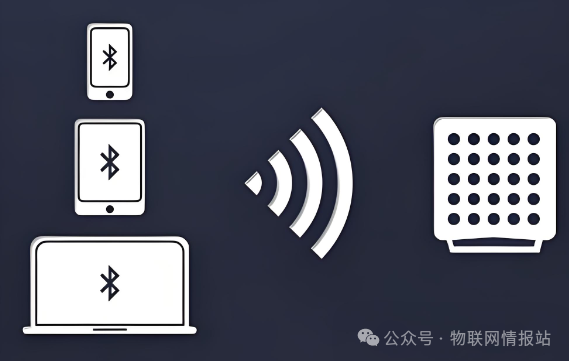
4. Typical Application Scenarios of Bluetooth
Bluetooth applications have penetrated multiple fields of life and work, with common scenarios including:
-
Personal Consumer Electronics
- Audio transmission: Mobile phones connecting to TWS earbuds, Bluetooth speakers, in-car Bluetooth (playing music / calls);
- Data synchronization: Mobile phones connecting to computers (transferring photos, files), tablets connecting to styluses;
- Peripheral connections: Computers connecting to wireless mice/keyboards, game controllers connecting to consoles.
Smart Home
- Low-power devices: Smart locks (Bluetooth unlocking), temperature and humidity sensors, smart bulbs (Bluetooth control);
- Central control connection: Connecting multiple BLE devices to the home network via a Bluetooth gateway.
Automotive Field
- In-car Bluetooth: Connecting mobile phones to car systems for hands-free calls, navigation voice prompts, music playback;
- Vehicle networking: Some models support Bluetooth keys (mobile phone unlocking of vehicles), tire pressure monitoring sensors (BLE data transmission).
Medical Health
- Wearable devices: Smart bands/watches (BLE transmitting heart rate, step data to mobile phones);
- Medical devices: Bluetooth blood glucose meters, electrocardiograms (wireless data transmission to doctor terminals).
Industry and Internet of Things (IoT)
- Sensor networks: Temperature and pressure sensors in factories (BLE low-power data transmission);
- Device control: Bluetooth remote controls for industrial robots, smart shelves (BLE locating goods).
5. Differences Between Bluetooth and Other Wireless Technologies (e.g., WiFi)
Many people confuse Bluetooth and WiFi; although both are wireless technologies in the 2.4GHz frequency band, their purposes are entirely different:
| Comparison Dimension | Bluetooth | WiFi (802.11 series) |
|---|---|---|
| Communication Distance | Short (10-100 meters) | Medium to long (100-300 meters) |
| Transmission Rate | Lower (up to 2Mbps, BLE lower) | Higher (WiFi 5 up to 3.5Gbps, WiFi 6 up to 9.6Gbps) |
| Power Consumption | Low (especially BLE) | High (requires continuous power, such as routers, mobile phones) |
| Number of Connected Devices | Few (a single master device can connect up to 7 slave devices) | Many (a single router can connect dozens of devices) |
| Core Purpose | Point-to-point communication between devices (e.g., headphones connecting to mobile phones) | Multiple devices accessing the internet (e.g., mobile phones, computers connecting to WiFi) |
Conclusion
Bluetooth is a wireless technology designed for “short-range, low-power, low-cost” scenarios. Through continuous version updates, it has evolved from early “simple data transmission” to a core technology supporting smart homes, wearable devices, and vehicle networking. Its core value lies in “breaking the cable constraints between devices,” making daily connections more convenient and flexible.
For more IoT information, please click the link below to follow us!