Click on the above “Huanghua Electronic Components” to follow us
What is a termination resistor? A termination resistor is a hindrance encountered during the transmission of electronic information. When transmitting high-frequency signals, the signal wavelength is relatively short compared to the transmission line, causing reflection waves at the end of the transmission line, which interferes with the original signal. Therefore, a termination resistor is required at the end of the transmission line to prevent signal reflection. This is not necessary for low-frequency signals. In long-line signal transmission, termination matching resistors are generally required at the receiving end to avoid signal reflection and echoes.
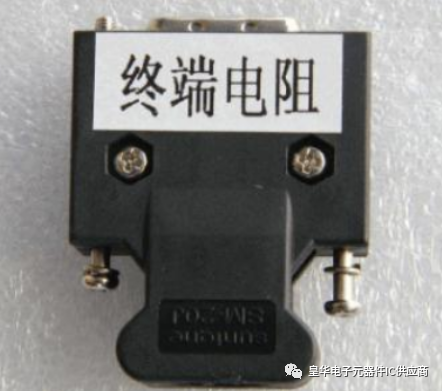
The value of the termination matching resistor depends on the impedance characteristics of the cable and is independent of the cable length. RS-485/RS-422 generally uses twisted pairs (shielded or unshielded) for connection, with termination resistors typically between 100 to 140 Ω, and a typical value of 120 Ω. In practical configurations, a termination resistor is connected at each of the two terminal nodes of the cable, i.e., the nearest and farthest ends, while nodes in the middle section should not connect to a termination resistor; otherwise, it will lead to communication errors.
The principle of termination resistor signal reflection
During communication, there are two reasons for signal reflection: impedance discontinuity and impedance mismatch.
Impedance discontinuity occurs when the signal suddenly encounters a very low or nonexistent cable impedance at the end of the transmission line, causing reflection at that point. This principle of signal reflection is similar to light reflecting when it enters a different medium. To eliminate this reflection, a termination resistor equal to the characteristic impedance of the cable must be connected at the end of the cable, ensuring continuity of the cable’s impedance. Since the signal transmission on the cable is bidirectional, a termination resistor of the same size can also be connected at the other end of the communication cable.
Another cause of signal reflection is impedance mismatch between the transceiver and the transmission cable. This type of reflection mainly manifests as network data chaos when the communication line is idle. To mitigate the impact of reflected signals on the communication line, methods such as noise suppression and adding bias resistors are typically employed. In practical applications, for relatively small reflected signals, the method of adding bias resistors is often used for simplicity and convenience.
The function of termination resistors
1. General statement: Termination resistors are used to reduce signal reflections in communication cables.
2. Signal transmission circuits have characteristic impedances (approximately 120Ω for twisted pairs). When a signal reaches the end of the transmission line, if its terminal impedance does not match the characteristic impedance, reflections will occur, causing signal waveform distortion (dips or peaks). This distortion is not obvious when the transmission line is short, but it becomes more severe as the transmission line length increases, making proper transmission impossible. At this point, a termination resistor (Terminator) must be installed. The FBs-PLC has a built-in 120Ω termination resistor. To apply the termination resistor, please open the PLC communication cover and set the dip switch to the “ON” position (the dip switch is set to “OFF” at the factory). However, note that termination resistors should only be applied at the far left and far right PLCs of the bus, while all PLCs in between should be set to “OFF”; otherwise, it will lead to insufficient driving capability of RS-485.
Applications of termination resistors
1. Clock in digital circuits.
2. When the data transmission speed is high.
3. Termination of address lines in series.
4. Termination of differential data lines in parallel.
Note: The source of this information is network information security and is for reference only. It does not represent the views of this public account. If there is any infringement, please contact us for deletion.
 About AMEYA360
AMEYA360 Mall (www.ameya360.com) was launched in 2011, with over 3,500 quality suppliers and 6 million product model data, offering over 1 million components in stock for selection. The products cover multiple fields, including MCU + memory + power chips + IGBT + MOSFET + operational amplifiers + RF Bluetooth + sensors + resistors, capacitors, inductors + connectors, etc. The platform’s main business includes the sale of electronic components, BOM matching, and providing product documentation, offering a one-stop purchase and sales service for customers.


 Click on the “Read the original text” below for a quick inquiry!