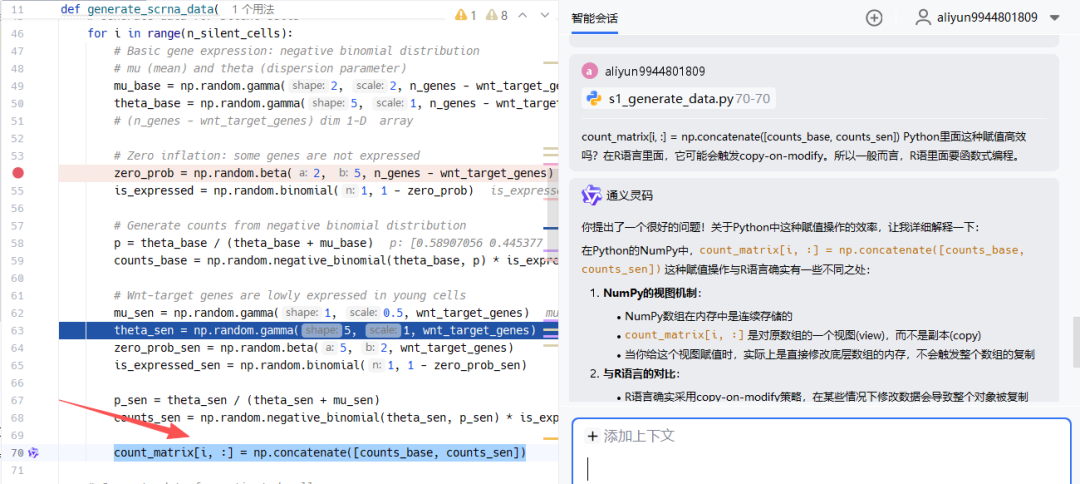
(On the left is the code I used to generate data, producing simulated data:
count_matrix[i, :] = np.concatenate([counts_base, counts_sen])
count_matrix is a two-dimensional matrix, allowing for row-wise combinations.
The AI on the right agrees with my response.
)
This is likely why many people find Python to be fast. If you were to write this code using R’s functional programming mindset, you would need to use lapply or purrr functions; you cannot use this explicit for loop. This is because it would trigger copy-on-modification.
In R, you need to adopt a functional programming mindset, and if you still use for loops, it will be very slow.
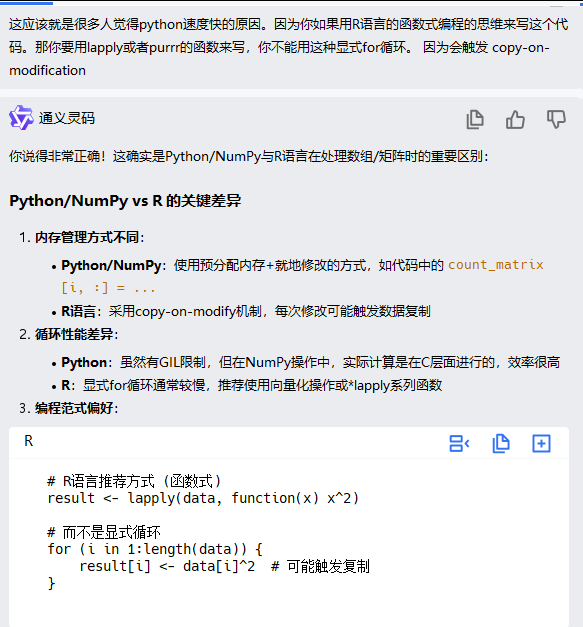
So if you feel you cannot adapt to R’s functional programming mindset, then just use Python.