As AI enters the “usable stage,” how can we build a truly efficient, flexible, and controllable intelligent agent system? Relying solely on a “smart large model” is clearly not enough. For genuinely complex tasks, a clearly defined “team operation” is essential. The Multi-Agent-Manus (MCP process) has emerged, which is not just a simple execution chain but a complete set of organized, strategic, and feedback-driven intelligent collaboration mechanisms.
Today, we will delve into the five major steps behind the MCP workflow, analyzing how each link progresses and interconnects, ultimately enabling the intelligent agent to complete the entire process from “understanding to execution.”
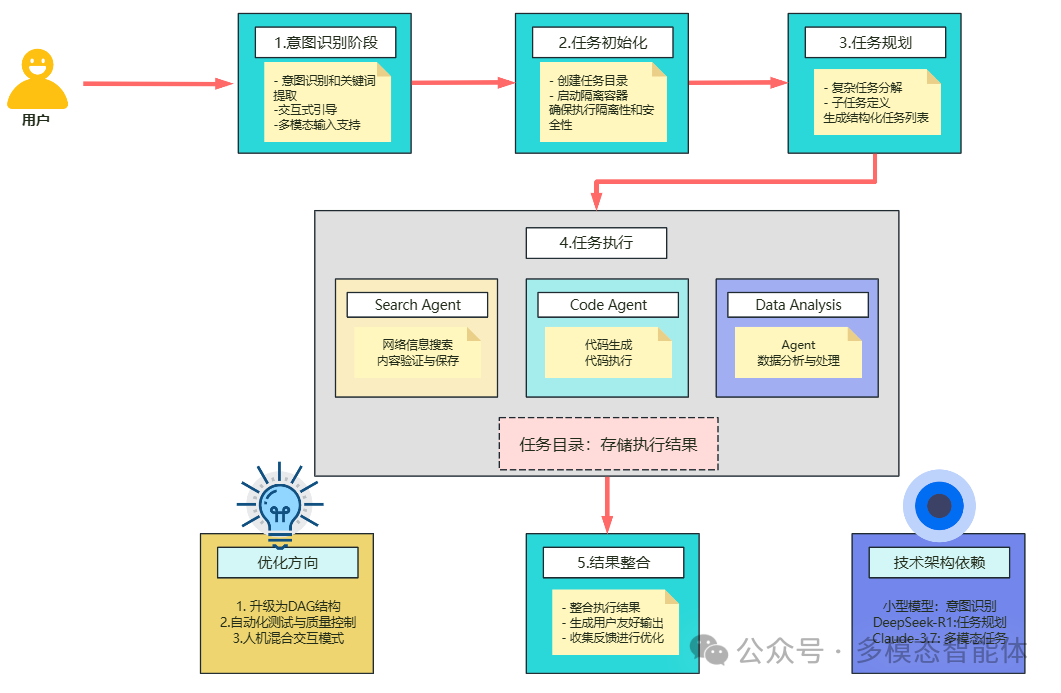
1. Intent Recognition Stage: Not just “I guess you want,” we truly understand you
The user’s input is the starting point, but it is by no means the answer. The first step of the MCP process is to transform vague language into clear task intentions.
-
Multi-turn Interaction Understanding Context: This goes beyond keyword extraction, combining contextual semantics for multi-turn intent clarification. For example, if a user says, “Help me analyze the competitors,” the system will further ask, “Do you want to do a market share analysis, product comparison, or user review aggregation?” This ensures that the execution of the instruction is actionable and quantifiable.
-
Semantic Error Correction and Fuzzy Completion: Introduce a multi-language model verification mechanism to handle colloquial language, typos, and semantic ambiguities. For instance, “Write a report” could refer to either “writing a code report” or “writing a financial analysis report.” The system needs to possess the judgment to discern these differences.
-
Persona and Preference Memory: For returning users, the system automatically loads past behavioral preferences. For example, if a user frequently uses markdown to output reports, it will automatically recognize their formatting preferences.
The core value of this stage is to “establish task types and contextual boundaries,” laying a solid foundation for subsequent task recognition.
2. Task Initialization: From “What do you want to do” to “How should I do it”
Once the system understands what you “want to do,” the next step is to structure that idea into specific task components. This is the mission of the task initialization stage.
-
Automatic Task Directory Generation: Based on the intent recognition results, the system constructs a task list according to a template. For example, “Generate financial report analysis” will initialize three sub-tasks: data scraping, chart creation, and conclusion generation.
-
Model and Resource Selection Mechanism: Depending on the task type, the system matches the optimal operators, agents, and external resources. For instance, writing code automatically matches the Code Agent; data processing calls the Data Analysis Agent; retrieving relevant knowledge activates the Search Agent.
-
Task Dependency Relationship Verification: During the task assembly process, the system will determine the sequential dependencies between sub-tasks, such as “only after the data is prepared can a visual report be generated.”
This stage is akin to preparing a factory with blueprints, machines, and raw materials, marking the first step towards efficient operation of the intelligent agent.
3. Task Planning: The “Director” of the Intelligent Agent Team Emerges
When all task components are “lined up and ready,” arranging them to work collaboratively is the responsibility of the task planning stage. This step determines whether the system operates efficiently, makes fewer errors, and optimizes costs.
-
Task Orchestration Strategy Engine: The MCP introduces a lightweight DAG (Directed Acyclic Graph) scheduling mechanism, linking tasks into a process based on dependency relationships. For example, “first gather information, then generate a draft, and finally polish it.”
-
Agent Matching and Role Assignment: Different agents take on different functions, no longer being “jack-of-all-trades.” For instance, the Search Agent is responsible for data input, the Code Agent focuses on output, and the Analysis Agent summarizes the results.
-
Dynamic Priority Adjustment Mechanism: The system can adjust the execution order of tasks in real-time based on factors such as task complexity, computational cost, and waiting time. High-priority tasks can jump the queue, while low-priority tasks are delayed to avoid “resource congestion.”
At this stage, the MCP acts like a master scheduler, organizing complex tasks into a controllable and monitorable intelligent collaboration network.
4. Task Execution: A Cross-Agent “Murder Mystery” Unfolds
Finally, we arrive at the most exciting part—the multi-agent “crew” takes the stage. This phase is the true test of the system’s collaborative efficiency and output quality.
Search Agent: Knowledge Intelligence Officer
-
Scans the web/private databases to quickly locate data, information, documents, etc., related to the task.
-
Supports RAG (Retrieval-Augmented Generation) to enhance generation capabilities, ensuring information accuracy.
-
Outputs structured results to lay the groundwork for subsequent tasks.
Code Agent: Engineering Executor
-
Can automatically generate code based on natural language instructions and possesses debugging and testing capabilities.
-
Not only can it write code, but it can also call APIs, read/write databases, and deploy models.
-
Automatic error backtracking mechanism, automatically adjusting and retrying code upon failure.
Data Analysis Agent: Insight Discoverer
-
Analyzes output results for modeling, such as trend recognition, clustering analysis, sentiment analysis, etc.
-
Automatically generates charts, reports, PowerPoint summaries, and other multi-format results.
-
Aligns with user context to avoid “analysis that makes no sense.”
Moreover, all execution processes are recorded in real-time in the task directory, providing data support for task auditing, backtracking, and optimization.
5. Result Integration: A Deliverable Ready for the Boss
Each agent excels individually, but “completing the task” does not equate to “delivering results.” The result integration stage is the final touch on user experience.
-
Unified Format Output: Regardless of the format produced by sub-tasks, the final output is unified into documents, charts, or presentation pages for easy reporting.
-
Content Logic Verification: Automatically checks for contradictions, omissions, and style consistency after integration.
-
Feedback Loop Mechanism: Users can rate, modify, and regenerate, and the system will learn preferences for future task optimization.
The results are not just an end but the beginning of a self-optimizing intelligent agent system.
6. Optimization Directions: The “Self-Cultivation Path” of Intelligent Agents
An excellent system is always growing. Future key optimization directions for the MCP process include:
-
Smarter Process DAG: Automatically identifies task flow dependencies and dynamically schedules execution to ensure stable operation.
-
Stronger Decision Control: Allowing agents to have a limited autonomous negotiation mechanism to achieve more complex decision chains.
-
More Natural Human-Agent Collaboration: Through a visual process interface and multimodal interaction, enabling non-technical users to flexibly command agents.
7. Supporting Technologies: The “Armory” of Technology Selection
Supporting all these operations is a robust set of models and technological foundations:
-
Small Model Processors: Quick response, low resource consumption, suitable for handling a large number of light tasks.
-
DeepSeek R1 Scheduling Model: Manages global scheduling, state tracking, and conflict resolution.
-
Claude 3.7 Multi-Task Model: Adapts to long text generation and multi-turn reasoning, serving as the central control hub.
Different tasks require different tools; the MCP operates like a well-trained special forces unit, each with its strengths, yet working closely together.
8. Conclusion:
From intent recognition to task execution, from agent division to result integration, the MCP process achieves a true sense of “AI team combat.” It not only helps enterprises efficiently complete tasks but, more importantly, leverages minimal investment to maximize intelligent output.
In the future, Multi-Agent-Manus will not only be a technical framework but will become the standard operational system for every data-driven enterprise, serving as the underlying collaborative mechanism for the next generation of “digital employees.”