Preface
In the field of technology and product development, technological maturity is typically divided into9 levels. Recently, Professor Leigh Tesfatsion from Iowa State University in the United States proposed the concept of maturity in the design of electricity market mechanisms in several reports and papers, which includes9 levels. Levels 1-3 represent the mechanism analysis, theory, and conceptual design stages, usually led by universities; levels 7-9 represent large system and practical market pilot operations and application stages, typically led by enterprises and industries. The intermediate levels 4-6 involve the process of validating basic theories based on more realistic market scenarios, requiring deep integration between universities and enterprises. Levels 4-6 are a critical process,Professor Leigh Tesfatsion refers to it as the “Valley of Death” (Valley of Death), which is considered a key factor in whether a theoretical mechanism can be adopted and applied by the industry. An important tool for steps 4-6 is multi-agent simulation. The book Multi-Agent-Based Simulation XXIV is a recent publication by Springer, which is a collection of selected papers (11 papers) revised after discussions at the 24th International Workshop on Multi-Agent-Based Simulation (MABS 2023) held in London, UK, from May 29 to June 2, 2023. Among them, the 9th paper is from the team of Jing Chaoxia at South China University of Technology, discussing the application of multi-agent simulation methods in the design of electricity market mechanisms, focusing on the issue of system operation cost compensation and the impact of irrational behavior on mechanism design research. Here, we introduce the main content of this book for your reference.
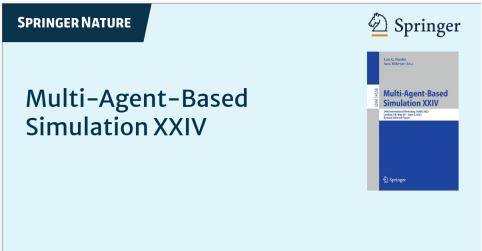
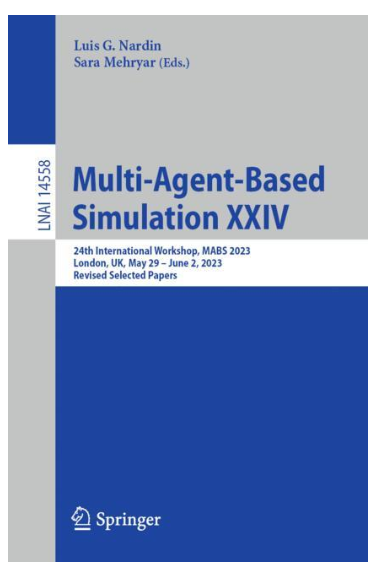
Multi-Agent-Based Simulation XXIV
24th International Workshop, MABS 2023, London, UK, May 29 – June 2, 2023, Revised Selected Papers
- Conference proceedings
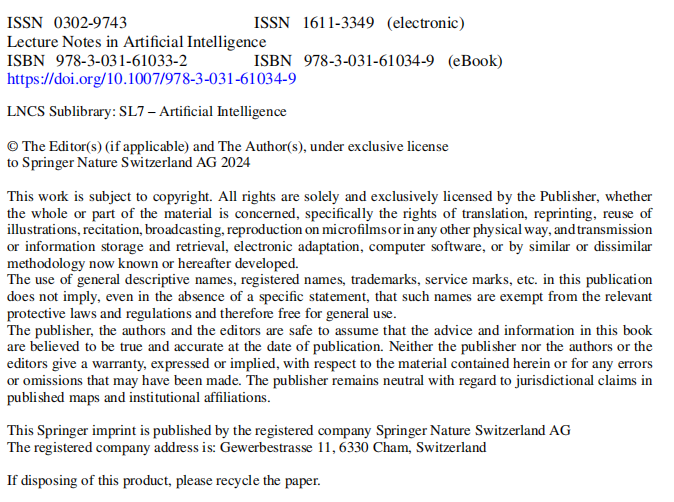
- © 2024
1. Introduction
Multi-Agent-Based Simulation (MABS) is a powerful tool widely used in policy decision-making across various practical fields. The collaboration between researchers in Multi-Agent Systems (MAS) engineering, simulation, and social, economic, and organizational sciences is well recognized for its role in promoting interdisciplinary communication. The synergy among researchers in these fields is undoubtedly a significant source of inspiration for the knowledge system in this domain.
The MABS workshop series aims to facilitate collaboration between researchers interested in MAS engineering and simulation and those dedicated to understanding and finding effective solutions for modeling complex social, socio-ecological, and socio-technical systems, including economics, management, organization, and social sciences. In these fields, agent theory, metaphors, models, analytical methods, experimental design, empirical research, and methodological principles converge in simulation as a means to achieve explanation and prediction, explore and test hypotheses, ultimately driving the design and optimization of systems.
This book includes the proceedings of the 24th International Workshop on Multi-Agent-Based Simulation (MABS 2023), which was held from May 29 to June 2, 2023, in London, UK, concurrently with the 22nd International Conference on Autonomous Agents and Multi-Agent Systems (AAMAS 2023). The 11 full papers included in this volume were carefully selected from 27 submitted papers, with approximately 40% acceptance rate. These papers underwent single-blind peer review by at least three reviewers and were revised based on insights discussed at the workshop. At this MABS conference, the paper titled “Active Sensing for Epidemic State Estimation Using ABM-Guided Machine Learning” won the Best Paper Award.
Without the contributions of many individuals, the workshop could not have been successfully held. We sincerely thank Bruce Edmonds for his inspiring talk titled “Combining Constraint-Based and Imperative Programming in MABS” and all participants for their active engagement in lively discussions during the paper presentations. We also appreciate the hard work of all program committee members during the paper review process. Additionally, we thank Francesco Amigoni and Arjun Sinha (2023 AAMAS Workshop Chairs), Noah Agmon and Bo An (2023 AAMAS Conference Co-Chairs), Alessandro Ricci and William Ye (2023 AAMAS Program Co-Chairs), and Enrico Gerding and Long Chen-Tan (2023 AAMAS Local Arrangement Co-Chairs) for their valuable support.
March 2024
École des Mines de Saint-Étienne, FranceLuis G. Nardin
London School of Economics and Political Science, UK Sara Mehryar
Note: École des Mines de Saint-Étienne, commonly known as Mines Saint-Étienne, is a prestigious elite engineering school and research university in France, a public engineering school, and a founding member of the Institut Mines-Télécom (IMT) group, one of the largest engineering school groups in France, belonging to the “Grandes Écoles” system, which is one of the oldest and most prestigious engineering schools in this system.
2. Main Content
This book includes a total of 11 articles divided into three parts: Multi-Agent Methods and Tools, Multi-Agent Systems and Social Behavior, and Multi-Agent Applications.
(1)Multi-Agent Methods and Tools (MABS Methodology and Tools)
1. Can (and Should) Automated Surrogate Modelling Be Used for Simulation Assistance? (An introduction and analysis of some basic concepts, advancements, and issues regarding multi-agent methods.)
Authors:Veronika Kurchyna, Jan Ole Berndt, and Ingo J. Timm, Affiliation: German Research Center for Artificial Intelligence (DFKI)
2. Towards a Better Understanding of Agent-Based Airport Terminal Operations Using Surrogate Modeling. (Simulation of airport terminal operations based on multi-agent systems.)
Authors:Benjamin C. D. de Bosscher, Seyed Sahand Mohammadi Ziabari, and Alexei Sharpanskykh, Affiliation: Delft University of Technology, Netherlands
3. Active Sensing for Epidemic State Estimation Using ABM-Guided Machine Learning. (Estimation of epidemic numbers based on multi-agent systems and machine learning.)
Authors:Sami Saliba, Faraz Dadgostari, Stefan Hoops, Henning S. Mortveit, and Samarth Swarup Affiliation: University of Virginia, USA
4. Combining Constraint-Based and Imperative Programming in MABS for More Reliable Modelling . (Explorations in modeling methods, suggesting separating life cycle and implementation phases.).
Authors:Bruce Edmonds and J. Gareth Polhill Affiliation: Manchester Metropolitan University, UK
5. Multi-agent Financial Systems with RL: A Pension Ecosystem Case (Multi-agent simulation applied to pension problem research.)
Authors:Fatih Ozhamaratli and Paolo Barucca Affiliation: University College London, UK
(2) Multi-Agent Systems and Social Behavior(MABS and Social Behavior )
6. Aspects of Modeling Human Behavior in Agent-Based Social Simulation – What Can We Learn from the COVID-19 Pandemic? .(Using multi-agent systems to analyze some social behaviors during the COVID-19 pandemic.) .
Authors:Emil Johansson, Fabian Lorig, and Paul Davidsson, Affiliation: SwedenMalmö University
7. Learning Agent Goal Structures by Evolution (How to adjust multi-agent parameters to align more closely with real situations.)
Authors:H. Van Dyke Parunak , Affiliation: Parallax Advanced Research, USA
8. Dynamic Context-Sensitive Deliberation (How to dynamically handle context in agent decision-making.)
Maarten Jensen, Loïs Vanhée, and Frank Dignum, Affiliation: Umeå University, Sweden
(3) Multi-Agent System Applications(MABS Applications )
9. A Multi-agent Simulation Model Considering the Bounded Rationality of Market Participants: An Example of GENCOs Participation in the Electricity Spot Market . (Multi-agent simulation considering the bounded rationality of market participants: An example of bidding strategies of generators in the electricity market under different system operation cost compensation mechanisms. This illustrates the importance of considering irrational behavior of agents in multi-agent simulation and reveals some counterintuitive issues in the electricity market, such as the failure to fully compensate system operation costs ultimately increasing total electricity costs.)
Authors:Zhanhua Pan, Zhaoxia Jing, Tianyao Ji, and Yuhui Song, Affiliation: South China University of Technology
Abstract: A key issue in multi-agent simulation is how to consider the bounded rationality of market participants in the simulation. This paper presents a new multi-agent simulation model that takes into account the bounded rationality of generation companies (GENCOs) in the electricity market (mainly focusing on the inability to accurately predict future market conditions). We also propose evaluation metrics to quantify the differences in simulation results between the proposed model and an agent-based model that ignores bounded rationality, assessing the performance of market mechanisms in the face of bounded rationality of generation companies. By illustrating the phenomenon of generation companies’ inability to accurately predict future load curves, we conducted numerical simulation experiments on various compensation mechanisms in electricity markets. The simulation results validate the effectiveness of the model.
Main Conclusions: When considering market information misjudgments, the bounded rationality of GENCOs, dynamic simulations show that the MWP (full cost compensation) mechanism has better incentive consistency, guiding GENCOs to bid according to their true costs. The MWP mechanism not only compensates GENCOs for their losses but also enhances social welfare. In the absence of compensation mechanisms, GENCOs may deviate from true costs in bidding to avoid losses. Considering long-term contracts in settlements leads to similar conclusions, making GENCOs’ bids more susceptible to external factors. Compared to other mechanisms, the MWP mechanism can reduce the influence of external information on GENCOs, thereby mitigating the negative impacts of misjudgments. The implication for mechanism design research is that if the bounded rationality of market participants is not considered in simulation studies of mechanism design, erroneous results may be obtained when validating mechanisms and comparing different mechanisms.
10. Modeling Cognitive Workload in Open-Source Communities via Simulation . (Multi-agent models simulating social issues related to open-source code.).
Authors:Alexey Tregubov, Jeremy Abramson, Christophe Hauser, Alefifiya Hussain, and Jim Blythe, Affiliation: Information Sciences Institute, University of Southern California, USA
11. Multi-agent Simulation of Intelligent Energy Regulation in Vehicle-to-Grid . (How to simulate electric vehicles using multi-agent methods.)
Authors:Aliyu Tanko Ali, Tim Schrills, Andreas Schuldei, Leonard Stellbrink, André Calero Valdez, Martin Leucker, and Thomas Franke, Affiliation: Lübeck University, Germany
 References
- Entering the Electricity Market: A Review of Multi-Agent-Based Simulation Research in Electricity Markets
- Wang Yeping, Yang Yan, Jing Chaoxia, et al. Application of Intelligent Agent Simulation in Electricity Markets [J]. Journal of South China University of Technology (Natural Science Edition), 2010, 38(03): 109-113+122.
- Wang Yeping, Jing Chaoxia, Chen Haoyong, et al. Discussion on Experimental Design Methods for Agent-Based Electricity Market Simulation [J]. Automation of Electric Power Systems, 2009, 33(17): 56-60+85.
- Jing Chaoxia, Yang Ying. Application of EWA Algorithm in Electricity Market Simulation [J]. Automation of Electric Power Systems, 2010, 34(24): 46-50.
- Jing Chaoxia, Zhu Jisong. Simulation Experimental Analysis of Monthly Electricity Centralized Bidding Market Rules [J]. Automation of Electric Power Systems, 2017, 41(24): 42-48.
-
Zhanhua Pan, Zhaoxia Jing, Decision-making and cost models of generation company agents for supporting future electricity market mechanism design based on agent-based simulation, Applied Energy, Volume 391, 2025, 125881, ISSN 0306-2619, https://doi.org/10.1016/j.apenergy.2025.125881.
(https://www.sciencedirect.com/science/article/pii/S0306261925006117)