Click the blue text to follow usRecently, Yawouvi, a scientist from Sorbonne University in France, combined UVP, MultiNet, and ZooSCAN, using both net sampling and underwater in situ observation techniques to reconstruct the standardized biomass particle size spectrum (NBSS) of large (>1mm) zooplankton in the global ocean, providing a more accurate assessment of the volume and biomass distribution of global zooplankton.Experimental BackgroundIn the vast ocean, although tiny, plankton play a crucial role. They are the foundation of the marine food chain and significantly impact the global carbon cycle and climate system. However, scientists have faced enormous challenges in studying plankton. Traditional plankton net sampling techniques often miss certain fragile or hard-to-capture zooplankton populations (such as copepods), while underwater particle and zooplankton in situ imaging techniques can capture images of these fragile organisms, but the imaging volume is relatively small.To more accurately assess the volume and mass distribution of large (>1mm) zooplankton in the global ocean, Yawouvi from Sorbonne University combined MultiNet net sampling/ZooSCAN image analysis and UVP underwater in situ observation techniques to reconstruct the standardized biomass particle size spectrum (NBSS), providing a new perspective for global marine zooplankton research.Experimental MethodsThe research team from Sorbonne University collected zooplankton data using MultiNet (a continuous plankton sampling net from HYDRO-BIOS, Germany) and UVP5 (an underwater particle and zooplankton imaging in situ collection system from HYDROPTIC, France) at 57 global stations (Figure 1).
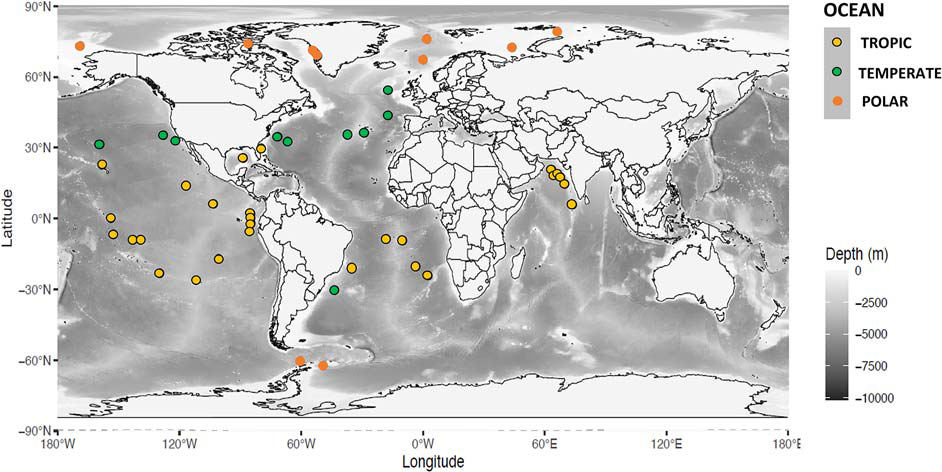
Figure 1 Locations of the 57 sampling sites using MultiNet and UVP5MultiNet consists of five continuous plankton nets that can collect zooplankton samples at five different depth layers, with a large sampling volume that can capture a broader range of zooplankton populations; ZooSCAN (a zooplankton image scanning analysis system from HYDROPTIC, France) is an efficient zooplankton image analysis system that can quickly and efficiently process and analyze zooplankton samples, with high-resolution images enabling scientists to identify zooplankton at the family or even genus level, providing strong support for taxonomic and ecological research.UVP5 (from HYDROPTIC, France) can record the size and abundance of zooplankton in real-time without damaging the organisms, and the high-resolution image data allows researchers to identify and quantify various zooplankton, including those fragile organisms, thus obtaining a more comprehensive biomass estimate.The research team integrated the data from the above two experimental methods to reconstruct the NBSS of medium to large zooplankton and compared the differences between the two experimental methods in calculating the NBSS slope and biomass.
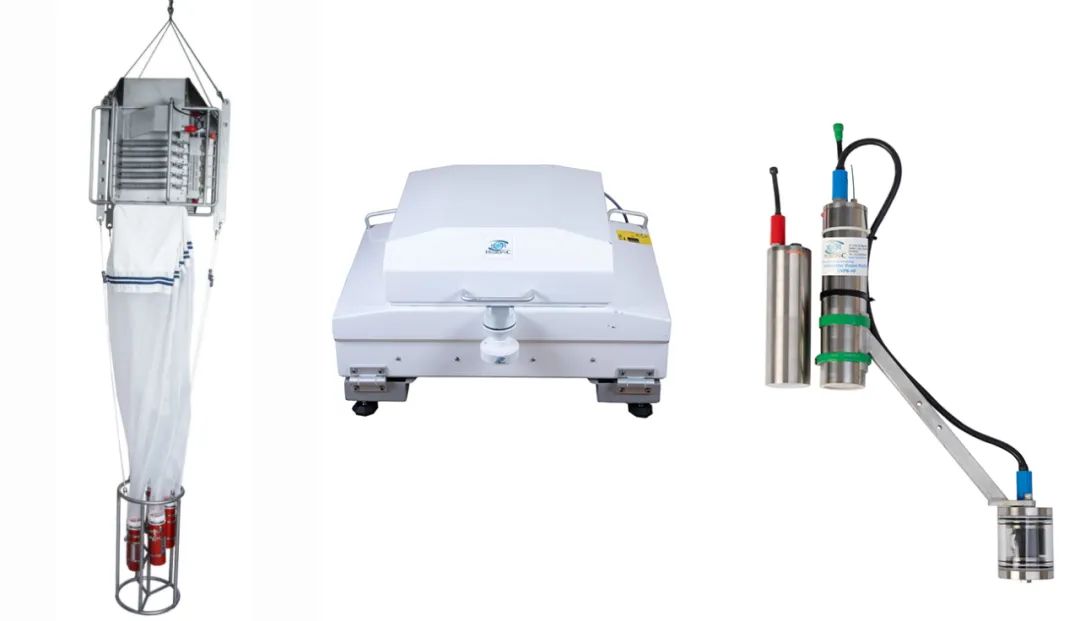
Figure 2 From left to right: MultiNet continuous plankton sampling net; ZooSCAN zooplankton image scanning analysis system; UVP underwater particle and zooplankton imaging in situ collection system (updated to UVP6-HF version)
Experimental Results(1) NBSS Slope: The reconstructed NBSS slope is between MultiNet and UVP5, being 20% shallower than MultiNet and 7.6% steeper than UVP5 (Figure 3). This indicates that MultiNet underestimates the number of certain fragile organisms, while UVP5 lacks resolution for small organisms.
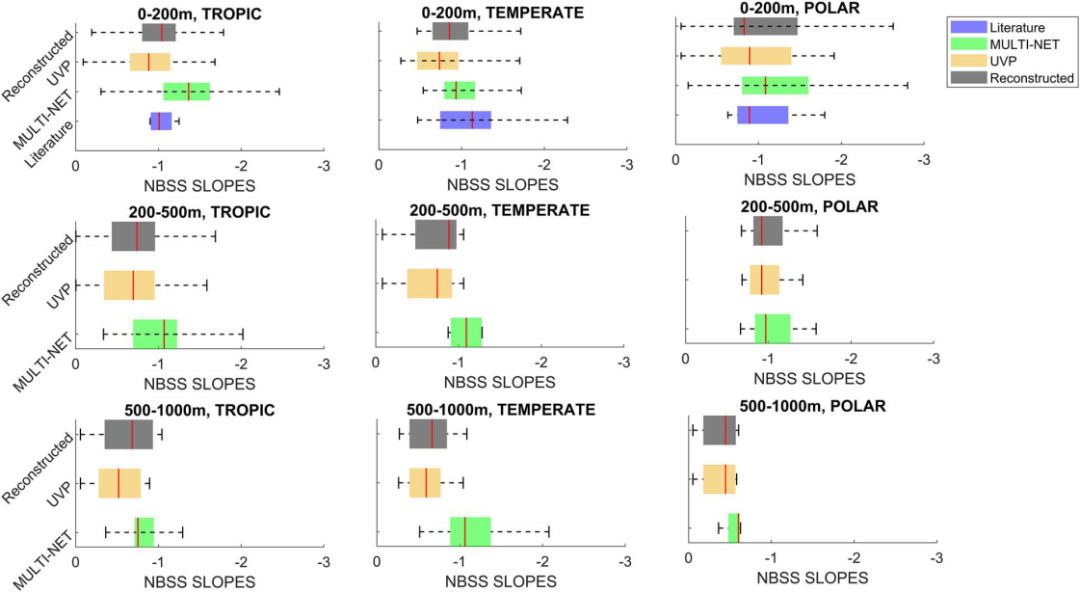
Figure 3 Results of NBSS for medium zooplankton using three methods (UVP5, net sampling, reconstruction) at different locations, three depth layers, and three latitude bands(2) Biomass Estimation: The reconstructed biomass is significantly higher in tropical and temperate regions compared to MultiNet estimates (Figure 4), especially more pronounced in surface waters. UVP5 excels in capturing information on fragile organisms (such as copepods), while MultiNet is more effective in capturing crustaceans.
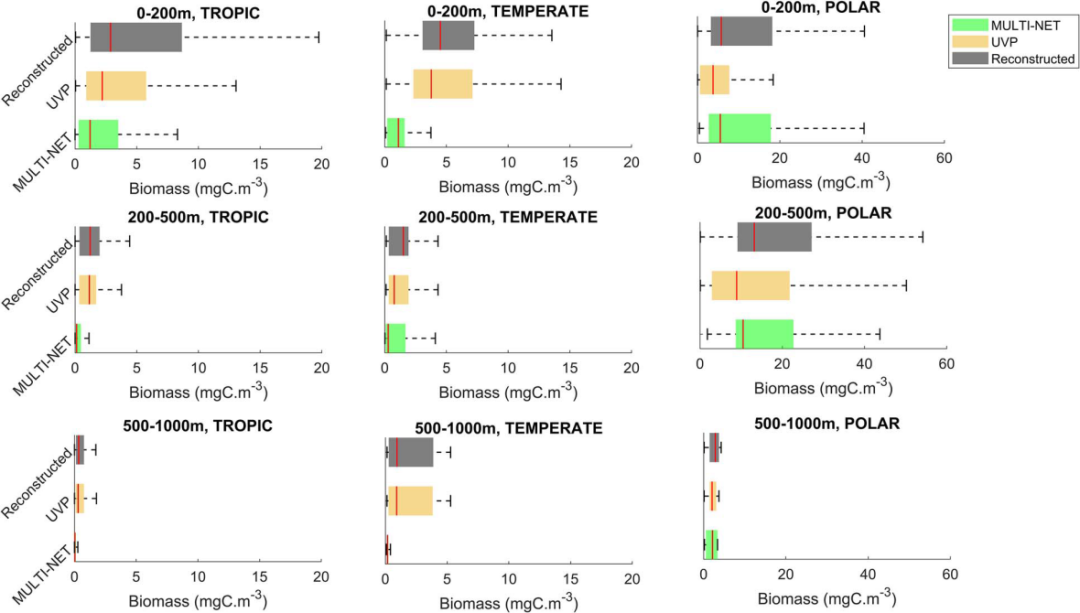
Figure 4 Results of biomass for medium zooplankton using three methods (UVP5, net sampling, reconstruction) at different locations, three depth layers, and three latitude bands(3) Latitude and Depth Differences: In tropical and temperate regions, copepods contribute significantly to the total biomass of zooplankton, while in polar regions, crustaceans dominate. As depth increases, the biomass of zooplankton gradually decreases.ConclusionThe combination of MultiNet/ZooSCAN and UVP5 methods can more accurately estimate the volume and biomass distribution of zooplankton. MultiNet/ZooSCAN has advantages in taxonomic resolution, while UVP5 performs better in capturing fragile organisms. The combination of the two methods provides a more complete dataset for studying the ecological functions of zooplankton.Looking ahead, with continuous technological advancements and innovations, UVP, MultiNet, and ZooSCAN will play increasingly important roles in zooplankton research. They will help us gain deeper insights into the mysteries of marine ecosystems and provide strong support for protecting marine ecological environments and addressing global climate change challenges!References1. Soviadan Y D, Dugenne M, Drago L, et al. Combining in situ and ex situ plankton image data to reconstruct zooplankton (> 1 mm) volume and mass distribution in the global ocean[J]. Journal of Plankton Research, 2024, 46(5): 461-474.Long press to follow Water Tools WeChat ID: WATERTOOLS Phone: 0532-87761284