
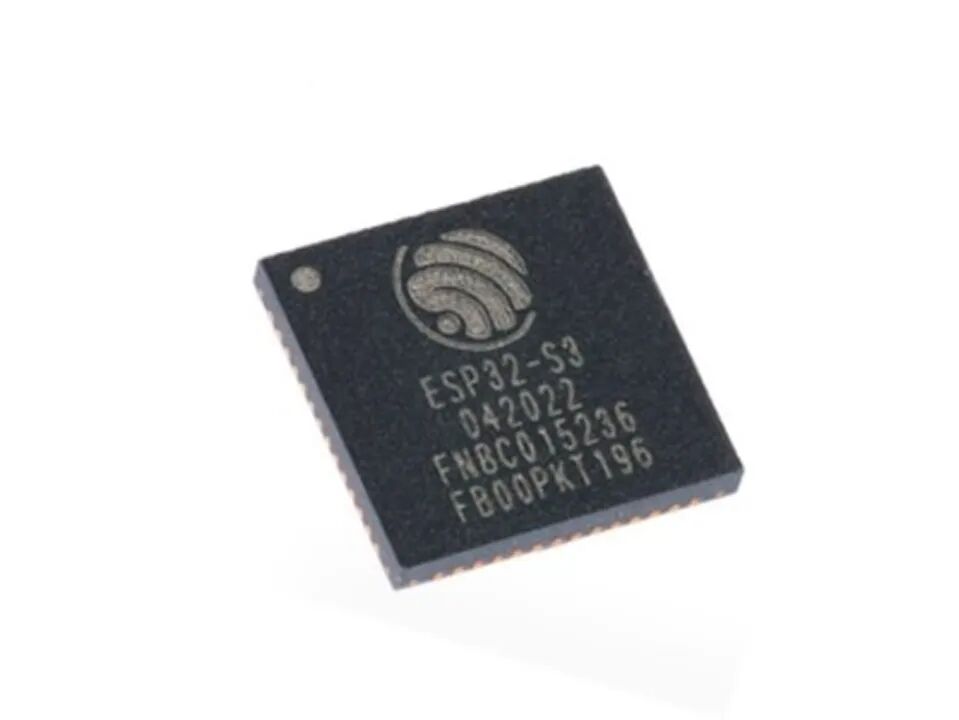
As a leader in the chip programming field, ACROVIEW has announced an expansion of its compatible chip model list alongside the release of its new programming software. The Espressif System-on-Chip (SoC) ESP32-S3FN8 is among the newly added models, now supported by the ACROVIEW universal programming platform AP8000.
The ESP32-S3FN8 is a low-power MCU SoC that supports 2.4 GHz Wi-Fi and low-power Bluetooth (Bluetooth® LE) wireless communication. The chip integrates a high-performance Xtensa® 32-bit LX7 dual-core processor, ultra-low power co-processor, Wi-Fi baseband, Bluetooth baseband, RF module, and peripherals.
Product Features
Wi-Fi
• Supports IEEE 802.11b/g/n protocols
• Supports 20MHz and 40MHz bandwidth in the 2.4GHz band
• Supports 1T1R mode with data rates up to 150Mbps
• Wireless Multimedia (WMM)
• Frame aggregation (TX/RX A-MPDU, TX/RX A-MSDU)
• Immediate Block ACK
• Fragmentation and defragmentation
• Beacon automatic monitoring (hardware TSF)
• Four virtual Wi-Fi interfaces
• Simultaneously supports Infrastructure BSS Station mode, SoftAP mode, and Station+SoftAP mode
• Antenna diversity
• 802.11 mc FTM
Bluetooth
• Low Energy Bluetooth (Bluetooth LE): Bluetooth 5, Bluetooth mesh
• High power mode (20dBm)
• Rate support for 125Kbps, 500Kbps, 1Mbps, 2Mbps
• Advertising Extensions
• Multiple Advertisement Sets
• Channel Selection Algorithm #2
• Coexistence of Wi-Fi and Bluetooth using the same antenna
CPU and Storage
• Xtensa® 32-bit LX7 dual-core processor
• Clock frequency: up to 240MHz
• CoreMark® score
– Single core, 240MHz: 613.86 CoreMark; 2.56 CoreMark/MHz
– Dual core, 240MHz: 1181.60 CoreMark; 4.92 CoreMark/MHz
• Five-stage pipeline architecture
• 128-bit data bus width, dedicated SIMD instructions
• Single-precision floating-point unit (FPU)
• L1 cache
• ROM: 384KB
• SRAM: 512KB
• RTC SRAM: 16KB
• Supports SPI protocols: SPI, Dual SPI, Quad SPI, Octal SPI, QPI, OPI, allowing external flash, external RAM, and other SPI devices
• Flash controller with cache mechanism
• Supports online programming of flash
Advanced Peripheral Interfaces and Sensors
• 45 programmable GPIOs
– 4 as strapping pins
– 6 for connecting internal flash or PSRAM
• Digital interfaces
– 2 SPI interfaces for connecting flash and RAM
– 2 general-purpose SPI interfaces
– LCD interface (8-bit + 16-bit parallel RGB, I8080, MOTO6800), supports conversion between RGB565, YUV422, YUV420, YUV411
– DVP 8-bit + 16-bit camera interface
– 3 UART interfaces
– 2 I2C interfaces
– 2 I2S interfaces
– RMT (TX/RX)
– Pulse counter
– LED PWM controller, up to 8 channels
– Full-speed USB OTG
– USB serial/JTAG controller
– 2 motor control PWM controllers (MCPWM)
– SD/MMC host interface with 2 card slots
– General DMA controller, 5 receive channels and 5 transmit channels
– TWAI® controller, compatible with ISO 11898-1 (CAN specification 2.0)
– On-chip JTAG debugging functionality
• Analog interfaces
– 2 12-bit SAR ADCs, up to 20 channels
– Temperature sensor
– 14 capacitive sensing GPIOs
• Timers
– 4 54-bit general-purpose timers
– 52-bit system timer
– 3 watchdog timers
Power Management
• Precise power control through clock frequency selection, duty cycle, Wi-Fi operating mode, and individual control of internal device power
• Four power modes designed for typical scenarios: Active, Modem-sleep, Light-sleep, Deep-sleep
• Power consumption as low as 7µA in Deep-sleep mode
• Ultra-low power co-processor (ULP)
– ULP-RISC-V co-processor
– ULP-FSM co-processor
• RTC memory remains operational in Deep-sleep mode
Security Mechanisms
• Secure boot
• Flash encryption
• 4-Kbit OTP, up to 1792 bits available for user
• Hardware encryption accelerator
– AES-128/256 (FIPS PUB 197)
– SHA (FIPS PUB 180-4)
– RSA
– Random Number Generator (RNG)
– HMAC
– Digital signature
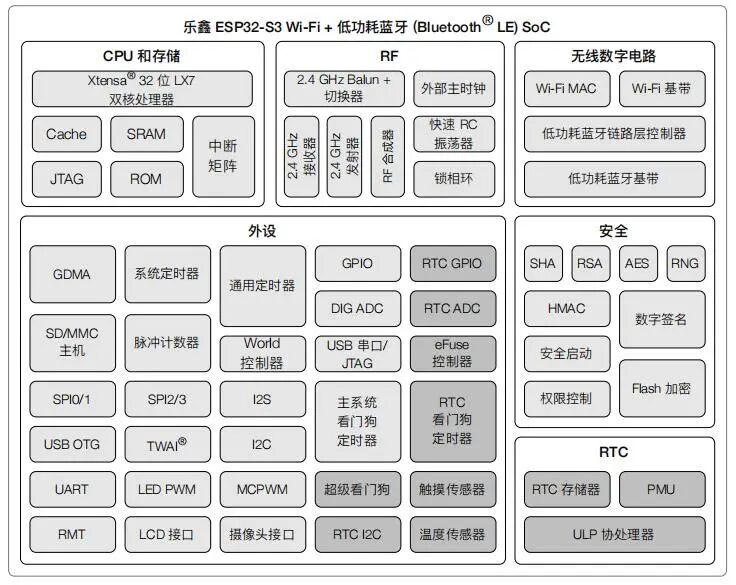
Functional Block Diagram
With its deep technical accumulation, ACROVIEW’s self-developed AP8000 universal programmer is regarded as a benchmark-level programming solution in the industry. This device supports flexible one-to-one and one-to-eight configurations, while providing both online and offline operating modes. It has also developed dedicated programming solutions for eMMC and UFS storage chips, fully meeting the bare chip offline programming and on-board programming needs ofEspressif‘s entire series of chips. The AP8000 consists of three core modules: host, baseboard, and adapter, and this modular design grants it excellent compatibility and expandability. As a universal programming platform, the AP8000 can adapt to various programmable chips on the market and, with its stable and efficient performance, has become the core component of ACROVIEW’s automated IPS5800S programming system, efficiently handling large-scale chip programming tasks to meet mass production needs.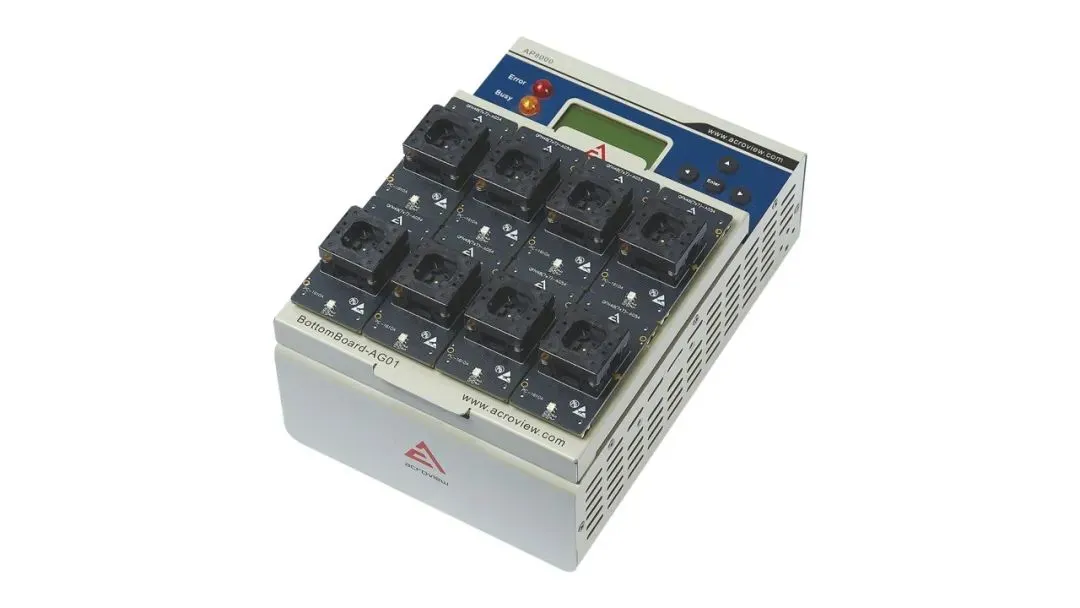
The AP8000 host features flexible connectivity options and is equipped with USB and NET interfaces, allowing for easy networking of multiple programmers. Through the networking function, users can easily achieve synchronized control of multiple programmers, efficiently conducting parallel programming operations. In terms of safety, the host is equipped with an intelligent safety protection circuit that can monitor the chip placement status and circuit connection in real-time. If it detects abnormal conditions such as chip reverse insertion or short circuits, it will immediately trigger a power-off protection mechanism, fully safeguarding the safe operation of the chip and programmer. The host is equipped with a high-speed FPGA chip, significantly enhancing data transmission and processing efficiency, ensuring a smooth and efficient programming process. To enhance user convenience, the back of the host is equipped with an SD card slot, allowing users to store project files generated on the PC to the SD card and insert it into the slot. They can then complete file selection and loading for programming operations through the physical buttons on the programmer, achieving independent operation without a PC. This design not only reduces dependence on computer hardware configurations but also simplifies the setup process of the working environment, significantly enhancing operational flexibility.
In terms of expandability and compatibility, the AP8000 adopts a modular design of baseboard and adapter, effectively extending the functional boundaries of the host. Currently, the device has achieved support for products from all major semiconductor manufacturers, covering well-known brands such as ESPRESSIF, ALLWINNER, ALLEGRO, TI, and RENESAS. It supports a wide range of device types, including NAND, NOR, MCU, CPLD, FPGA, EMMC, and is fully compatible with various industry-standard file formats such as Intel Hex, Motorola S, Binary, and POF, providing users with a one-stop, all-scenario chip programming solution.
Company Introduction
About Espressif:Espressif is a global fabless semiconductor company focused on developing high-performance, low-power wireless communication chips. Espressif’s AIoT solutions are energy-efficient, feature-rich, and cost-effective, earning the trust of customers worldwide. Espressif has a series of core self-developed technologies, including Wi-Fi & Bluetooth LE & IEEE 802.15.4 protocol stacks, RF technology, RISC-V MCU architecture, AI algorithms, operating systems, toolchains, AIoT software development frameworks, and cloud services, achieving a closed loop of hardware and software R&D.
About ACROVIEW:ACROVIEW is a national-level specialized and innovative “little giant” enterprise engaged in the R&D, production, and sales of semiconductor chip testing and programming equipment. The company is committed to empowering the entire industry chain customers, including Fabless, IDM, OSAT, wafer fabs, and end-device companies, through innovative semiconductor testing technologies and solutions. ACROVIEW’s pioneering fully automated aging testing ABI (Auto Burn-In) system greatly enhances the aging testing efficiency of customer chips and reduces Per DUT testing costs. Additionally, it provides equipment products and solutions for various stages from PSV, CP, FT, BI, SLT, to programming. We perfectly integrate the leading advantages of product technology, system-level expertise, and a globally laid-out R&D and sales service network to create value for customers to gain a competitive edge in the market.
Scan to follow us

ACROVIEW Service Account

ACROVIEW Subscription Account