Translator: Xie Panda Jun
Source of Content:The AI Revolution: Road to Superintelligence & The AI Revolution: Our Immortality or Extinction
Artificial intelligence is likely to lead to either the immortality or extinction of humanity, and all of this may happen within our lifetime.
The above statement is not alarmist; please read this article patiently before expressing your opinion. This translated manuscript totals 35,000 words; I started translating it last week and spent several sleepless nights to finish it because I find this material extremely valuable. I hope you can read it patiently, as it may change your worldview.
We are on the brink of a revolution, and this revolution will be as significant as the emergence of humanity.
If you were standing here, how would you feel?
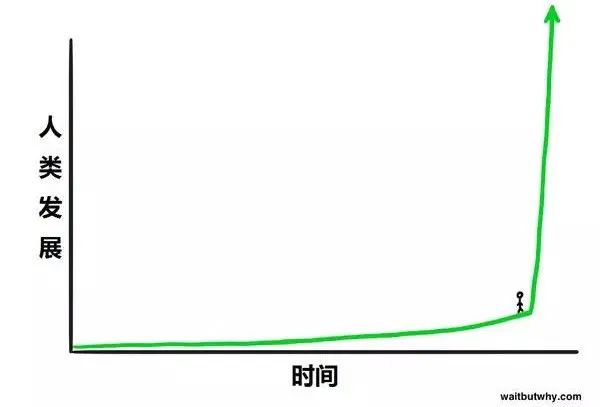 It looks very exciting, right? But remember, when you actually stand on the timeline, you cannot see the right side of the curve because you cannot see the future. So your real feeling is probably like this:
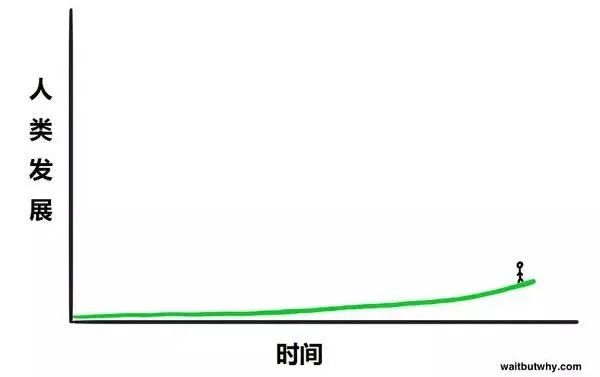
Ordinary.
The distant future is right before our eyes.
Imagine sitting in a time machine and going back to Earth in 1750, a time without electricity, where communication relied heavily on shouting, and transportation was mainly by animal power. You invite someone named Old Wang from that era to visit 2015 and see what he thinks of the “future.” We might not be able to understand Old Wang’s feelings in 1750—seeing metal ships racing on wide roads, chatting with people on the other side of the Pacific, watching sports competitions happening thousands of kilometers away, attending a concert from half a century ago, pulling out a black rectangular device to record what’s happening in front of him, generating a map that shows his current location with a blue dot, chatting with someone on the other side of the earth while looking at their face, and other various black technologies. Don’t forget, you haven’t even explained to him about the internet, the International Space Station, the Large Hadron Collider, nuclear weapons, and relativity.
What would Old Wang experience at that moment? Surprise, shock, and mind-blowing are all too mild; I think Old Wang would probably be scared to death.
But what if Old Wang returned to 1750 and thought being scared to death was an embarrassing experience, so he wanted to scare others to satisfy himself? What would happen? So Old Wang travels back to 1500, inviting a young man named Xiao Li from that time to visit 1750. Xiao Li might be shocked by many things from 250 years later, but at least he wouldn’t be scared to death. The difference between 1750 and 2015 is much greater than the difference between 1500 and 1750. Xiao Li from 1500 might learn a lot of amazing physical knowledge, be surprised by Europe’s imperialist journey, and have his understanding of the world map greatly changed, but he wouldn’t be scared to death by the transportation, communication, and so on in 1750.
Therefore, for Old Wang in 1750, to scare someone, he needs to go back to an even older past—like back to 12000 BC, before the first agricultural revolution. At that time, there were no cities, no civilization. A human from the hunting and gathering era was just one of many species at the time; Xiao Zhao from that era would see the vast human empire in 1750, gigantic ships sailing on the oceans, living “indoors,” countless collections, and amazing knowledge and discoveries—he would likely be scared to death.
If Xiao Zhao, after being scared to death, also wanted to do the same thing, what if he went back to 24000 BC to find Xiao Qian from that time and show him what life was like in 12000 BC? Xiao Qian would probably think Xiao Zhao was just bored—”Isn’t this similar to my life? Haha.” If Xiao Zhao wanted to scare someone, he might need to go back 100,000 years or more and use humanity’s mastery of fire and language to scare the other person.
So, for someone to go to the future and be scared, they need to satisfy a “scare unit.” The required time gap to satisfy a scare unit varies. In the hunting and gathering era, it took more than 100,000 years to satisfy a scare unit, while after the Industrial Revolution, it only took a little over 200 years.
The futurist Ray Kurzweil refers to this accelerated human development as the Law of Accelerating Returns. This phenomenon occurs because a more developed society has a stronger capacity for further development and can develop faster—this is a standard of being more developed. People in the 19th century understood much more than those in the 15th century, so naturally, the development speed of those in the 19th century is faster than that of those in the 15th century.
Even when looking at smaller time scales, this law still holds. In the famous movie “Back to the Future,” the protagonist living in 1985 travels back to 1955. When the protagonist returns to 1955, he is shocked by the novelty and low prices of the newly emerged television, the fact that no one liked electric guitars, and the different slang.
But if this movie took place in 2015, the protagonist’s shock at returning to 30 years earlier would be much greater. A person born around 2000 returning to a 1985 without personal computers, the internet, or mobile phones would see a much greater difference than the protagonist returning from 1985 to 1955.
This is also due to the Law of Accelerating Returns. The average development speed from 1985 to 2015 is faster than from 1955 to 1985 because the world in 1985 was more developed, starting from a higher point, so the changes in the past 30 years are greater than those in the previous 30 years.
Progress is becoming greater and happening faster, which means our future will be very interesting, right?
The futurist Kurzweil believes that the progress of the entire 20th century, at the pace of 2000, can be achieved in just 20 years—this means that the development speed in 2000 is five times the average development speed of the 20th century. He believes that starting from the year 2000, it will take only 14 years to achieve the entire century’s progress, and after 2014, it will take just 7 years (by 2021) to achieve another century’s progress. Decades later, we might achieve several times the equivalent of the entire 20th century’s progress every year, and perhaps even once a month. According to the Law of Accelerating Returns, Kurzweil believes that human progress in the 21st century will be 1000 times that of the 20th century.
If Kurzweil and others are correct, then the world in 2030 could scare us—perhaps the next scare unit will only take a decade, and the world in 2050 will be unrecognizable.
You might find it ridiculous to say that the world in 2050 will be unrecognizable, but this is not science fiction; it is what scientists, much smarter than you and me, believe, and it is logically predictable based on history.
So why do you find the statement “the world in 2050 will be unrecognizable” laughable? There are three reasons that make you doubt predictions about the future:
1. We think about history linearly.
When we consider changes over the next 35 years, we refer to what has happened in the past 35 years. When we think about the changes that can occur in the 21st century, we reference the changes that happened in the 20th century. It’s like Old Wang in 1750 thinking that Xiao Li in 1500 could be scared in 1750. Linear thinking is instinctive, but when considering the future, we should think exponentially. A smart person wouldn’t use the developments of the past 35 years as a reference for the next 35 years but would see the current speed of development, making predictions a bit more accurate. Of course, this is still not accurate enough; to be more precise, you have to imagine that the speed of development will continue to accelerate.
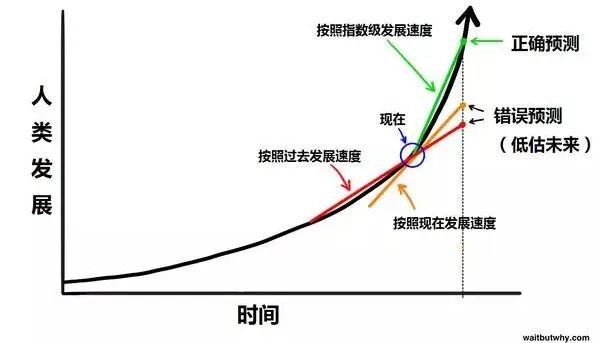
2. Recent history may mislead people.
First, even if it is a steep exponential curve, as long as the part you are looking at is short enough, it can appear linear; it’s like taking a very small section of a circle, which looks similar to a straight line. Secondly, exponential growth is not smooth and uniform; development often follows an S-curve.
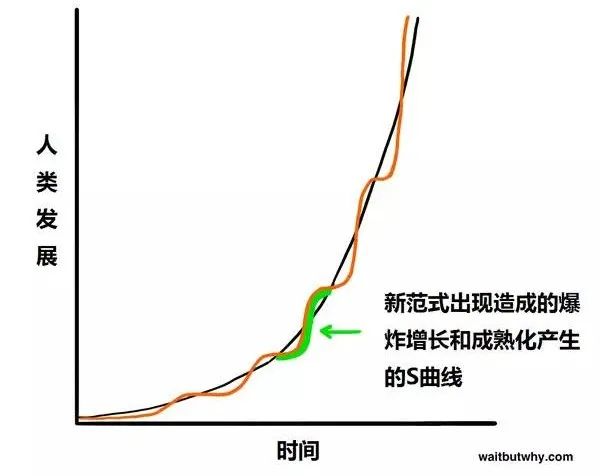
The S-curve occurs when a new paradigm spreads throughout the world; the S-curve has three parts: slow growth (the early stage of exponential growth); rapid growth (the period of fast exponential growth);
and a plateau that appears as the new paradigm matures.
If you only look at recent history, you are likely to see a part of the S-curve that may not illustrate how fast development is. The period from 1995 to 2007 was an explosive development time for the internet, with Microsoft, Google, and Facebook entering the public eye, accompanied by the emergence and popularization of social networks and mobile phones, and the rise of smartphones; this period represents the rapid growth phase of the S-curve. From 2008 to 2015, the development was not as rapid, at least in the technological field. If you estimate the current speed of development based on the past few years, you might be wildly off, as the next rapid growth phase could be on the verge of emerging.
3. Personal experiences make our expectations for the future too rigid.
We form our worldview through personal experiences, and experiences imprint the speed of development in our minds—”This is the speed of development.” We are also limited by our imagination because imagination is constructed from past experiences that inform our predictions about the future—but what we know is insufficient to help us predict the future. When we hear a prediction about the future that contradicts our experiences, we tend to think that prediction is off. If I tell you now that you could live to 150 years old, 250 years old, or even achieve immortality, would you think I’m talking nonsense—”Since ancient times, everyone has died.” Yes, no one has ever lived forever, but before the invention of airplanes, no one had ever flown either.
The following content may make you think “Haha” as you read, and it may indeed be wrong. However, if we truly engage in logical thinking based on historical patterns, our conclusion should be that far more changes than we expect will occur in the next few decades. The same logic also indicates that if humanity, the most advanced species on this planet, continues to accelerate, there will come a day when they will take a giant leap that fundamentally changes the notion of “what it means to be human,” just as natural evolution made strides toward intelligence and eventually made a giant leap to produce humans, thereby completely changing the fate of all other life forms. If you pay attention to recent technological advancements, you will find that everywhere suggests our understanding of life will be completely transformed by the developments to come.
The Road to Superintelligence—What is Artificial Intelligence?
If you have always regarded artificial intelligence (AI) as science fiction, but recently have heard many serious discussions about this issue, you might feel confused. This confusion is understandable:
1. We always associate artificial intelligence with movies. Star Wars, Terminator, 2001: A Space Odyssey, etc. Movies are fictional, and those movie characters are also fictional, so we always feel that artificial intelligence lacks a sense of reality.
2. Artificial intelligence is a broad topic. From calculators on mobile phones to self-driving cars, to major changes that may change the world in the future, artificial intelligence can describe many things, leading to confusion.
3. We are already using artificial intelligence in our daily lives, but we just don’t realize it.John McCarthy first used the term artificial intelligence (Artificial Intelligence) in 1956. He always complained that “once something is achieved with artificial intelligence, people no longer call it artificial intelligence.”
Because of this effect, artificial intelligence always sounds like a mysterious future existence rather than a reality that already exists around us. At the same time, this effect also makes people feel that artificial intelligence is a popular concept that has never been realized. Kurzweil often mentions that people say artificial intelligence was abandoned in the 1980s; this statement is as ridiculous as saying “the internet died during the internet bubble burst in the early 21st century.”
So, let’s start from the beginning.
First, don’t think of robots every time you mention artificial intelligence. Robots are just containers for artificial intelligence; sometimes they are humanoid, and sometimes they are not, but artificial intelligence itself is just the computer inside the robot. If artificial intelligence is the brain, then robots are the body—and this body is not necessarily required. For example, the software and data behind Siri are artificial intelligence; the voice of Siri is the personification of this artificial intelligence, but Siri itself does not have a robotic component.
Secondly, you may have heard of the term “singularity” or “technological singularity.” This term is used in mathematics to describe situations where normal rules do not apply, such as in the case of infinitely small high-density black holes. Kurzweil defines the singularity as the point where the Law of Accelerating Returns reaches its limit, where technological progress develops at an almost infinite speed, and after the singularity, we will live in a completely different world. However, many current thinkers about artificial intelligence no longer use the term singularity, and this term can easily confuse people, so this article will use it sparingly.
Finally, the concept of artificial intelligence is broad, so there are many types of artificial intelligence, which can be categorized based on their capabilities into three main types.
Narrow Artificial Intelligence (ANI): Narrow artificial intelligence is specialized in specific areas. For example, there are AIs that can defeat world chess champions, but they can only play chess; if you ask them how to better store data on a hard drive, they wouldn’t know how to answer.
General Artificial Intelligence (AGI): Human-level artificial intelligence. General artificial intelligence refers to AI that can match human capabilities in all aspects; it can perform all the intellectual tasks that humans can do. Creating AGI is much more challenging than creating ANI, and we are not there yet. Professor Linda Gottfredson defines intelligence as “a broad mental capacity that involves the ability to think, plan, solve problems, think abstractly, understand complex ideas, learn quickly, and learn from experience.” AGI should perform these operations as effortlessly as humans.
Super Artificial Intelligence (ASI): Oxford philosopher and renowned AI thinker Nick Bostrom defines superintelligence as “intelligence that is vastly superior to the smartest human brains in almost all fields, including scientific innovation, general knowledge, and social skills.” Superintelligence could be slightly stronger than humans in all aspects or could be trillions of times stronger. Superintelligence is also why the topic of artificial intelligence is so hot, and it’s also why the terms immortality and extinction appear multiple times in this article.
Currently, humanity has mastered narrow artificial intelligence. In fact, narrow artificial intelligence is everywhere; the AI revolution is a journey from narrow AI through AGI to ASI. During this journey, humanity may survive or may not, but regardless, the world will become completely different.
Let’s take a look at how thinkers in this field view this journey and why the AI revolution might be closer than you think.
Our Current Position—A World Full of Narrow AI
Narrow AI is machine intelligence that equals or exceeds human intelligence/efficiency in specific areas; some common examples include:
There are many narrow AI systems in cars, from computers controlling the anti-lock braking system to computers controlling fuel injection parameters. The self-driving cars that Google is testing include a lot of narrow AI that can perceive their surroundings and react accordingly.
Your phone is also filled with narrow AI systems. When you navigate using map software, receive music recommendations, check the weather for tomorrow, chat with Siri, and many other applications, you are actually using narrow AI.
Spam filters are a classic example of narrow AI—they initially loaded a lot of intelligence to identify spam and learn and gain experience based on your usage. Smart thermostats work similarly; they intelligently adjust based on your daily habits.
Various product recommendations you see on other e-commerce sites while browsing the internet, as well as friend recommendations on social media, are also composed of narrow AI, which communicate and use your information to make recommendations. The recommendations that say “people who bought this item also bought” are actually narrow AI that collects the behaviors of millions of users to generate information to sell products to you.
Google Translate is also a classic example of AI—it is very proficient in a single area. Voice recognition is another example. Many software applications utilize the cooperation of these two types of intelligence, allowing you to speak Chinese into your phone, which then translates it into English.
When an airplane lands, it is not a human who decides which gate the plane should go to. Just like when you buy a ticket online, the ticket is not determined by a human.
The strongest checkers, chess, Scrabble, backgammon, and Go players are all narrow AI.
Google Search is a vast narrow AI, with a very complex ranking and content retrieval method behind it. The latest news on social networks is similarly constructed.
These are just examples of consumer-grade products. Various complex narrow AIs are widely used in military, manufacturing, finance (high-frequency algorithm trading accounts for half of U.S. stock trading), and many other fields. There are also expert systems, such as those that assist doctors in diagnosing diseases, including the well-known IBM Watson, which stores a large amount of factual data and can understand the host’s questions, winning against the toughest contestants in quiz shows.
Current narrow AI systems are not frightening. At worst, it’s just poorly written code, causing individual disasters, such as power outages, nuclear plant malfunctions, financial market crashes, and so on.
While current narrow AI does not have the capability to threaten our survival, we should still regard the increasingly large and complex ecosystem of narrow AI with caution. Every innovation in narrow AI adds bricks to the road towards General AI and Superintelligence. According to Aaron Saenz, today’s narrow AI is like amino acids in the early mud of the Earth—static substances that suddenly formed life.
The Road from Narrow AI to General AI
Why is this road so difficult?
Only by understanding how challenging it is to create a computer that matches human intelligence can you truly appreciate how incredible human intelligence is. Building skyscrapers, sending humans into space, understanding the details of the Big Bang—these are all much simpler than understanding the human brain and creating something similar. So far, the human brain is the most complex thing we know in the universe.
Moreover, the difficulties in creating General AI are not what you might instinctively think.
Building a computer that can instantly calculate ten-digit multiplication—very simple;
Building a computer that can distinguish between a cat and a dog—extremely difficult;
Building a computer that can defeat the world chess champion—already done.
Building a computer that can read the text in a six-year-old’s picture book and understand the meanings of those words—Google has invested billions of dollars in this, and it still hasn’t succeeded.
Some things we find difficult—like calculus, financial market strategies, and translation—are too simple for computers.
What we find easy—like vision, dynamics, movement, and intuition—are extremely difficult for computers.
In the words of computer scientist Donald Knuth, “Artificial intelligence has surpassed humans in almost all areas requiring thought, but in those areas where humans and other animals can perform without thought, it still falls far behind.”
Readers should quickly realize that those things that are simple for us are actually very complex; they seem simple because they have been optimized over millions of years of evolution in animals. When you reach out to grab something, the muscles, tendons, and bones in your shoulder, elbow, and wrist instantly engage in a complex physical operation, all coordinated with the operation of your eyes, allowing your hand to move in a straight line through three-dimensional space. For you, all of this is easy because the “software” in your brain responsible for processing these actions is already perfected. Similarly, software struggles to recognize website CAPTCHAs, not because the software is stupid, but precisely because being able to read CAPTCHAs is an incredibly difficult task.
Likewise, multiplying large numbers, playing chess, etc., are very new skills for biological beings; we haven’t had millions of years to evolve these abilities, so computers easily defeat us. Consider this: if I asked you to write a program that can multiply large numbers, it would be easy, but writing a program that can recognize thousands of different fonts and handwriting styles would be much more challenging.
For example, when looking at the image below, both you and the computer can recognize that this is a large rectangle made up of small rectangles of two colors.

You and the computer are on equal footing. Now, let’s remove the black part in between:

You can easily describe the transparent or opaque cylinders and 3D shapes in the image, but the computer cannot see them. The computer will describe the 2D shadow details, but the human brain can interpret the depth shown by these shadows, the blending of shadows, and the lighting of the house. Looking at the image below, the computer sees black and white, while we see a completely black stone.

Moreover, we are still discussing static, unchanging information.To achieve human-level intelligence, a computer must understand deeper things, such as subtle facial expression changes, the distinctions between emotions like happiness, relaxation, satisfaction, and why “The Grand Budapest Hotel” is a great movie while “The Five Elements of Fuchun” is a bad movie.
Thinking about it is quite difficult, right?
How can we reach such a level?
The first step toward General AI: Increase computer processing speed
To achieve General AI, the computational power of computer hardware must meet a certain standard. If an AI is to be as intelligent as the human brain, it must at least reach the computational power of the human brain.
The unit used to describe computational power is called cps (calculations per second). To calculate the cps of the human brain, you just need to understand the maximum cps of all structures in the brain and sum them up.
Kurzweil estimates the maximum cps for a structure, then considers the weight of that structure in the overall brain, multiplying to derive the brain’s cps. It sounds a bit unreliable, but Kurzweil has used professional estimates for different brain regions, and the final results are quite similar, about 10^16 cps, or 100 quadrillion calculations per second.
Currently, the fastest supercomputer, China’s Tianhe-2, has actually surpassed this computational power, performing 340 petaflops per second. Of course, Tianhe-2 occupies 720 square meters, consumes 24 million watts, and cost 390 million dollars to build. Broad application aside, even most commercial or industrial uses are very expensive.
Kurzweil believes that the benchmark for computer development is how much cps $1000 can buy; when $1000 can buy a computational power equivalent to 100 quadrillion cps, General AI might become a part of life.
Moore’s Law states that the computational power of computers worldwide doubles every two years; this law is supported by historical data and indicates that computer hardware development is also exponential, similar to human development. We can use this law to measure when $1000 will be able to buy 100 quadrillion cps. Currently, $1000 can buy 100 trillion cps, which aligns with historical predictions of Moore’s Law.
This means that the computers that $1000 can currently buy are already more powerful than a mouse and have reached one-thousandth of the human brain’s level. It still sounds weak, but let’s consider that in 1985, the same amount of money could only buy one trillionth of the human brain’s cps, in 1995 it became one billionth, in 2005 it was one millionth, and by 2015 it was already one-thousandth. At this rate, by 2025 we could spend $1000 to buy a computer that can compete with the human brain’s processing speed.
At least in terms of hardware, we already have the capability for General AI (China’s Tianhe-2), and within a decade, we will be able to purchase hardware that supports General AI at a low price.
However, computational power alone does not make a computer intelligent; the next question is how we can utilize this computational power to achieve human-level intelligence.
The second step toward General AI: Make computers intelligent
This step is more challenging. In fact, no one knows how to do it—we are still at the stage of debating how to get a computer to determine that “The Five Elements of Fuchun” is a bad movie. However, there are some strategies that may be effective. Here are the three most common strategies:
1. Imitate the human brain
It’s like having a top student in your class. You don’t know why the top student is so smart and why they score full marks on every exam. Even though you study hard, you just can’t do as well. Eventually, you decide, “I’ll just copy their answers.” This kind of “copying” makes sense; we want to build an incredibly complex computer, but we have the human brain as a model to refer to.
The scientific community is working hard to reverse engineer the human brain to understand how biological evolution created such a magical thing; optimistically, we might complete this task before 2030. Once this achievement is reached, we will understand why the human brain operates so efficiently and quickly, gaining inspiration for innovation. An example of a computer architecture that simulates the human brain is artificial neural networks. It is a network made up of transistors as “neurons”; transistors connect with each other and have their own input and output systems, knowing nothing—just like a baby’s brain. Then it learns by performing tasks, such as recognizing handwriting. Initially, its neural processing and guesses will be random, but when it receives correct feedback, the connections between relevant transistors will strengthen; if it receives incorrect feedback, the connections will weaken. After a period of testing and feedback, this network will form an intelligent neural pathway, and its ability to perform this task will be optimized. The learning process of the human brain is similar, albeit more complex; as we delve deeper into brain research, we will discover better methods for constructing neural connections.
A more extreme form of “copying” is “whole brain emulation.” Specifically, it involves slicing the human brain into very thin sections, accurately constructing a 3D model using software, and then installing this model on a powerful computer. If this can be achieved, the computer can perform all the tasks that the human brain can do—provided it learns and absorbs information. If the engineers are skilled enough, the emulated human brain could even retain the original personality and memories of the human brain, resulting in a very human-like General AI that we could then modify into an even more powerful Super AI.
How far are we from whole brain emulation? So far, we have only been able to simulate the brain of a flatworm, which contains 302 neurons. The human brain has 100 billion neurons, which sounds like a long way off. But remember the power of exponential growth—we have already been able to simulate the brain of a small worm; the brain of an ant is not far behind, and then the brain of a mouse, at which point simulating the human brain will not seem so unrealistic.
2. Mimic biological evolution
Copying the answers of the top student is one way, but what if the answers are too difficult to copy? Can we learn from the study habits of the top student?
First, we are certain that it is possible to build a computer as powerful as the human brain—our brain is evidence of that. If simulating the brain is too difficult, we can simulate the process of evolution that led to the brain’s development. In fact, even if we could completely simulate the brain, the result would be like copying the flapping of bird wings to create airplanes—often, the best way to design machines is not to copy biological designs.
So can we use simulated evolution to create General AI? This method is called “genetic algorithms,” and it works like this: establish a repeated performance/evaluation process, just as biological beings express themselves through survival, and evaluate based on their ability to reproduce. A group of computers will perform various tasks, and the most successful ones will “reproduce,” merging their programs to create new computers, while the unsuccessful ones will be eliminated. After several iterations, this process of natural selection will produce increasingly powerful computers. The challenge with this method is establishing an automated evaluation and reproduction process so that the entire process can run itself.
The drawback of this method is also apparent; evolution takes billions of years, while we want to achieve results in decades.
However, compared to natural evolution, we have many advantages. First, natural evolution lacks foresight; it is random—it produces many more useless mutations than useful ones, but artificial simulated evolution can control the process to focus on beneficial changes. Secondly, natural evolution lacks objectives; the intelligence produced by natural evolution is not its goal, and specific environments can even be unfavorable for higher intelligence (since higher intelligence consumes a lot of energy). However, we can direct the evolutionary process to develop toward higher intelligence. Additionally, to generate intelligence, natural evolution first needs to produce other features, such as improving how cells generate energy, but we can easily substitute electricity for that added burden. Therefore, human-directed evolution can be much faster than natural evolution, but we still do not know if these advantages can make simulated evolution a feasible strategy.
3. Let the computer solve these problems
If copying the answers of the top student and simulating their study method don’t work, why not let the exam questions answer themselves? This idea may sound absurd, but it is actually one of the most promising approaches.
The general idea is to build a computer that can perform two tasks—research artificial intelligence and modify its own code. This way, it can not only improve its architecture but also make enhancing its intelligence its own task.
All of the above will happen soon
Rapid hardware development and software innovation occur simultaneously; General AI may arrive sooner than we expect, because:
1) The onset of exponential growth may seem slow, but it will run very fast in the later stages;
2) Software development may appear slow, but a single insight can forever change the speed of progress. Just as scientists could not calculate the workings of the universe when humanity still believed in geocentrism, the discovery of heliocentrism made everything much easier. Creating a computer capable of self-improvement may seem far away, but a single accidental change could make current systems a thousand times more powerful, thus kick-starting the sprint toward human-level intelligence.
The Road from General AI to Super AI
One day, we will create a General AI computer that matches human intelligence, and then humans and computers will live together equally and happily.
Just kidding.
Even a General AI that is identical in intelligence and processing speed to humans will have many advantages over humans:
In terms of hardware:
Speed. The maximum processing speed of brain neurons is 200 Hz, while today’s microprocessors can run at 2 GHz, which is a million times the speed of neurons, and this is still far from the hardware required to achieve General AI. The internal information transmission speed of the brain is 120 meters per second, while computer information transmission speed is at the speed of light, differing by several orders of magnitude.
Capacity and storage space. The human brain is limited in size and cannot grow larger; even if it were enlarged, the 120 meters per second information transmission speed would become a significant bottleneck. The physical size of computers can be very flexible, allowing them to utilize more hardware, greater memory, and long-lasting effective storage media, which are not only larger in capacity but also more accurate than the human brain.
Reliability and durability. Computer storage is not only more accurate but also more precise than neurons and is less prone to deterioration (and repairs are easier). The human brain easily tires, but a computer can operate at peak speed 24/7.
In terms of software:
Editability, upgradability, and more possibilities. Unlike the human brain, computer software can undergo more upgrades and corrections, and testing is easy. Computer upgrades can strengthen areas where the human brain is comparatively weak—while the visual components of the human brain are highly developed, the engineering components are quite weak. Computers can not only compete with humans in visual tasks but can also enhance and optimize in engineering tasks.
Collective capability. Humans can crush all species in terms of collective intelligence. From the early formation of language and large communities to the invention of writing and printing, and the popularization of the internet, human collective intelligence is one of the main reasons we dominate other species. Computers can be much stronger in this regard; a network of artificial intelligence running a specific program can self-synchronize globally, so what one computer learns will be immediately learned by all other computers. Additionally, computer clusters can execute the same task together, as human traits like dissent, motivation, and self-interest may not manifest in computers.
Artificial intelligence that achieves General AI through self-improvement will consider “human-level intelligence” as an important milestone, but that’s all it will be. It will not stop at this milestone. Considering the various advantages of General AI over the human brain, artificial intelligence will only make a brief stop at the “human-level” node before making giant strides toward superhuman-level intelligence.
When all of this happens, we may be scared to death because, from our perspective, a) while there are differences in intelligence among animals, a common characteristic of animal intelligence is that it is much lower than that of humans; b) the smartest humans are vastly smarter than the dumbest humans.
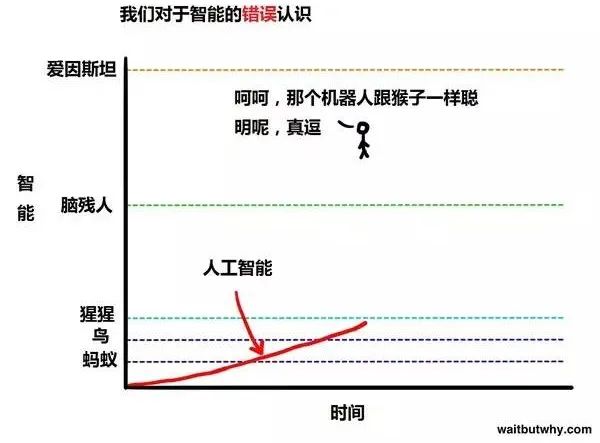
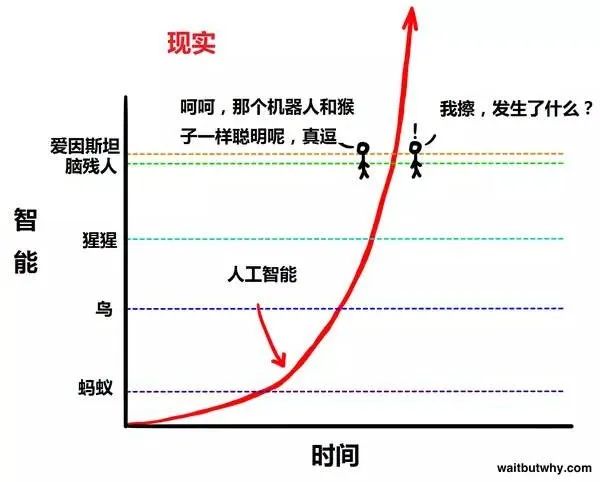
So, as artificial intelligence starts to approach human-level intelligence, we will see it gradually becoming more intelligent, much like an animal. Then, it suddenly reaches the level of the dumbest human, and we may exclaim, “Look at this artificial intelligence; it’s as smart as a brain-dead human; how cute!”
But the problem is that, in the grand scheme of intelligence, the differences in intelligence among humans—such as the gap between the dumbest humans and Einstein—are not that large. So when artificial intelligence reaches brain-dead level intelligence, it will quickly surpass even Einstein in intelligence:
What happens next?
Intelligence Explosion
From here on, the topic is going to get a bit scary. I want to remind everyone that what I’m about to say is the truth—a collection of respected thinkers and scientists’ honest predictions about the future. When you read something outrageous below, remember that these ideas come from people much smarter than you and me.
As mentioned above, the models we currently use to achieve General AI mostly rely on the self-improvement of artificial intelligence. However, once it achieves General AI, even considering the small portion of systems that do not reach General AI through self-improvement, it will be smart enough to start self-improvement.
This brings us to a heavy concept—recursive self-improvement. This concept is as follows: an artificial intelligence operating at a certain level of intelligence, say, at the level of a brain-dead human, has a mechanism for self-improvement. When it completes a self-improvement cycle, it becomes smarter than before, let’s say it reaches the level of Einstein. At this point, it continues to self-improve, and now, with Einstein-level intelligence, this next improvement becomes easier and more effective. The second improvement makes it significantly smarter than Einstein, which enhances the visibility of subsequent improvements. This process continues recursively, with the intelligence level of this General AI increasing exponentially until it reaches superintelligent levels—this is the intelligence explosion and the ultimate manifestation of the Law of Accelerating Returns.
There is still debate about when artificial intelligence will reach human-level intelligence. A survey of hundreds of scientists shows that they believe the median year for the emergence of General AI is 2040—just 25 years from now. This may not sound like much, but remember that many thinkers in this field believe the transition from General AI to Super AI will be much quicker. The following scenario could occur: an artificial intelligence system takes decades to reach the level of a brain-dead human, and when that milestone occurs, the computer’s perception of the world is likely similar to that of a four-year-old child; yet within an hour after reaching that milestone, the computer could derive a unified theory of general relativity and quantum mechanics; and an hour and a half later, this General AI becomes Super AI, achieving an intelligence level 170,000 times that of ordinary humans.
This level of superintelligence is beyond our comprehension, just as bees cannot understand Keynesian economics. In our terms, we call an IQ of 130 smart and an IQ of 85 dumb, but we have no concept of how to describe an IQ of 12,952; such a concept does not exist in human language.
However, what we do know is that humanity’s dominion over Earth teaches us one lesson—intelligence is power. This means that once a superintelligent AI is created, it will be the most powerful entity in the history of Earth, and all life, including humans, will have to submit to it—and all of this may happen within the next few decades.
Imagine if our brains can invent Wifi, then a brain that is 100 times, 1000 times, or even a billion times smarter than us could manipulate the positions of all atoms in the world at will. What seems supernatural to us, abilities that belong to an omnipotent God, could be as simple as flipping a light switch for a superintelligent AI. Preventing human aging, curing incurable diseases, solving world hunger, even achieving human immortality, or manipulating the climate to protect the future of Earth—these will all become possible. Equally possible is the end of all life on Earth.
When a superintelligent AI is born, it will be like an omnipotent God descending on Earth.
At this point, what we care about is

END

For more exciting articles, please click the blue title below:
-
CALL FOR PAPERS|《Physics and Engineering》 Call for Papers Quantum Century Year
-
China University Physics Education MOOC Alliance 2023 Work Meeting (Expanded) and Typical Case Exchange Meeting Minutes
-
2023 National Higher Education Physics Basic Course Academic Seminar Minutes
-
2023 National Higher Education Physics Basic Course Young Teacher Lecture Competition Held at Kashgar University
-
National University Physics Experiment Teaching Support (Intellectual Support for Xinjiang) Seminar Held at Xinjiang Normal University
-
Professor Wang Qing: Understanding Academician Wang Zhonglin’s “Extended Maxwell Equations”
-
“Peddling” Maxwell: Interesting Talks on Galileo Covariance and Lorentz Covariance Electromagnetic Field Theory
-
Hot Topics: Motion Medium Lorentz Covariant Electromagnetic Theory
-
2021《Physics and Engineering》 Outstanding Paper, Outstanding Reviewer, Outstanding Young Scholar List
-
Professor Wang Qing: Problem-Driven Education Originating from Socrates—Learning and Growing Together in Interaction
-
Reflections: Reality and the Future in Education
-
Professor Wang Qing: Last night (June 9), Tsinghua Electrodynamics Final Exam
-
Academician Zhu Bangfen: The Misunderstanding of “Reducing Burden” and the Challenges Facing Science Education in China
-
2023 Issue 4 Directory of《Physics and Engineering》
-
Yongkang Le: Physics Experiment Teaching in the Context of COVID-19 Prevention and Control in the United States and Comparison of China and the United States
-
Mu Mu: Understanding and Experience of the Revised Basic Requirements for Teaching Physics Courses in Non-Physics Engineering Disciplines
-
Academician Zhu Bangfen: From Basic Science Class to Tsinghua University Physics Class
-
Academician Zhu Bangfen: Thoughts on Cultivating First-Class Innovative Talents
-
Professor Li Xueqian: Physics as a Culture
-
Professor Li Xueqian: How to Help Physics Department Students Transition from Senior Year to College
-
Mu Liangzhu: The Core of Ideological Education in Physics Courses is Cultivating Scientific Cognitive Ability
-
Mu Liangzhu: What is Physics and Physics Culture?
-
Mu Liangzhu: What is the ETA Physics Cognitive Model?
-
Mu Liangzhu: What is the ETA Physics Teaching Method?
-
Professor Wu Guozhen: My Impressions of Studying Abroad—Written for the 20-Year Anniversary of Tsinghua University Physics Department’s “Basic Class” and 10-Year Anniversary of the “Classroom Class”
-
Chen Jiaer, Zhao Kaihua, Wang Zhidong: Urgently Need to Rebuild China’s Engineering Physics Education for the 21st Century
- Professor Wang Yayu: The Concept and Practice of Undergraduate Talent Cultivation in Tsinghua University Physics Department
-
Professor Ge Weikun: A Few Thoughts on Talent Cultivation in China and Abroad
-
Professor An Yu: Why the Traditional Classroom Teaching Model Needs to Change
-
Professor An Yu: In fact, teaching is a process of accumulation
-
Professor Liu Yuxin: Some Thoughts on Teaching Basic Physics Courses for Undergraduates and Textbook Compilation
-
Shen Qianru: The Impact of the US-Canada Curriculum Reform on Science Education
-
Henderson C: Physics Education Research Supported by US Research Funds and Its Impact on Higher Physics Education
《Physics and Engineering》 Journal focuses on academic research in physics education and teaching, is a core journal in Chinese science and technology, founded in 1981, and welcomes active submissions. Journal Submission and Review Platform:
http://gkwl.cbpt.cnki.net

Welcome to follow
《Physics and Engineering》 WeChat Official Account