IoT Think Tank Original
Ten years ago, when the 3.5mm headphone jack was first removed from smartphones, the entire industry was still debating whether this was innovation or regression. Looking back now, this “interface revolution” has completely rewritten the way we connect with music. TWS (True Wireless Stereo) headphones have transformed from niche gadgets to standard equipment found on the streets, allowing us to finally break free from the headphone cables that always seem to tangle at the worst moments.
But freedom comes at a cost.
Users who pursue sound quality know well: wireless means compromise. This compromise is so prevalent that the phrase “headphones are just for sound” has shifted from a joke to a default industry consensus. Even flagship TWS models priced in the thousands are often labeled as “good enough” in audiophile reviews.
The technical dilemma lies in an almost unsolvable contradiction: When you want a stable connection, sound quality must give way; when you pursue low-latency gaming experiences, bitrate becomes the sacrifice; and when you try to enhance sound quality, disconnections and stuttering follow closely behind. This problem, referred to by engineers as the “impossible triangle,” has loomed over the evolution of wireless audio for the past decade.
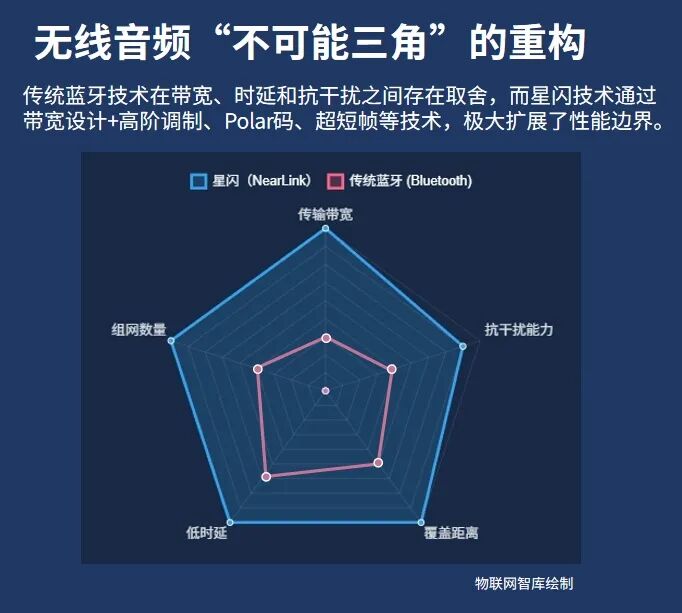
The crux of the issue is quite clear: It is not that the audio source is inadequate, but that the transmission pipeline is too narrow.
Imagine a scenario: your phone stores high-resolution audio at 96kHz/24bit, and the processor is powerful enough to run ten music apps simultaneously, but when the music needs to be transmitted to the headphones, it must squeeze through a Bluetooth channel with only 2Mbps bandwidth. This is like trying to “stream” a waterfall through a narrow pipe; no matter how powerful the source, the output can only be a trickle. To fit through this “pipe,” the originally rich musical details must undergo lossy compression.
The entire industry is waiting for a breakthrough.
NearLink’s emergence is not a minor tweak within the existing framework, but a complete rewrite of the rules of the game.
It applies cutting-edge technologies like Polar codes to short-range transmission, achieving spectral efficiency several times that of traditional Bluetooth, breaking the technical ceiling that has plagued the industry for a decade. When bandwidth is no longer a bottleneck, high sound quality, low latency, and strong stability stand together for the first time.
It is worth noting that NearLink has chosen an open route. It is not a proprietary weapon of a single company, but a technical standard that the entire industry can participate in. From chip designers to terminal manufacturers, from audio brands to content platforms, everyone can showcase their capabilities on this new technological foundation. This openness signifies an important shift: the competition in wireless audio will shift from “who has the best compression algorithm” to “who can provide the most extreme music experience.”
Reconstructing the Physical Foundation: Why is NearLink a ‘Dimensionality Reduction Strike’?
If the “impossible triangle” of traditional Bluetooth is a collective trauma for the entire industry, then the emergence of NearLink is more like a surgical operation: It does not merely apply a band-aid to the wound but replaces the organ directly.
This thoroughness is reflected in the choice of technical path. While other manufacturers are still pondering how to optimize the SBC compression algorithm by another 5%, NearLink has directly brought in technology from 5G base stations.
Bandwidth is justice; this is the first law of the wireless audio world.
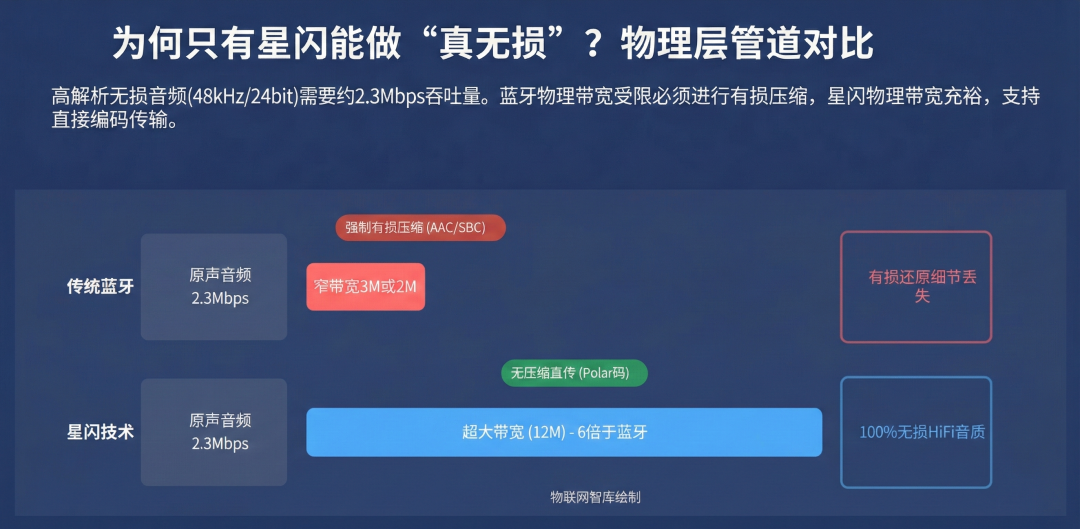
For the past decade, the entire industry has been playing a futile game: how to fit a 4.6Mbps lossless audio stream into a 2Mbps Bluetooth channel? The answer is singular: compression. SBC cuts audio by 70%, AAC is slightly better but still requires cutting half… This is like scanning an oil painting into a black-and-white fax; no matter how sophisticated the receiving end’s algorithm is, Van Gogh’s starry night ultimately becomes a mosaic.
NearLink’s 12Mbps physical bandwidth completely ends this “compression race.”
Let’s do the math: CD-quality audio (44.1kHz/16bit) requires 1.4Mbps bandwidth, while high-resolution audio requires 2.3Mbps. On a 12Mbps highway, these data streams are like small cars running on an eight-lane road, no longer needing to collide with each other to overtake. More importantly, NearLink supports “native direct delivery”: whatever the source is, that is what is transmitted, and that is what the headphones receive.
But having a wide road is not enough; you also need a vehicle that won’t break down.
This is where Polar codes come into play. As the core technology of 5G communication, Polar codes were established as the encoding scheme for 5G control channels in 2016, shaking the entire communication industry. Polar codes are the first class of channel coding methods that have been theoretically proven to achieve Shannon’s limit, based on the channel polarization theory proposed by scientist Arikan. This top-tier technology, originally serving cellular communication, has been “dimensionality reduced” and applied to headphones by NearLink.
A 5.5dB improvement in reception sensitivity may sound like a cold number. But in real-world scenarios, its power truly manifests.
Beijing’s subway Line 10 during the morning rush hour is perhaps one of the worst wireless environments globally, with dozens of active Bluetooth devices per square meter, and the 2.4GHz band is as crowded as a train station during the Spring Festival. Traditional Bluetooth headphones here are like driving in fog; the signal is intermittent, and the music is choppy. However, devices equipped with Polar codes from NearLink can carve out a stable channel in this “electromagnetic swamp” thanks to their excellent error correction capabilities. Even if 30% of data packets are damaged during transmission, Polar codes can accurately restore complete information through their unique channel polarization characteristics.
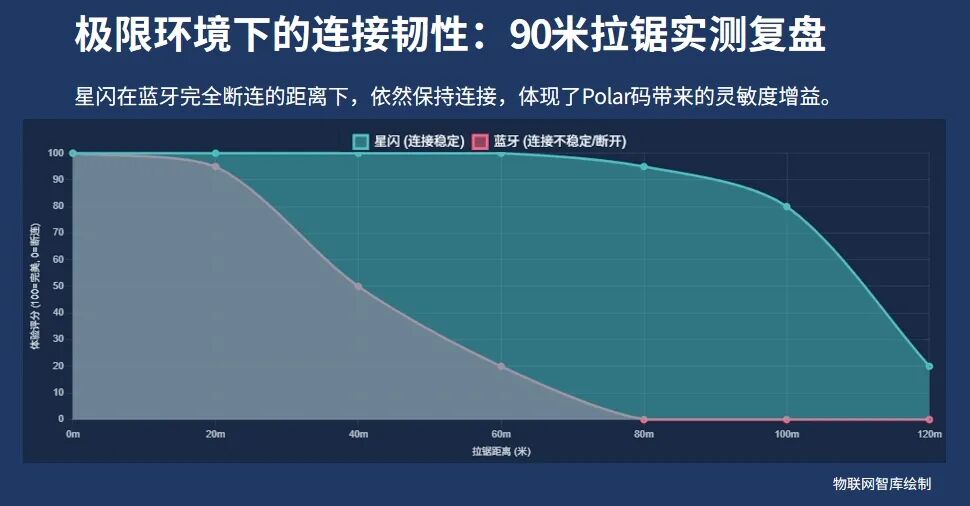
This improvement in stability makes “wireless” no longer synonymous with “unreliable.”
What is even more intriguing is the timing of NearLink’s choice. By 2025, it will be a turning point for the TWS headphone market as growth slows; when everyone already has a pair of Bluetooth headphones, what will be the next reason to buy? NearLink’s answer is simple and straightforward: Not a better compression algorithm, not fancier noise cancellation effects, but truly uncompromised sound quality.
A saying has circulated in audiophile circles: “Wireless means no HiFi.” This assertion has persisted for twenty years without being truly broken. The reason is simple: When the transmission link itself is the bottleneck, no matter how good the decoding chip at the front end or how high-quality the dynamic driver at the back end, it is all in vain.
The IoT Think Tank believes that the significance of NearLink audio lies in the fact that it provides wireless audio with a starting point that is not inferior to wired audio, for the first time on a physical level. This is not a gradual improvement but a reconstruction of the underlying logic. NearLink proves one thing: the so-called technical ceiling is often just a ceiling of imagination.
The Rise of Computational Audio: When “Connection” Meets “Edge AI”
NearLink solves the transmission problem, but the other half of the audio experience story happens inside the headphones. While most manufacturers are still competing over who has the “thicker pipe,” Shanghai HiSilicon’s NearLink audio solution has chosen a more challenging but imaginative path: integrating AI into the headphones.
This choice is backed by a harsh reality: traditional TWS headphones are essentially just audio terminals, with all intelligent processing relying on the phone. The headphones play whatever they receive, like obedient but unthinking speakers.
This architecture has the most obvious pain point: noise cancellation.
You have certainly encountered the awkward situation: wearing headphones that claim to have top-notch noise cancellation while walking into a Starbucks; the sound of the air conditioning indeed disappears, but the whispers of the couple next to you pierce your ears like needles. The reason is simple: traditional ANC (Active Noise Cancellation) technology only processes “dumb noise”: those sounds with fixed frequencies and predictable patterns. The roar of airplane engines and the rumble of subways are ANC’s strong suits. But human voices, keyboard sounds, and the clinking of cups… these randomly occurring, complex-frequency “smart noises” are beyond the reach of traditional noise cancellation.
The answer from Shanghai HiSilicon’s NearLink audio solution is: to pack an AI core (NPU) into a chip the size of a fingernail.
This decision is nearly insane from an engineering perspective. Every square millimeter of TWS headphone chips is precious, and integrating an NPU under such extreme constraints is akin to carving a supercomputer out of a pigeon egg. But once achieved, the rewards are revolutionary.
We witnessed a stunning demonstration in the lab: a tester wearing a prototype equipped with this solution was in a loud background where the news broadcast was playing at high volume, with the host’s clear voice, the reporter’s interviews, and various background noises mixed together. Normally, such complex human voice reverberations would penetrate the noise cancellation system directly. But miraculously, the tester heard only the music they were playing, while the background news broadcast was completely evaporated.
This is due to the NPU’s hundreds of millions of real-time calculations per second. This is not simple sound filtering but a form of sound understanding based on deep learning.
Even more impressive is the ability to resist wind noise. Anyone who has ever ridden a shared bike while talking on the phone knows that wind noise is the enemy of call quality. Shanghai HiSilicon’s deep neural network algorithm can maintain call clarity at wind speeds of 5m/s (equivalent to cycling speed). AI does not simply filter out wind noise but understands the characteristics of human voices through learning, reconstructing complete speech signals amidst wind noise.
But the value of edge AI goes far beyond noise cancellation.
When computing power is right next to you, a whole new possibility opens up. Imagine a scenario: you are listening to a symphony recording, and AI can analyze the sound field information in real-time, adjusting the position of each instrument based on your head movements, creating a sense of space as if you were sitting in the center of the concert hall. Or in a video conference, AI can enhance the speaker’s voice while softening background noise, making remote communication feel like face-to-face conversation. These experiences share a commonality: they require extremely low latency and extremely high computing power, which is precisely the strength of edge AI.
Privacy protection is another underestimated advantage. When all audio processing is done within the headphones, your voice data does not need to be uploaded to the cloud or stored on the phone.

From an industry perspective, HiSilicon’s NearLink solution represents a new technological paradigm: headphones are no longer the endpoint of the audio chain but an edge computing node with perception and thinking capabilities. The IoT Think Tank predicts that as more devices begin to possess this “edge AI,” the entire audio ecosystem’s gameplay will change. This is a gamble, betting that the future of audio is not just about “hearing clearly” but also about “understanding what you hear.”
The Fracture of the Ecological Network: From “One-to-One” to the Imagination of “All Things Connected”
While breakthroughs at single points are important, true revolutions often occur through changes in connection methods. Bluetooth has spent 20 years without breaking free from the “one-to-one” mindset, with phones connecting to headphones and computers connecting to speakers, and nothing more. However, Shanghai HiSilicon’s NearLink audio solution aims to transform audio devices from accessories into a network.
The significance of this shift may be deeper than you think.
First, consider a very real pain point: live streaming. Today, any slightly professional streamer has a tangle of wires on their desk: the clip-on mic’s wire, the sound card’s wire, the monitoring headphones’ wire. Why, with wireless technology so advanced, are creators still entangled with cables? Because traditional Bluetooth simply cannot handle multi-device scenarios. Most Bluetooth microphones support a maximum of “2 transmitters and 1 receiver”; having two people speaking is already the limit.
HiSilicon’s NearLink audio solution directly breaks through this ceiling: multi-transmit and multi-receive, 48kHz full-band sampling, and true multi-receive.
In traditional solutions, sound can only be transmitted unidirectionally to one receiving end, either for recording by a camera or for monitoring by a director, but not both. However, in actual workflows, these needs often exist simultaneously. NearLink’s multi-receive capability means that a streamer’s voice can be sent simultaneously to the camera for archiving, to the director’s headphones for monitoring, to the live sound system, and to a backup phone for streaming… one microphone serves the entire production chain.
The home theater scenario is similar. You may not know that many of the so-called “wireless surround” speaker systems on the market primarily use WiFi connections, with latencies typically between 40-100 milliseconds. This latency has little impact on music playback, but it becomes apparent when watching movies; the explosion on screen has ended, but the subwoofer is still lagging behind.
HiSilicon’s NearLink audio solution supports 5.1 channel wireless networking, significantly reducing end-to-end latency. More importantly, phase synchronization between multiple speakers is crucial for creating the correct sound field, requiring extremely precise clock synchronization, akin to having six dancers perform blindfolded while maintaining perfectly synchronized movements. NearLink’s synchronization technology makes this blind dance possible.
However, the application scenario that most impressed me is actually hearing aids.
Traditional hearing aids face a paradox: to hear clearly, they require high gain and complex signal processing, which means high power consumption; but hearing aids have very small batteries, making battery life a perpetual pain point. Many elderly people would rather not hear clearly than frequently recharge or change batteries.
HiSilicon’s NearLink audio solution’s energy efficiency allows hearing aids to maintain high performance while extending battery life to all-day use levels. The warmth of technology sometimes manifests in these details.
Of course, even the best hardware needs ecological support. If HiSilicon’s NearLink audio solution is a sharp knife, then the HarmonyOS ecosystem is the chef wielding that knife.
This combination produces a wonderful chemical reaction. When you approach a HarmonyOS TV while wearing NearLink headphones, the system will automatically ask if you want to switch the audio; if you were listening to a podcast in the car, you can seamlessly transfer it to a smart speaker at home; and in the future, what you say to the NearLink headphones could be translated into foreign languages in real-time through cloud collaboration, allowing for smooth communication in foreign lands.
These seemingly sci-fi scenarios have a fully established technological foundation. NearLink provides a high-speed and stable transmission channel, the edge NPU offers real-time processing capabilities, and the open-source HarmonyOS provides intelligent scheduling between devices.
From an industry perspective, the IoT Think Tank believes that HiSilicon’s NearLink audio solution represents a new competitive dimension: covering the full stack capability of “chip + protocol + system.” This is not simple vertical integration but a systematic consideration of the future audio form. Audio devices should not be islands but part of an intelligent network.
In Conclusion, the Market Turning Point Has Arrived
Technological breakthroughs ultimately must face market validation. By the end of 2025, NearLink stands at the critical point of transforming from “black technology” to “standard configuration.”
The upcoming release of Huawei FreeBuds Pro 5 is not just a product iteration. As the first mass-produced flagship of NearLink technology in the TWS field, it serves more as a mobilization order to the entire industry. The supply chain’s response speed confirms this: Leading audio manufacturers’ onboarding cycles have been compressed to 4-6 months, meaning that new products equipped with NearLink will flood the market in the first half of 2026.
Market acceptance is faster than expected. In a blind listening test conducted with ordinary users, 20 “novice users” were able to distinguish the sound quality difference between NearLink transmission and traditional Bluetooth with 100% accuracy, completely unaware of the context. This breaks an industry unspoken rule: high sound quality is “mystical” and only audiophiles can hear the difference.
The deeper competitive barrier lies in the differences in delivery models.
Traditional Bluetooth chip manufacturers sell “semi-finished products”: a bare chip with basic firmware, leaving the remaining debugging work to downstream manufacturers. In contrast, NearLink offers a “turnkey” solution: from the underlying chip to AI algorithms, from development tools to audio standards, the entire technology stack is packaged and delivered. For competitors, replicating a chip may be feasible, but replicating an entire ecosystem is nearly impossible.
Looking back at the end of 2025, the evolution of wireless audio history is essentially a process of solving two questions: Bluetooth solved the “whether” problem, freeing us from cables; NearLink addresses the “how good” problem, ensuring that wireless is no longer synonymous with compromise.
But the significance of NearLink goes far beyond audio. In the context of all things connected, sound is the most natural human-machine interface: it is the ear through which AI understands the world and the tentacle through which smart devices respond to commands. When this audio highway is fully opened, the interaction efficiency of the entire AIoT ecosystem will be rewritten.
From cutting the headphone cord to reconstructing the audio ecosystem, we have taken a full decade. In the next decade, as computing power, connectivity, and intelligence converge at our ears, audio will no longer just be a carrier of sound but the gateway to intelligent living. This transformation has only just begun.