In recent years, the fourth industrial revolution, characterized by the integration of new generation information technologies such as artificial intelligence, the Internet of Things, and cloud computing, has quietly arrived. Humanity has begun to enter the 5G era. The traditional lighting industry is urgently facing transformation and upgrading, and the intelligentization of products based on new generation information technology has become an inevitable direction for industry development, which has left many manufacturers in a state of hesitation and confusion.
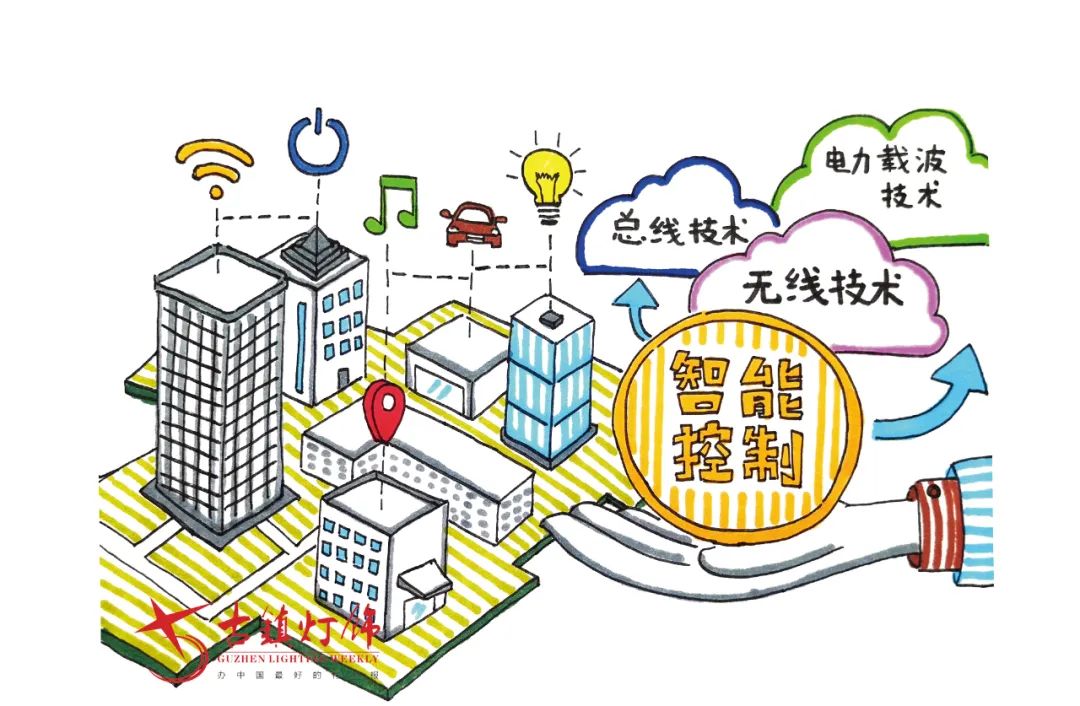
The current intelligentization of lighting products mainly manifests in the interaction of communication information, with the primary communication technologies being:
- First, the wireless technology solution. This solution uses communication protocols such as Wifi, Zigbee, Bluetooth, and Enocean for wireless local area network transmission, enabling control over smart individual products and systems;
- Second, the bus technology solution. This involves laying new communication lines alongside the existing electrical wiring, utilizing communication protocols such as RX-485 and KNX to concentrate the devices needing control onto a single bus in a fully distributed intelligent network control technology;
- Third, the power line carrier technology solution. This solution is based on PLC and other communication protocols, using existing power grids with modems at both ends to enable all electrical devices to function as a cohesive unit to control smart products.
Each of these three solutions has its advantages and disadvantages, and no single application is perfect. The wireless technology solution has low energy consumption, flexible networking, and is cost-effective, but has a shorter transmission distance and smaller communication range; the bus technology solution provides stable transmission but is cumbersome to install, inconvenient for system upgrades, and has high configuration costs; the power line carrier technology solution offers more stable signals compared to the wireless technology solution and does not require rewiring like the bus technology solution, making installation easier, with lower maintenance costs and more competitive pricing, effectively combining the advantages of both wireless and bus solutions. However, it also shares the drawbacks of both, especially the high demands for power grid stability.
-
For high-end users, stability is paramount, making the bus control solution more suitable;
-
For mid to low-end consumers, price is the primary concern, making the wireless control solution more popular;
-
For mid to high-end customers, the power line carrier technology solution may be the most ideal choice.
Of course, regardless of which communication technology solution is chosen, none exist in isolation; various communication technologies can interconnect, control, and transform one another. For instance, wired control solutions and power line carrier technology solutions often come equipped with wireless control capabilities to compensate for the shortcomings present in their application scenarios.
In the era of the Internet of Things, the vast amounts of data generated from user interactions and information exchanges represent a tremendous asset. Once lighting companies relinquish their most core and valuable resources, they lose their bargaining chips and may even forfeit their eligibility to enter the Internet of Things arena.
The intelligent upgrade of the lighting industry should not merely stop at adding a smart module to lighting products to sell them at a higher price. Instead, it should integrate the enterprise into the Internet of Things era, either by establishing its own IoT platform or deeply participating in an existing IoT platform. Regardless of the choice, it should consider the interests of all parties involved, aiming for win-win cooperation.
- First, smart module providers and manufacturing enterprises should achieve win-win outcomes, and not merely have traditional manufacturers serve as a facade for IoT companies;
- Second, manufacturers and distributors should also achieve win-win results, ensuring that one side does not win at the expense of the other, and manufacturers do not benefit twice;
- Third, manufacturers should win alongside users, where users joining the manufacturer’s IoT platform should receive specialized services such as intelligent lighting environment design and installation, enhancing their quality of life.
The premise of enterprise development is win-win outcomes, and the ultimate goal should also be win-win. Every enterprise should fully consider the interests of all parties, pursuing its own benefits on the foundation of seeking win-win solutions, ensuring that every consumer’s legal rights are fully and effectively protected.
Capital is wild; a platform or enterprise relying solely on capital for support, believing itself to be supreme, may enjoy temporary glory, but in the long run, it risks self-destruction.
Only by following the trend can one achieve results; only through cooperation can there be a future.
–THANK YOU—
Written by: Gu Jin
Editor: He Qi
Reviewed by: He Chunyan
Compiled by: Guzhen Lighting Media Center
—Recommended Reading—
Terminal store upgrades, launching a hundred-store plan, Langdewan’s century-old brand starts anew
LED lighting industry faces second price increase! How significant is the impact of multiple price hikes in chips, copper materials, aluminum materials, and acrylic on the industry?
“Price wars” are intensifying; is it due to material shortages or capital schemes?