Recently, several robotics companies have announced product updates: On August 29, New Times stated in response to investor inquiries that the company plans to launch an embodied intelligent welding solution in September, which can be widely applied in various industries such as shipbuilding, steel structures, tower corners, and construction machinery; on August 25, Chen Nanjian, chairman of Yichang Qingkui Robot Technology Co., Ltd., introduced in a public report that the company’s uninterrupted full-process organic synthesis robot will complete debugging by the end of September and be sent to the Singapore Science and Technology Research Agency…
The integration of technologies such as embodied intelligence is making industrial robots increasingly “smart.” Meanwhile, in the unseen areas, the MCU, which serves as the “brain” of the robot control system, is bearing increasingly higher computational demands.
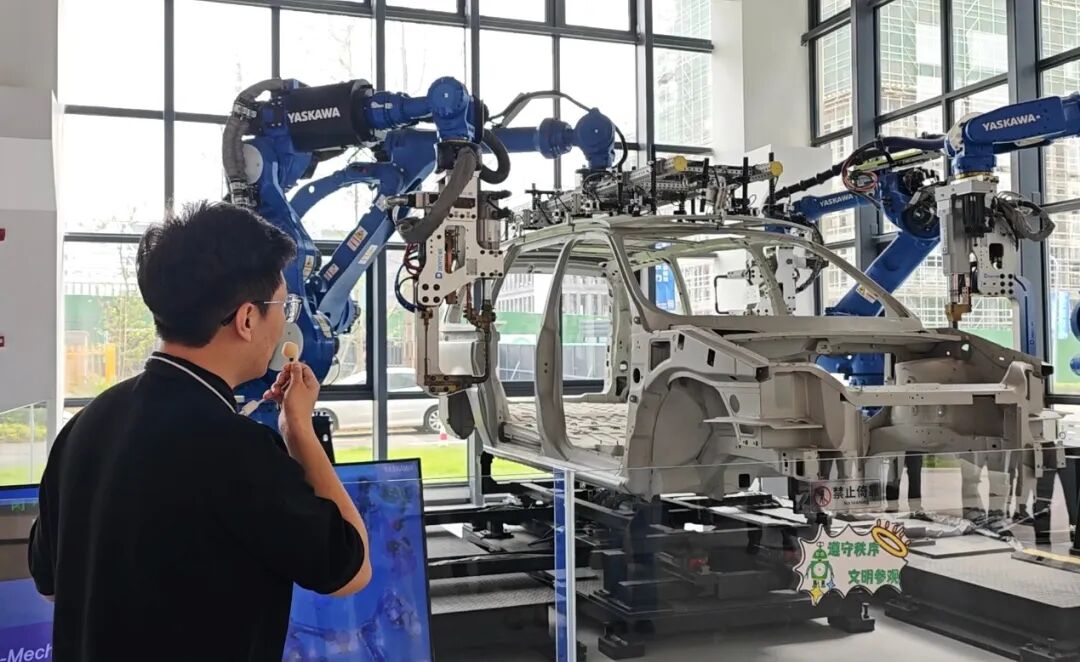
Robotic arms used in automotive production lines
More “AI” in the brain
“When industrial robots incorporate new forms of embodied intelligence, they upgrade from mere fixed-path actuators to comprehensive systems capable of autonomous perception, reasoning, and execution,” said Shen Qing, marketing director of Renesas Electronics’ Embedded Processor Division, in an interview with China Electronics News. Robots are no longer limited to executing pre-defined workflows; they can autonomously perceive their environment and make judgments like humans. This increase in intelligence means that the amount of information processed during task execution has exploded.
For embodied intelligent robots to operate like humans, they need not only “hands” for manipulation but also “eyes” and “brains” for perception and computation. Shen Qing provided an example: the operation of a seven-degree-of-freedom embodied intelligent robotic arm requires at least two visual signals, twelve axis encoders, six synchronized torque sensor signals, and control of seven independent motion axes. The raw data volume that such a robotic arm needs to process for a single task is enormous, and the entire closed-loop of perception, reasoning, and execution must be controlled within 5 milliseconds, with a jitter of no more than 50 microseconds. Moreover, all data processing and computation must be completed on the edge or even on a single chip; otherwise, it would impose significant bandwidth and power consumption pressures on the entire system.
In the face of the explosive growth in functional requirements for robots, the MCU, which acts as the “brain” in industrial robots, must possess stronger advanced processing capabilities and machine learning abilities to handle these demands.
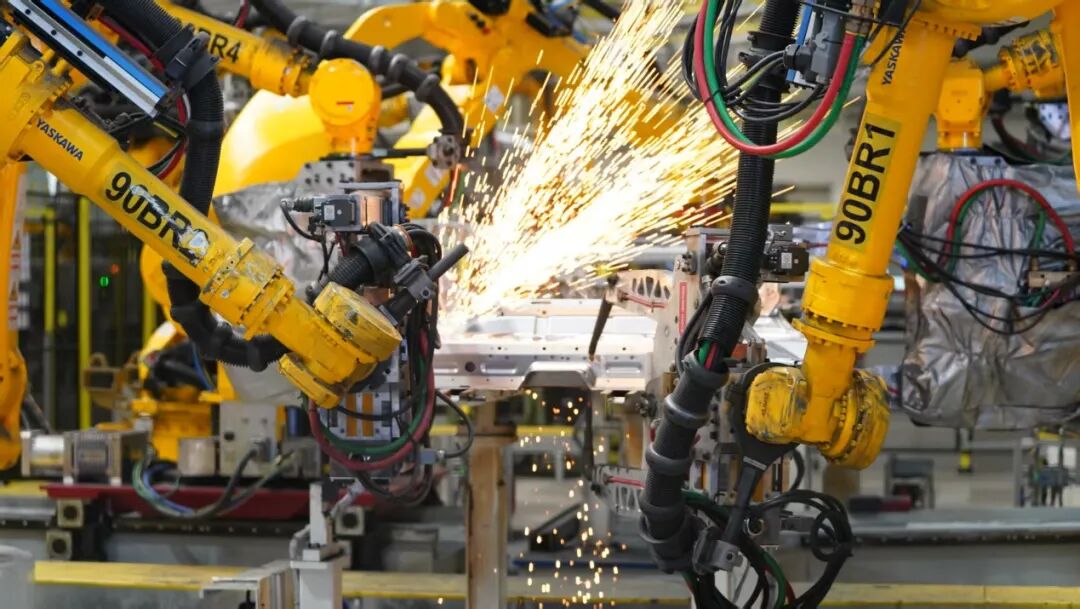
Industrial robot working scene
Shen Qing stated that Renesas has built an AI ecosystem to meet the growing AI demands of industrial robots, which includes underlying hardware CPUs, MPUs capable of supporting AI applications, a software stack and pre-trained library supporting over 100 application cases, and model deployment tools with various functions such as signal processing, anomaly detection, voice command recognition, and image classification.
Chad Steider, senior product marketing manager at SiFive, mentioned that under the backdrop of AI-driven technology and manufacturing upgrades, downstream customers have raised higher performance expectations for MCUs. They expect new industrial MCUs to integrate AI, have wireless transmission capabilities, and enhanced security. For instance, edge computing demands are driving the deep integration of AI with MCUs for applications such as image recognition and voice processing.
Integration requirements are further upgraded
In industrial production processes, scenarios such as production process management, manufacturing site management, and equipment maintenance require the integration of MCU control with AI and edge computing. Chad Steider stated, “This requires further integration of AI acceleration units within the MCU, expanding the capacity of on-chip storage and the number of general-purpose input/output (GPIO) interfaces to enhance edge computing capabilities for various scenarios such as manufacturing and smart cities, efficiently achieving local real-time control and small model inference.” He noted that this integration has already been validated in scenarios such as smart security and industrial inspection, enabling rapid completion of tasks like image recognition, sound processing, and monitoring of equipment and environmental anomalies without relying on the cloud, thus reducing dependency on cloud services, improving response speed, and saving costs.
Multimodal perception is also a technological revolution that embodied intelligent industrial robots are undergoing. To achieve autonomous judgment and action, robots need to capture complex sensory information such as vision, force, temperature, and position. As a result, the same robot can transition from serving simple scenarios to simultaneously meeting diverse tasks across different scenarios through information acquisition and machine learning. This enhances the flexibility of task load conversion for industrial robots. However, such a robot, which can be reused in different scenarios, will see a dramatic increase in the number of signal pathways it needs to process, especially the number of sensors mounted.
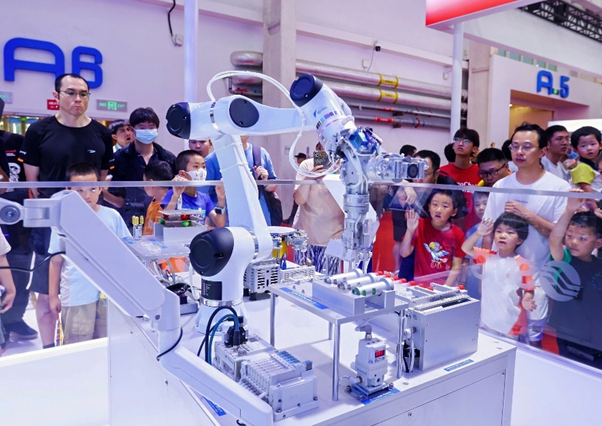
Automation technology companies atthe 2025World Robot Conference showcase picking and placing devices
Shen Qing stated, “Devices that previously did not carry sensors, or only carried one or two sensors, now need to carry a sudden increase to dozens of sensors. The data sampling rate has also increased from the kilohertz level to the megahertz level.”
She added that multimodal perception requires the MCU’s interfaces to be sufficiently rich, not only to support EtherCAT (an Ethernet-based fieldbus system), CAN FD (an upgraded version of the CAN bus), and TSN (a network protocol system based on standard Ethernet technology), but also to have dedicated encoder interfaces, high-precision ADCs, hardware filters, etc., to meet the surging demand for sensor data processing.
Highly competitive MCUs possess three key features
After a prolonged period of inventory adjustment, the industrial MCU market is returning to a growth phase. The construction of smart factories and the digital transformation of old factories are bringing innovative vitality to the industrial robot and MCU markets. Shen Qing stated, “We can clearly feel that both domestic and international customers are actively embracing AI technology to enhance factory operational efficiency. The construction of smart factories is a comprehensive system engineering project that includes hardware layers.”
Chad Steider noted that as manufacturing evolves towards higher-end, intelligent, sustainable, and human-centered directions, more sensors and actuators will be introduced at every stage of industrial manufacturing, leading to a continuous increase in demand for industrial MCUs.
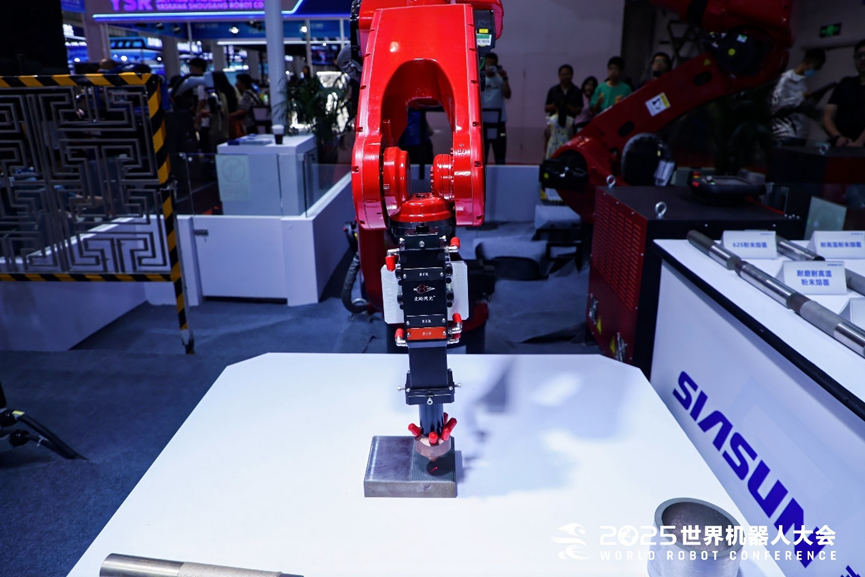
New松 industrial robots can break through the limitations of traditional processing methods on complex geometric shapes
Under the trend of AI-driven technology and manufacturing upgrades, MCUs that meet the following four requirements will maintain strong demand for a long time:
First, support for edge AI inference. The market capacity for edge AI inference is rapidly growing. Advanced edge AI processors can make critical decisions locally without relying on the cloud, thereby improving response speed, ensuring data privacy, and reducing system operating costs.
Second, high energy efficiency and low power consumption. In scenarios where battery power is deployed at the edge and energy supply is limited, low-power products have a higher market competitiveness; especially as AI functionality deployment increases the demand for edge computing power, processors must support low power consumption.
Third, high security and reliability. In terms of data security, MCUs need to have hardware-level security modules and integrated encryption engines; in terms of functional safety, they must meet the IEC61508 industrial functional safety standards.
Fourth, support for efficient real-time decision-making. The increasing automation of industrial production requires faster data processing responses. The most straightforward way to achieve this is to move the decision-making process closer to the data collection point. This means that MCUs must not only be responsible for data collection but also process the data and transmit the results to the entire system.
 Follow China Electronics NewsFollow the author of this article
 Further Reading:Mixed feelings, the three giants of home appliances reveal their half-year performancePanel companies show stable growth in the first half of the yearAuthor丨Ji XiaotingEditor丨Qiu JiangyongArt Editor丨MariaSupervisor丨Lian Xiaodong
 Click “View” to stay connected