First Company: Jucheng Co., Ltd.
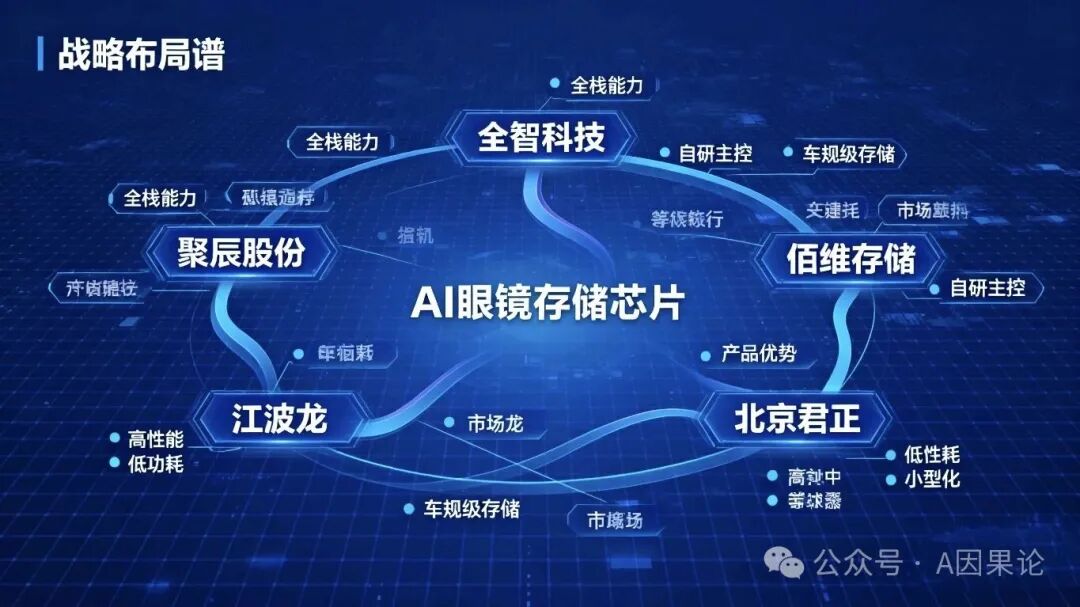
Jucheng Co., Ltd. focuses on the AI glasses and storage chip sector, relying on a threefold strategy of “technological positioning + product adaptation + ecological extension” to deeply bind to the core demands of miniaturization and long battery life in AI glasses, establishing competitive barriers in the small-capacity storage market.
Core Competitiveness is reflected in precise technological positioning and ecological integration capabilities. The company has independently developed WLCSP EEPROM chips, which have entered the mainstream AI glasses supply chain, addressing the pain points of device endurance and stability with low power consumption and high electrostatic protection. Additionally, through “internal R&D + external expansion,” it has perfected its storage matrix, covering a full range from EEPROM to NOR Flash. The “storage + analog” chip set strategy creates differentiated advantages, such as VCM integrated EEPROM products that can save module manufacturers 15% of BOM costs, which have been adopted by leading manufacturers.
Product Advantages focus on performance adaptation and cost control. EEPROM chips meet the long-term storage needs of key parameters for AI glasses, with data retention for decades and endurance of millions of write cycles. NOR Flash, using NORD technology, has reduced size by 15% compared to competitors, with a 20% cost reduction, covering capacities from 512Kb to 64Mb to adapt to different scenario needs. By the first half of 2025, related storage products for AI glasses have achieved shipments in the tens of millions, validating product competitiveness.
Future Development Potential relies on industry dividends and technological depth. Global shipments of AI glasses have surged by 110% year-on-year, with a trillion-yuan market space waiting to be tapped. As the only domestic supplier of a full range of automotive-grade EEPROMs, the company can expand its share through the synergy of consumer electronics and smart vehicles. With the advancement of 24nm NOR Flash R&D and the implementation of the chip set strategy, its market space will expand from the $1.2 billion of EEPROM to $6 billion, significantly raising the growth ceiling.
Second Company: Allwinner Technology
Allwinner Technology focuses on the AI glasses and storage chip sector with a core logic of “chip + algorithm + ecosystem” for collaborative development. By leveraging high-performance chips and integrating self-developed AI algorithms, it builds an open ecosystem to meet the demands of AI glasses for low power consumption, miniaturization, and intelligence.
Core Competitiveness lies in technological R&D strength and market share advantages. The company is a leading domestic designer of smart application processor SoCs, with R&D expenses of 132 million yuan in the first quarter of 2025, a 10% year-on-year increase. In the AI glasses SoC field, Allwinner Technology dominates the mid-to-low-end market, with an expected market share of over 30% in 2025, deeply binding with leading customers like Xiaomi. Product Advantages are reflected in chip performance and integration. For example, the V821 chip adopts a dual RISC-V architecture with a dual-core heterogeneous design to meet various power consumption scenarios, achieving millisecond-level system cold starts. It supports SPI NOR/SPI NAND/SD NAND/eMMC storage media and can be used in combination to meet storage expansion needs. The package size is only 9mm x 9mm, enabling extreme miniaturization of hardware. Additionally, Allwinner provides a highly integrated algorithm toolkit, one-stop turnkey services, and an open platform to help manufacturers quickly realize product deployment. Future Development Potential lies in industry demand growth and technological innovation, which will bring opportunities to Allwinner Technology. The global AI glasses market is continuously expanding, and the upcoming V881 next-generation fully integrated smart vision chip has iterated on imaging performance, chip size, and edge computing capabilities, further adapting to the structural and power consumption design needs of lightweight wearable products. At the same time, the company has extensive layouts in smart vehicles and robotics, which can create synergies with the AI glasses business and expand market space.
Third Company: Baiwei Storage
Baiwei Storage focuses on the AI glasses and storage chip sector with a core logic of “full-stack capability support, scenario-based customization,” providing high-performance, low-power storage solutions tailored to the unique needs of AI glasses through a full industry chain layout of storage chips.
Core Competitiveness lies in full-stack technical strength and customer resource advantages. The company is one of the few domestic manufacturers with full-stack capabilities in storage chips, boasting a research and development team of over a thousand. As of June 2025, the number of R&D personnel reached 1,054, a year-on-year increase of 40.53%, and has built a complete industry chain from storage chip design to packaging and testing. The company has also entered the supply chains of the top three global AI glasses manufacturers, with its ePOP series products holding over 35% market share in wearable devices, indicating rich customer resources.
Product Advantages are primarily reflected in high performance, low power consumption, and miniaturization. For example, the ePOP4x integrates eMMC and LPDDR4X in the same package, being small and lightweight, saving PCB space and simplifying product design complexity. This chip achieves a data transfer rate of up to 4266Mbps, with ROM sequential read and write speeds reaching 310MB/s and 240MB/s, respectively, and a maximum capacity combination of 32GB + 16Gb, meeting the high-performance storage needs of AI glasses. Additionally, the ePOP4x adopts advanced low-power design and optimized power management technology, intelligently adjusting operating voltage and frequency under different load conditions to help AI glasses achieve all-day battery life.
Future Development Potential lies in industry demand growth and technological innovation, which will provide Baiwei Storage with vast opportunities. The global AI glasses market is continuously expanding, and with the improvement of terminal chip computing power and edge model capabilities, higher requirements for the efficiency and reliability of data storage are being set. Baiwei Storage, through continuous R&D investment, such as the UFS main control (SP9300) expected to be launched in 2025, will further enhance its competitiveness in the AI glasses and storage chip sector. The company also has layouts in AI smartphones, AIPC, and robotics, which can create synergies with the AI glasses business and expand market space.
Fourth Company: Jiangbolong
Jiangbolong focuses on the AI glasses and storage chip sector with a core logic of “technology innovation drives product differentiation, and full industry chain integration enhances comprehensive competitiveness.” By developing its own main control chips and advanced packaging and testing processes, it provides high-performance, low-power, and miniaturized storage solutions for AI glasses.
Core Competitiveness lies in technological R&D strength and full industry chain layout. The company possesses self-developed main control chip technologies, such as WM7400 and WM6000, continuously enhancing the performance of storage products. Additionally, through the acquisition of Yuancheng Suzhou, it has achieved full industry chain integration from chip design to packaging and testing, with the capability to provide customized packaging and testing for ESAT specialty products, offering customers more competitive products. Furthermore, Jiangbolong adopts TCM and PTM business models to integrate upstream and downstream resources, reduce costs, and improve supply stability.
Product Advantages are primarily reflected in high performance, low power consumption, and miniaturization. For example, Jiangbolong’s 0.6mm ultra-thin ePOP4x integrates eMMC and LPDDR4x, being small and lightweight, saving PCB space. Its eMMC Ultra product, equipped with the self-developed WM6000 main control, has a theoretical transmission speed of up to 600MB/s, with bandwidth improved by 50% compared to mainstream products on the market, and performance close to UFS 2.2 levels, yet at a lower cost.
Future Development Potential lies in industry demand growth and technological innovation, which will provide Jiangbolong with vast opportunities. The global AI glasses market is continuously expanding, setting higher requirements for the performance and capacity of storage chips. Jiangbolong, through continuous R&D investment, is constantly launching new products, such as UFS 4.1 flash memory, which will further enhance its competitiveness in the AI glasses and storage chip sector. The company also has layouts in smart vehicles and industrial computers, which can create synergies with the AI glasses business and expand market space.
Fifth Company: Beijing Junzheng
Beijing Junzheng focuses on the AI glasses and storage chip sector with a core logic of “storage + computing + scenario” collaborative development. Based on high-performance storage chips, combined with self-developed computing chips and AI algorithms, it provides integrated solutions tailored to the specific scenario needs of AI glasses.
Core Competitiveness lies in technological R&D strength and market share advantages. The company has a deep technical foundation in the storage chip field, ranking fourth among global niche DRAM suppliers for automotive applications, second in SRAM globally, and first in mainland China, maintaining the top position in the automotive sector worldwide. In terms of computing chips, its self-developed NPU has certain edge-level AI capabilities, and its AI algorithms have been adopted by many customers, with RISC-V CPU cores applied in some chip products. At the same time, the company has established long-term stable partnerships with globally renowned enterprises such as Bosch, Continental Group, and BYD, boasting rich customer resources.
Product Advantages are primarily reflected in high performance, low power consumption, and scenario adaptability. In the storage chip sector, the company’s LPDDR5X chip achieves a rate of 7500Mbps, with a 30% reduction in power consumption, already applied in Tesla’s HW5.0 intelligent driving system and certified for ASILD functional safety. In the computing chip sector, the T32 series chips combined with Qualcomm solutions achieve breakthroughs in “low power consumption + lightweight”. The T32ZN chip supports 200ms rapid capture and automatic focusing functions, and can collaborate with the cloud to complete AI scene recognition, achieving long battery life with a 300mAh battery, effectively addressing the industry pain points of AI glasses regarding “short battery life and difficulty in functional implementation.”
Future Development Potential lies in industry demand growth and technological innovation, which will provide Beijing Junzheng with vast opportunities. The global AI glasses market is continuously expanding, setting higher requirements for the performance, capacity, and power consumption of storage and computing chips. The company, through continuous R&D investment, is constantly launching new products, such as 21nm and 20nm process DRAM products expected to be launched in 2025, and the T42 chip expected to be produced in the first half of 2026, with computing power expected to increase to 4TOPS, supporting more complex edge-side scenarios. At the same time, the company has extensive layouts in smart vehicles and industrial sectors, which can create synergies with the AI glasses business and expand market space.