From major national projects that reach from the sky to the sea, to the daily necessities of life…Since the new era, under the forward-looking deployment of General Secretary Xi Jinping for building a modern industrial system, China has actively developed future industries and strengthened emerging industries. A series of new fields and new tracks have emerged, becoming new driving forces and advantages for shaping high-quality development.
Future industries are those formed based on cutting-edge and significant technological innovations. The “Suggestions of the Central Committee of the Communist Party of China on Formulating the 15th Five-Year Plan for National Economic and Social Development” (hereinafter referred to as the “Suggestions”) clearly outlines the deployment for cultivating and strengthening emerging industries and future industries during the “15th Five-Year Plan” period: “Accelerate the development of strategic emerging industry clusters such as new energy, new materials, aerospace, and low-altitude economy” and “promotequantum technology, biomanufacturing, hydrogen energy and nuclear fusion energy, brain-computer interfaces, embodied intelligence, and sixth-generation mobile communication to become new economic growth points.”
Future industries are becoming the core arena of the next trillion-dollar market.
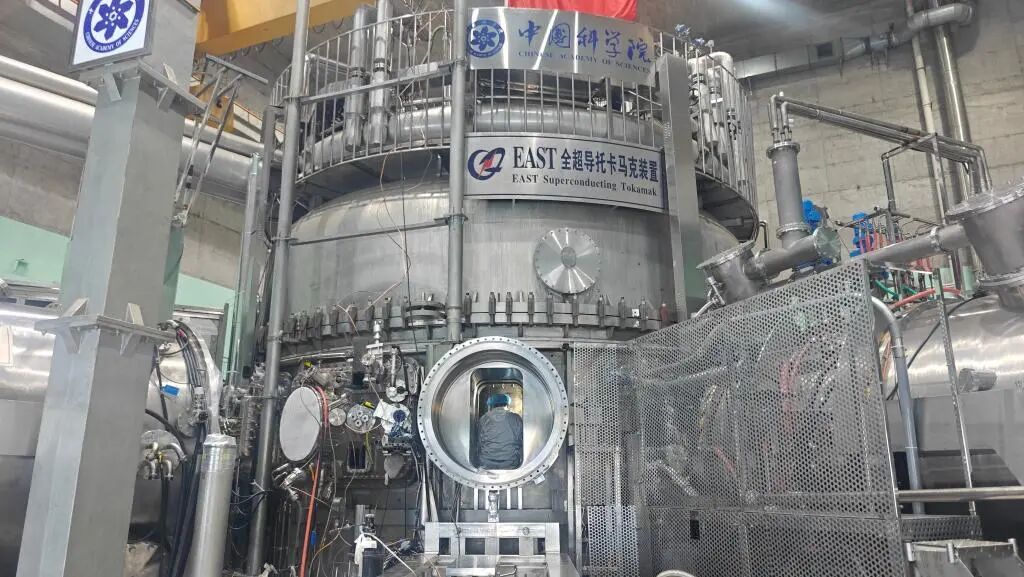
The upgrade and transformation site of the Hefei Scientific Island all-superconducting Tokamak nuclear fusion experimental device (EAST).
Six Core Tracks of Future Industries
The explosive power of future industries is accelerating in six core fields:
Quantum Technology
Three core tracks of quantum technology are advancing simultaneously, transitioning from frontier research to industrialization, with some fields reaching international leading levels. Quantum communication, represented by the “Mozi” satellite and the “Beijing-Shanghai trunk line,” is leading internationally in engineering and application, covering multiple fields and 16 key cities with quantum metropolitan networks; quantum computing has entered the international first tier, achieving quantum superiority in superconducting and photonic quantum systems, with notable achievements from “Zuchongzhi No. 3” and “Jiuzhang No. 3,” and commercial and cloud services are gradually expanding; key technologies in quantum precision measurement are approaching or reaching international advanced levels, with related equipment already deployed in medical, industrial, and other scenarios. The industrial end is supported by clusters such as Hefei’s “Quantum Avenue” and several leading enterprises.
Biomanufacturing
Centered on synthetic biology, the industry is transitioning from “carbon consumption” to “carbon recycling.” China accounts for over 70% of global biomanufacturing capacity, achieving breakthroughs in precision medicine in healthcare, microbial proteins in agriculture, and bio-based plastics in chemical engineering. Despite facing challenges with core strains and key enzymes, the integration of biotechnology and artificial intelligence is rapidly opening up its trillion-dollar market space.
Hydrogen Energy and Nuclear Fusion Energy
The controllable nuclear fusion technology, known as the “artificial sun,” has achieved a leap from following to keeping pace. The “China Fusion Engineering Test Reactor” has set a new domestic record for fusion device operation, and the world’s first fusion energy research and training collaboration center has been established in China. According to the plan, plasma combustion experiments will be conducted in 2027, with the potential to achieve commercial power generation by the middle of this century, providing humanity with ultimate clean energy solutions.
Brain-Computer Interfaces
Three major scenarios in medical, consumer electronics, and industrial safety are being implemented simultaneously. Tsinghua University’s NEO system and Fudan University’s spinal interface technology have shown significant clinical results, with products such as mind-typing AR glasses and emotion-monitoring headbands already on the market. With policy support, China is moving towards building an internationally competitive industrial ecosystem by 2030, with differentiated collaborative layouts forming in the Beijing-Tianjin-Hebei, Yangtze River Delta, and Pearl River Delta regions.
Embodied Intelligence
Embodied intelligence is a key future industry in the “15th Five-Year Plan,” transitioning from laboratory to pilot verification, with rapid technological breakthroughs and an initial industrial ecosystem forming, while facing many challenges. Core hardware is gradually being localized, with advancements in both large models and complete machine technology, and some achievements reaching international standards; the industry shows a trend of “head concentration and long tail distribution,” with enterprises in Beijing, Guangdong, and Shanghai accounting for nearly 50%. By 2025, related financing is expected to exceed 24 billion yuan, with strong performance in enterprise orders; application scenarios are continuously expanding, with mature implementations in special and industrial scenarios, while open scenarios such as home services are still in the technical accumulation stage.
Sixth-Generation Mobile Communication
The Zijinshan Laboratory has established the world’s first 6G intelligent sensing integrated outdoor experimental network, creating over ten “world firsts” in terahertz transmission, with commercial pilots for low-altitude inspections and intelligent logistics already launched. As the foundational base for future information industries, 6G will support integrated communication across air, land, sea, and space, giving rise to more disruptive applications.
“Rebuilding a High-Tech Industry in China”
Emerging industries are accelerating to “lead the way,” while future industries are strengthening their “roots”.. By 2024, the added value of China’s “three new” economies will account for over 18% of GDP.
The “Suggestions” propose accelerating the development of strategic emerging industry clusters such as new energy, new materials, aerospace, and low-altitude economy. It emphasizes the integrated promotion of innovation facility construction, technology research and development, and product iteration and upgrading; implementing large-scale application demonstration actions for new technologies, new products, and new scenarios… These series of deployments aim to accelerate the large-scale development of emerging industries.
Currently, China’s production and sales of new energy vehicles have maintained the global lead for ten consecutive years; the production of photovoltaic and wind power equipment ranks among the world’s top; and over 60 national advanced manufacturing clusters in emerging industries have been cultivated, with 23 national independent innovation demonstration zones established.
The “Suggestions” propose promoting quantum technology, biomanufacturing, hydrogen energy and nuclear fusion energy, brain-computer interfaces, embodied intelligence, and sixth-generation mobile communication to become new economic growth points.
Data shows that China’s biomanufacturing industry has reached nearly 1 trillion yuan; by 2025, the market size of embodied intelligence is expected to reach 5.295 billion yuan, accounting for about 27% of the global market.
“Innovation breeds new growth, which means cultivating and strengthening emerging industries and future industries. These industries are gaining momentum, and the new scale added in the next decade is equivalent to rebuilding a high-tech industry in China, injecting continuous new momentum into the national economy and high-quality development.” said Zheng Zhanjie, Director of the National Development and Reform Commission, at a previous press conference.
Multiple Efforts Support the Rise of Future Industries
The innovation ecosystem is the “fertile soil” for “rebuilding” high-tech industries and building a modern industrial system. It requires the collaborative innovation and integrated development of government, enterprises, and research institutions to solve issues related to core technologies, high-end talent, and market mechanisms, providing institutional guarantees and resource support for industrial development.
The government needs to play a “guiding + guaranteeing” role, constructing a “precise and clustered” policy system. In emerging pillar industries, in recent years, the “chain leader system” has promoted collaboration between leading enterprises and small and medium-sized enterprises to form a cluster ecosystem, enhancing the resilience of the industrial chain; in future industries, a special fund for “listing and leading” has been established to focus on tackling “bottleneck” issues. In 2024, China’s R&D expenditure is expected to exceed 3.6 trillion yuan, with a continuous increase in the proportion of basic research, providing financial support for original breakthroughs.
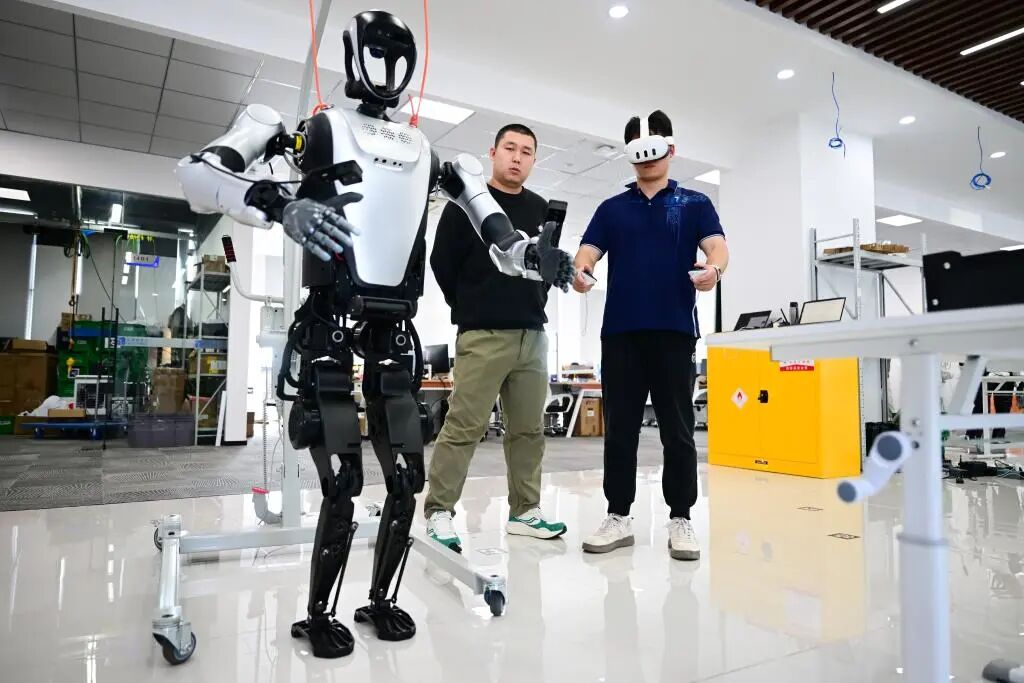
On October 24, researchers in Hefei
used VR devices for remote operation of robots to collect data for motion capture..
At the same time, the government is increasing investment in scientific and technological infrastructure, building national-level research platforms; strengthening intellectual property protection to create a fair competitive environment; and providing financial support to reduce innovation costs for enterprises, offering special support for fields such as quantum technology and biomanufacturing. These practical measures provide dual guarantees of policy and resources for the construction of a modern industrial system.
Enterprises need to take on the role of innovation主体, creating a dual-driven model of “industry-university-research collaboration + talent reserve”. On one hand, enterprises should collaborate with research institutions and universities to establish a collaborative innovation mechanism, promoting the rapid transformation of laboratory technologies into industrial results and shortening the technology landing cycle; on the other hand, enterprises should cooperate with universities for targeted training, steadily increasing the scale of high-tech industry practitioners, providing human support for continuous innovation.
Behind this, as the only country in the world with all industrial categories in the United Nations Industrial Classification (ISIC),China’s complete industrial system provides strong support for enterprise innovation. At the same time, enterprises focus on cultivating and attracting innovative talent, building high-quality teams through school-enterprise cooperation and internal training systems.
Research institutions and universities need to strengthen the “source of knowledge,” focusing on original breakthroughs from “0 to 1”. In recent years, key research institutions and universities have continued to focus on basic research in areas such as quantum entanglement and nuclear fusion, publishing numerous top papers in high-tech fields; in the field of artificial intelligence, China’s generative AI large model patents account for nearly 40% of the global total, with local leadership achieved in areas such as embodied intelligence and brain-like computing. At the same time, research institutions promote the transformation of results, and universities enhance the conversion rate of research achievements through technology transfer platforms, turning “laboratory results” into “new industrial momentum”. Additionally, research institutions and universities actively engage in international cooperation and exchanges, absorbing and learning from advanced international research achievements and experiences to enhance their own research levels.
In the next decade, relying on the “foundation support” of emerging pillar industries, the “incremental breakthroughs” of future industries, and the “momentum activation” of collaborative innovation ecosystems, China’s high-tech industry is expected to achieve a transformation from “following” to “leading”.
The charm of future industries lies not only in technological breakthroughs but also in the innovation of lifestyles and the reshaping of economic structures. From prototypes in laboratories to consumer products in the market, from breakthroughs in single technologies to collaboration across the entire industrial chain, from precise policy support to spontaneous market growth, the outline of the trillion-dollar market is becoming increasingly clear.
Here, there is the favorable policy environment, the accumulation of technology, the demand of the market, and a group of innovators daring to explore the “unmanned zones”.The next trillion-dollar market is not in the distant future, but in every technological breakthrough, every application scenario, and every fertile ground of industrial clusters today.
Source: China Development and ReformEditors: Lin Yancheng, Chen BinyaReviewed by: Zhou Xiaoting, Liang WeiguoIssued by: Cen Jinghong