
Abstract
National Natural Science Foundation Project Report
HER2 exon 20 insertion mutations (HER2 20ins) are the most common type of HER2 mutations in lung cancer, accounting for 62%-90%. However, the response rate of these patients to existing targeted drugs (such as TKIs) is only 10%-30%, and the mechanisms of resistance have long been unclear. The team led by Zhao Shen from Sun Yat-sen University, under the National Natural Science Foundation project (Approval No.: 82002408), focuses on the αC-β4 loop structure of HER2 kinase, systematically revealing its regulatory mechanism on the sensitivity to targeted therapy, providing a new theoretical basis and potential therapeutic strategies for the precise treatment of HER2 mutant lung cancer.
Research Background
Lung cancer is one of the most prevalent and deadly malignant tumors globally, and HER2 mutant lung cancer has become a clinical challenge due to the limited efficacy of targeted therapies. HER2 belongs to the epidermal growth factor receptor family, and its structure is highly homologous to that of EGFR, but HER2 mutant lung cancer shows significantly lower sensitivity to EGFR/pan-HER tyrosine kinase inhibitors (TKIs).
Previous studies have found significant heterogeneity among HER2 20ins mutants, with marked differences in their responses to targeted drugs. Zhao Shen’s team previously suggested that this difference may be related to the αC-β4 loop structure of HER2 kinase — a hotspot region for HER2 mutations, but the specific mechanism by which it affects sensitivity to targeted therapy remains unclear. Therefore, elucidating the relationship between the αC-β4 loop structure and resistance to targeted therapy has become key to breaking through the treatment bottleneck of HER2 mutant lung cancer.
Content Overview
1. The length of the αC-β4 loop is a key factor affecting sensitivity to targeted therapy
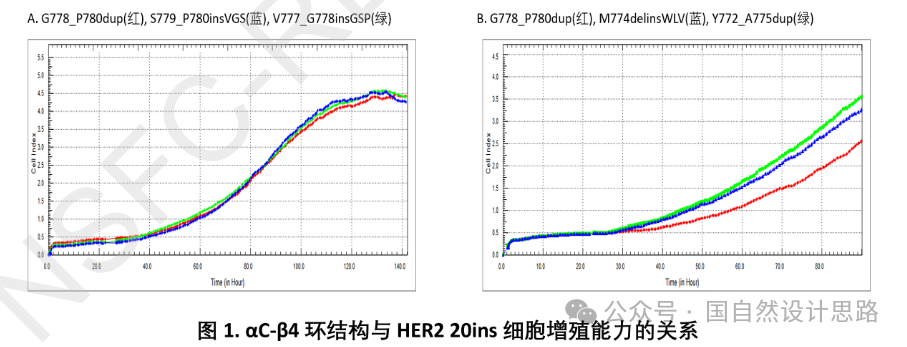
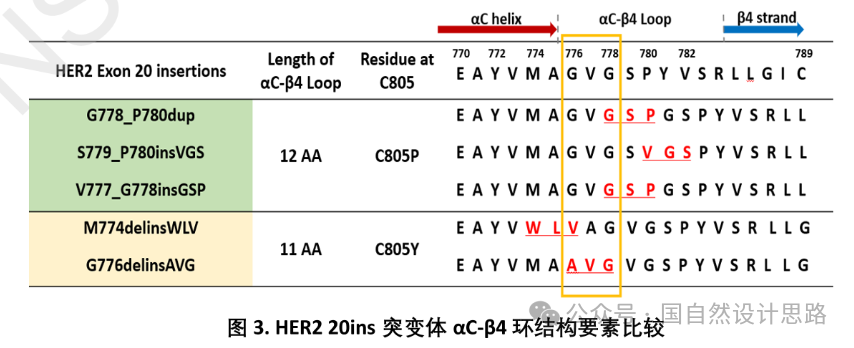
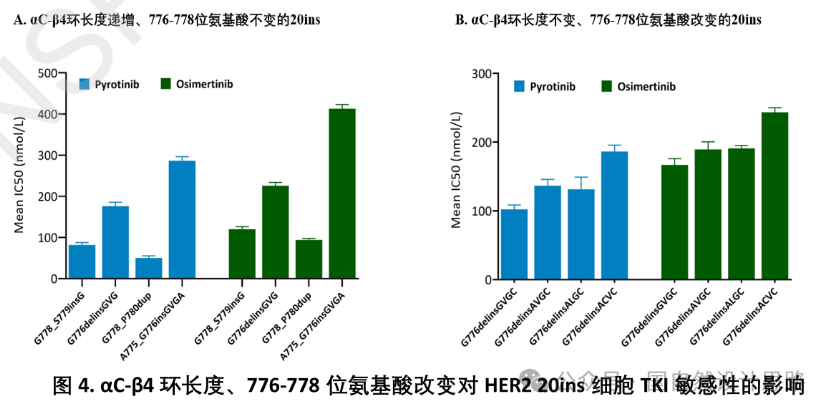
The research team constructed two types of mutants: one type maintains the amino acids at positions 776-778 (GVG) unchanged while only altering the length of the αC-β4 loop (10-13 amino acids); the other type keeps the loop length (12 amino acids) constant while only mutating the amino acids at positions 776-778. The results showed:
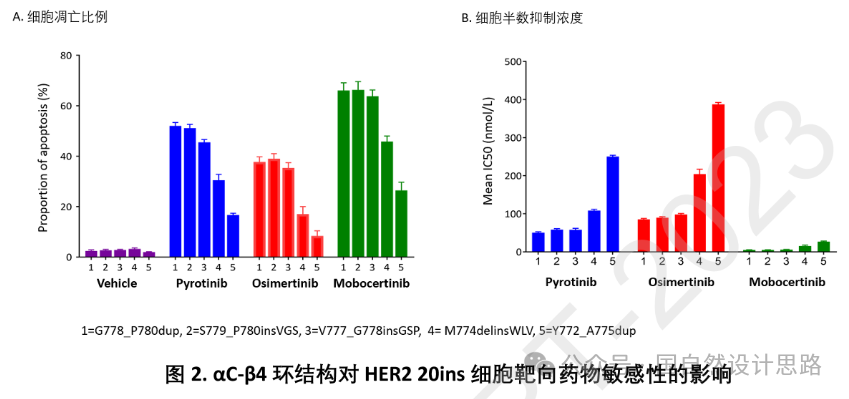
Mutants with the same loop length showed similar sensitivity to TKIs (such as pyrotinib and osimertinib);
Mutants with different loop lengths exhibited significant differences in sensitivity (for example, mutants with lengths of 10 and 12 showed higher sensitivity, while those with lengths of 11 and 13 showed lower sensitivity);
In contrast, mutations at positions 776-778 had a relatively minor impact on sensitivity.
This indicates that the length of the αC-β4 loop is a core factor determining the sensitivity of HER2 20ins lung cancer to targeted therapy.
2. Revealing the molecular mechanism by which the αC-β4 loop regulates sensitivity
Through molecular docking and phosphoprotein detection techniques, the team found that the length of the αC-β4 loop affects sensitivity through two pathways:
Inhibiting TKI binding: An increase in loop length (e.g., 11 or 13) leads to the substitution of cysteine (C805) at position 805 of the HER2 kinase by tyrosine (Y) or methionine (M), weakening the covalent binding ability of TKIs to the kinase and reducing the drug’s inhibitory effect;
Activating bypass pathways: An increase in loop length enhances the dimerization affinity of HER2 with HER3, activating the PI3K/AKT pathway independent of HER2 kinase activity, leading to drug resistance in tumor cells.
This mechanism provides the first structural explanation for the poor efficacy of targeted therapy in HER2 20ins lung cancer.
3. Clinical validation and exploration of new treatment strategies
In clinical case validations, the team found a significant correlation between the length of the αC-β4 loop and TKI efficacy. When further exploring combination treatment strategies, they found:
HER2 monoclonal antibodies (such as infigratinib) can significantly enhance the anti-tumor effects of TKIs, especially for mutants with a loop length of 13 (the least sensitive);
Clinical studies showed that the disease control rate reached 84.1% after treatment with HER2 monoclonal antibodies combined with pyrotinib in patients with HER2 mutant lung cancer, with a median progression-free survival of 5.5 months and good safety profile.
Conclusion
This study clarifies that the length of the HER2 kinase αC-β4 loop is a key structural element regulating the sensitivity of HER2 20ins lung cancer to targeted therapy, revealing its molecular mechanism of inducing resistance by affecting TKI binding and HER2-HER3 dimerization activating the PI3K pathway. Meanwhile, the proposed strategy of “HER2 monoclonal antibody combined with TKI” provides a new option for clinical treatment and is expected to promote the development of precise treatment for HER2 mutant lung cancer.
Display for Learning Purposes Only!
The images used in this article are from the National Natural Science Foundation project report. Due to objective reasons, we were unable to contact the rights holders. This platform cites them for academic exchange purposes and does not intend to infringe on the rights of the original authors. If the rights holders find it inappropriate, please contact the public account backend promptly, and we will delete or negotiate a solution immediately.
Medical National Natural Science, Provincial Natural Science, Doctoral Project Design, Medical Experiment Outsourcing, Medical SCI, Experimental Scheme Design,Free online one-on-one communication with doctoral supervisors, confirming strength before discussing cooperation, research cooperation can add WeChat: SCI971SCI

Expert one-on-one Q&A, 10-point article design, stem cell direction
Doctoral project online Q&A, gut microbiome + organoid direction
National Youth Q&A, how to choose inflammation bodies + mitochondria + pan-apoptosis
Traditional Chinese Medicine direction national youth design, how to break through in national natural science
Research Information Collection
High-Score Literature Analysis
Research Sharing in the Field of Tumors
Master’s and Doctoral Thesis Analysis
Research Sharing in the Field of NeuroscienceResearch Sharing in the Field of OrthopedicsMedical Recruitment Information
Medical Project Application Information
Research Sharing in the Field of Cardiovascular
Frontier Progress in Traditional Chinese Medicine