 Table of Contents for the 5th Issue of 2025
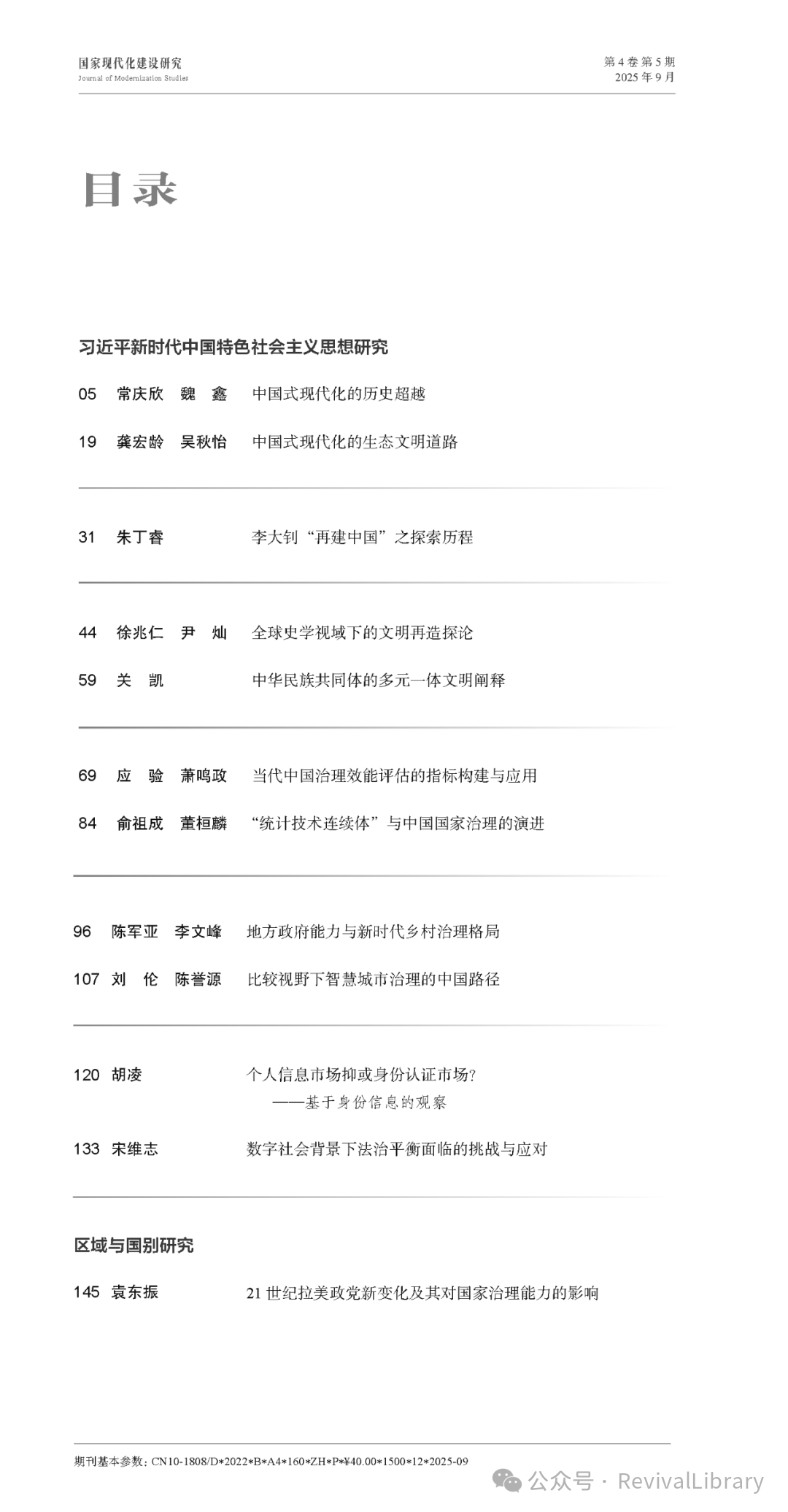 Abstracts for the 5th Issue of 2025The Historical Transcendence of Chinese-style Modernization
Abstract:Western-style modernization is essentially capital-centered modernization, which, while promoting capital accumulation and expansion, exhibits incompatibility with the social productive forces it produces. Chinese-style modernization adheres to a people-centered approach, emphasizing the coordination of material and spiritual aspects, the symbiosis of humans and nature, and the unity of human destiny, based on the realities and cultural heritage of the country. It has constructed a new form of modernization from the perspectives of social forms, development paths, and human civilization, transcending the determinism of Western-style modernization, the universality of development paths, and the uniqueness of development forms. This showcases the Chinese wisdom and solutions for the question of “where to go” in modernization development, providing theoretical guidance and action guidelines for the comprehensive advancement of national strength and the great rejuvenation of the nation.
Keywords:Chinese-style modernization; new form of human civilization; socialism with Chinese characteristics
Authors:Chang Qingxin, Research Fellow at the National Research Center for Political Economy of Socialism with Chinese Characteristics, Renmin University of China; Wei Xin, PhD student at the School of Marxism, Renmin University of China.
 Ecological Civilization Path of Chinese-style Modernization
Abstract:Chinese-style modernization is a comprehensive implementation of the “five-in-one” overall layout. Since the new era, China has achieved remarkable historical achievements in ecological civilization construction, forming an ecological civilization path centered on harmonious coexistence between humans and nature, coordinating the relationship between production, life, and ecology, and aiming to meet the people’s growing demand for a beautiful ecological environment. From the perspective of further development, China’s ecological civilization construction also faces many contradictions and challenges, and the foundation for a stable ecological environment is not yet solid. Therefore, it is necessary to uphold the Party’s comprehensive leadership over ecological civilization construction, improve the institutional mechanisms for ecological civilization construction, enhance the ecological environment governance system, promote nationwide green and low-carbon conscious actions, and advance global sustainable development.
Keywords:Chinese-style modernization; ecological civilization construction; “five-in-one”; green low-carbon; sustainable development
Authors:Gong Hongling, Associate Professor at the School of Public Administration, Chongqing University; Wu Qiuyi (corresponding author), Assistant Researcher at the School of Marxism, Nanjing University.
 The Exploration Journey of Li Dazhao’s “Rebuilding China”
Abstract:As one of the main founders of the Communist Party of China, Li Dazhao was a vibrant and creative thinker who spent his life exploring the modernization path of “rebuilding China.” Starting from his involvement in editing the monthly magazine “Yanzhi” in 1913, he widely participated in discussions on political issues, advocating for political ideas such as freedom, equality, and popular sovereignty, and promoting democracy, hoping for the healthy development of a democratic republic in China. After the victory of the October Revolution in Russia, influenced by both democracy and Marxism, Li Dazhao saw a new future for China’s political development—civilian politics with broader political participation. After the May Fourth Movement, Li Dazhao enriched and updated his political thought system with Marxism, finding a new modernization path led by the Communist Party of China. From admiring Western democratic politics to skepticism, from understanding and absorbing Marxism to practicing proletarian democratic politics, Li Dazhao developed his thoughts on the modernization of politics through continuous learning, research, and practical observation, experiencing a transformation from democracy to Marxism, leaving valuable ideological and spiritual wealth for the sinicization of Marxism and the Communist Party of China.
Keywords:Li Dazhao; “Rebuilding China”; democracy; Marxism
Author:Zhu Dingrui, Assistant Researcher at the Institute of Modern History, Chinese Academy of Social Sciences.
 Exploration of Civilization Reconstruction from a Global Historical Perspective
Abstract:“Civilization” is the overall structure and comprehensive entity formed by the long-term evolution of human society, representing the freedom and vitality of life creation, the enlightenment and rationality of cognitive thinking, the wisdom and achievements of cultural development, and the progress of lifestyles and science. The originality and uniqueness of Chinese civilization are marked by aspects such as “Qi theory,” “wisdom strategy,” “unity of heaven and humanity,” and “great unity”; while the originality and uniqueness of Western civilization are concentrated in aspects such as “atomism,” Christian faith, “Greek spirit,” modern scientific and technological inventions, contracts, and legal forms. The reconstruction of Chinese civilization fundamentally relies on the creative transformation and innovative development of excellent traditional Chinese culture in contemporary times, a profound understanding of the patterns of civilization rise and fall in world history, grasping the laws of civilization development, and scientifically planning at the national strategic level to catch up with the forefront of world civilization, drawing on the essence of world civilization, integrating innovation, and breaking through the barriers of civilization development.
Keywords:civilization; civilization markers; civilization reconstruction; national strategy; global history
Authors:Xu Zhaoren, Professor at the School of History, Renmin University of China; Yin Can, PhD student at the School of History, Renmin University of China.
 Interpretation of the Multicultural and Unified Civilization of the Chinese Nation
Abstract:Starting from the analysis of the concepts of culture and civilization, and combining the prominent characteristics and cohesion mechanisms of Chinese civilization, systematically explaining the civilizational foundation and development context of the Chinese national community is an important research approach. Chinese civilization has shaped the historical logic of the Chinese nation from diversity to unity through a “snowball”-like cultural integration and political consolidation. Fei Xiaotong’s theory of the “multicultural and unified pattern of the Chinese nation” and Zhao Tingyang’s “vortex theory” reveal the endogenous driving force of the historical generation of the Chinese national community. Entering the new era, strengthening the awareness of the Chinese national community is deeply nourished by civilization and has sufficient practical basis, and has enlightening significance for the future development of human civilization.
Keywords:civilization; Chinese civilization; Chinese national community; multicultural unity
Author:Guan Kai, Professor at the School of Ethnology and Sociology, Minzu University of China.
 Evaluation of Governance Effectiveness in Contemporary China: Indicator Construction and Application
Abstract:National governance is a holistic governance composed of an active government, an effective market, and an organic society. Based on policy documents, academic research, and expert advice, this paper collects, organizes, and screens continuous statistical data from contemporary China, using 1,468 valid samples for factor analysis to quantify and construct a three-dimensional national governance effectiveness evaluation indicator system, including government governance effectiveness, market governance effectiveness, and social governance effectiveness. The author measures the national governance effectiveness of contemporary China using a weighted index, showing that national governance presents characteristics and trends of development from low-level to high-quality, from extensive to modernization, and from a single subject-driven to multi-subject collaboration.
Keywords:national governance; governance effectiveness; indicator system; institutional advantages; modernization
Authors:Ying Yan, Lecturer at the School of Marxism, University of Science and Technology of China; Xiao Mingzheng (corresponding author), Researcher at the National Governance Research Institute, Peking University, and Professor at the School of Government Management, Peking University.
 The “Statistical Technology Continuum” and the Evolution of National Governance in China
Abstract:There exists a complex interaction between statistical technology and national governance. By constructing a theoretical framework of the “statistical technology continuum,” analyzing the evolution of the agricultural era’s yellow register system, the functional role of the industrial era’s unit system archives, and the application of digital identity systems in the intelligent era, it can be found that identity coding, spatial locking, and relational binding constitute the core elements of statistical technology. As an important means of national governance, statistical technology possesses stability and adaptive transformation capabilities that transcend institutional fractures; “technical devices” continuously play a role across different historical periods through “translational power,” achieving cross-era political power reproduction; this technological resilience enhances governance effectiveness while also triggering governance paradoxes such as algorithmic authoritarianism and data alienation. From a long-term perspective, the interactive evolution of China’s technological tradition and governance system breaks through the binary narrative of “traditional empire-modern state,” providing a new perspective for understanding the transformation of national governance.
Keywords:“statistical technology continuum”; national governance; technological governance
Authors:Yu Zucheng, Professor at the School of International Relations and Public Affairs, Shanghai International Studies University, and Director of the (Global) Urban Grassroots Governance Research Center; Dong Huanlin, Assistant Researcher at the (Global) Urban Grassroots Governance Research Center, Shanghai International Studies University.
 Local Government Capacity and the Governance Pattern of Rural Areas in the New Era
Abstract:Modernization of rural governance is one of the core issues of grassroots governance modernization. Under the governance philosophy and goal of “co-construction, co-governance, and sharing,” rural governance in different regions presents significant morphological differences. Research shows that local government capacity is a key factor shaping rural governance forms. The government’s institutional integration ability, resource mobilization ability, and service realization ability dynamically embed into the rural governance field, directly affecting the level of multi-subject collaboration, the degree of localized policy transformation, and the accessibility of public service provision, shaping different rural governance forms such as “government collaborative type,” “government-guided type,” and “government-led type.” To achieve balanced development of rural governance models and construct a governance pattern of government and society co-governance, it is urgent to shift from institutional supply to government capacity building, addressing the unbalanced construction challenges of the “co-construction, co-governance, and sharing” governance system through systematic enhancement of government capacity.
Keywords:local government capacity; rural governance forms; balanced development
Authors:Chen Junya, Professor at the Institute of Political Science and National Governance, Central China Normal University; Li Wenfeng, Research Assistant at the Institute of Political Science and National Governance, Central China Normal University.
 China’s Path to Smart City Governance from a Comparative Perspective
Abstract:In the past decade, China has actively explored smart city governance, forming a governance practice and model distinct from that of the UK and the US. In practice, typical content of China’s smart city governance includes building a digital foundation, creating an urban brain, and conducting rapid public opinion processing, while smart city content in the UK and US mainly reflects government data openness, providing smart living services, and promoting citizen co-creation. In this regard, the characteristics of China’s smart city governance path are concentrated in global optimization in application routes, government coordination in promoting subjects, comprehensive transformation in mechanism matching, and synchronous improvement in regulatory construction. The global significance of China’s smart city governance path mainly lies in: in agenda setting, it can provide transformation topics more aligned with the concerns of developing countries; in path demonstration, it can offer a smart route that benefits the broadest population; in solution adjustment, it can provide a complete transformation plan based on large-scale application iteration.
Keywords:smart city; urban governance; independent knowledge system; international comparison
Authors:Liu Lun, Tenured Associate Professor and Researcher at the Institute of Public Governance, Peking University; Chen Yuyuan, Postdoctoral Fellow at the School of Government Management, Peking University.

Personal Information Market or Identity Authentication Market?
——Observations Based on Identity Information
Abstract:In modern production and social spaces, space managers or organizers manage the use and allocation of specific limited resources by creating, collecting, and using identity information in a unified, top-down manner. This type of information is only used for authentication activities within a certain scope, lacking a related transaction market, and serves as social infrastructure and public goods. However, the continuous changes and updates in authentication technology have created a sustained demand and competitive drive for changes in the forms of personal identity information (from mobile phone numbers to QR codes), resulting in a personal identity information market that is essentially a competition between different authentication technologies, rather than a personal information market, and this market is organized by social production rather than operated by individuals. Traditionally, the establishment of identity authentication mechanisms was aimed at allocating and using limited resources of unit organizations. With the reduction of information costs and the emergence of new business models, the function of identity authentication has gradually transformed into managing the uncertainties and risks brought by mobility. Currently, there are two existing identity information markets: the basic identity identifier market and the black market, both closely related to the aforementioned functions. In the future, the use of identity information will gradually shift from external documents and identifiers to machine backend recognition, thus, it is necessary to promote continuous changes in authentication technologies developed around specific types of identifiers.
Keywords:identity information; sensitive personal information; authentication; market; infrastructure
Authors:Hu Ling, Associate Professor at the Law School and Artificial Intelligence Research Institute, Peking University.
 Challenges and Responses to Legal Balance in the Context of Digital Society
Abstract:The arrival of the digital society has profoundly changed the appearance of society. By processing human and social affairs in a digital form and constructing social relationships in a computational manner, the digital society presents an unprecedented fast pace and high efficiency. At the same time, digital monopolies have emerged, posing challenges to social development, especially to the construction of the rule of law. In the binary framework of “power-rights,” digital technology promotes a more refined operation of power, which exhibits a strong posture. Although rights also share the dividends of digital technology, their development lags behind that of power, placing them in a substantively shrinking weak position. The imbalance between power and rights further exacerbates the challenges facing the legal balance. Therefore, the construction of the rule of law in the context of the digital society urgently needs transformation: in legal practice, it is necessary to strictly limit power to ensure the realization of rights; in legal research, the focus needs to shift from exploring emerging rights to constructing mechanisms for power constraints.
Keywords:digital society; legal balance; rule of law construction; power constraints; rights protection
Authors:Song Weizhi, Postdoctoral Researcher at the Kaiyuan Law School, Shanghai Jiao Tong University, and Lecturer at the Law School, Nanchang University.

New Changes in Latin American Political Parties in the 21st Century and Their Impact on National Governance Capacity
Abstract:Since the beginning of the 21st century, political parties in Latin American countries have undergone new changes while maintaining continuity, presenting new characteristics and trends in party politics. These changes are reflected to varying degrees in party systems, party structures, party functions, party stability, and party ideologies. The new changes in Latin American political parties have profound political, economic, and social roots, forming a dual impact on national governance capacity: some changes are conducive to promoting decision-making transparency and openness in Latin American countries, helping to advance national governance in a positive direction; while other changes have increased the difficulty of national governance to varying degrees, causing certain damage and negative impacts on national governance capacity.
Keywords:party development; party politics; Latin American countries; national governance capacity
Author:Yuan Dongzhen, Senior Professor at Guangdong University of Foreign Studies, Yunsan Scholar.