 Optical modules, as the ‘micro core’ of optical communication systems, directly determine network bandwidth, transmission distance, and energy efficiency. From the ‘computing artery’ of data centers to the ‘information trunk’ of telecom networks, and into the ‘intelligent nervous system’ of industrial and automotive fields, optical modules have deeply integrated into every layer of the digital society. Driven by the massive data demands of the AI and 6G era, optical module technology is evolving at an unprecedented speed, continuously expanding the boundaries of optical interconnect..
Author: Wu Gong
Source: ChipBaiwei Electronics
01
Key Challenges in Optical Module DesignCurrently, the design and application of optical modules still face several key technical challenges:
- DAC Precision: The DAC must accurately convert MCU digital commands to drive EML/DFB lasers for precise dimming;
- Poor Generality of Driver Circuits: EML/DFB Drivers need to precisely match the threshold current, modulation efficiency, and other characteristics of the laser. Different wavelength/power devices have stringent requirements for linearity and response speed, lacking widely applicable driving solutions.
- Challenges in Analog Link Noise Suppression: Limited Amplifiers must maintain stable gain in complex noise environments and integrate with DAC and Driver. Electromagnetic interference and power supply noise can easily degrade the signal.
- Insufficient Temperature Control Response Rate: TEC must quickly compensate for the temperature effects on laser wavelength/power. Under extreme temperature variations (e.g., -40℃ to 85℃), delays in temperature control algorithms and hardware can lead to fluctuations in optical signals, affecting long-distance transmission stability.
02
ChipBaiwei: Driving the Future of Optical Connectivity with Superior Performance
To address the core challenges of optical modules in precision, driving, noise, and temperature control, ChipBaiwei has launched an integrated chip solution covering digital-to-analog conversion, driving control, signal conditioning, and temperature management, providing critical support for customers to build high-speed, stable, and reliable optical communication systems:
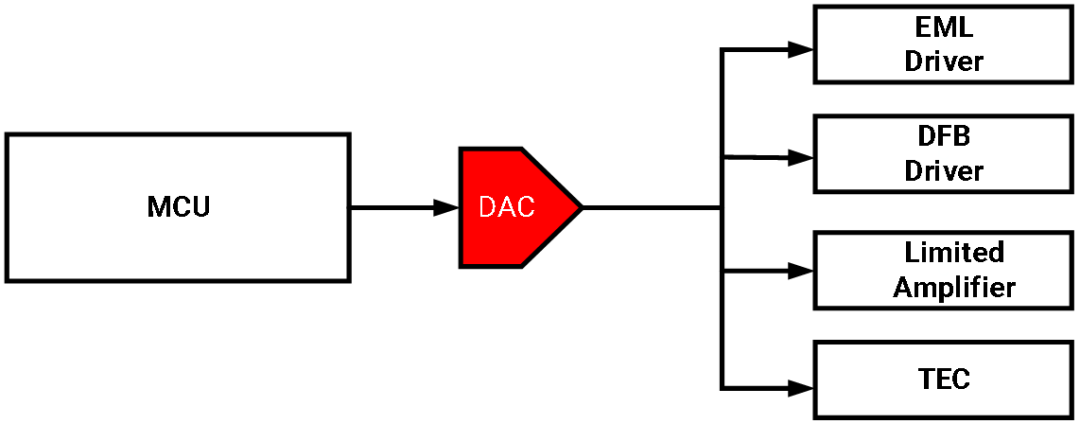
Optical Module Application Block Diagram
Core Product RecommendationsHigh-Precision Digital-to-Analog Converter (DAC)Recommended Models: CBM53D24, CBM128S085ChipBaiwei DAC chips possess high-precision digital-to-analog conversion capabilities, accurately converting MCU digital commands into analog signals, providing stable driving voltage/current for EML Driver and DFB Driver, and precisely controlling the laser’s output power and wavelength. The high bandwidth characteristics meet the signal requirements of high-speed optical modules, ensuring distortion-free signal conversion and aiding optical modules in achieving high-efficiency, stable optical signal transmission.CBM53D24 digital-to-analog conversion chipCBM1117, as an efficient LDO chip, can stably output 0.8A current and supports a wide voltage input range of 2.6V to 15V, providing clean and stable power supply for key components such as fingerprint recognition and communication modules. Its thermal overload and current limiting protection functions can prevent abnormal currents from damaging devices, ensuring safe and reliable power supply for locks.
- High-Precision Conversion:12-bit resolution, INL ±2LSB, DNL ±0.2LSB, capable of providing precise analog output. The output voltage range is from 0V to VREF, integrating a rail-to-rail buffer amplifier, with a DC output impedance of only 0.5Ω, capable of stably driving 2kΩ loads and 500pF capacitive loads, with a short-circuit current of up to 25mA@5V.
- Wide Temperature Operating Capability:Operating temperature range of -40℃ to 105℃, with a gain error of ±0.75% FSR at 85℃, exhibiting good temperature stability, suitable for various harsh industrial environments.
- Ultra-Low Power Design:Standard mode current is 500μA at 3V and 600μA at 5V; in sleep mode, current drops to 80nA@3V and 200nA@5V, making it very suitable for battery-powered or power-sensitive applications.
- Flexible Interface and Synchronous Control:Utilizes a 3-wire SPI compatible interface, with a maximum clock frequency of 30MHz, supporting binary two’s complement / offset binary output. Through dual-buffer logic, register updates can be controlled via the LDAC bit, achieving synchronous refresh of four outputs and avoiding timing discrepancies.
- Wide Power Supply Voltage Range:Power supply voltage range of 2.5V to 5.5V, with a power supply common-mode rejection ratio of -60dB, effectively suppressing the impact of ±10% power supply fluctuations on output accuracy, suitable for complex power supply environments in industrial scenarios.
- Optimized Reference Voltage Input:Reference input voltage range of 0.25V to VDD, with a typical impedance of 45kΩ. To maintain optimal reference stability in wide temperature environments, it is recommended to pair with an external buffer.
CBM128S085 Digital-to-Analog ConversionChip
- High-Precision Conversion:High resolution: 12-bit resolution, capable of providing high analog output precision, suitable for applications requiring high precision, such as industrial control and data acquisition.
-
Multi-Channel Output:A single chip integrates an 8-channel voltage output digital-to-analog converter with output buffering, meeting the demand for multiple analog signals in various application scenarios.
-
Wide Voltage Range:Normal operating power supply voltage range of 2.7V to 5.5V, adaptable to various power conditions, reducing power supply requirements and enhancing chip applicability. Its I/O voltage is 1.8V to 5.5V, and core voltage is 1.8V to 3.6V.
-
Low Power Consumption:In the absence of load, the overall current consumption is only 540μA@3V and 600μA@5V. When all digital-to-analog converters enter sleep mode, the chip operates at μW level power consumption, making it very suitable for portable devices or power-sensitive scenarios.
-
High-Speed Interface:Utilizes a three-wire serial interface, with a maximum clock speed of 40MHz, allowing for flexible configuration, compatible with common SPI, QSPI, MICROWIRE, and DSP interface standards, supporting daisy chain operation mode, enabling simultaneous control of multiple chips with a single interface, ensuring multiple chips update their status at the same time.
-
High-Precision Characteristics:Integral non-linearity (INL) of ±2LSB, differential non-linearity (DNL) ensuring monotonicity of ±0.2LSB, zero code error temperature drift of -20μV/℃, gain error temperature drift of -1.0ppm/℃, capable of providing very precise analog output, meeting high-precision application requirements.
-
Flexible Reference Voltage Configuration:Two external reference voltage inputs, one for channels A to D and the other for channels E to H. Each reference voltage can be configured separately, supporting a wide input range of 0.5V to VDD, ensuring the chip can output a wide range of dynamic signals to meet diverse application needs.
03
Implementation Scenarios and Actual Performance Demonstration
With high-precision DAC and other chip technologies, ChipBaiwei empowers optical modules to adapt to diverse scenarios, showcasing the value of precise signal control: Industrial Intelligent ControlScenario:Industrial automation production lines (such as automotive manufacturing, electronic processing), intelligent factory interconnections, facing complex environments of high temperature, vibration, and electromagnetic interference.Value of the Solution:ChipBaiwei DAC and driver circuits work together to ensure the industrial-grade SFP optical module maintains stable optical signals within a wide temperature range of -40℃ to 85℃, providing reliable optical links for PLC control, machine vision, etc., supporting intelligent production line operations and high reliability. Measures such as timely alarms for abnormal unlocking attempts ensure the security of store assets.Automotive Optical CommunicationScenario:Intelligent vehicle ADAS systems, in-vehicle Ethernet (such as in-car camera – domain controller connections), requiring miniaturized, interference-resistant optical modules.Value of the Solution:By achieving precise temperature control and stable driving of lasers through high-precision DAC, automotive optical modules can still achieve high-speed, low-latency data transmission under harsh conditions such as vibration and high temperatures, aiding the safe and stable operation of autonomous driving systems. Selected Previous Content RecommendationsChip Dialogue | How CBM16AD125Q ADC Doubles My Performance?Solutions | The Secret Weapon of High-Performance Oscilloscopes! High-Speed ADC, USB Controllers, and RS232 ChipsChip Dialogue | The Breakthrough Journey of CBM24AD98Q 24-Bit Precision Medical Chip
Click the video below
Follow for more data content
👇 Click “Read the Original” to visit ChipBaiwei’s official website for more product information