Source: cnBeta
Did you know? 34 years ago, one of the most significant software projects in history was born from an unassuming post in a Usenet newsgroup.
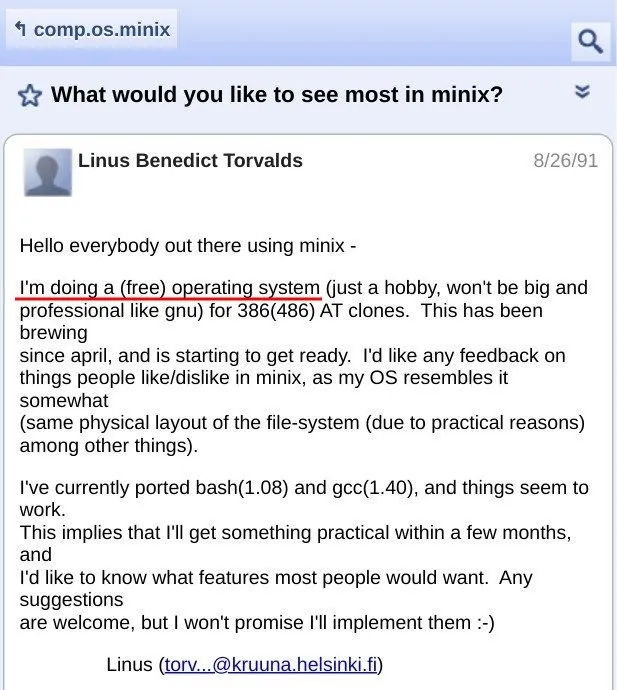
This project is the Linux kernel. At the time, 21-year-old Linus Torvalds stated that it was just a hobby and would not grow into a professional project, which he clearly was mistaken about.
Linus Torvalds initially developed the Linux kernel as a personal hobby, never intending to turn it into a professional version. The initial project started in April 1991, and by July 1991, he began working on user-level aspects such as device drivers and runnable disks. Other early milestones included porting bash and gcc, and in September 1991, he released the first source code of version 0.01 to a small group of users.
Interestingly, the earliest version of Linux, 0.01, was merely source code and was not actually runnable. Linus Torvalds stated that releasing this version was just a symbolic gesture to those who were interested at the time. Another interesting detail is that early versions of Linux were not portable and relied on i386 features and the GCC compiler—note that support for i386 was dropped in the 3.8 version of the kernel released in 2012.
The Linux kernel finally released version 0.02 in October 1991, officially entering use. As the first usable version, this was a significant advancement. Nevertheless, it was still a “hacker kernel” with numerous bugs and lacked features such as floppy disk drivers. However, it was able to successfully run important binaries like bash, gcc, and GNU utilities.
The 0.11 version released in December 1991 further improved the system, including on-demand loading, code/data sharing, better drivers, and support for various keyboards and graphics cards. Version 0.11 was also a significant milestone as it included programs like mkfs, fsck, and fdisk for the first time, eliminating the need for users to set up using Minix.
Around this time, the Linux kernel evolved from independent development to collaborative development, incorporating new features written by others, such as POSIX job control developed by tytso. As more people began to learn about Linux, the first mailing list, “Linux-activists,” was created, along with mirror sites for FTP access.
The community helped address a critical issue: the need to run the system with less memory, prompting Linus Torvalds to implement disk paging. The copyright regime initially used by the kernel was also interesting. It was both lenient and restrictive, as it did not allow monetary transactions, a regime that was later modified.
With the release of version 0.12 in January 1992, the kernel became very stable and began to spread more rapidly. This version included significant fixes, VM (disk paging), and job control to meet critical user needs. At this point, Linux was performing better than Minix in many aspects, generating significant interest. Subsequently, the version number jumped from 0.12 to 0.95.
Since the release of these early versions, Linux has come a long way, with the third release candidate of Linux 6.17 just released yesterday. Although Linux has not gained much traction on personal computing devices, with market share hovering around 5%, it has achieved tremendous success in other areas. It is widely used on servers, supports most cloud infrastructure, runs on the majority of supercomputers globally, exists in many embedded devices, and is the core of Android.
Happy 34th Birthday to Linux!