Click the blue text above to follow us

Preface:
The essence of an AI Agent is the ability to call tools from large models, and the recently popular Manus is actually an application of this.
For example, if you want to create a travel plan, you tell the large model your schedule, such as: preparing to take a train to Xi’an on July 26, planning to stay for a week, wanting to visit famous attractions and eat local delicacies. The large model will then converse with you to create a complete travel plan. However, just having the plan is not enough because you still need to book tickets, find hotels, and check maps yourself.
If the large model could automatically book train tickets through 12306, plan the itinerary using Gaode, check the weather, and book hotels through a hotel assistant, what would we need to do? We would just need to make choices and click “confirm”. This efficiency would increase exponentially compared to before!
Once, this operation was merely an ideal; now, with MCP, it has become a reality!
The world has undergone tremendous changes, and I hope we are not left behind by the times! Time will not betray those who study diligently! In this article, I will clearly explain its concepts and classifications.

In 2016, AlphaGo defeated Lee Sedol, shocking the world.
In 2017, the new version of AlphaGo, AlphaGo Master, defeated Ke Jie, once again astonishing the world.
However, this was not the end. In the same year after defeating Ke Jie, AlphaGo’s new version, AlphaGo Zero, defeated the previous AlphaGo Master with a score of 89:11.
This version of AlphaGo truly instilled fear. Because previous versions, no matter how powerful, learned Go by studying human-provided game records. Ultimately, they still stood on the shoulders of humans and could not exceed human capabilities by much.
In contrast, AlphaGo Zero had never studied any game records; it only received feedback on wins or losses, and through self-play, it discovered moves that humans had never thought of, reaching unprecedented heights. This made top players realize: humans actually did not understand what Go was!
This was almost a decade ago, and after so many years of development, large models have fully arrived. If we do not learn, we will gradually fall behind and be left behind by the great era, without even a greeting, the most obvious sign being that we do not know the meanings of terms related to large models. To address this issue, I wrote this article to clarify eight keywords and principles related to large models: LLM, Transformer, GPT, Bert, pre-training, fine-tuning, deep learning, and Token.
What is an AI Agent?
In recent years, with the explosive development of large language models like ChatGPT, a new concept has emerged in the field of artificial intelligence—AI Agent (智能体). For many, this concept may still be unfamiliar: What exactly is an AI Agent? How does it differ from large language models? What is its working principle? What practical problems can it solve for us? This article will provide a comprehensive analysis of the concept, principles, and applications of AI Agents, helping you quickly understand this cutting-edge technology.
1. What is an AI Agent?
An AI Agent is an intelligent system that canperceive the environment, make decisions, and take actions to achieve specific goals. Compared to traditional large language models (LLMs), AI Agents not only have the ability to understand and generate text but also actively plan, implement actions, and interact with the environment.
Five Key Features of AI Agents
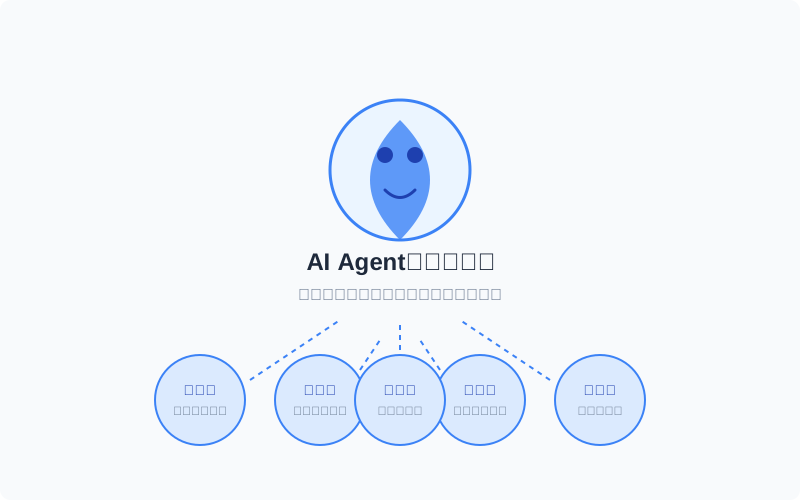
- Autonomy: The ability to perform tasks independently without continuous human intervention.
- Reactivity: The ability to perceive changes in the environment and respond accordingly.
- Proactivity: The ability to set goals and take actions to achieve them.
- Social ability: The ability to interact and collaborate with other agents or humans.
- Adaptivity: The ability to learn from experience and continuously improve performance.
In simple terms, if traditional AI systems are likened to “smart books” that can answer questions, then AI Agents are more like “intelligent assistants” that can think and act, not only understanding your needs but also proactively providing solutions and putting them into practice.
2. The Relationship Between AI Agents and Large Language Models
To understand the relationship between AI Agents and large language models (LLMs), we can use a vivid analogy:
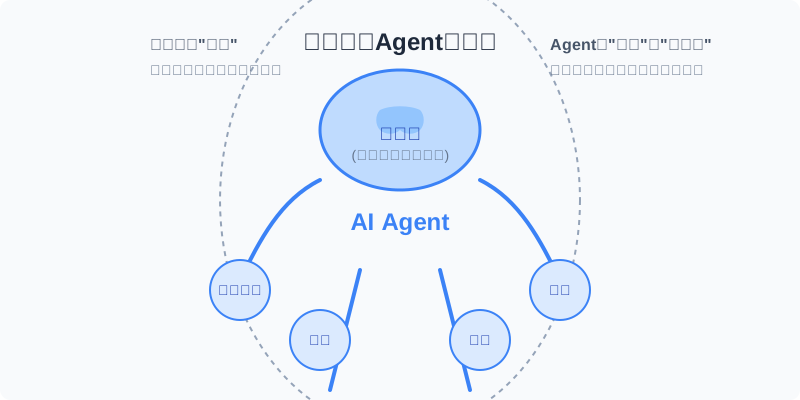
Large language models (such as GPT-4, Claude, etc.) are the “brains” of AI Agents, providing thinking, reasoning, and decision-making capabilities. AI Agents, on the other hand, are the “hands” and “toolkits” of large models, enabling them to perceive the environment and execute actions.
Why do we still need AI Agents with large models? The main reasons are:
- Large models excel atunderstanding and generating, but lackexecution capabilities.
- Large models are limited by training data, while Agents can obtainthe latest information through tools.
- Large models struggle to completecomplex multi-step tasks, while Agents can plan and execute them.
- Large models are general-purpose, while Agents can becustomized for specific scenarios.
Mathematical Formula of AI Agents
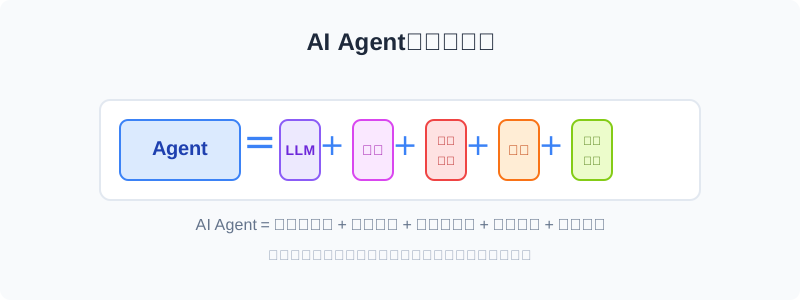
Agent = LLM + Memory + Perception & Reflection + Planning + Tool Usage
3. Core Components of AI Agents
A complete AI Agent framework typically includes the following four core components:
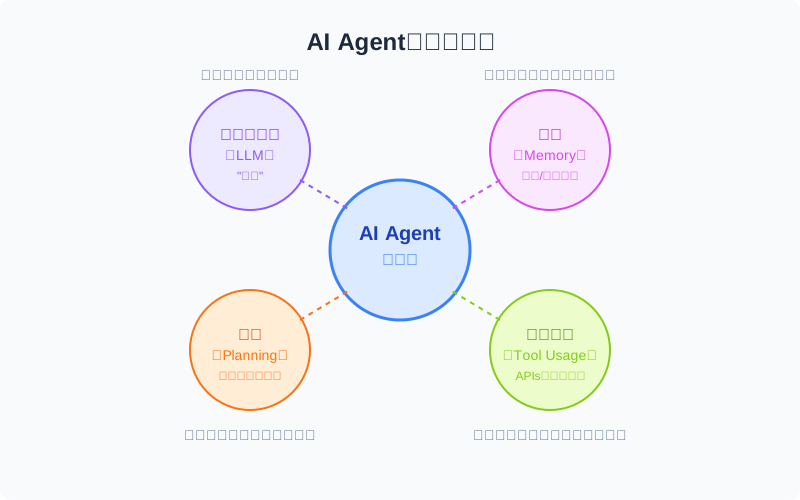
Large Language Model (LLM)
As the “brain” of the Agent, it provides understanding, reasoning, and decision-making capabilities. It generates corresponding responses and action plans based on input information and context.
Memory
Divided into short-term and long-term memory. Short-term memory stores the current dialogue context, while long-term memory (usually using vector databases) stores historical interactions and knowledge, allowing the Agent to learn from past experiences.
Planning
Responsible for task decomposition and goal planning, breaking complex tasks into executable subtasks. Common techniques include Chain of Thought (CoT) and Tree of Thought (ToT).
Tool Usage
By calling various external APIs and services (such as search engines, databases, programming environments, etc.), it expands the Agent’s capabilities, enabling it to obtain the latest information and perform complex operations.
4. Workflow of AI Agents
The workflow of an AI Agent is a closed-loop execution process, mainly consisting of the following stages:

- Perception
Receiving information from the environment through sensors, interfaces, or APIs, including text, images, audio, and other multimodal data.
- Planning/Reasoning
Using the large language model to analyze the collected information, understand the problem, and devise a solution. At this stage, the Agent will break down complex tasks into smaller subtasks and plan the execution order.
- Decision-making
Based on analysis and planning, the Agent evaluates the feasibility and effectiveness of different action plans and selects the optimal one.
- Action
Executing the decision, which may include calling external APIs, using tools, generating content, or interacting with users.
- Learning and Reflection
Based on the results and feedback from actions, evaluating execution effectiveness, updating memory, and self-optimizing to provide a better foundation for the next cycle.
This workflow allows AI Agents to continuously iterate and optimize, gradually improving the efficiency and quality of task completion.
5. Classification of AI Agents
Based on intelligence level and functional complexity, AI Agents can be classified into the following categories:

Simple Reflex Agents
The most basic type of AI Agent, which reacts based solely on current perceived information without considering historical states or future impacts. For example: basic chatbots.
Model-Based Reflex Agents
Equipped with an internal model, capable of tracking world states and predicting environmental changes. For example: customer service assistants that remember conversation history.
Goal-Based Agents
In addition to maintaining a world model, they have explicit goals and can plan sequences of actions to achieve those goals. For example: intelligent assistants that can plan travel routes.
Utility-Based Agents
Further optimize the decision-making process by evaluating the value of different actions through utility functions, choosing actions that maximize utility. For example: investment advisors that can weigh multiple factors.
Learning Agents
The most complex type of agent, capable of learning from experience and continuously adjusting strategies and behaviors. For example: personalized assistants that adjust recommendations based on user habits.
6. Application Scenarios of AI Agents
With technological advancements, AI Agents have a wide range of applications across various fields:
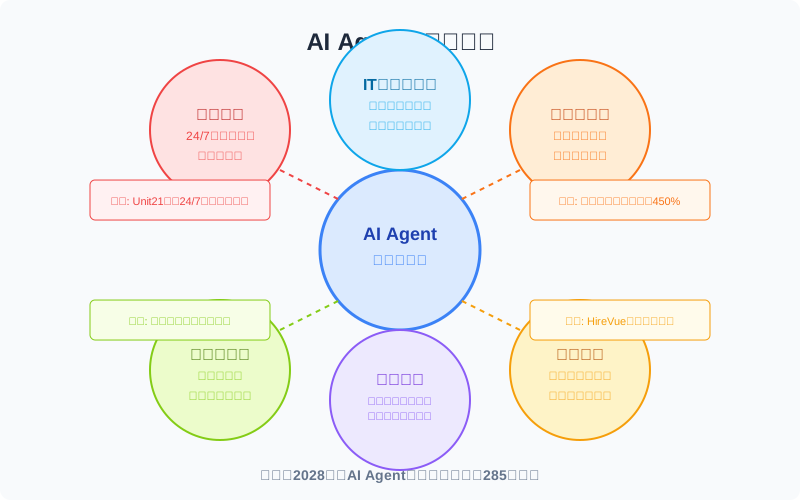
Customer Service
- 24/7 customer inquiries
- Personalized product recommendations
- Automated handling of common issues
- Customer sentiment analysis and response
Case: Unit21 utilizes AI Agents to provide round-the-clock customer support, enhancing customer satisfaction.
Sales and Marketing
- Automated lead generation
- Personalized email marketing
- Sales data analysis and forecasting
- Competitor monitoring and analysis
Case: JPMorgan Chase increased click-through rates by 450% through automated email marketing.
Human Resources
- Resume screening and initial interviews
- Employee training and development
- Job satisfaction monitoring
- Internal knowledge management
Case: HireVue uses AI to assess candidates’ video interview performances, improving recruitment efficiency.
Finance and Accounting
- Automated journal entries
- Account reconciliation and auditing
- Financial anomaly detection
- Tax planning and optimization
Case: Multiple companies achieve continuous auditing and real-time financial monitoring through AI Agents.
IT and Cybersecurity
- Network traffic monitoring and anomaly detection
- Automated security testing
- Threat intelligence collection and analysis
- System health checks and maintenance
Case: Several security firms utilize AI Agents for 24/7 security monitoring.
Other Industry Applications
- Healthcare: Remote patient monitoring, medical information queries
- Finance: Intelligent risk control, investment analysis
- Logistics: Route optimization, demand forecasting
- Education: Personalized learning plans, automated grading
Case: Amazon uses AI algorithms to predict product demand and optimize inventory levels.
7. Future Prospects and Challenges of AI Agents
Market Size Forecast
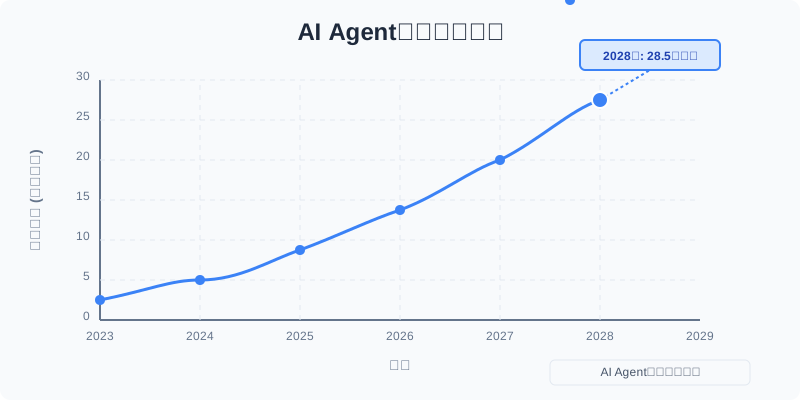
It is expected that by the end of 2028, the market size for AI Agents will reach $28.5 billion.
Development Trends
- Enhanced multimodal perception capabilities
- Improved autonomous learning and adaptability
- Cross-domain collaboration and integration
- Increased levels of personalization and customization
- Evolution of human-machine collaboration models
Challenges Faced
- Data privacy and security issues
- Establishment of ethical and regulatory frameworks
- Technical reliability and stability
- User trust and acceptance
- Interpretability and transparency of complex systems
Final Summary:

Click the blue text above to follow us

Give us a thumbs up for good luck!

This article clarifies eight keywords and principles related to large models: LLM, Transformer, GPT, Bert, pre-training, fine-tuning, deep learning, and Token.
This article helps you understand all the content of the large model “training and inference platform”.
A lengthy article explaining the principles and practical applications of virtual machines and vGPU in the era of large models (for those without patience, it starts at half an hour).