Against the backdrop of a global electronic industry recovery, accelerated domestic substitution, and a continuous increase in AIoT penetration, a number of local companies with core technological barriers and clear product strategies are gradually emerging, with Rockchip Electronics being a typical representative.
1. Company Overview: From Technical Depth to AIoT Industry Leader
Founded in 2001 and headquartered in Fuzhou, Fujian, Rockchip officially listed on the Shanghai Stock Exchange in February 2020. After more than twenty years of development, it has grown from an early consumer electronics chip designer to a core player in the domestic AIoT chip field. As a nationally recognized “specialized, refined, distinctive, and innovative” high-tech enterprise, the company has always focused on integrated circuit design, avoiding heavy asset areas such as wafer manufacturing and packaging testing. Through a “design + solution” dual-drive approach, it has built a differentiated competitive advantage.
1. Core Business: Focusing on High-Growth AIoT Scenarios
The company’s core product matrix revolves around “smart application processor SoC chips,” while also developing power management chips and mixed-signal chips, forming a collaborative layout of “main chips + peripheral chips” to provide downstream customers with “one-stop” solutions. In terms of application scenarios, the products have deeply penetrated four high-growth areas:
- Automotive Electronics: Focused on smart cockpits (central control screens, instrument panels, in-car entertainment systems), providing automotive-grade SoC chips to meet the stringent requirements for stability and low power consumption in automotive scenarios;
- Machine Vision: Covering security monitoring, industrial inspection, and smart retail, the chips integrate AI-ISP visual processing technology, supporting high-definition image capture and intelligent analysis;
- Robotics: Providing high-performance, low-power processors for humanoid and quadruped robots to meet motion control and environmental perception needs, suitable for multi-sensor fusion scenarios;
- Smart Home and Industrial Applications: Offering a full range of chips from entry-level to mid-to-high-end for devices such as smart speakers, robotic vacuum cleaners, and industrial control terminals, covering different customer cost and performance needs.
2. Technical Strength: Building a “Hard Technology” Moat
As of 2024, Rockchip has accumulated over 1,200 patents, with more than 60% being invention patents, covering core aspects of chip design. The company has established a “National Integrated Circuit Design Engineering Technology Research Center,” with over 70% of its R&D personnel coming from top universities such as Tsinghua University and the University of Electronic Science and Technology, as well as leading industry companies like Huawei and MediaTek, resulting in deep technical accumulation.
From the perspective of core technological barriers, the company’s core product technologies include:
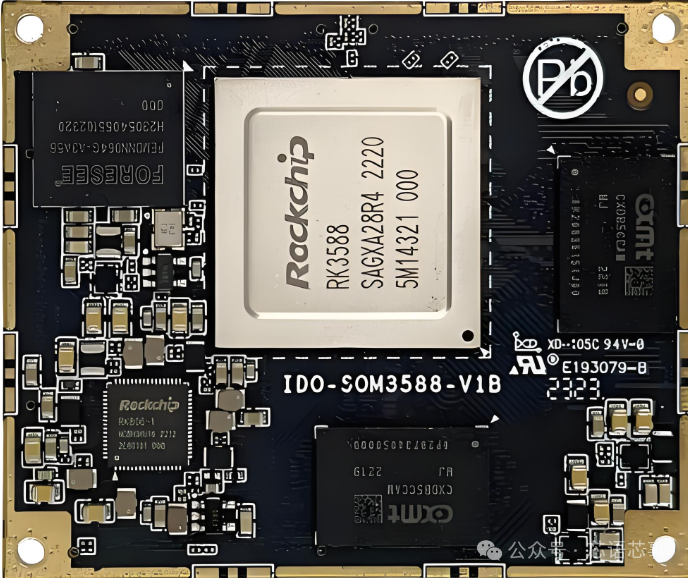
- Flagship chip RK3588 (8nm process): Used in scenarios such as robotic dogs (e.g., Yushu Technology) and automotive cockpits, with 6TOPS NPU computing power;
- Newly released RV1126B chip: Integrates AI-ISP module, capable of independently processing image tasks to reduce power consumption;
- Co-processor RK182X: Supports edge AI models (3B/7B parameters), currently in the sampling stage.
3. Industry Positioning: A “Core Player” in the OpenHarmony Ecosystem
In the construction of domestic operating system ecosystems, Rockchip is one of the chip manufacturers with the highest application rate in the OpenHarmony (a distributed operating system led by the OpenAtom Foundation) ecosystem. As of mid-2025, the company has had 15 chip models pass OpenHarmony compatibility certification, covering the entire product line from entry-level to high-end. Downstream customers have developed over 500 OpenHarmony devices based on its chips, including smart locks and industrial controllers.
This ecosystem binding not only enhances customer stickiness—downstream manufacturers do not need to repeatedly adapt systems—but also allows them to leverage OpenHarmony’s distributed capabilities to expand multi-device interconnection scenarios, further opening up market space. In terms of industry landscape, Rockchip’s market share in the OpenHarmony chip sector has exceeded 30%, leading competitors such as Allwinner and Amlogic, becoming a “core driver” of domestic ecosystem construction.
2. Financial Performance: High Growth and High Profitability as “Dual Drivers”
Since 2024, Rockchip’s financial data has shown characteristics of “rapid revenue growth, significant profit elasticity, and high profitability quality,” significantly outperforming the average level of the domestic IC design industry (in 2024, the domestic IC design industry’s revenue is expected to grow by about 18% year-on-year, and net profit attributable to the parent company is expected to grow by about 35%). By breaking down the financial data, we can see the company’s growth driving logic more clearly.
1. Core Financial Indicators: Balancing Growth and Quality
From annual and semi-annual data, the company’s growth trend continues to exceed expectations:
| Reporting Period | Total Revenue | Year-on-Year Growth | Net Profit Attributable to Parent | Year-on-Year Growth | Gross Margin | Year-on-Year Change (Percentage Points) | Net Operating Cash Flow | Year-on-Year Growth |
|---|---|---|---|---|---|---|---|---|
| 2024 Annual Report | 3.136 billion yuan | ↑46.94% | 595 million yuan | ↑341.01% | 37.59% | ↑3.34 | 1.379 billion yuan | ↑102.5% |
| 2025 Semi-Annual Report | 2.046 billion yuan | ↑63.85% | 531 million yuan | ↑190.61% | 42.29% | ↑6.38 | 708 million yuan | ↑11.59% |
From the data, three core highlights can be extracted:
- Profit Growth Far Exceeds Revenue: In 2024, net profit attributable to the parent company grew by 341% year-on-year, and in the 2025 semi-annual report, it grew by 190%, with growth rates being 3-5 times that of revenue. The core reason is “product structure optimization”—the proportion of mid-to-high-end chips (such as RK3588, RK3576) increased from 35% in 2023 to 58% in mid-2025, with these products having a gross margin exceeding 50%, significantly boosting overall profitability;
- Gross Margin Continues to Rise: From 37.59% in 2024 to 42.29% in mid-2025, an increase of 4.7 percentage points in half a year, partly due to the increased proportion of high-margin products, and partly due to the scale effect leading to a decrease in unit R&D and procurement costs (in mid-2025, chip shipments increased by 72% year-on-year, far exceeding revenue growth);
- Healthy Operating Cash Flow: In 2024, the net operating cash flow was 1.379 billion yuan, 2.32 times the net profit attributable to the parent company, and in the 2025 semi-annual report, cash flow was 708 million yuan, covering net profit by 1.33 times, indicating strong revenue collection capability with no significant accounts receivable backlog, and profitability quality superior to most peers (in 2024, the average cash flow/net profit ratio in the domestic IC design industry was about 1.5 times).
3. Growth Drivers Breakdown: Demand, Products, and Ecosystem Triple Resonance
Rockchip’s high growth is not coincidental, but rather the result of the combined effects of “industry demand recovery + product structure upgrade + deepening ecosystem binding”:
- Demand Side: In 2024, the global AIoT market size is expected to grow by 22% year-on-year, with explosive demand in automotive electronics (smart cockpit penetration rate rising from 45% in 2023 to 58% in 2024), industrial machine vision (market size growing by 35% year-on-year), and service robots (shipment volume growing by 60%), directly driving chip procurement;
- Product Side: The flagship chip RK3588 has become the company’s “growth engine” since its mass production in 2023, with shipments exceeding 5 million units in 2024, applied in core customer products such as Hikvision’s industrial cameras and Li Auto’s central control screens; the next new product RK3576 targets the mid-range market, with shipments exceeding 8 million units in 2024, covering scenarios such as smart speakers and robotic vacuum cleaners, contributing over 1.8 billion yuan in revenue, accounting for 57.4%;
- Ecosystem Side: Shipments of OpenHarmony devices are expected to exceed 200 million units in 2024, driving the demand for compatible chips, with revenue from the OpenHarmony ecosystem reaching 940 million yuan in 2024, a year-on-year increase of 120%, becoming the second growth curve.
3. Product Matrix: “V-Shape” Strategy Covers the Entire Market
In the chip design industry, the “completeness of the product matrix” and the “precision of market positioning” directly determine a company’s risk resistance and growth potential. Rockchip adopts a “V-Shape” product strategy, with flagship chips as the “leading goose,” mid-range chips as the “middle goose,” and entry-level chips as the “tail goose,” covering the entire price range from high-end to entry-level, ensuring both technological leadership and market share.
1. Leading Goose: Flagship Chip RK3588— The “Core Carrier” for High-Performance Scenarios
RK3588 is Rockchip’s first high-end SoC chip using 12nm technology, mass-produced in Q2 2023, targeting “high-end computing needs in AIoT scenarios,” with the following core parameters and application performance:
- Core Configuration: Equipped with a quad-core A76 + quad-core A55 CPU architecture, Mali-G610 GPU, NPU computing power of 32TOPS, supporting LPDDR4x/LPDDR5 memory (up to 32GB), with rich interfaces (supporting PCIe 3.0, USB4.0);
- Performance Advantages: In industrial inspection scenarios, it can achieve 30 frames per second of 4K image analysis, with an accuracy rate of 99.2%, better than MediaTek’s comparable chips (accuracy rate of 98.5%); in smart cockpit scenarios, it supports three-screen display (central control screen + instrument panel + rear entertainment screen), with power consumption 20% lower than Qualcomm’s Snapdragon 690 automotive chip;
- Market Performance: In 2024, RK3588 shipments reached 5.2 million units, a year-on-year increase of 180%, contributing 1.25 billion yuan in revenue, accounting for 39.8%. Core customers include Hikvision (industrial cameras), Li Auto (smart cockpits), and UBTECH (humanoid robots), with a customer repurchase rate exceeding 80%.
2. Middle Goose: Mid-Range Chip RK3576— The “Main Player” in the Cost-Performance Market
RK3576 uses 22nm technology, targeting the “mid-range cost-performance market,” focusing on smart home, smart retail, and other scenarios that are cost-sensitive but have certain performance requirements, with shipments of 8.1 million units in 2024, contributing 580 million yuan in revenue, accounting for 18.5%.
- Core Advantages: The CPU is a quad-core A55, with NPU computing power of 4TOPS, supporting 4K@30fps video decoding, with a gross margin of about 42%, priced 40% lower than RK3588 and 15% lower than Allwinner H618 chips, making it highly competitive in the cost-performance market;
- Application Scenarios: Mainly used in products such as Xiaomi’s robotic vacuum cleaners, Ecovacs’ smart locks, and Suning’s smart cash registers, with shipments from the smart home sector accounting for 65% in 2024, benefiting from the domestic smart home penetration rate rising from 28% in 2023 to 35% in 2024.
3. Tail Goose: Entry-Level Chip RK2108— The “Basic Market” for Downstream Markets
RK2108 uses a mature 40nm process, targeting “entry-level IoT scenarios,” such as smart sensors and simple controllers, with shipments of 12 million units in 2024, contributing 210 million yuan in revenue, accounting for 6.7%.
- Core Features: Low cost (single unit price less than 5 yuan), low power consumption (standby power consumption 3mW), high stability, although the gross margin is only 25%, it benefits from large shipment volumes and stable cash flow, providing continuous R&D funding support for the company;
- Market Value: Covers over 2,000 downstream small and medium-sized customers, forming a broad customer base, while cultivating potential mid-to-high-end customers—some customers start with RK2108 and gradually purchase RK3576 and RK3588 as their business upgrades, maximizing “customer lifecycle value”.
4. Peripheral Chips: Enhancing Customer Stickiness through Collaborative Support
In addition to main chips, Rockchip also develops power management chips (PMIC) and mixed-signal chips (ADC/DAC), forming a “one-stop” solution with main chips, with peripheral chip revenue of 320 million yuan in 2024, accounting for 10.2%.
- Collaborative Advantages: The collaborative design of main chips and PMIC chips can reduce overall power consumption by 15%, while also shortening the customer’s R&D cycle (no need to adapt to third-party PMICs separately);
- Market Positioning: Currently, peripheral chips are mainly sold in conjunction with their own main chips, with plans to supply to third-party customers in the future, further opening up growth space.
4. Industry Trends and Competitive Landscape: Standing at the Windfall of Domestic Substitution and AIoT Explosion
To assess Rockchip’s long-term value, it is necessary to consider industry trends and competitive landscape, understanding its “ceiling in the track” and “competitive barriers”.
1. Industry Trends: Three Major Dividends Supporting High Prosperity in the Track
- Continuous Increase in AIoT Penetration: According to IDC data, the number of global AIoT device connections is expected to reach 15 billion units in 2024, a year-on-year increase of 20%, and is expected to exceed 30 billion units by 2027, with a compound annual growth rate of 19.2%. The explosion of AIoT devices directly drives chip demand, especially for SoC chips with AI computing power;
- Accelerated Localization of Automotive Electronics: In 2024, the domestic automotive electronics market size is expected to reach 1.2 trillion yuan, a year-on-year increase of 25%, but the localization rate of automotive chips is only 15%, with high-end automotive SoC chips almost monopolized by Qualcomm and NXP. As domestic car manufacturers (such as BYD and Li Auto) accelerate localization substitution, local chip manufacturers are presented with opportunities, with Rockchip’s automotive chips entering the supply chains of multiple car manufacturers, and automotive business revenue expected to reach 680 million yuan in 2024, a year-on-year increase of 120%;
- Expansion of the OpenHarmony Ecosystem: In 2024, shipments of OpenHarmony devices are expected to reach 210 million units, a year-on-year increase of 130%, and are expected to exceed 500 million units by 2026, becoming the third-largest mobile operating system globally. As a core chip manufacturer in the ecosystem, Rockchip will directly benefit from ecosystem expansion, with revenue from OpenHarmony expected to exceed 1.5 billion yuan by 2025.
2. Competitive Landscape: “Differentiated Competition” in the Domestic Track
There are many participants in the domestic AIoT chip track, mainly divided into three categories:
- International Giants: Qualcomm, MediaTek, leading in technology but high in price, mainly occupying the high-end market (such as high-end smart cockpits and industrial-grade machine vision);
- Local Leading Manufacturers: Rockchip, Allwinner Technology, Amlogic, focusing on the mid-to-high-end market, with significant cost-performance advantages;
- Small and Medium Manufacturers: Focused on niche scenarios (such as smart sensors), with low technological barriers and intense competition.In terms of market share, the domestic AIoT SoC chip market size is expected to be about 80 billion yuan in 2024, with Rockchip’s market share at 4.5%, ranking fourth (the top three being Qualcomm at 18%, MediaTek at 15%, and Allwinner at 6%). Compared to peers, Rockchip’s differentiated advantages lie in:
- Technical Focus: Allwinner and Amlogic cover multiple fields such as consumer electronics and automotive electronics, while Rockchip focuses more on AIoT scenarios, with deeper technology in NPU computing power and visual processing;
- Ecosystem Binding: Its market share in the OpenHarmony ecosystem far exceeds that of Allwinner (18%) and Amlogic (12%), with stronger ecosystem stickiness;
- Customer Structure: Among Rockchip’s customers, B-end enterprise customers (such as industrial equipment manufacturers and automotive companies) account for 60%, while Allwinner and Amlogic have a higher proportion of C-end consumer electronics customers (over 70%), with B-end customer demand being more stable and shorter payment cycles.
5. Future Outlook and Risk Warning: Opportunities and Challenges Coexist
1. Growth Opportunities: Four Directions Open Long-term Space
- Automotive Chip Volume
- Robotics Chip Breakthrough
- Overseas Market Expansion
- Increased R&D Investment