Recommended Unit and Author
Hubei Energy Group Xiangyang Yicheng Power Generation Co., Ltd.
Ma Jun
Abstract:With the continuous development of industrial technology, digitalization is increasingly prevalent in modern industrial applications. Coal-fired power generation units are considering intelligent and digital directions to save engineering investment in coal transportation systems, reduce construction workload, and facilitate future equipment modifications and optimizations. The distributed control system in the coal transportation area of thermal power projects adopts the Profibus communication mode, which can effectively save engineering investment and construction workload, improving the project’s economic efficiency and construction flexibility.
Keywords:Distributed Control System; Profibus
Introduction
The distributed control system of the 2×1000MW thermal power generation unit of Hubei Energy Group Xiangyang Yicheng Power Generation Co., Ltd. (hereinafter referred to as Yicheng Power Plant) adopts an integrated conventional I/O + Profibus bus design mode. The coal transportation control system uses the main station of the Ruivo control system from Xi’an Thermal Engineering Research Institute Co., Ltd. (hereinafter referred to as Xi’an Thermal Institute) and the communication mode of the slave station from Hunan Xianbu Information Co., Ltd. (hereinafter referred to as Hunan Xianbu Company), effectively saving engineering investment and construction workload. This configuration also reserves expansion interfaces for subsequent equipment upgrades and modifications, minimizing work difficulty and enhancing the economic efficiency and flexibility of the modification project. The project design considered adopting a distributed control system based on Profibus DP bus communication from the beginning, while using a two-level bridging method to construct the communication network, maximizing the savings on installation auxiliary materials such as cables, cable trays, and conduits, optimizing the overall structure. The entire system topology is simple, clear, and fully functional, completely meeting on-site needs.
1
Analysis of the Structure and Core Principles of the Coal Transportation Control System
1.1 Structure of the Coal Transportation Control System
The coal transportation control system of Yicheng Power Plant uses the FCP100 controller and FBP101 main station module of the Ruivo DCS system from Xi’an Thermal Institute. The slave station consists of the intelligent controller SSPCU9101DTD from Hunan Xianbu Company, forming a first-level Profibus DP communication network. The SSPCU9101DTD intelligent controller serves as the main station, while the second-level Profibus DP communication network is composed of the SSPCU series multi-channel controllers as slave stations. On-site direct measurement sensor signals (such as belt deviation, slippage, tearing, rope pulling, coal blockage, etc. for switch signals, and coal quantity for analog signals) and remote control commands are accessed by the SSPCU series multi-channel controllers, thus achieving data collection and remote control. The SSPCU9101DTD intelligent controller acts as a gateway, facilitating the two-level bridging function, thereby enabling two-level Profibus communication.
Due to the wide range of coal transportation systems in coal-fired power plants or coal storage sites, with many coal belts and long signal transmission distances, if the control system is designed using conventional hard-wiring methods, it would result in significant cable and construction investments, and replacing faulty components would incur substantial costs. The Profibus DP protocol adopted in this project effectively addresses the investment issues related to hard-wired cables. Furthermore, the two-level bridging communication network reduces the investment in main station communication modules, allowing the SSPCU9101DTD intelligent controller to support various communication protocol conversions, facilitating two-level bridging for different communication protocols, thus providing convenience for future equipment modifications and expansions.
The SSPCU9101DTD intelligent controller from Hunan Xianbu Company achieves bridging between the two-level Profibus-DP bus networks: it connects with Profibus-DP slave devices to form a secondary bus network and links to the primary Profibus-DP bus network, completing data exchange between the PLC system with Profibus-DP protocol and on-site local devices. The SSPCU9101DTD intelligent controller has 2 Profibus-DP master station interfaces and 2 Profibus-DP slave station interfaces. The two DP master station interfaces operate in dual DP communication mode, allowing for flexible switching during communication; in dual communication mode, input and output data are processed based on the first-come-first-served principle of communication message data. The 2 DP slave stations can be configured for system redundancy mode or dual DP mode using address dip switches. In dual DP mode, the two interfaces can freely switch during single communication, and in dual communication, input and output data are processed based on the first-come-first-served principle of communication message data.
Moreover, any device that can serve as a Profibus-DP slave can utilize this product, enabling bidirectional interconnection between multiple Profibus-DP secondary networks and the primary Profibus-DP bus network, facilitating on-site applications.
1.2 Working Principle of the SSPCU9101DTD Intelligent Controller
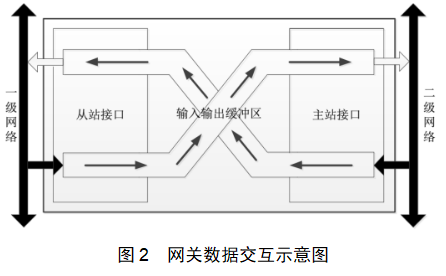
The data exchange between the Profibus-DP master station and slave stations of the SSPCU9101DTD intelligent controller is achieved through a “mapping” relationship. The SSPCU9101DTD intelligent controller contains input and output data buffers. The Profibus-DP master station stores information obtained from the secondary network into the input buffer, while the Profibus-DP slave station stores information sent from the primary network into the output buffer. The SSPCU9101DTD intelligent controller reads and writes data from both buffers, retrieving information from various Profibus-DP slave devices in the secondary network through the input buffer, and uploading it to the upper computer via the Profibus-DP slave station. The data in the output buffer is then sent to various Profibus-DP slave devices in the secondary network through the Profibus-DP master station, thus achieving transparent data transmission between the two Profibus-DP networks. A schematic diagram of data exchange between the two-level networks is shown below.
The SSPCU9101DTD intelligent controller from Hunan Xianbu Company is compact and powerful, making it a suitable choice for various small and complex control tasks. The SSPCU9101DTD consists of multiple system units, including input and output units, which enable the entire machine control system to achieve cost-effective engineering. The SSPCU9101DTD can be applied in mobile devices or other locations requiring measurement, input, and output control, while the Windows-based programming provides users with a programmable control platform, allowing them to program control according to actual on-site needs, thus flexibly applying it on-site to solve practical problems.
2
Budget for the Coal Transportation Control System Project
Based on the communication structure adopted in this project, the engineering quantity and investment savings are roughly estimated as follows:
This project employs devices based on the Profibus fieldbus protocol, resulting in cost savings in project equipment and materials compared to conventional hard-wired projects. The engineering design simplifies the design and reduces system complexity; in terms of installation, it reduces materials such as cables, cable trays/boxes/conduits, and lowers installation labor costs. With a total of 14 coal transportation belts and related equipment, which is a conventional configuration for domestic 1000MW thermal power generation units, the investment cost calculations indicate that materials and installation costs for cable trays/boxes/conduits can save approximately 70%, cable laying and connection costs can save about 60%, and I/O module and cabinet material costs can save around 80%. However, the SSPCU9101DTD intelligent controller used in this project, as a domestically produced control product, has costs comparable to conventional distributed control system communication modules, with communication cable costs slightly higher than conventional hard-wired cables. Overall, this system can reduce costs by about 50% compared to traditional methods.
In terms of cost control, the more significant advantage of adopting fieldbus projects is to fully leverage the benefits of digital information. As thermal power projects gradually move towards intelligence, the application of digital information can assist maintenance personnel in reducing maintenance workload and improving maintenance efficiency.
3
Conclusion
The successful application of this project not only reduces investment and shortens construction time for the coal transportation system engineering of Yicheng Power Plant’s 2×1000MW thermal power generation unit but also provides similar solutions and valuable references for similar industrial control systems, facilitating engineering construction and technical modification projects while saving investment. In the current context of coal power industry construction, the coal transportation control system serves as the core control hub for fuel delivery in thermal power plants, highlighting its importance. The successful application of this project has conducted in-depth and comprehensive research and discussion on the coal transportation control system, aiming to provide theoretical support and practical guidance for enhancing the reliability and intelligence level of the coal transportation system. The degree of automation of the system has significantly increased, effectively reducing manual operations and labor intensity; at the same time, adjustments to the control system structure have improved the overall operational efficiency of the coal transportation system, bringing significant economic and social benefits to the power plant.
Although this project has achieved certain results in the coal transportation control system, with the development of new energy power and the optimization of market electricity structure, the entire coal power industry still faces many challenges and difficulties in sustainable development and improving quality and efficiency. This project can serve as a reference for similar application environments or scenarios, attempting to adopt the same solutions or draw on relevant experiences, exploring the deep integration of other production systems in coal power projects, constructing an integrated intelligent power plant management and control platform, achieving information sharing and collaborative control, and further improving the overall operational management level of power plants, contributing substantial economic benefits to coal power projects.
References
[1] Zhou Zhimin, Ji Ai Hua. Design and Application of Profibus Bus System [M]. China Electric Power Press, 2009: 5-6
[2] Technical Guidelines for Installation of Fieldbus Equipment in Thermal Power Plants [S]. China Electric Power Press, 2013.
Source:
2025 (8th) Seminar on Fuel Management and Intelligent Technology Applications in Thermal Power
Previous Recommendations
[Oil Quality Supervision] Issues and Solutions in Mixing and Supplementing Oil in Power Plant Operations
[Water Treatment] Abnormal Analysis and Treatment of Cooling Water in 1000MW Units
[Information Innovation] Technical Practice and Innovation of Domestic Products in Power Generation Enterprises—Taking the Development of Datang Heilongjiang Power Safety Audit Integrated Machine as an Example


Scan the QR code丨Follow us
All Electric Technology Collaboration Service Center