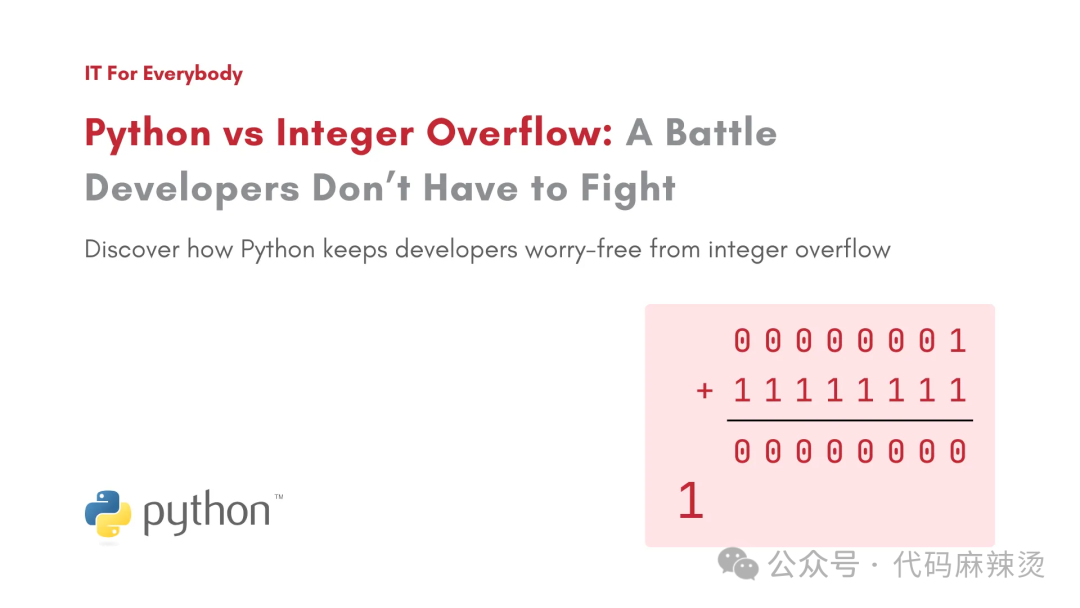
Integer overflow is a classic programming problem.
In many languages, such as C, C++, or Java, integers are stored in a fixed amount of memory. This means they can only hold values within a limited range. For example, a 32-bit signed integer can represent numbers from <span>-2,147,483,648</span> to <span>2,147,483,647</span>.
So, what happens if you try to add <span>2,147,483,647</span> and <span>1</span>?
It won’t give you <span>2,147,483,648</span>, but rather the number overflows and wraps around to <span>-2,147,483,648</span>. This is not only confusing but can lead to serious errors in financial, scientific, or cryptographic applications.
However, Python does not have this issue — its integers can grow to the size allowed by your computer’s memory.
For example, let’s try to calculate <span>2**1000</span> in Python and see the result:
print(2**1000)
Output:
10715086071862673209484250490600018105614048117055336074437503883703510511249361224931983788156958581275946729175531468251871452856923140435984577574698574803934567774824230985421074605062371141877954182153046474983581941267398767559165543946077062914571196477686542167660429831652624386837205668069376
The result is a 302-digit number — and Python handles it effortlessly.
But how does Python achieve this?
Let’s analyze it!
Python and Arbitrary Precision Integers
In Python 3, the way integers are stored is different from many traditional languages. They are implemented as arbitrary precision integers.
This means:
- For small values, integers behave like regular 32-bit or 64-bit numbers (fast and efficient).
- When values grow beyond the native word size of the machine, Python automatically converts them to a long integer representation that can grow as needed.
Thanks to this mechanism, Python programs will never encounter integer overflow errors.
How is this implemented at a low level?
To truly appreciate this, let’s look at the low-level implementation:
- In Python, integers are objects. Under the hood, CPython (the most common implementation of Python) uses a C structure called
<span>PyLongObject</span>to represent them. This structure does not fix the size of the integer. Instead, it stores the number as a dynamic array (with a base of either 2³⁰ or 2¹⁵ depending on the system). - When you perform arithmetic operations that exceed the current storage capacity, Python automatically adjusts the storage space to accommodate the new number. This adjustment makes integers practically unlimited in practice, only constrained by the available memory on your machine.
- Python also stores the sign separately, meaning negative and positive numbers are equally flexible — no need for tricks like two’s complement.
But wait — is there a cost?
Yes, there is a small trade-off.
Since Python integers can grow arbitrarily, very large numbers require more memory and longer processing times.
For example, consider the following code:
import sys
sys.set_int_max_str_digits(1000000)
a = 2**1000000
b = 2**1000000
c = a * b
print("Number of digits:", len(str(c)))
Here, the multiplication produces a number with over 600,000 digits. Python can handle it, but it won’t finish instantly.
So, while you don’t have to worry about overflow, you need to remember that the larger the number, the slower the operations and the higher the memory usage.
Conclusion
Python’s handling of integers is not just a technical detail — it reflects Python’s philosophy:
- Make things simple for the programmer.
- Reduce the chances of hidden errors.
- Prioritize correctness over low-level optimizations.
By automatically managing integer sizes, Python frees you from one of the most frustrating traps in programming: integer overflow. While other languages force you to deal with data types or seek special libraries, Python simply says, “Relax, I’ve got this.”
With Python, you can think big — really.