2025 is referred to as the “AI Agent Year One” in the industry, as this technology based on large models is transitioning from the laboratory to the depths of industry. As an advanced form of generative AI, AI Agents break through the limitations of traditional large language models in executing long-chain tasks through autonomous tool invocation, task decomposition, and closed-loop optimization, becoming the core carrier of AI empowering various industries.
In China, a policy system has formed that includes “regulation + incentives + support“; through regulations such as the “Interim Measures for the Management of Generative Artificial Intelligence Services”, data compliance and algorithm security are standardized; promoting the integration of AI Agents with key industries such as manufacturing, healthcare, and transportation; at the same time, special funds and tax incentives are established to support core technology (perception, reasoning, human-computer interaction) breakthroughs and talent cultivation.
1. The Technical Core and Evolution Logic of AI Agents
AI Agents (agents) are application systems that achieve control flow decision-making based on large models, with the core feature being “autonomously invoking tools to complete complex tasks”. Compared to traditional AI, AIGC, and LLM, its positioning emphasizes the closed-loop nature of task execution: LLM only provides basic understanding and reasoning capabilities, AIGC focuses on content generation, and traditional chatbots rely on preset rules; while AI Agents can achieve full-process automation from goal decomposition to tool invocation and result optimization through the “planning – execution – feedback” loop.
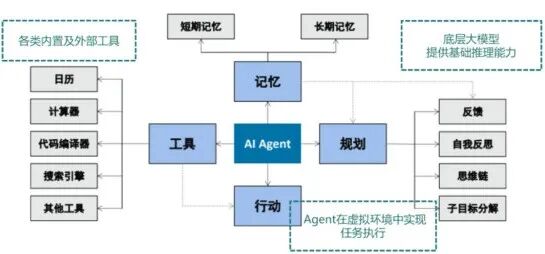
The technical architecture of AI Agents has initially taken shape, consisting of three core modules:1) Underlying Large Models: provide understanding and reasoning capabilities, supporting task planning and decision-making (e.g., GPT-4o, GLM-4.5, etc.);2) Tool Layer: includes MCP (Model Context Protocol), RAG (Retrieval-Augmented Generation), etc., empowering Agents to invoke external tools (such as databases, browsers) and process internal and external information;3) Supporting Infra: covers components such as environment (virtual machines, browser plugins), memory (long-term state storage), and security (compliance assurance), providing operational support for Agents.
The core features of AI Agents are autonomy (no need for continuous human intervention), planning and memory (task decomposition and information storage), and closed-loop execution (effect monitoring and self-optimization). They can be divided into general AI Agents (multi-task, cross-scenario, such as Microsoft Copilot) and vertical AI Agents (high-barrier fields, such as medical diagnosis Agents). C-end products focus on generality, while B-end products emphasize deep integration with business processes.
The evolution of AI Agents is highly correlated with the maturity of generative AI technology: in the early stage of large models in 2023, tools like AutoGPT, LangChain, etc., opened up exploration and validated the feasibility of “large models + tool invocation”; from 2024 to 2025, global giants (such as Microsoft, Google) and domestic companies (ByteDance, Alibaba) accelerated their layouts, with products like Manus, GenSpark emerging, and the technical framework and product forms gradually solidifying; in 2025, the industry will enter the “Year One”, with Agent products being scaled in office, healthcare, and industrial scenarios, the framework maturing, becoming the core tool for enterprise intelligent transformation.
AI Agents have achieved commercial breakthroughs in four major scenarios: office automation, customer service, industrial intelligence, and medical assistance, addressing the efficiency and cost pain points of traditional models.
2. Industry Overview and Market Size
The AI Agent industry chain covers the entire process of “computing power – models – data – platforms – applications”;
Upstream: Computing power (chips, cloud services), models (large model vendors), data (labeling, cleaning), account for 40% of the total industry value (computing power 25%, models 10%, data 5%);
Midstream: Platform development (agent development toolchain), technology integration (multi-tool collaboration), developer ecosystem (open-source frameworks), accounting for 30%;
Downstream: Applications in finance, healthcare, manufacturing, etc., accounting for 30% (performance-based payment 60%, subscription-based 30%, custom development 10%).
According to IDC data, the global market size in 2024 is expected to reach 5.29 billion USD, while in China, the market size is approximately 69.5 billion CNY in 2024, expected to exceed 173.5 billion CNY in 2025, and reach 544.2 billion CNY by 2027, with an average annual compound growth rate of 77%. In terms of technology penetration, general scenarios such as office and customer service will enter a period of large-scale promotion in 2025, expanding to vertical industries such as finance and healthcare by 2027.
3. Market Landscape
International tech giants, such as OpenAI, Google, Microsoft: relying on computing power, models, and user base, dominate general Agent technology (e.g., OpenAI Operator);
Emerging independent labs, such as Anthropic, xAI: focus on safe and controllable technology paths with low hallucination rates (e.g., Anthropic MCP protocol);
Leading domestic platform companies, such as ByteDance, Alibaba, Baidu: promote the integration of “general models + application frameworks + industry plugins”; for example, ByteDance’s “Button” platform, Alibaba’s “Shadowless AgentBay”;
Startups and open-source communities, such as Monica, BetterYeah: deeply cultivate vertical scenarios, such as Monica Manus cross-platform operations, BetterYeah enterprise-level Infra.
The global market is dominated by giants like OpenAI, Anthropic, etc., with a combined penetration rate exceeding 50%, while domestic computing power and model resources are concentrated in leading companies like ByteDance and Alibaba, but the application layer presents fragmented competition due to scenario diversification. With the establishment of standards like MCP, small and medium enterprises are rapidly rising in localized deployment and vertical customization, leading to a concentration of the industry at the bottom layer and a diversified evolution at the upper layer.
4. Core Targets in the Industry Chain
1. Computing Power and Models
Cambricon (688256): a leading domestic AI chip manufacturer, its Shiyuan series chips are adapted for large model training and inference, providing underlying computing power support for AI Agents.
iFlytek (002230): self-developed “Spark” large model, implementing agent applications in education, healthcare, etc., such as AI educational assistants and medical consultation Agents;
360 (601360): based on the “360 Smart Brain” large model, launched “360AI Assistant”, covering office, search, etc., exploring the commercialization of general Agents.
2. Toolchains and Platforms
Tuya (300229): leading in NLP and knowledge graph technology, providing information retrieval and knowledge reasoning support for AI Agents, already laid out intelligent agents in government affairs, finance, etc.;
Haitian Ruisheng (688787): AI training data service provider, offering high-quality labeled data for Agents, assisting model optimization and scenario adaptation.
3. Scenario Applications
Kingsoft Office (688111): integrates large models into WPS, launching “Intelligent Document Assistant” and “Meeting Minutes Agent”, enhancing office automation efficiency;
Yonyou Network (600588): a leading enterprise service provider, its “Yonyou BIP” platform integrates AI Agent capabilities, achieving process automation in finance, supply chain, etc.;
Weining Health (300253): a leading healthcare information technology company, developing the “WiNEX AI Diagnostic Assistant”, enhancing efficiency in grassroots healthcare;
Caixun Co., Ltd. (300634): an enterprise email and collaborative office service provider, launched “Caixun AI Customer Service Agent”, achieving intelligent customer service in finance, government affairs, etc.