Quick Sort is an efficient sorting algorithm that is also based on the “divide and conquer” principle. Its core idea is to select a “pivot value” to partition the array into two parts: one part contains elements less than the pivot value, and the other part contains elements greater than the pivot value, followed by recursively sorting both parts.Core Idea:
- Select a pivot value (pi)
- Partition the array: place elements less than the pivot value on the left, and elements greater than the pivot value on the right
- Recursively perform the same operation on the left and right subarrays
Code ImplementationHeader File
#include <stdio.h>Main Function
int main() {    int arr[] = { 10, 7, 8, 9, 1, 5 };    int n = sizeof(arr) / sizeof(arr[0]);
    printf("Original array: ");    printArray(arr, n);
    quickSort(arr, 0, n - 1);
    printf("Sorted array: ");    printArray(arr, n);
    return 0;}
Function to Swap Two Integers
// Function to swap the values of two integers
void swap(int* a, int* b) {    int t = *a;    *a = *b;    *b = t;}
Main Function of Quick Sort
// Main function of Quick Sort
// arr: array to be sorted
// low: starting index
// high: ending index
void quickSort(int arr[], int low, int high) {    if (low < high)     {        // pi is the index of the pivot value, after partitioning arr[pi] is in the correct position        int pi = partition(arr, low, high);
        // Recursively sort the left subarray of the pivot value        quickSort(arr, low, pi - 1);        // Recursively sort the right subarray of the pivot value        quickSort(arr, pi + 1, high);    }}
Partition Operation: Select a pivot value and divide the array into two parts
// Partition operation: select a pivot value and divide the array into two parts
// Return the final index of the pivot value
int partition(int arr[], int low, int high) {    // Choose the rightmost element as the pivot value    int pivot = arr[high];      // Boundary index for the area less than the pivot value    int i = (low - 1);
    for (int j = low; j <= high - 1; j++)     {        // If the current element is less than or equal to the pivot value        if (arr[j] <= pivot)         {            // Expand the area less than the pivot value            // i starts incrementing from low            i++;
            // Place the current element in that area            swap(&arr[i], &arr[j]);          }    }    // Place the pivot value in the correct position (between the less than and greater than areas)    swap(&arr[i + 1], &arr[high]);    return (i + 1);  // Return the index of the pivot value}
Print Array
// Function to print the array
void printArray(int arr[], int size) {    for (int i = 0; i < size; i++)        printf("%d ", arr[i]);    printf("\n");}
Analysis of the quickSort Function:
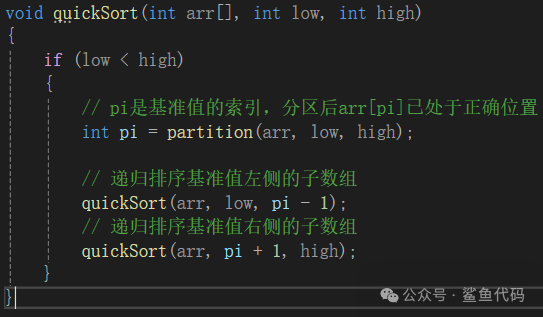
- Function: Recursively implements quick sort
- Implementation Steps:
- Perform partition operation on the array to get the pivot value index
<span>pi</span> - Recursively sort the left subarray of the pivot value (
<span>low</span>to<span>pi-1</span>) - Recursively sort the right subarray of the pivot value (
<span>pi+1</span>to<span>high</span>)
Analysis of the partition Function: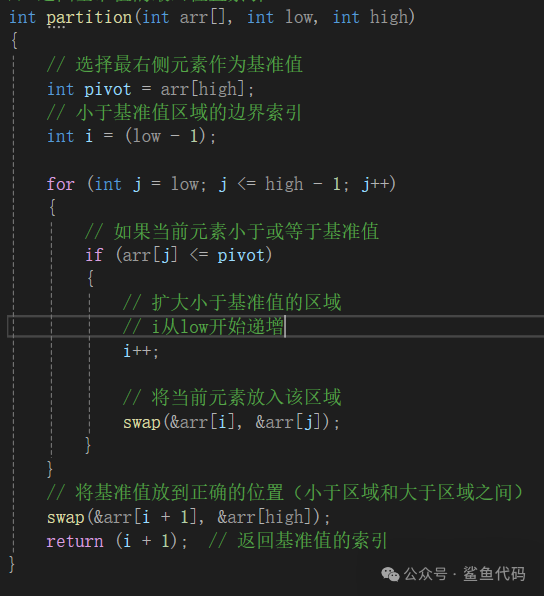
- Function: Implements the partition operation and returns the final position of the pivot value
- Implementation Steps:
- Select the rightmost element as the pivot value
- Maintain a boundary index for the area less than the pivot value
<span>i</span> - Traverse the array and swap elements less than or equal to the pivot value to the left area
- Place the pivot value to the right of the left area, forming two partitions
Characteristics of Quick Sort
- Advantages
- Average time complexity isO(n log n), usually faster than merge sort in practical applications
- In-place sorting (requires only O(log n) of recursive stack space)
- Cache-friendly with good locality
- Disadvantages
- Worst-case time complexity isO(n²) (when the array is sorted and the two end elements are chosen as pivots)
- Unstable sorting algorithm (the relative position of equal elements may change)
Optimization Techniques
-
Pivot Value Selection:
- Randomly select the pivot value
- Median of three method (median of the first, last, and middle elements)
Optimization for Small Subarrays:
- When the subarray size is small (e.g., less than 10 elements), use insertion sort instead
Tail Recursion Optimization:
- Use loops for larger subarrays and recursion for smaller subarrays to reduce stack space usage
Applicable Scenarios
- Sorting large-scale data
- Scenarios with high average performance requirements
- Memory-constrained environments (due to in-place sorting characteristics)
Many standard library sorting functions in programming languages use quick sort or its variants (e.g., C++’s<span>std::sort</span>).