🚀 Mixed Traffic Testing: The Key to Revealing the True Strength of the System
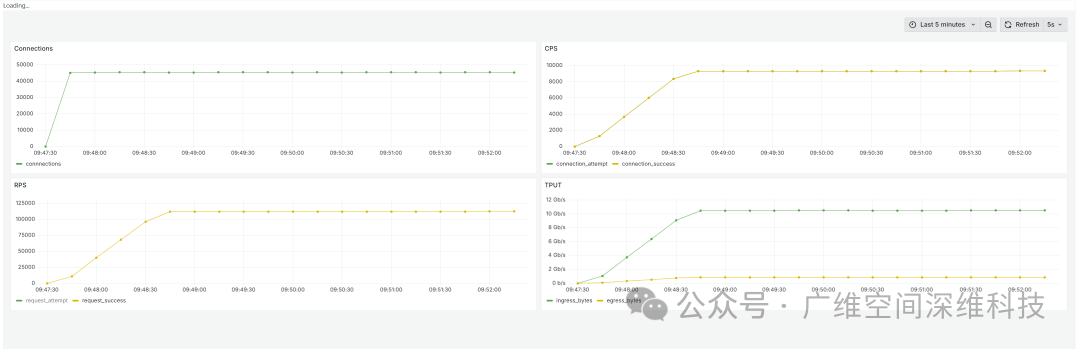 (Schematic of mixed pressure testing using ECC-SM2-SM4-GCM-SM3 algorithms)
In real business scenarios,
-
CPS (New Connection Rate)
-
QPS (Requests Per Second)
-
Concurrent Connections
-
Throughput (Gbps)
are never isolated metrics. They are interdependent:
-
Pursuing high CPS (short connections/frequent handshakes) will squeeze QPS / Throughput
-
Raising QPS often relies on connection reuse, which in turn can lower CPS
-
Throughput is strongly related to object size and network characteristics
-
Concurrent ≈ QPS × Average Response Time
👉 Measuring only one metric can easily lead to “getting the right number but measuring the wrong system”.
To make the pressure test closer to production, we need mixed traffic: covering short connection peaks, long connection stability, high concurrency, and a mix of packet sizes, while incorporating the real costs of TLS handshakes and session reuse.
🔑 Why Conduct Comprehensive Testing?
1. Scenario Coupling
-
Flash Sales/Login: Short connections with high CPS
-
Content Distribution/API Gateway: Long connections with high QPS
-
Large Files/Streaming Media: High throughput
Single point limits do not represent the overall carrying boundary of the system. Measuring only throughput does not reveal connection limits; measuring only connections does not reflect concurrency stability.
2. Bottleneck Identification
For the same DUT (Device Under Test), the bottleneck location can vary significantly under different conditions:
-
High CPS, Low QPS → May be bottlenecked at handshake and certificate computation
-
Low CPS, Extremely High QPS → May be bottlenecked at application/database/network stack
Comprehensive testing is necessary to reveal the migration path of bottlenecks under different pressure combinations.
3. Closer to Real Business
In real traffic:
-
Mixed long and short connections
-
Large data transfers coexist with small requests
-
The overhead of TLS handshakes and session reuse cannot be ignored
Only mixed traffic can approach the production environment.
⚡ Example Testing Scenarios
Short Video Services
-
Users repeatedly open/close video pages → Surge in short connections
-
Video playback → Sustained high throughput
-
Simultaneous large numbers of users online → Pressure from concurrent connections
E-commerce Promotion Scenarios
-
At the moment of flash sales → Explosion in new connection numbers
-
Surge in requests for product detail pages → QPS skyrockets
-
Shopping cart, payment pages → Long connections maintained
Instant Messaging Applications
-
Large numbers of long connections maintained online → Test of concurrent capacity
-
Message push peaks → High throughput pressure
-
Frequent user logins/logouts → New connection testing
🎯 Excellent Capabilities Required for Testing Instruments
-
Concurrent Processing Capability: Stably maintain hundreds of thousands or even millions of connections
-
Efficient Data Engine: Maintain low latency even under large-scale data transmission
-
Rapid Connection Establishment Capability: Support tens of thousands or even hundreds of thousands of connections established and released per second
-
Precise Request Control: Flexibly combine packet sizes, long and short connections, to restore real traffic models
-
Multi-Dimensional Metric Analysis: Real-time observation of system performance changes and bottleneck migration under different conditions
✅ Mixed traffic testing is not just about obtaining a specific number, but about approaching the real business environment to comprehensively assess the system’s capacity and stability under complex pressures.
Your system can only demonstrate its true strength under such comprehensive testing!