
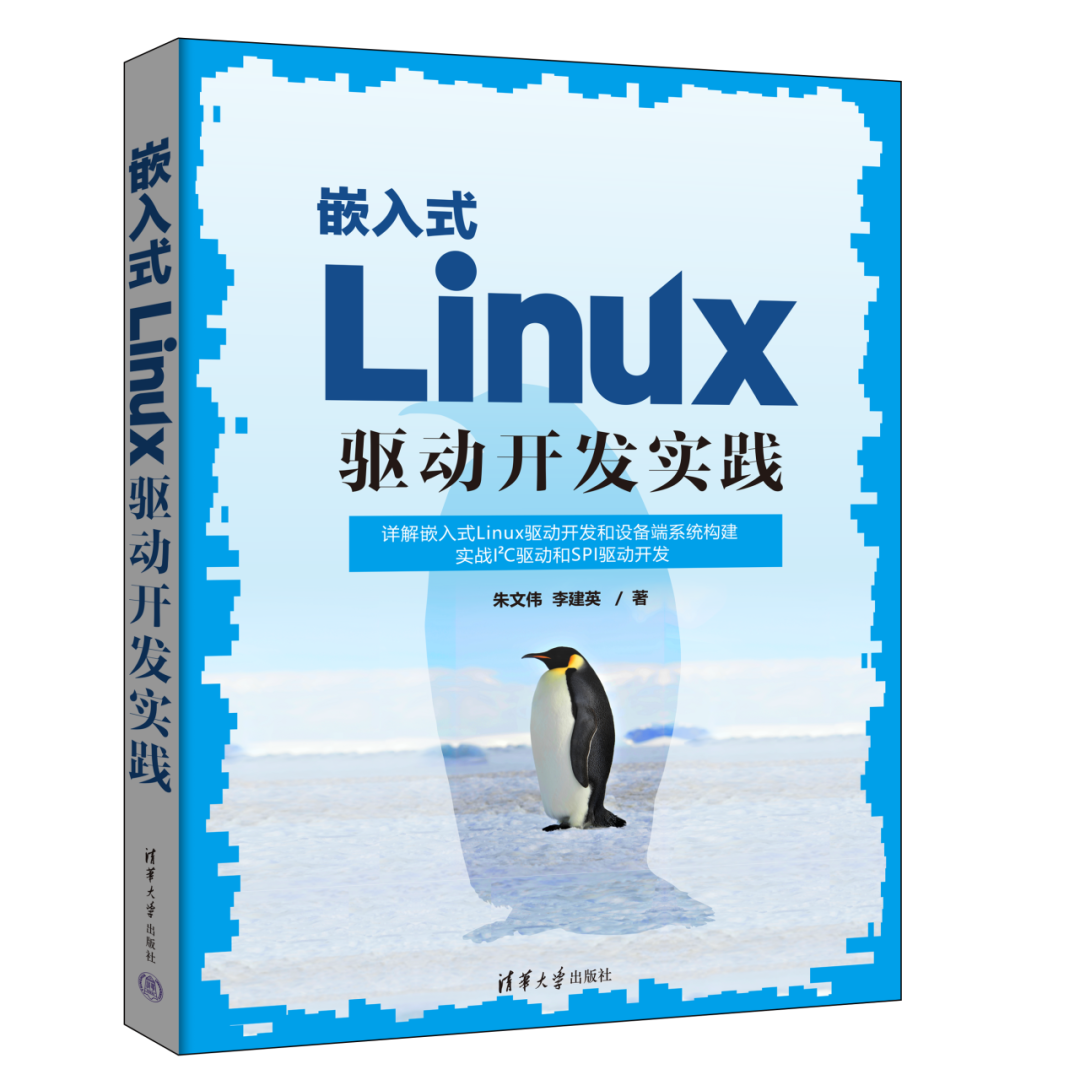
Detailed Explanation of Embedded Linux Driver Development and Device System Construction
Practical Development of I2C and SPI Drivers

Content of the Book
The most common interaction in people’s daily lives is with embedded systems. Currently, widely used devices such as smartphones, MP3 players, smart home appliances, drones, autonomous vehicles, and robots all utilize embedded systems. The development of embedded systems is increasingly significant in the overall computer system development. This book provides a detailed explanation of embedded Linux driver development and device system construction, along with source code examples for the entire book and QQ support from the author.
The book is divided into 12 chapters, covering an overview of embedded systems, setting up a secure Linux development environment, essential embedded application layer technologies, kernel module development, character device drivers, concurrency control of driver modules, block device drivers, Linux platform drivers, AArch64-based kernels and file systems, device trees, practical I2C driver development, and practical SPI driver development.

About the Author
Zhu Wenwei, a master’s degree holder in computer science from a prestigious university, has over 20 years of experience in C/C++ and Java development. He has led the development of products in cryptography, graphics, and artificial intelligence. He is proficient in Linux, Windows system development, and database development technologies. He has authored several books, including: “Core Technologies Revealed in High-Performance Linux Network Programming”, “Practical Linux C/C++ Server Development”, “Qt 6.x from Beginner to Expert”, “PyQt 5 from Beginner to Expert”, “Linux C and C++ Frontline Development Practice”, “Visual C++2017 from Beginner to Expert”, “Windows C/C++ Encryption and Decryption Practice”, “Principles of Cryptography and Java Implementation”, “OpenCV 4.5 Computer Vision Development Practice (Based on VC++)”, and “OpenCV 4.5 Computer Vision Development Practice: Based on Python”.

Target Audience
The book “Practical Embedded Linux Driver Development” is suitable as a beginner’s guide for embedded Linux driver development and as a reference for embedded Linux developers. It is also appropriate as a textbook and teaching reference for courses on “Embedded Operating Systems” in higher education programs in electronics, communications, automation, and computer science.

Editor’s Recommendation
Embedded development covers a wide range of topics, and one must focus on specific knowledge points to master the relevant skills necessary for basic development work in this field, continuously improving through practical experience. How should one approach learning? The author’s experience suggests dividing the study into two main areas: the host-side drivers and the device-side system construction.
The content of this book is carefully designed, using Linux virtual machines to learn driver development and employing QEMU software to simulate a development board for learning device-side system construction, thereby reducing the learning costs and entry barriers for readers.
This article is excerpted from “Practical Embedded Linux Driver Development” and is published with the authorization of the publisher and the author.